Styles / Staged & conceptual
Afrofuturist staged photographic portraiture
- Key: a softbox, about 40° to the camera’s left, high, soft.
- Rim or hair light: a spot or bare head, from behind, to the camera’s right, high, hard.
- Edge light: a strip softbox, from behind, to the camera’s left, soft.
- Edge light: a strip softbox, from behind, to the camera’s right, soft.
Key high: about 30–45° above eye level, angled down.
Schematic, not to scale: worked out from the style’s choices. No set-up of this style has been rendered yet.
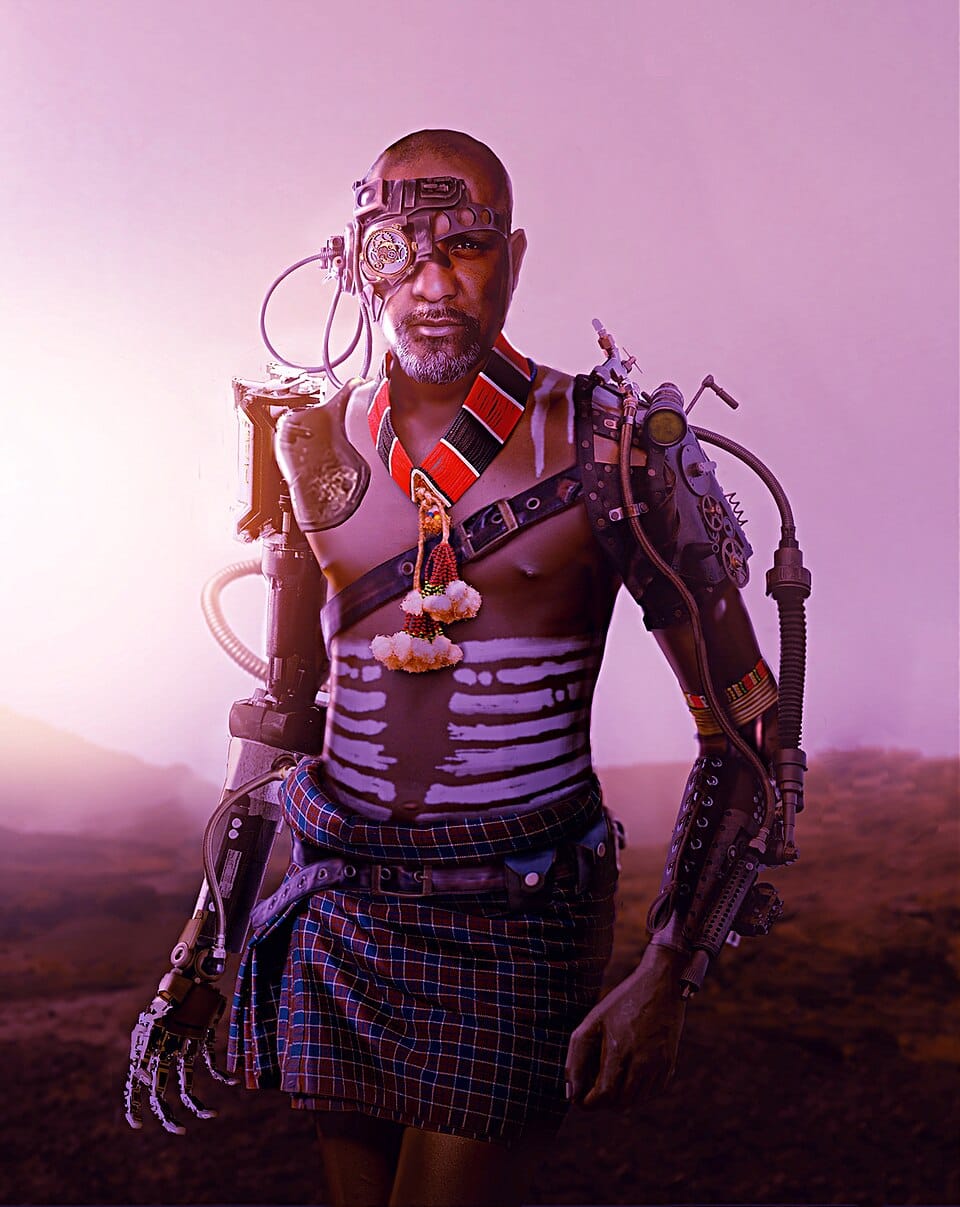
Serengeti Cyborg
Solen Feyissa, Serengeti Cyborg, 2020; CC BY-SA 2.0, via Wikimedia Commons. Source: Serengeti Cyborg at Wikimedia Commons (from Flickr)

Directed portraits of Black sitters, singly or in groups, dressed and lit as characters from an invented future or an alternative past: cyborg limbs, speculative devices, reworked heritage costume, painted skin, mist and saturated colour. The set is built, often from several exposures, and the picture states openly that it is fiction. Unlike a cinematic tableau, the costumed figure faces the lens and carries the frame; unlike fashion portraiture, the story and the invented world do.
Built on two systems: Costumed tableau and Stage light. What systems are.
Shoot sheet for your kit A prompt for an image model The photographs
How the look is made
- Invent a world before you shoot: write the character, the technology and the history it belongs to, then dress, make up and prop the sitter to that one idea.
- Cast the sitter as the hero: upright, facing the lens, shot from eye level or slightly below, so that they command the frame.
- Light for drama and separation: a hard or glossy key, an edge or backlight to rim the figure, and a coloured gel or glow behind to set the atmosphere.
- Photograph the pieces to match: shoot costume, prosthetics and background with the same light direction and perspective so that the composite holds together as a single picture.
- Push the colour to one saturated key (magenta or amber) and add haze or mist for depth, but keep skin tone true and detailed rather than lightened.
- State the fiction openly in the title or series, and build each character with the sitter and their community, not as an ethnographic record.
Shoot sheet for your kit
Fill in your camera, lenses and lights, and the sheet says which light plays each part, what to work around and where to start on your camera. Without a kit it starts on a full-frame camera.
Light
Key: a softbox, about 40° to the camera’s left, high, soft.
Rim or hair light: a spot or bare head, from behind, to the camera’s right, high, hard.
Edge light: a strip softbox, from behind, to the camera’s left, soft.
Edge light: a strip softbox, from behind, to the camera’s right, soft.
- Key high: about 30–45° above eye level, angled down.
- Shape & form
- Light turning gradually into shade across faces and objects, so their volume shows.
- Highlights
- Small, bright glints where the light reflects off wet, oily or polished surfaces: glistening food, dewy skin, the sparkle of jewellery or chrome.
How the style is lit
- A large soft or glossy key on the figure from one side, an edge light behind the other shoulder, and a coloured glow or haze behind to set the mood (reconstructed from the pictured highlights, not a documented rig).
- A hazy backlit sky or smoke-filled background shot separately, with a matching light direction on the sitter so that the cut-out sits inside it.
This plan is worked out from the style’s choices, so it is drawn as a schematic. One way to get the light, not a record of how any photograph was lit.
Lens and settings
Start at
On a full-frame camera: the same depth of field and exposure as the style’s own numbers, in the same light. Then meter and adjust.
- The style’s f/7.8 on 6 × 4.5 cm gives about the depth of field of f/4.9 on full frame.
- Then
- 45–85 mm · f/5.6–f/11 · 1/500–1/125 s · ISO 50–200 on 6 × 4.5 cm, inferred from the gear and the look. Illustrative studio-strobe starting ranges for medium-format digital, based on a practitioner's reported use of a Hasselblad system with an 80 mm lens (about 50 mm full-frame equivalent on 645) and Profoto lights; no exposure record exists for any specimen. Component layers of a composite may be shot at other settings.
- White balance
- Daylight balance on the sitter for true skin tone; let gel, haze and sky carry one saturated colour.
- Focal length
- Roughly the eye’s own perspective; no visible distortion.
- Focus
- One plane sharp, the rest melting into blur and bokeh.
- Angle
- The camera at the height of a standing person or of the subject. Looking up: the subject towers.
- Distance
- Whole figures and their immediate surroundings.
- Balance
- The subject in the middle, the frame balanced around it.
- Instant
- Movement stopped dead by a fast shutter or flash.
- Duration
- An unmoving scene, exposed slowly and carefully.
Direct
Upright, frontal and held: the sitter faces the lens with a stern or composed look, shoulders square or turned slightly, in a stance that reads as a hero or elder rather than a pose of fashion. Groups are arranged as a crew or a tribe of characters, each in their own invented role. Direct sitters with a written character, and let them shape the pose.
- Body position
- Upright, weight on both feet, shoulders level: the plain, even stance of a formal sitting or a line-up.
- Head & gaze
- Looking straight into the camera, so the subject meets the viewer’s eye.
- Line & energy
- Large, readable gestures and attitudes, as on a stage or in a silent film: a feeling or a story acted out.
- Expression
- A hard, searching stare or a set jaw: gravity, strength or defiance.
- With the sitter
- The subject performs for the camera and shapes the picture.
- The set-up
- A scene staged and directed like a film still or a painting. Sets, models and miniatures built to be photographed.
Style the set
Costume is built from many parts: salvaged and fabricated technology (mechanical limbs, goggles, tubes), reworked cultural garments and beadwork, painted skin and sculpted hair, on a set or landscape added in post. Keep the invention legible as fiction, and credit the sitter, designers and craftspeople who made it.
- Clothes
- Period dress, fancy dress, stage costume or someone else’s clothes, worn to play a part rather than as one’s own.
- Hair & make-up
- Hair and make-up as art: graphic colour, glitter, prosthetics, extreme shapes.
- Set & props
- Props chosen and placed for colour, texture and story: linen, ceramics, cutlery, flowers, scattered ingredients.
- How much is styled
- Clothes, hair, make-up, props and set all chosen and placed by a team to one idea.
Finish
- Colour
- Strong, dense colours. The colour of ordinary things treated as the point of the picture.
- Digital & other
- A modern digital camera: clean, detailed, neutral.
- Texture
- Smooth tones with no visible grain.
- Post-production
- Several photographs combined into one picture. Perfected skin and surfaces.
- Shown as
- Pictures made and shown as a set.
- Frame
- A tall frame made for phones and screens.
Stay away from candid & unobserved, unstyled, as found, straight print, document & record, objective & scientific, deadpan and unseen camera.
Before you shoot it
This is a contemporary strand of living African and diasporic artists, many of whom draw on culturally specific dress, beadwork, body painting and heritage images. The costumes are fiction, not ethnographic record: never present a staged character as a real community, and avoid generic 'tribal' dress, face paint or beadwork used as exotic decoration, especially where it borrows from sacred or ceremonial practice. Some work (for example on albinism, dwarfism or former circumcisers) concerns real people and sensitive subjects, so obtain consent and credit sitters. Do not imitate a named living practitioner, and commission and credit the photographers, stylists, designers and craftspeople whose work this is. Do not lighten skin or flatten faces into stereotypes. The open specimen, Serengeti Cyborg, shows a real, unnamed sitter in Maasai-style shuka, beadwork and painted ribs: do not use it to represent a real community.
A prompt for an image model
No prompt for this style
Behind its pictures: caution asks to commission and credit living practitioners rather than imitate.
Borrows ceremonial dress and body paint.
The costumes are fiction, not ethnographic record: never present a staged character as a real community, and avoid generic 'tribal' dress, face paint or beadwork used as exotic decoration, especially where it borrows from sacred or ceremonial practice. Some work concerns real people and sensitive subjects, so obtain consent and credit sitters. Do not imitate a named living practitioner, and commission and credit the photographers, stylists, designers and craftspeople whose work this is. Do not lighten skin or flatten faces into stereotypes. No generated imitation of real sitters or of any named artist is appropriate.
Work with photographers of this tradition, or take only its light and lens (the shoot sheet above) without its people, places or rituals.
Where to see it
From open collections, shown whole with their credits. Later photographs are linked, not shown, while they are in copyright.
With other styles
The opposite: Staged tableau photography. Where the tableau leaves a figure caught in an unresolved scene, here the costumed hero faces the lens and the invented world is stated openly.
Pairs with New Black Vanguard fashion portraiture. Take its colour discipline and careful skin modelling, then add props, prosthetics and an invented technology so that the picture tells a story beyond fashion.
The opposite: Staged identity portraits (She Who Tells a Story). Its frontal serial portraits argue about representation with costume and backdrop; this strand builds a speculative world out of composite, colour and light.
The opposite: Speculative documentary photobook. Both invent fictions, but here the fiction is announced as fiction and never passed off as a document.
Sources
- https://www.mocp.org/exhibition/in-their-own-form/ — In Their Own Form, MoCP Chicago, 12 April–8 July 2018, curator Sheridan Tucker Anderson; 13 artists, 33 photographic and video works; Peskine's Aljana Moons – Twins Carriage (2015) and Alun Be's Potentiality; its definition of Afrofuturism.
- https://www.montaguecontemporary.com/artists/36-osborne-macharia/overview/ — his representing gallery: his work as AfroFuturism built on cultural identity and fiction.
- https://www.designindaba.com/profiles/osborne-macharia — his own words (2017 interview) on Afrofuturism as 'recreating a different Africa based on fantasy, fiction and history'; series Macicio (Sep 2015), Kenya's League of Extravagant Grannies (Mar 2016), Melanin-0 (Mar 2016), Kipipiri (Jan 2017), Magadi.
- https://en.wikipedia.org/wiki/Osborne_Macharia — encyclopedia account of his workflow: team pre-production, medium-format Hasselblad system with an 80 mm lens, Profoto lighting, heavy Photoshop post-production (secondary source; not used for his birth date, which sources give differently).
- https://amsterdam.wereldmuseum.nl/en/whats-on/exhibitions/afrofuturism — Wereldmuseum Amsterdam's exhibition (to 26 August 2018) featuring Macharia's invented communities.
- https://www.ngola-biennial.org/Participants/osborne-macharia — biennial participant page (São Tomé e Príncipe, 26 July–18 August 2019): historic images and folkloric stories given a futuristic twist.
- https://en.wikipedia.org/wiki/Afrofuturism — Mark Dery's 1993 coinage and Ytasha Womack's definition.
- https://commons.wikimedia.org/wiki/File:Serengeti_Cyborg,_by_Fanuel_Leul.jpg — the open specimen; its file page, licence and Photoshop metadata.