Styles / Early processes
Albumen travel-view photography
- Key: the sun, about 45° to the camera’s left, high, hard.
Key high: about 30–45° above eye level, angled down.
Schematic, not to scale: worked out from the style’s choices. No set-up of this style has been rendered yet.
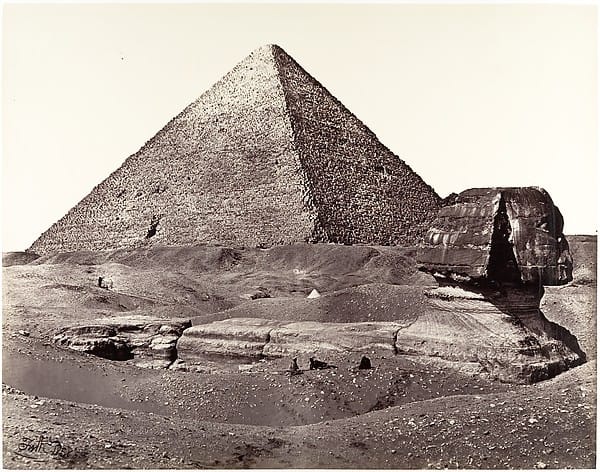
The Great Pyramid and The Great Sphinx
Francis Frith, The Great Pyramid and The Great Sphinx, 1858. The Metropolitan Museum of Art, Gilman Collection, Purchase, William Talbott Hillman Foundation Gift, 2005 (public domain, Open Access). Source: The Great Pyramid and The Great Sphinx at The Metropolitan Museum of Art
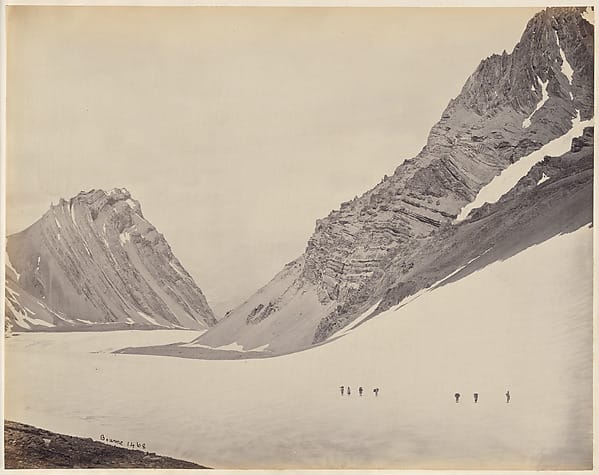
The Manirung Pass
Samuel Bourne, The Manirung Pass, 1866. The Metropolitan Museum of Art, Purchase, Cynthia Hazen Polsky Gift, 1993 (public domain, Open Access). Source: The Manirung Pass at The Metropolitan Museum of Art
Large wet-collodion negatives of ruins, monuments, mountains and river banks, contact-printed on albumen paper to a warm brown, sharp from the nearest stone to the horizon. The camera stands far back and level, often at a corner of the subject, usually in hard sun (softer flat light is a variant), a pale empty sky above, with tiny figures or none to give scale. Titles are written on the negative, and the views were sold singly or bound into travel albums.
Built on two systems: Albumen view and Deadpan document. What systems are.
Shoot sheet for your kit A prompt for an image model The photographs
How the look is made
- Carry the largest plate you can: expose a big wet-collodion glass negative and contact-print it, so every stone, brick course and rock stratum is resolved edge to edge.
- Choose a landmark, ruin or great natural form and plant the camera far back and level, often from a corner, with the horizon steady.
- Shoot in hard, high sun where you can and stop the lens down for a still, deep scene (open shade or overcast is the quieter variant); read the sky as a blank pale tone and let the sunlit masonry and the shadow side carry the form.
- Place a few tiny figures, a camel party or porters, to give the monument its scale, or leave the scene empty; never pose anyone at the front.
- Print on albumen paper, toned warm brown, with the title or number written into the negative, and bind the series into a travel album.
Shoot sheet for your kit
Fill in your camera, lenses and lights, and the sheet says which light plays each part, what to work around and where to start on your camera. Without a kit it starts on a full-frame camera.
Light
Key: the sun, about 45° to the camera’s left, high, hard.
- Key high: about 30–45° above eye level, angled down.
- Shadow edges
- Shadows with crisp outlines, cast by a small or distant light: direct sun, a bare flash, a spotlight.
How the style is lit
- High, hard sun, so that the sunlit face of the monument is bright and the shadow side dark.
- Pale, blank sky left uncorrected above the subject.
- Overcast or open shade in valleys, with long exposures to hold the shadows.
This plan is worked out from the style’s choices, so it is drawn as a schematic. One way to get the light, not a record of how any photograph was lit.
Lens and settings
Start at
On a full-frame camera: the same depth of field and exposure as the style’s own numbers, in the same light. Then meter and adjust.
- The style’s f/27 on 8 × 10 in gives about the depth of field of f/3.6 on full frame.
- Then
- 200–360 mm · f/16–f/45 · 1–20 s · ISO 1–2 on 8 × 10 in, inferred from the gear and the look. Inferred from the process and the plates (Frith's largest 16 x 20 in; Bourne's 10 x 12 in): focal length is the real lens length on the large plate (about 200-360 mm; roughly 50-100 mm in 35mm-equivalent terms); wet collodion is about ISO 1, so bright-sun views need seconds at small stops; moving figures blur or vanish.
- Focus
- Everything sharp from the nearest stone to the horizon.
- Distance
- Standing well back; people are small.
- Balance
- The subject faces the lens; planes run parallel to the picture.
- Crop & fill
- The subject shown small within its setting, which explains it.
- Depth
- A strong horizon splits the frame into bands.
- Duration
- An unmoving scene, exposed slowly and carefully.
Direct
Usually nobody poses. If people appear, they are small and incidental: porters, guides, camel drivers or a few visitors left to stand or sit still for the long exposure at the scene's edge, used as a scale rule.
- Without a pose
- No people at all, or people so small or far off that their pose does not read (hands alone are Hands alone).
Style the set
Nothing is dressed. The photographer picks the monument, the hour and the angle, and sometimes clears or places a few figures; any people in the scene wear what they wear, and the set is the ruin, wall or mountain as found.
- How much is styled
- Nothing dressed, made up, moved or added for the picture.
Finish
- Monochrome
- A monochrome image tinted sepia, brown, selenium purple or cyanotype blue.
- Colour
- An overall yellow, orange or red cast.
- Early processes
- Warm-brown prints of the 19th century, made from negatives.
- Film
- A view camera on a tripod: great detail, slow and deliberate.
- Texture
- Every surface resolved, more than the eye would see.
- Post-production
- Words or graphic marks added to the photograph.
- Shown as
- Pictures made and shown as a set.
- Shown in
- Prints for an album, a card or a frame at home.
Stay away from direct on-camera flash, visible grain, snapshot, candid & unobserved, high-contrast black & white, laughing, fast, full-body movement, tilted angle, shallow depth of field, formal posed portrait and studio backdrop.
Before you shoot it
These views were made by Europeans for European buyers, often in the service of empire, the colonial survey or the tourist trade; they present Egypt, India, Palestine, China and Japan as picturesque, empty or timeless places and often caption local people as scale figures or types. Show originals with their makers and context, and for new work credit and commission local photographers. Some views, such as Beato's Lucknow and Pehtang, include war dead; a pastiche must not recreate them.
A prompt for an image model
No prompt for this style
Behind its pictures: colonial views that pose local people as types and show sacred sites and war dead.
Caution forbids fake period views or vintage prints.
Show originals with their makers and context, and for new work credit and commission local photographers. a pastiche must not recreate them.
Work with photographers of this tradition, or take only its light and lens (the shoot sheet above) without its people, places or rituals.
Photographs that define it
From open collections, shown whole with their credits. Later photographs are linked, not shown, while they are in copyright.
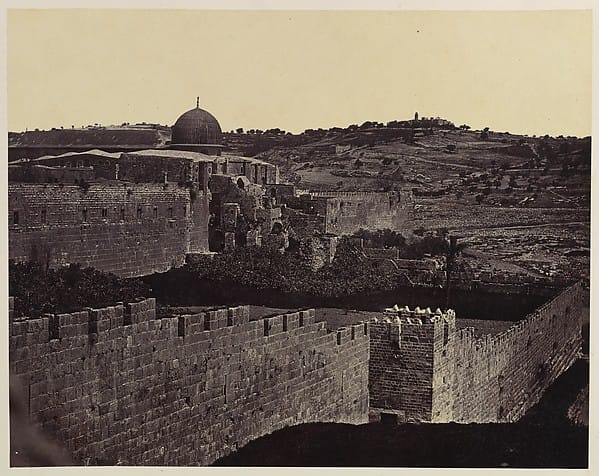
[Dome of the Rock, Jerusalem]
Felice Beato (with James Robertson), [Dome of the Rock, Jerusalem], 1856-57. The Metropolitan Museum of Art (accession 2013.1098.8; public domain, Open Access). Source: [Dome of the Rock, Jerusalem] at The Metropolitan Museum of Art
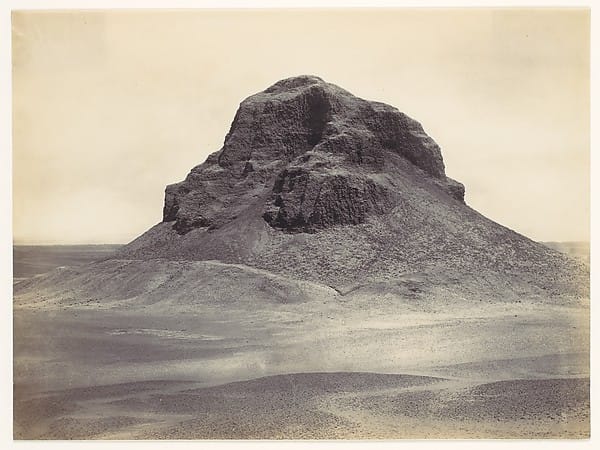
[Pyramid at Dahshûr]
Francis Frith, [Pyramid at Dahshur], ca. 1857. The Metropolitan Museum of Art, The Elisha Whittelsey Collection, The Elisha Whittelsey Fund, 1973 (public domain, Open Access). Source: [Pyramid at Dahshûr] at The Metropolitan Museum of Art
With other styles
The opposite: Calotype and paper-negative photography. Choose the collodion plate and albumen print when the brief wants a crisp glassy monument; choose the calotype when you want soft, fibrous, matte paper-negative masses.
Pairs with Yokohama photography. Both sold albumen views in albums; borrow Beato's hand-colouring sparingly to tint a plain landscape view, and keep the staged figures out.
The opposite: Carte-de-visite studio portraits. The carte puts one posed figure on a studio backdrop; here the figure shrinks to a speck against the site.
The opposite: Modernist architectural photography. Both prize sharpness and hard light on masonry, but this style stands frontal and far on a ruin, where the modernist view takes oblique corners and new buildings.
Sources
- https://en.wikipedia.org/wiki/Francis_Frith
- https://en.wikipedia.org/wiki/Samuel_Bourne
- https://en.wikipedia.org/wiki/Felice_Beato
- https://en.wikipedia.org/wiki/Albumen_print
- https://www.metmuseum.org/art/collection/search/260973
- https://www.metmuseum.org/art/collection/search/286141
- https://www.metmuseum.org/art/collection/search/266921
- https://www.metmuseum.org/art/collection/search/631032