Styles / Staged & conceptual
Anthropometric and ethnographic typological photography
- Key: the open sky, all around and above, soft.
- Fill: a softbox, about 25° to the camera’s right, high, soft.
Daylight studio: a skylight, a glasshouse or a courtyard, with a backdrop behind the sitter. Shadowless: big sources close in on both sides (or a light tent, or a white cove) so nothing casts a shadow.
Schematic, not to scale: worked out from the style’s choices. No set-up of this style has been rendered yet.
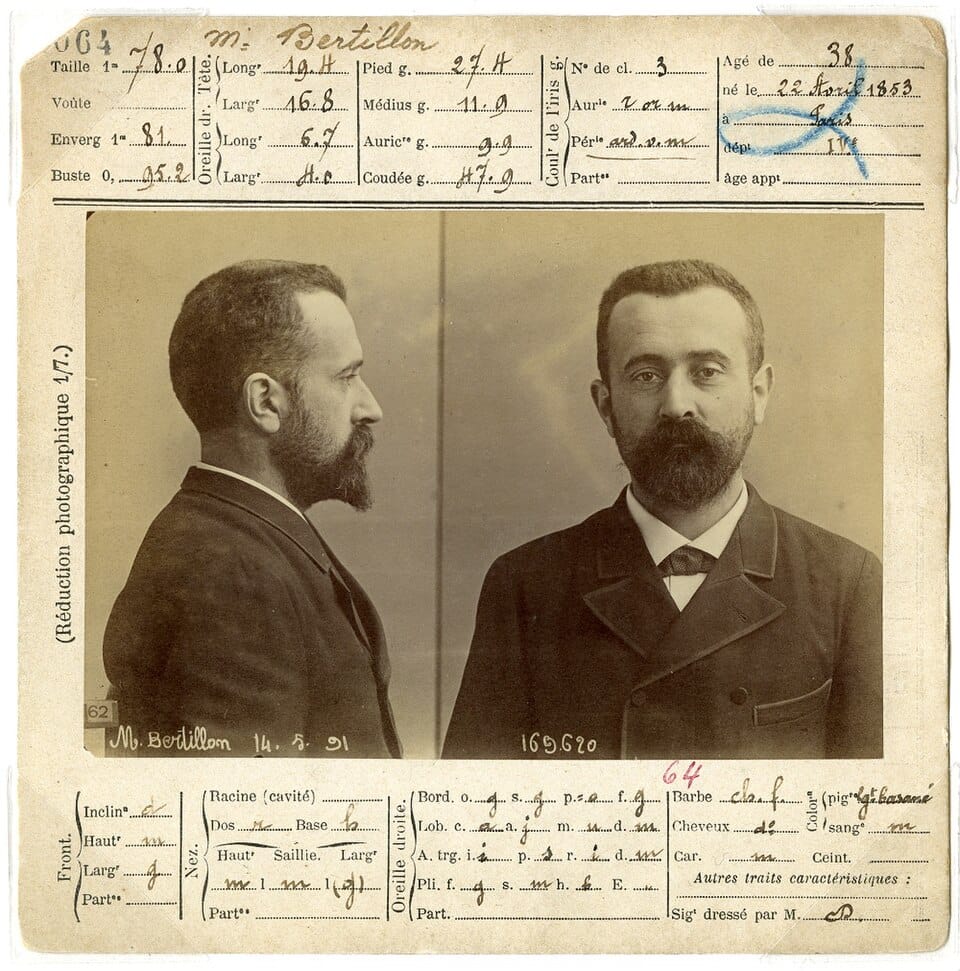
Fiche anthropométrique d'Alphonse Bertillon (self-record)
Alphonse Bertillon, fiche anthropométrique d'Alphonse Bertillon, 14 May 1891. Via Criminocorpus and Wikimedia Commons; public domain (PD-old-100). Source: Fiche anthropométrique d'Alphonse Bertillon (self-record) at Wikimedia Commons (from Criminocorpus)

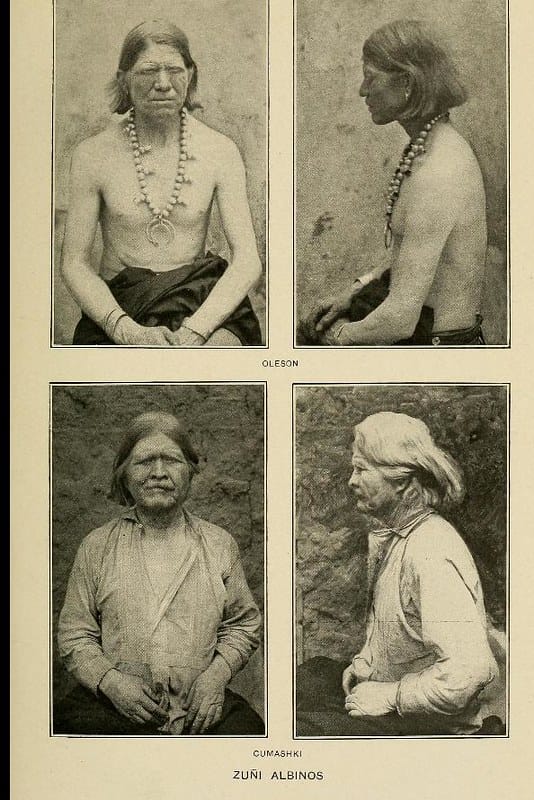
Anthropometric Photographs of Four Zuni Individuals ("Zuñi Albinos")
Aleš Hrdlička, 'Zuñi Albinos', plate in Physiological and medical observations among the Indians of southwestern United States and northern Mexico, 1908. Via the Medical Heritage Library and Wikimedia Commons; public domain in the United States. Source: Anthropometric Photographs of Four Zuni Individuals ("Zuñi Albinos") at Wikimedia Commons (from the Medical Heritage Library)

Portraits of people as specimens or records, made to a fixed protocol: the same two views, full face and exact profile, in the same plain light, at the same distance, against a bare or gridded ground, so that bodies and heads can be measured and compared across a table. The sitter holds still, with a blank face, and is stripped of personality; the picture is a record, filed as part of a series and often mounted on a card of measurements.
Built on two systems: Painted studio and Albumen view. What systems are.
Shoot sheet for your kit A prompt for an image model The photographs
How the look is made
- Make two views of every sitter, full face and exact profile, and never a third interpretive one.
- Fix the camera distance, height and lens, and keep them identical for every sitter so that heads and bodies can be compared across the series.
- Put a plain ground behind the sitter, or a measuring screen of squares or a scale; let nothing in the frame carry meaning but the body.
- Light the sitter evenly from the front with soft daylight so that no shadow hides a feature: shadowless, flat and equal for all.
- Have the sitter sit or stand square and still, shoulders level and face blank, eyes forward in the front view; direct them to remove expression, never to perform.
- Print the pair side by side and file it with its numbers, name and measurements in a grid or on a card; show the record, not the photographer.
Shoot sheet for your kit
Fill in your camera, lenses and lights, and the sheet says which light plays each part, what to work around and where to start on your camera. Without a kit it starts on a full-frame camera.
Light
Key: the open sky, all around and above, soft.
Fill: a softbox, about 25° to the camera’s right, high, soft.
- Daylight studio: a skylight, a glasshouse or a courtyard, with a backdrop behind the sitter.
- Shadowless: big sources close in on both sides (or a light tent, or a white cove) so nothing casts a shadow.
- Shadow edges
- Light from all around, so almost no shadows form even under the chin or behind objects: a white cove, a light tent, a large ring light, fog over snow. Shadows that fade gradually from light to dark, cast by a large or diffused light: a window, a softbox, a cloudy sky.
- Shape & form
- Light from the camera’s own position (an on-camera flash, a ring light, a frontal softbox) fills every hollow, so faces and objects look flat, with little shape.
How the style is lit
- Open north-light or skylight in a glass-roofed studio or the open shade of a courtyard, no fill card, the same light for every sitter.
- Bare wall, cloth or a screen hung with threads at two-inch intervals behind the sitter, lit separately so that no shadow falls on it.
This plan is worked out from the style’s choices, so it is drawn as a schematic. One way to get the light, not a record of how any photograph was lit.
Lens and settings
Start at
On a full-frame camera: the same depth of field and exposure as the style’s own numbers, in the same light. Then meter and adjust.
- The style’s f/23 on Quarter plate gives about the depth of field of f/7.2 on full frame.
- Then
- 50–85 mm · f/16–f/32 · 0.5–4 s · ISO 3–50 on Quarter plate, inferred from the gear and the look. Worked out from the plate processes of the time, a fixed studio or open-shade set-up and the need for sharp detail across both face and shoulders: a normal lens stopped down, exposures of a second or more on slow plates, with the sitter held still. Plate sizes and distances varied between institutions; Bertillon's cards show the print reduced to one-seventh.
- Focal length
- Roughly the eye’s own perspective; no visible distortion.
- Focus
- Everything sharp from the nearest stone to the horizon.
- Angle
- The camera at the height of a standing person or of the subject.
- Distance
- Whole figures and their immediate surroundings.
- Balance
- The subject faces the lens; planes run parallel to the picture. The subject in the middle, the frame balanced around it.
- Duration
- An unmoving scene, exposed slowly and carefully.
Direct
Seat or stand every sitter in the same marked spot, shoulders square for the front view and a quarter-turn to an exact profile for the second, head level, hands resting on the knees or at the sides, mouth closed and face blank. The protocol forbids the photographer's direction from showing: no smile, no turn, no prop. It was applied to people who could not refuse, such as prisoners, sailors and subjects of colonial rule, which is why the stillness reads as submission.
- Body position
- On a chair or stool, back straight, hands and feet placed: the formal sitting. Upright, weight on both feet, shoulders level: the plain, even stance of a formal sitting or a line-up.
- Turn to the camera
- Seen from the side, the face or the whole body turned 90° from the lens, like a head on a coin. Shoulders and hips face the lens straight on: direct, symmetrical, sometimes confrontational.
- Head & gaze
- Looking straight into the camera, so the subject meets the viewer’s eye.
- Arms & hands
- Arms by the sides, hands folded in the lap or resting on a chair: quiet and formal.
- Line & energy
- Rigid and motionless, sometimes braced against a head rest or gripping a chair: held for a long exposure or a solemn occasion.
- Expression
- Unsmiling, composed and blank: the face gives nothing away.
- With the sitter
- The sitter arranged and still, facing the camera.
- The set-up
- The same kind of subject, photographed the same way, many times.
Style the set
Remove the setting: a plain wall, cloth or a gridded screen, no props, nothing that says who the sitter is. Sitters wear whatever they have on, or are stripped to the waist or further so that the body can be read; a number, name and date are written on the print or card, and the pair is pasted into a printed form of measurements.
- Clothes
- Simple, solid, unbranded clothes chosen so they do not distract from the face.
- Set & props
- A painted, cloth, paper or seamless backdrop behind the subject.
- Look of the styling
- Few, simple elements on clean surfaces, with space around them.
Finish
- Monochrome
- Rich blacks, clean whites and every grey between. A monochrome image tinted sepia, brown, selenium purple or cyanotype blue.
- Early processes
- Warm-brown prints of the 19th century, made from negatives.
- Post-production
- Nothing changed beyond exposure and development.
- Shown as
- Two or three pictures shown together as one work. Pictures made and shown as a set.
- Shown in
- Prints for an album, a card or a frame at home.
Stay away from smiling, theatrical & acted, relaxed & natural, smouldering look, full glamour make-up, fully art-directed, low-key & chiaroscuro, golden hour, shallow depth of field, soft focus & diffusion, heavy retouching, glamour & aspiration, sensual, lyrical & poetic, candid & unobserved and snapshot.
Before you shoot it
These photographs were made of people who could not refuse: prisoners, seamen, colonised and Indigenous people, often stripped, and used to support racial classification that is now discredited. Many sitters are named in the plates or archives, and Native American sitters, such as those in the Zuni plate shown here (a medical 'albino' plate with named individuals), appear only as history; no current community statement has been verified, and the specimen should be withdrawn if an objection is found. Treat the idiom as history only: do not use it to make new pictures of real people, to type anyone by race or body, or to imitate the look as a style; show original specimens with their context and credit.
A prompt for an image model
No prompt for this style
Behind its pictures: coercive records of prisoners and of colonised and Indigenous people.
The caution itself says no generated images.
No current community statement has been verified, and the specimen should be withdrawn if an objection is found. Treat the idiom as history only: do not use it to make new pictures of real people, to type anyone by race or body, or to imitate the look as a style; show original specimens with their context and credit. A generated image of a person in this format would imitate a coercive record and should not be made.
Work with photographers of this tradition, or take only its light and lens (the shoot sheet above) without its people, places or rituals.
Photographs that define it
From open collections, shown whole with their credits. Later photographs are linked, not shown, while they are in copyright.
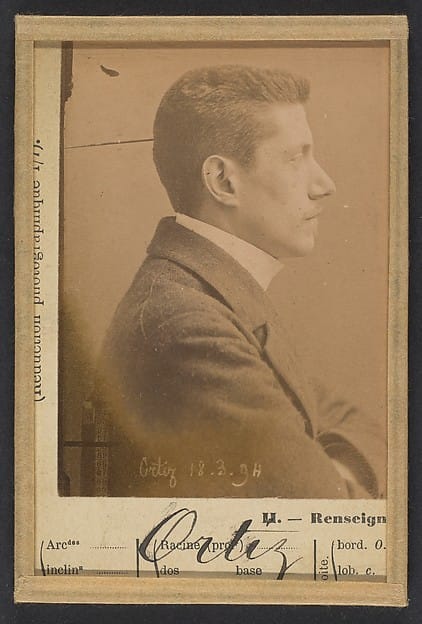
Ortiz. Léon. 25 ans, né à Paris. Commis d'architecte. Anarchiste. Voyage ordinairement en bicyclette.
Alphonse Bertillon, Ortiz, 1894. The Metropolitan Museum of Art, Gilman Collection, Museum Purchase, 2005 (2005.100.375.313). Open Access, public domain. Source: Ortiz. Léon. 25 ans, né à Paris. Commis d'architecte. Anarchiste. Voyage ordinairement en bicyclette. at The Metropolitan Museum of Art
With other styles
The opposite: New Objectivity photography. Typology made as art by choice of the maker; here the same plain, repeated view is imposed on people who did not choose it.
The opposite: Düsseldorf School of Photography. Deadpan grids of buildings and objects; do not carry that method onto human subjects without consent.
The opposite: Carte-de-visite studio portraits. Sitters in carte portraits chose their dress, pose and props; here those choices are removed.
The opposite: Malian studio portraiture. A studio where the sitter commissions and styles the portrait, the opposite of the specimen portrait.
Sources
- https://historywiki.therai.org.uk/index.php?title=John_H._Lamprey
- https://en.wikipedia.org/wiki/Bertillon_system
- https://en.wikipedia.org/wiki/Mug_shot
- https://visualizingcultures.mit.edu/john_thomson_china_01/ct_essay03.html
- https://commons.wikimedia.org/wiki/File:Anthropometric_Photographs_of_Four_Zuni_Individuals.jpg
- https://www.metmuseum.org/art/collection/search/306933