Styles / Modernist
Australian modernist photography
- Key: the sun, from behind, to the camera’s left, high, hard.
Key high: about 30–45° above eye level, angled down. No reflector or fill: let the shadows fall to black.
Schematic, not to scale: worked out from the style’s choices. No set-up of this style has been rendered yet.
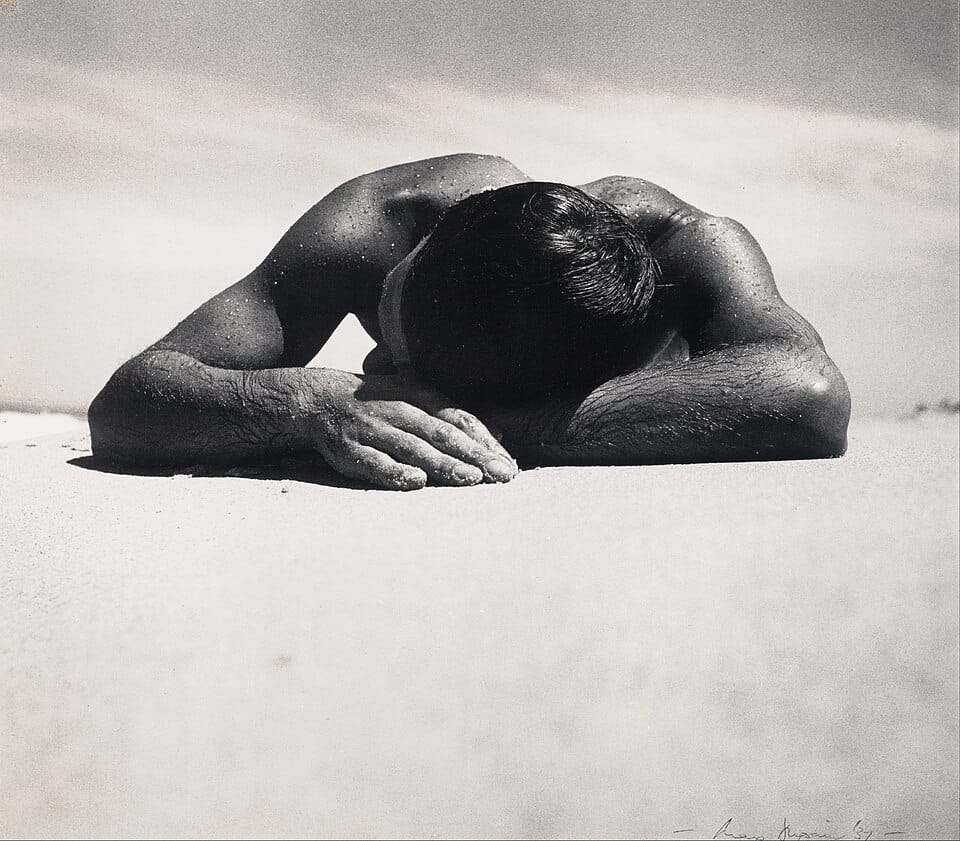
Sunbaker
Max Dupain, Sunbaker, 1937, gelatin silver photograph, National Gallery of Victoria (PH216-1976), via Wikimedia Commons (Google Art Project); tagged public domain in Australia and the United States on Commons. Source: Sunbaker at National Gallery of Victoria

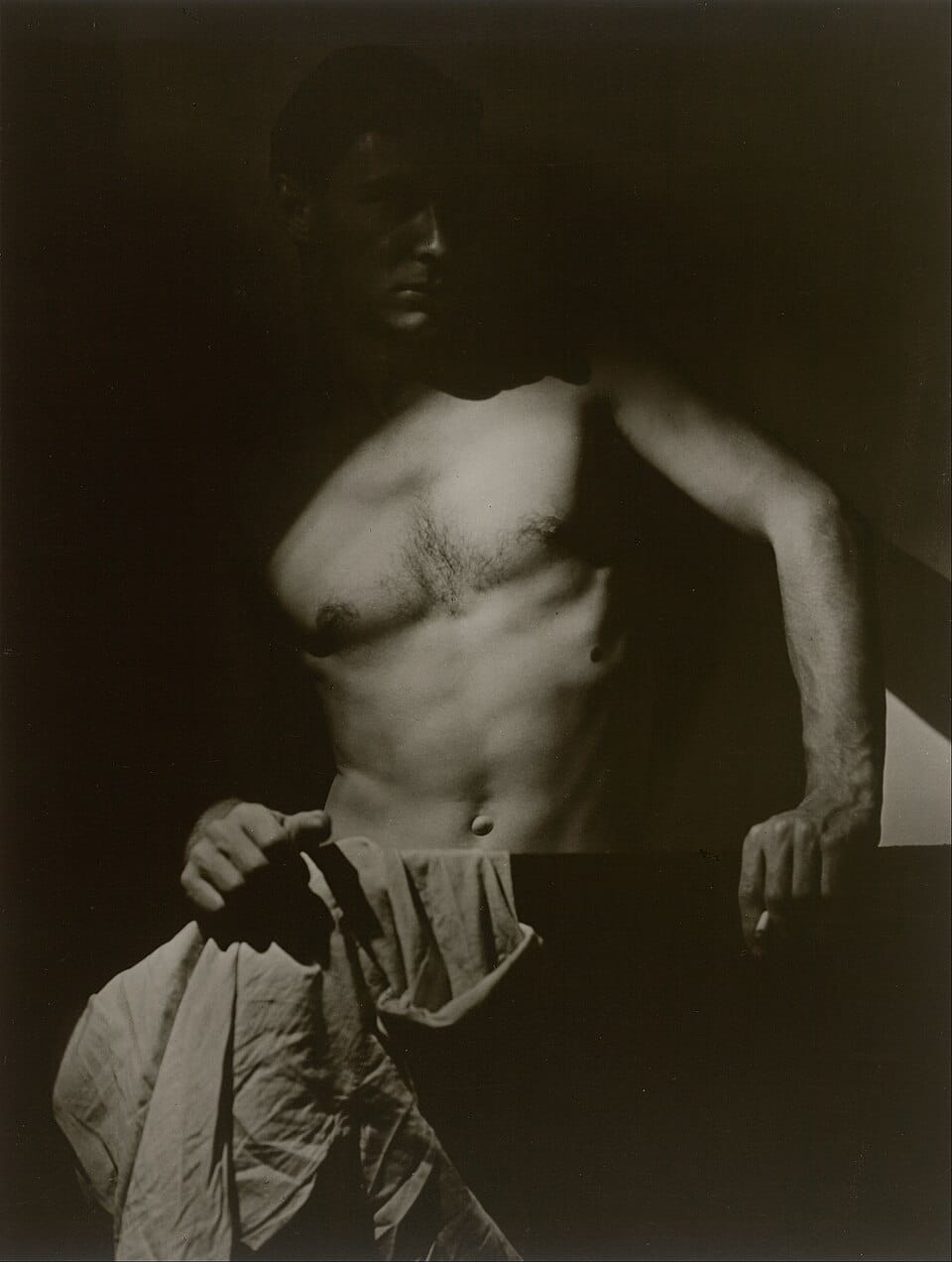
Max after surfing
Olive Cotton, Max after surfing, 1939 (printed 1998), gelatin silver photograph, National Gallery of Victoria (1998.251), via Wikimedia Commons; tagged public domain in Australia (taken before 1955) and the United States on Commons. The NGV credit line reads (c) the estate of Olive Cotton. Source: Max after surfing at National Gallery of Victoria
Sydney photography of the 1930s to 1950s that took modernism's hard edges to the beach, the studio and the street: a sunbaker's head and arms seen from sand level against a pale sky, a single hard light carving a torso out of black, shadows cast by cheap china, commuters streaming off a ferry into backlight. Strong angles, close viewpoints and crisp black and white; after the war the same eye turned to plain documentary pictures of ordinary Australians at work and in queues, a span this style takes in deliberately.
Built mostly on one system: Event reportage. What systems are.
Shoot sheet for your kit A prompt for an image model The photographs
How the look is made
- Get down to sand level or up on a wharf and shoot from an unaccustomed height, so that a body or a shed roof becomes a landform or a diagonal.
- Work in hard Australian sun or one hard lamp: let the light cut a shape out of shadow and print the shadow dark, with clean highlights and no soft focus.
- Fill the frame with one simple, close form (a back, an arm, a cup, a gear) and leave the rest as plain sky, sand or black.
- Photograph friends and colleagues on holidays, at the beach and at work, and let their bodies fall into natural, relaxed shapes rather than stiff studio poses.
- Keep the print straight: a sharp negative, a modest crop, rich black-and-white gelatin silver, and no darkroom tricks to disguise the subject.
- After the war, turn the same frame on ordinary life: stand where the crowd moves, wait for the exchange between people and make it plain, not sentimental.
Shoot sheet for your kit
Fill in your camera, lenses and lights, and the sheet says which light plays each part, what to work around and where to start on your camera. Without a kit it starts on a full-frame camera.
Light
Key: the sun, from behind, to the camera’s left, high, hard.
- Key high: about 30–45° above eye level, angled down.
- No reflector or fill: let the shadows fall to black.
- Shadow edges
- Shadows with crisp outlines, cast by a small or distant light: direct sun, a bare flash, a spotlight.
- Shadow depth
- Dark shadows that still hold some detail (a high lighting ratio, about 4:1 to 8:1: the shadow side two to three stops darker). Shadows with no fill at all that fall to pure black with no detail, so parts of the subject disappear.
- Shape & form
- Shadows thrown away from what casts them (a figure’s long shadow, railings on a wall) that become shapes of their own in the composition.
How the style is lit
- Hard midday or afternoon sun on the beach or the street, with the subject lit from the side or back and the shadows left dark.
- One hard studio lamp or a shaft of sun through a window, cutting a figure or an object out of a black ground, with no fill.
This plan is worked out from the style’s choices, so it is drawn as a schematic. One way to get the light, not a record of how any photograph was lit.
Lens and settings
Start at
On a full-frame camera: the same depth of field and exposure as the style’s own numbers, in the same light. Then meter and adjust.
- The style’s f/11 on 6 × 6 cm gives about the depth of field of f/6.2 on full frame.
- Then
- 28–50 mm · f/8–f/16 · 1/500–1/125 s · ISO 25–100 on 6 × 6 cm, inferred from the gear and the look. Inferred from the look: a normal lens on roll film or sheet film, stopped down to hold sand, sky and subject sharp, in bright sun on slow panchromatic film; no source consulted records the settings of the individual pictures. Studio light pictures like Tea cup ballet and Max after surfing would need longer exposures with a hard lamp.
- Focus
- Everything sharp from the nearest stone to the horizon.
- Angle
- Looking up: the subject towers.
- Distance
- Within arm’s reach: faces, hands and details fill the frame.
- Balance
- Tilted lines and oblique movement drive the picture.
- Crop & fill
- A small subject in a large empty field. The edges cut into the subject: heads, limbs or objects run out of frame. The subject shown small within its setting, which explains it.
- Depth
- Separate events in the foreground, middle ground and background.
- Instant
- Movement stopped dead by a fast shutter or flash.
Direct
Mostly friends, lovers and colleagues caught or placed in relaxed shapes: lying face down on sand with the head hidden, leaning, or turned half away with the gaze off to the side or down. Faces are often shaded or lost; the body is the form. In the post-war documentary pictures people queue, walk and work; some look away, and in the ferry picture many commuters smile and look toward the camera.
- Body position
- Lying down or propped on an elbow: on a sofa, the grass, the sand or the floor. Caught or posed in mid-step, one foot lifted, clothes swinging.
- Turn to the camera
- Seen from behind, facing into the scene, so the viewer looks with them.
- Head & gaze
- Eyes off the frame, past the camera or into the distance, as if lost in thought.
- Line & energy
- Loose and unforced, as people stand and sit when they forget the camera, whether caught or coaxed by prompts.
- The moment
- People photographed as they are, unaware or unconcerned.
Style the set
Almost nothing is styled. Bathing trunks, plain suits and working clothes as worn, hats and coats of the period, sand, concrete, timber wharf and sky as found. In the studio a single cloth, a plain dark ground or a few cheap household objects stand in; props are chosen for their shape and the shadow they throw.
- Clothes
- What people happened to be wearing; nothing chosen for the picture.
- How much is styled
- Nothing dressed, made up, moved or added for the picture.
Finish
- Monochrome
- A black-and-white scale pushed towards pure black and pure white, with few middle greys. Rich blacks, clean whites and every grey between.
- Post-production
- Nothing changed beyond exposure and development.
- Shown as
- Each picture stands on its own.
Stay away from soft focus & diffusion, soft monochrome, painted, scratched or drawn on, composite & montage, full glamour make-up, glamour & aspiration, sell & persuade and golden hour.
Before you shoot it
These are photographs of real people, mostly Sydney friends, colleagues and anonymous commuters of the 1930s and 1940s; Sunbaker shows a named sitter, and bare bodies and bathers are common, so ask consent before photographing anyone this way. The beach-and-sun imagery was long made to stand for a single white Australian national identity: do not treat it as the whole of Australian photography, and do not depict Country as empty or available for picturesque use. It was made on First Nations land, and this selective account leaves out Indigenous photographers and subjects. Copyright status is mixed: the Commons specimens carry public-domain tags that rest on Australian pre-1955 law and may not hold in other countries, while the NGV credits Olive Cotton's work to her estate.
A prompt for an image model
A ready prompt that describes this look to an image model: where the lights stand, the lens, the framing and the colour. It starts on the style’s own choices; change any of them and the prompt and the notes follow.
The prompt
Notes on this prompt
- Image models put the light in the wrong place more often than anything else, so the prompt says where each light stands: which side of the picture, and how high. Keep to one light pattern per prompt, or the model splits the difference.
- Describe an invented person by age, clothes and pose. Never name a real or famous person, and never write “looks like”.
- Black and white: colour words in the subject (a red dress, green leaves) can pull the model back to colour, so leave them out.
The model makes a new picture, not a photograph of anything that happened. Label it as AI-generated, and don’t pass it off as the style’s history or as a real person.
Photographs that define it
From open collections, shown whole with their credits. Later photographs are linked, not shown, while they are in copyright.
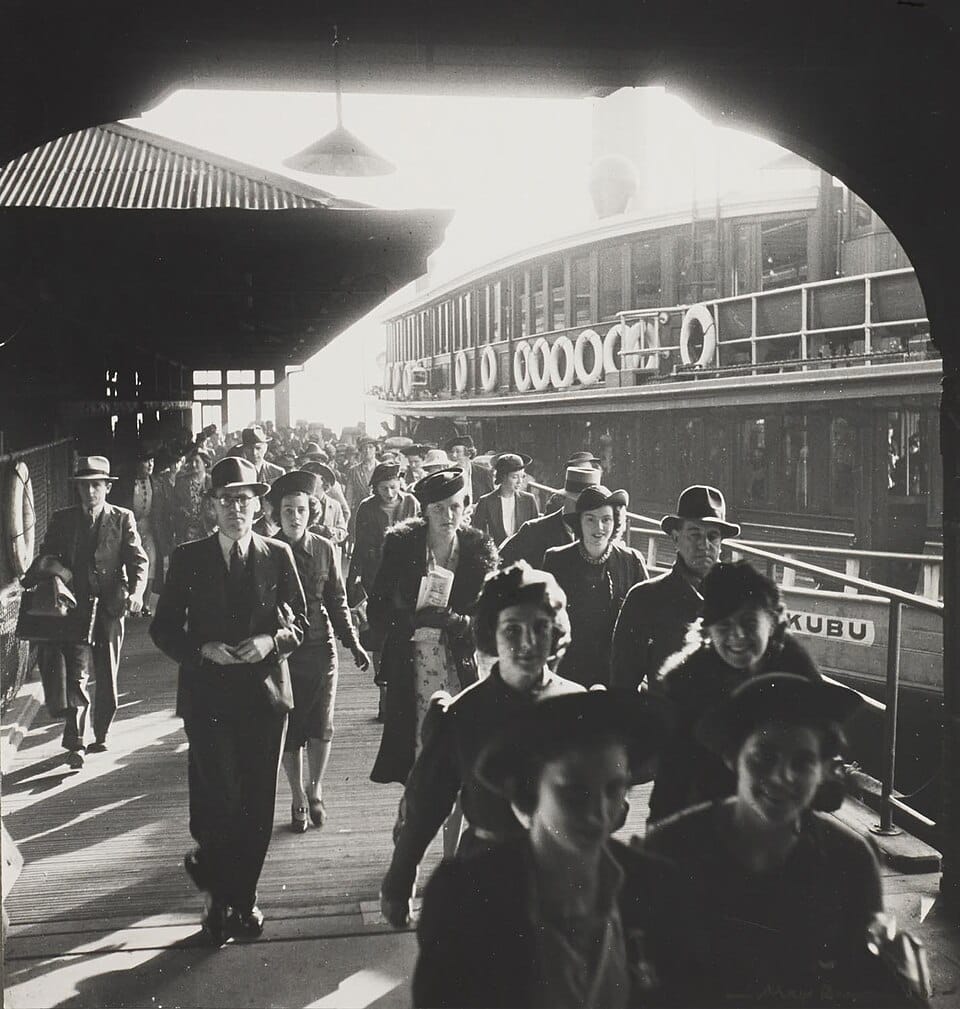
Sydney Ferry KUBU at Circular Quay
Max Dupain, Sydney Ferry KUBU at Circular Quay, 1938, via Wikimedia Commons (uploaded from an auction listing); tagged public domain in Australia on Commons because its copyright term has expired. Source: Sydney Ferry KUBU at Circular Quay at Wikimedia Commons (from an auction listing)

Made by an AI model
An image gpt-image-2 made from this style’s choices, then checked against them by a vision model. Not a photograph, and not part of the style’s history. All generated images
-
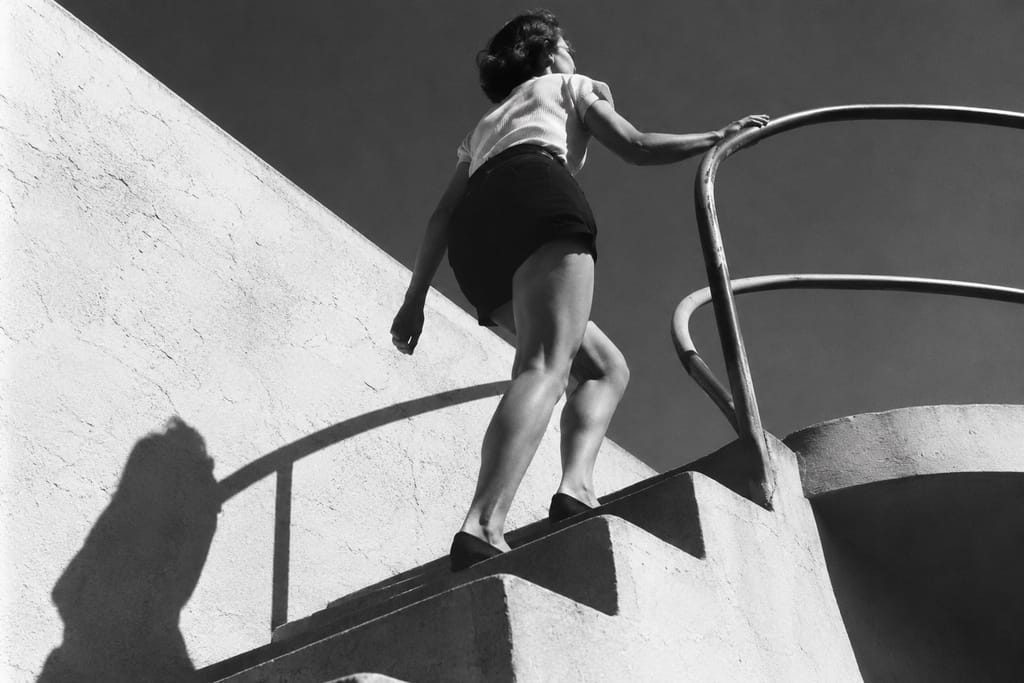
A woman in a light short-sleeved top, dark shorts and low heels climbs an outdoor concrete staircase with one hand on a curved metal railing. Seen from below in black and white, she and the railing cast strong shadows across a textured white wall beneath a clear sky. What the check saw. The dramatic low viewpoint, diagonal stairs and crisp sunlit shadows give this black-and-white photograph a strongly geometric composition.
With other styles
Pairs with New Vision. Borrow its tilted frames and steep viewpoints, then take them to the beach and the wharf with warm, living subjects.
The opposite: Sydney Camera Circle: sunlight-and-shadow pictorialism. Keep its hard sun and backlight but drop the soft focus and toned, hand-worked prints for crisp, straight gelatin silver.
Pairs with Modernist architectural photography. Combine its corrected verticals and clean surfaces with a human figure and a low, unlevel point of view.
Pairs with Straight photography. Share its sharp negatives and unmanipulated prints, but shoot handheld and fast in strong sun rather than on a tripod.
Pairs with French humanist photography. Take its warm, unposed ordinary people for the post-war documentary side: queues, wharves, workers.