Styles / Vernacular & studio
Brazilian vernacular fotopintura
- Key: a softbox, about 40° to the camera’s left, high, soft.
Key high: about 30–45° above eye level, angled down.
Schematic, not to scale: worked out from the style’s choices. No set-up of this style has been rendered yet.
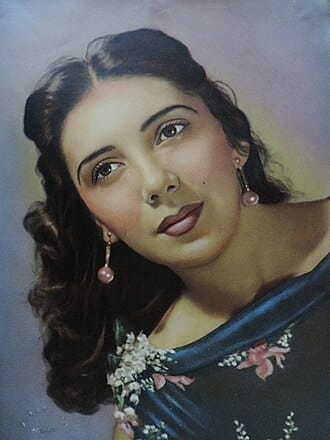
Autorretrato de Telma Saraiva, 1949 (fotopintura)
Telma Saraiva, Arquivo pessoal de Telma Saraiva, via Wikimedia Commons, CC BY-SA 3.0. Source: Autorretrato de Telma Saraiva, 1949 (fotopintura) at Wikimedia Commons, from the personal archive of Telma Saraiva

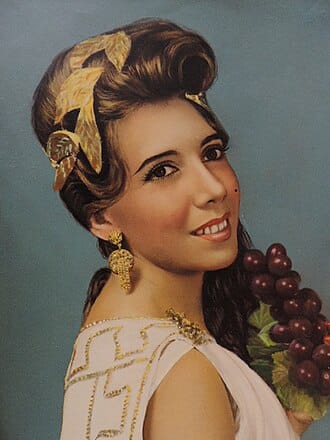
Autorretrato de Telma Saraiva, 1968 (fotopintura)
Telma Saraiva, Arquivo pessoal de Telma Saraiva, via Wikimedia Commons, CC BY-SA 3.0. Source: Autorretrato de Telma Saraiva, 1968 (fotopintura) at Wikimedia Commons, from the personal archive of Telma Saraiva

Family and studio portraits in Brazil, above all in the Northeast, made from a black-and-white enlargement that a painter works up in oil, pastel or watercolour. The head and bust are shown close, with smooth modelled skin, painted lips, lashes and jewellery, and a flat pastel ground that replaces the studio; clothes and backgrounds are changed at will, and families sit for group prints. One documented variant, Telma Saraiva's painted self-portraits, tilts the head and borrows the poses of film stars (fotocinepintura). The result is a single, enlarged keepsake to hang in the house.
Built on two systems: Painted over and Sculpted glamour. What systems are.
Shoot sheet for your kit A prompt for an image model The photographs Its portrait light in the lab
How the look is made
- Start from a sharp, evenly exposed black-and-white print on paper that takes paint well, and enlarge it to a size that fits a living-room wall.
- Frame the head and shoulders close and centred. Telma Saraiva's self-portraits turn the head three-quarters with the chin lifted and the eyes off the lens, as in a film-star portrait; this is one documented variant, and the sources seen here do not say how commissioned family sitters posed.
- Paint the skin in smooth, thin glazes that model the face; add the colour of lips, cheeks, lashes, earrings and necklace by hand with fine brushes, using paper masks for clean edges.
- Replace what the studio gave you: paint a plain pastel ground in blue, green or lilac, and change the clothes or add a flower, garland or other prop to suit the sitter's wish.
- Finish the print as one object for the house, with a sitter who is dressed up, still and tender in expression, not as a record of the day it was made.
Shoot sheet for your kit
Fill in your camera, lenses and lights, and the sheet says which light plays each part, what to work around and where to start on your camera. Without a kit it starts on a full-frame camera.
Light
Key: a softbox, about 40° to the camera’s left, high, soft.
- Key high: about 30–45° above eye level, angled down.
- Shadow edges
- Shadows that fade gradually from light to dark, cast by a large or diffused light: a window, a softbox, a cloudy sky.
- Shape & form
- Light turning gradually into shade across faces and objects, so their volume shows.
How the style is lit
- Soft studio key from one side, a reflector or second lamp to open the shadow, giving the even, low-contrast black-and-white original that paint can model.
- Plain mid-tone ground behind the sitter, to be overpainted in pastel blue, green or lilac.
This plan is worked out from the style’s choices, so it is drawn as a schematic. One way to get the light, not a record of how any photograph was lit.
Lens and settings
Start at
On a full-frame camera: the same depth of field and exposure as the style’s own numbers, in the same light. Then meter and adjust.
- The style’s f/7.8 on 6 × 6 cm gives about the depth of field of f/4.3 on full frame.
- Then
- 45–85 mm · f/5.6–f/11 · 1/125–1/30 s · ISO 100–400 on 6 × 6 cm, inferred from the gear and the look. Inferred. Telma Saraiva's cameras are recorded as Rolleiflex and Kiev (medium format); the Sesc text says studios enlarged a small negative, so 6x6 (the Rolleiflex format) is used here as the recorded case while 35 mm negatives were also plausible; the format list has no 35 mm entry. Film stock is not confirmed. A normal to short-tele view for a head and shoulders, stopped down a little for sharp eyes; a slow shutter on a tripod with continuous lamps is a guess. No exposure data is recorded in the sources; the numbers vary with studio and decade.
- White balance
- The camera film is black and white, so there is no balance to set; the colour is added by the painter: warm skin and gold jewellery against a cool blue, green or lilac ground.
- Distance
- Within arm’s reach: faces, hands and details fill the frame.
- Balance
- The subject in the middle, the frame balanced around it.
- Crop & fill
- The edges cut into the subject: heads, limbs or objects run out of frame.
Direct
Seated or standing, still, with the body mostly out of the picture and the hands out of shot; families, children and graduates also sit in rows for a group print. In the film-star variant documented for Telma Saraiva's self-portraits the sitter turns the head and shoulders three-quarters, lifts the chin, looks to one side and up, and may smile. The sources seen here do not record how commissioned sitters posed.
- Turn to the camera
- The body, the head or both turned about 45° from the lens, so one side is nearer the camera and the far ear is hidden.
- The moment
- Ordinary photographs by and for ordinary people, or images that look like them. Existing images taken over and photographed again.
- With the sitter
- The subject performs for the camera and shapes the picture.
Style the set
Dress for the picture and, where the sitter wishes, change it afterwards: an off-shoulder dress, a garland or hair ornament, earrings and a necklace, strong lipstick and lashes. The painter may rework make-up, clothes and composition, and paints a flat pastel ground behind, in blue, green or lilac, in place of the studio.
- Clothes
- Best clothes, jewellery and accessories put on for the studio or the occasion.
- Hair & make-up
- Visible artifice: sculpted brows, strong lips, lashes, contouring and set or sculpted hair.
- Set & props
- A painted, cloth, paper or seamless backdrop behind the subject.
Finish
- Colour
- Colour painted onto a monochrome print.
- Post-production
- Marks made by hand on the negative or the print. Perfected skin and surfaces. Several photographs combined into one picture.
- Shown as
- Each picture stands on its own.
Stay away from straight print, black & white, full range, candid & unobserved, snapshot, direct on-camera flash and wide angle.
Before you shoot it
These are portraits of real, often named people made as family keepsakes, and some were made to remember the dead; the Mestre Júlio Santos collection comes with some images unidentified. The trade is a living tradition: Telma Saraiva died in 2015 and her house is now a museum run by her family, and the living status and current studio of Mestre Júlio Santos are not confirmed. For new work, commission and credit painters and keep their families' consent, never prompt in their names, and treat a painted retouching as a retrospective keepsake rather than evidence of how a person looked. The Telma Saraiva Commons files were photographed in 2021 and carry the uploader's licence statement, so their ownership rests on that claim.
A prompt for an image model
No prompt for this style
Behind its pictures: memorial portraits of real, often deceased sitters.
Its caution asks to commission and credit living painters and never generate memorial faces.
These are portraits of real, often named people made as family keepsakes, and some were made to remember the dead. For new work, commission and credit painters and keep their families' consent, never prompt in their names, and treat a painted retouching as a retrospective keepsake rather than evidence of how a person looked.
Work with photographers of this tradition, or take only its light and lens (the shoot sheet above) without its people, places or rituals.
Photographs that define it
From open collections, shown whole with their credits. Later photographs are linked, not shown, while they are in copyright.
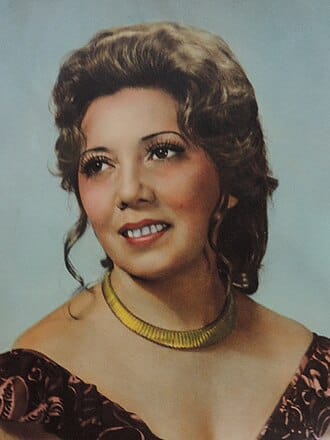
Autorretrato de Telma Saraiva, 1980 (fotopintura)
Telma Saraiva, Arquivo pessoal de Telma Saraiva, via Wikimedia Commons, CC BY 3.0. Source: Autorretrato de Telma Saraiva, 1980 (fotopintura) at Wikimedia Commons, from the personal archive of Telma Saraiva

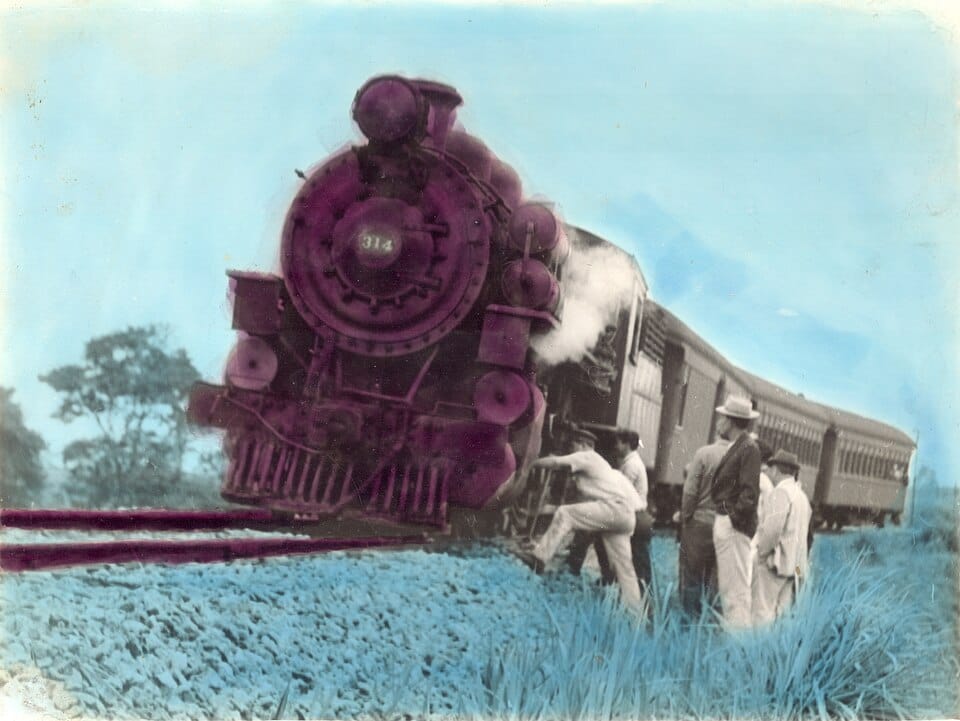
Trem (Fotopintura de Trem)
Não identificado, Conjunto Antonio Roseno de Lima, Centro de Memória Unicamp, via Wikimedia Commons, CC BY-SA 4.0. Source: Trem (Fotopintura de Trem) at Conjunto Antonio Roseno de Lima, Centro de Memória Unicamp, via Wikimedia Commons

With other styles
The opposite: Indian painted photographs. The Indian painter works over a frontal, still sitter and buries the costume in regalia colour; the Brazilian painter models smooth skin and swaps clothes and ground, and in the film-star variant turns the face away, so choose by whether you want rank or romance.
Pairs with Hollywood glamour portraiture. Both light the head to flatter and tilt it away from the lens; use a Hollywood-style black-and-white original as the underpainting and let the brush, not the retoucher's pencil, add the colour.
The opposite: Carte-de-visite studio portraits. The carte leaves the whole small print as made; the fotopintura enlarges it to a wall-size keepsake and repaints clothes, face and ground.
Pairs with Malian studio portraiture. Both are studio trades making portraits for the sitter's own household, with the sitter's chosen dress and backdrop; the link is only this shared household trade, so treat it as a loose pairing.
Sources
- Fotopinturas: Coleção Mestre Júlio Santos, 14ª Bienal Naïfs do Brasil, Sesc Piracicaba, 2014: https://edicoesnaifs.sescsp.org.br/2014/curador%C3%ADa/fotopinturas-cole%C3%A7%C3%A3o-mestre-j%C3%BAlio-santos.html (recorded mainly in the Northeast from the early twentieth century; collection of studios from the 1950s-70s; sizes 18 x 24, 24 x 30 and 30 x 40 cm; text by Diógenes Moura; Sesc Piracicaba, 8 August - 30 November 2014)
- Fotocinepintura, Revista ZUM 29: https://revistazum.com.br/revista-zum-29/fotocinepintura/ (Telma Saraiva, Crato, 1928-2015; her father Júlio Saraiva; oil, pastel and watercolour on enlargements, Kodak Ektalure and Kodabromide papers; masks, fine brushes, bleach; costume, make-up and backdrop painted in lilac, green and blue; Hollywood-inspired self-portraits; decline with digital technology and Photoshop)
- Telma Saraiva self-portraits, Wikimedia Commons: https://commons.wikimedia.org/wiki/File:Autorretrato_de_Telma_Saraiva_-_1949.jpg (images from Telma Saraiva's personal archive, labelled 'Autorretrato, Fotopintura')
- Fotopintura de Trem, Conjunto Antonio Roseno de Lima, Centro de Memória Unicamp, Wikimedia Commons: https://commons.wikimedia.org/wiki/File:Fotopintura_de_Trem.jpg (1960-1969, Indaiatuba, SP (uncertain: the Commons place is bracketed and its medium field says collotype), 18 x 24 cm without frame, CC BY-SA 4.0)