Styles / Vernacular & studio
Burmese commercial studio portraiture
- Key: a window, about 60° to the camera’s left, soft.
Open shadows: bright surroundings (walls, ground, sky) fill them; no reflector needed.
Schematic, not to scale: worked out from the style’s choices. No set-up of this style has been rendered yet.
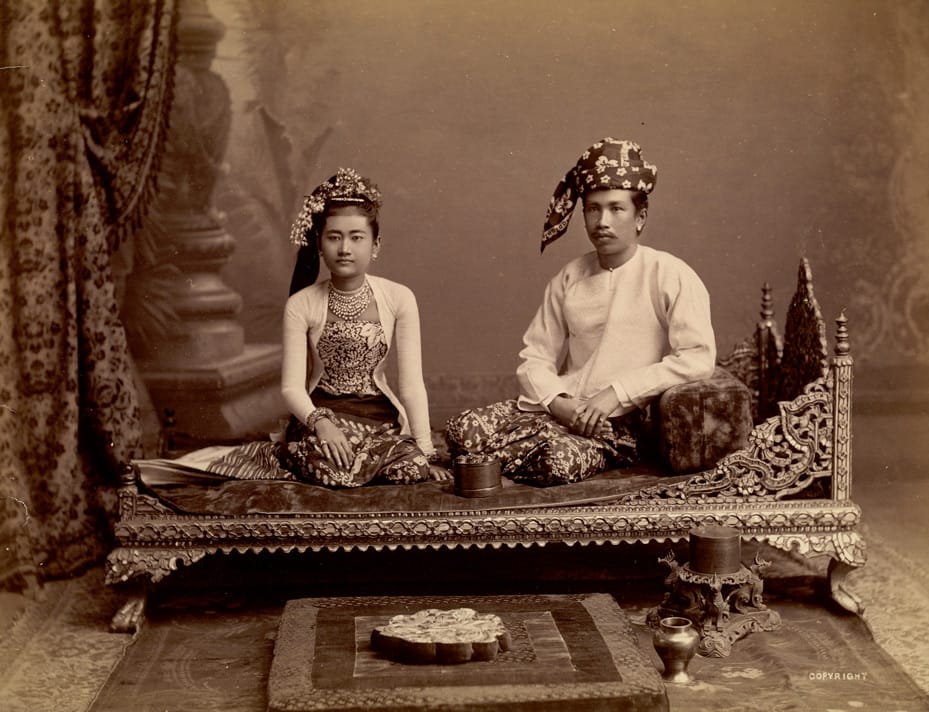
Burmese couple of the upper class seated on a wooden couch
Probably Philip Adolphe Klier, 1890s; public domain, via Wikimedia Commons. Source: Burmese couple of the upper class seated on a wooden couch at Wikimedia Commons

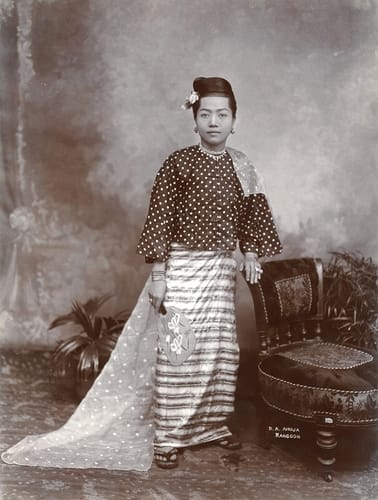
A woman from Burma
D. A. Ahuja, Rangoon, early 20th century; public domain, via Wikimedia Commons. Source: A woman from Burma at Wikimedia Commons (Myanmar historical archive)

Full-length and seated portraits of paying clients, alone, in couples or in families, made in a Rangoon or Mandalay studio. Early sitters wear silk longyi, htamein and jewellery against a painted jungle or palace backdrop, with a carved couch or European chair, a lacquer box, a potted palm. Glass negatives are hand-retouched to lighten and smooth skin, prints are albumen, then gelatin silver and sometimes hand-coloured. By the 1950s sitters bring Western dress and a trade object, and backdrops simplify.
Built on two systems: Painted studio and Painted over. What systems are.
Shoot sheet for your kit A prompt for an image model The photographs
How the look is made
- Seat or stand the client whole in the frame, square to the camera, with enough floor to show the couch, chair or carpet.
- Hang a painted backdrop and dress it with a curtain, a potted palm and one or two props; keep the backdrop visible to its edges.
- Let the client choose the dress: silk longyi, htamein and jewellery for ceremony, later a suit, a wristwatch or a tool of their trade.
- Light the sitter evenly and softly from a skylight or window so that faces, silks and backdrop all read; leave no deep shadows.
- Retouch the negative by hand: paint the face and hands to lighten and smooth them, then print small and colour by hand if the client pays for it.
- Deliver as single prints, memento cards and album pages, stamped with the studio's name.
Shoot sheet for your kit
Fill in your camera, lenses and lights, and the sheet says which light plays each part, what to work around and where to start on your camera. Without a kit it starts on a full-frame camera.
Light
Key: a window, about 60° to the camera’s left, soft.
- Open shadows: bright surroundings (walls, ground, sky) fill them; no reflector needed.
- Shadow edges
- Shadows that fade gradually from light to dark, cast by a large or diffused light: a window, a softbox, a cloudy sky.
- Shadow depth
- Shadows kept light and full of detail by a reflector, a fill light, bounce or bright surroundings (a low lighting ratio, up to about 3:1: the shadow side at most a stop and a half darker).
How the style is lit
- Skylight or large side window over a studio floor, softened with blinds or white cloth, falling evenly on sitter and painted backdrop.
- A white reflector or sheet on the shadow side so that faces and pale silks keep detail.
- Tungsten studio lamps, spread evenly, in the later black-and-white studios.
This plan is worked out from the style’s choices, so it is drawn as a schematic. One way to get the light, not a record of how any photograph was lit.
Lens and settings
Start at
On a full-frame camera: the same depth of field and exposure as the style’s own numbers, in the same light. Then meter and adjust.
- The style’s f/13 on Quarter plate gives about the depth of field of f/4.2 on full frame.
- Then
- 40–65 mm · f/8–f/22 · 1/10–2 s · ISO 10–100 on Quarter plate, inferred from the gear and the look. The Royal Ontario Museum's Mandalay negatives are gelatin glass plates about 11 × 8.5 cm, which suggests a quarter-plate camera with a normal lens; stops, times and plate speeds are inferred from process and indoor daylight. Over half of that set is thought unprinted for blur or overexposure, so times and sharpness varied.
- Focal length
- Roughly the eye’s own perspective; no visible distortion.
- Angle
- The camera at the height of a standing person or of the subject.
- Distance
- Whole figures and their immediate surroundings.
- Balance
- The subject faces the lens; planes run parallel to the picture. The subject in the middle, the frame balanced around it.
- Crop & fill
- The subject shown small within its setting, which explains it.
- Duration
- An unmoving scene, exposed slowly and carefully.
Direct
Seat the client on a carved couch or European chair, or stand them beside a chair or table, shoulders square to the camera, hands resting in the lap, on the knee or holding a fan or a prop, face composed and unsmiling, eyes to the lens, held still for the exposure. Couples sit side by side and families cluster close, the eldest seated.
- Body position
- On a chair or stool, back straight, hands and feet placed: the formal sitting. Upright, weight on both feet, shoulders level: the plain, even stance of a formal sitting or a line-up.
- Turn to the camera
- Shoulders and hips face the lens straight on: direct, symmetrical, sometimes confrontational.
- Head & gaze
- Looking straight into the camera, so the subject meets the viewer’s eye.
- Arms & hands
- Arms by the sides, hands folded in the lap or resting on a chair: quiet and formal.
- Line & energy
- Rigid and motionless, sometimes braced against a head rest or gripping a chair: held for a long exposure or a solemn occasion.
- Expression
- Unsmiling, composed and blank: the face gives nothing away.
- Several people
- Bodies close together, overlapping and leaning in: friends, a band, a family on a sofa.
- With the sitter
- The sitter arranged and still, facing the camera. The subject performs for the camera and shapes the picture.
Style the set
Clients wear their best: silk longyi or htamein, jacket, scarves, jewellery and flowers in the hair for early colonial-era portraits, mixed with leather shoes, wristwatches or a cane; from the 1950s Western suits and dresses and an object from the sitter's trade. The studio supplies a painted backdrop of jungle or palace columns and curtain, a carved couch, chair, carpet, potted palms, vases and lacquer boxes.
- Clothes
- The wearers’ own festive, religious or wedding clothes: saris and lehengas, boubous, robes, kimono. Best clothes, jewellery and accessories put on for the studio or the occasion. Outfits the wearers put together to be seen, designer labels included: layering, sneakers, statement pieces.
- Set & props
- A painted, cloth, paper or seamless backdrop behind the subject. The stock furniture of a portrait studio, standing in for a setting: a posing chair, a column, a balustrade, a draped table, a potted palm. Things shown to say who the sitter is or wants to be, their own or lent by the studio: a radio, a bicycle, a watch, books, tools.
- Look of the styling
- Patterns, objects and textures piled together: pattern on pattern, flowers on brocade.
Finish
- Monochrome
- Rich blacks, clean whites and every grey between.
- Colour
- Colour painted onto a monochrome print.
- Film
- A view camera on a tripod: great detail, slow and deliberate.
- Post-production
- Marks made by hand on the negative or the print. Perfected skin and surfaces.
- Shown as
- Each picture stands on its own.
- Shown in
- Prints for an album, a card or a frame at home.
Stay away from candid & unobserved, snapshot, tilted angle, direct on-camera flash, low-key & chiaroscuro, shallow depth of field, laughing, unstyled, as found, black shadows and visible grain.
Before you shoot it
These are portraits of real, mostly unnamed clients and their families, made for their own use; some were produced under colonial conditions, and colonial-era studios also sold picturesque views of Burmese people in traditional dress to foreign visitors, a gaze not to be repeated on new subjects. Hand-lightening of skin in retouching reflects colour prejudice; do not copy it as an ideal. Court dress in 1890s portraits carried rank and ceremonial meaning (Konbaung sumptuary rules once restricted some clothing), so do not treat it as costume. Klier worked largely for European buyers, so the picturesque, exoticising view is part of this style's own history; prefer sitter-led portraits.
A prompt for an image model
No prompt for this style
Behind its pictures: portraits of real clients and families whose descendants and archives hold an interest, with court dress of rank and a colonial gaze.
Its caution asks to credit them.
These are portraits of real, mostly unnamed clients and their families, made for their own use. Hand-lightening of skin in retouching reflects colour prejudice; do not copy it as an ideal. Court dress in 1890s portraits carried rank and ceremonial meaning, so do not treat it as costume. prefer sitter-led portraits.
Work with photographers of this tradition, or take only its light and lens (the shoot sheet above) without its people, places or rituals.
Photographs that define it
From open collections, shown whole with their credits. Later photographs are linked, not shown, while they are in copyright.
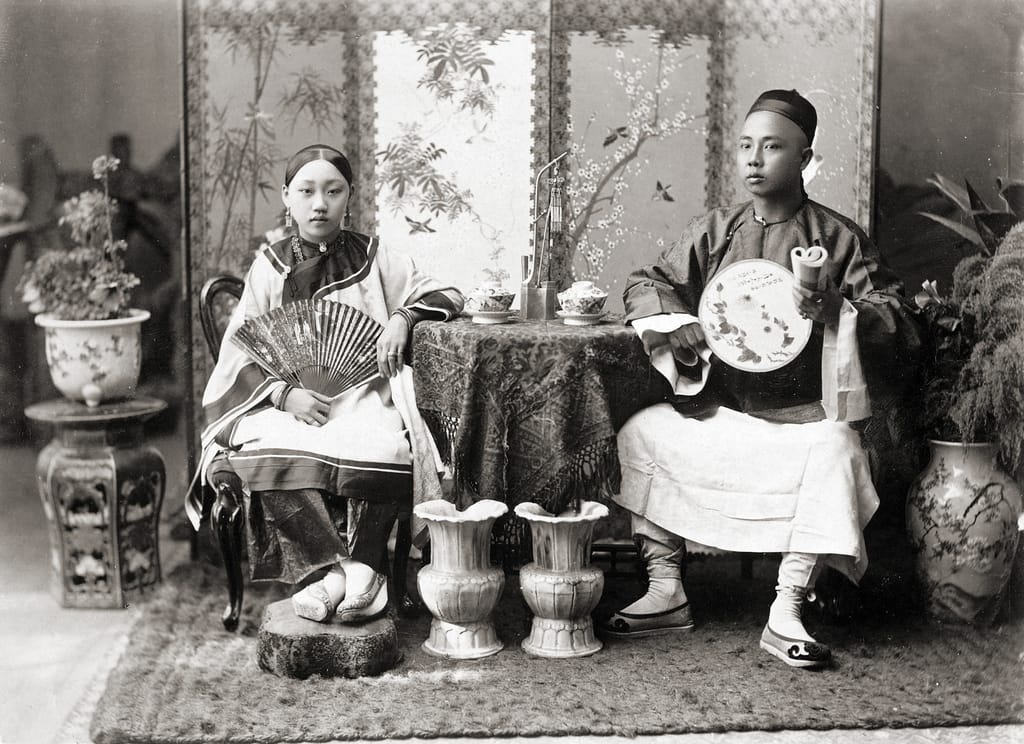
Chinese merchant and his wife in Burma
Watts and Skeen, 1890s, Curzon Collection; public domain, via Wikimedia Commons. Source: Chinese merchant and his wife in Burma at Wikimedia Commons (Curzon Collection)

With other styles
Pairs with Carte-de-visite studio portraits. Both build a paying client's likeness from a painted backdrop, props and a held pose; take the carte's curtain, carpet and full-length stance and add local dress, a carved couch and brush-retouched faces.
Pairs with Malian studio portraiture. Both are sitter-led commercial studios where clothes and props signal standing; compare Mali's flat patterned cloth with Burma's painted jungle and carved furniture, and keep the whole figure in even light.
The opposite: Yokohama photography. Yokohama studios made hand-coloured souvenirs of types for foreign buyers; keep the Burmese studio's local clientele and their own choice of dress rather than a view for visitors.
Sources
- Migration Through the Lens of an Unknown Burmese Studio, Royal Ontario Museum magazine: https://www.rom.on.ca/magazine/migration-through-lens-unknown-burmese-studio (as quoted in search results: 99 glass negatives from an unknown Mandalay studio, mostly 1890–1910, mostly portraits of Indian migrants and Burmese sitters, some outdoors against walls or plain fabric; painted backdrops and props; hand-painting on faces and hands to lighten and smooth skin; about 11 × 8.5 cm; page itself not retrievable)
- Philip Adolphe Klier, Wikipedia: https://en.wikipedia.org/wiki/Philip_Adolphe_Klier (born 1845, Moulmein then Rangoon studio on Signal Pagoda Road after 1880, partnership with J. Jackson from about 1885, died 1911; albumen prints; staged portraits of Burmese people in traditional dress for customers)
- Myanmar Photo Archive, Wikipedia: https://en.wikipedia.org/wiki/Myanmar_Photo_Archive (founded 2013 by Lukas Birk; more than 30,000 images dated 1889 to 1995; studio accessories; replica colonial studio at the 2018 Secretariat exhibition)
- About, Myanmar Photo Archive: https://www.myanmarphotoarchive.org/about/ (painted jungle backdrops in colonial-era portraits, change after independence in 1948, studios in high demand in the 1950s and 1960s, Indian then Chinese-run studios)
- Burmese Photographers, Thamine blog: https://thamine.blog/2018/02/24/burmese-photographers/ (European-style painted backgrounds, mixed Eastern and Western dress, 1950s Western dress and simpler backdrops with trade items, early-1960s expulsion of foreigners, memento cards and stencilled frames, black-and-white and hand-colouring until the 1990s)
- Asia Studio collection, British Library Endangered Archives Programme EAP898/1: https://eap.bl.uk/collection/EAP898-1 (as reported by search: U Kyawt 1913–1988, studio portraits 1940s to the late 1960s, 134 negatives; page body not retrievable)
- Exhibition Looks Back on 120 Years of Photography in Myanmar, The Irrawaddy: https://www.irrawaddy.com/culture/exhibition-looks-back-120-years-photography-myanmar.html (as reported by search: D. A. Ahuja business 1885–2007; U Ohn Maung's London Art Studio, 1915, probably the first Burmese-owned studio; page itself not retrievable)
- Burmese upper class couple, Wikimedia Commons: https://commons.wikimedia.org/wiki/File:Burmese_upper_class_couple.jpg (full-length seated studio portrait, probably Klier, 1890s, public domain)