Styles / Early processes
Chronophotography
- Key: the sun, about 45° to the camera’s left, high, hard.
Key high: about 30–45° above eye level, angled down.
Schematic, not to scale: worked out from the style’s choices. No set-up of this style has been rendered yet.
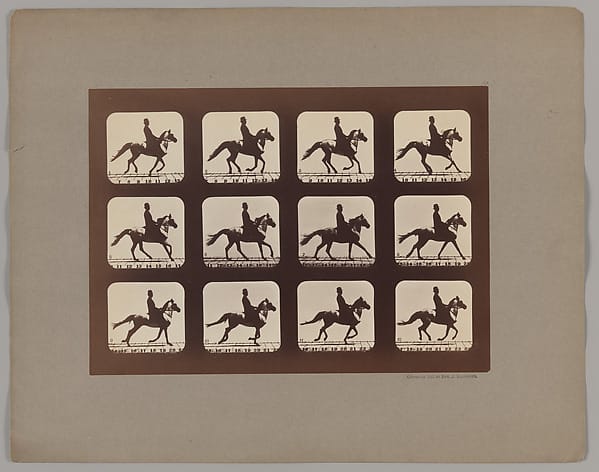
Attitudes of Animals in Motion
Eadweard Muybridge, Attitudes of Animals in Motion, 1879, printed 1881. The Metropolitan Museum of Art, Gift of Joyce F. Menschel, 2015. Source: Attitudes of Animals in Motion at The Metropolitan Museum of Art
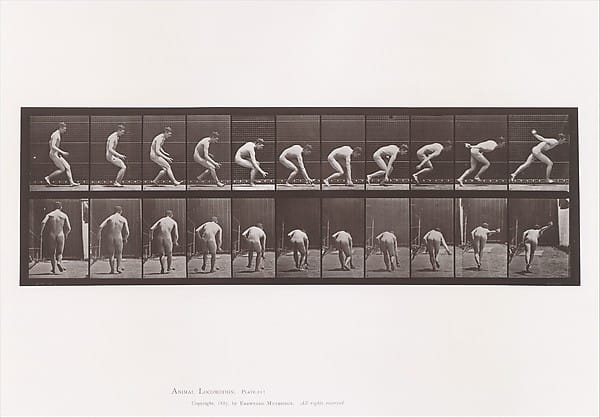
Animal Locomotion, Volume I, Men (Nude): a plate of a man stooping and throwing
Eadweard Muybridge, Animal Locomotion, Volume I, Men (Nude), 1880s. The Metropolitan Museum of Art, Rogers Fund, transferred from the Library. Source: Animal Locomotion, Volume I, Men (Nude): a plate of a man stooping and throwing at The Metropolitan Museum of Art
Time as the subject: a horse, a bird or an athlete performing one action, caught as a row of frozen instants numbered in order or stacked on a single plate. Fast shutters in bright sun and a plain or gridded ground make each phase legible, and the whole is a measurement, not a picture of a moment. Side-on, level, centred and repeated across many bodies and actions, the plates read as brown-toned tables of movement, from the 1878 cabinet cards to the 1887 collotype plates.
Built on two systems: Albumen view and Deadpan document. What systems are.
Shoot sheet for your kit A prompt for an image model The photographs
How the look is made
- Choose one action and break it into phases: a stride, a leap, a wingbeat, a lift, each shown as its own numbered frame.
- Fix the camera position and view the subject square-on from the side at a middle distance, level with its body, so every frame shares the same scale and angle.
- Freeze every phase with the fastest shutter you have, in bright direct sun, so limbs and wings come out sharp, not blurred.
- Put a plain or measured ground behind the action, such as a white wall, a black shed or a ruled grid, so position and distance can be read off the plate.
- Keep the frames evenly spaced in time and lay them out in ordered rows, or, on one plate, as separate positions on a dark ground, so the sequence reads left to right.
- Repeat the same set-up for many bodies and many actions, and judge each plate by what it measures, not by its drama.
Shoot sheet for your kit
Fill in your camera, lenses and lights, and the sheet says which light plays each part, what to work around and where to start on your camera. Without a kit it starts on a full-frame camera.
Light
Key: the sun, about 45° to the camera’s left, high, hard.
- Key high: about 30–45° above eye level, angled down.
- Shadow edges
- Shadows with crisp outlines, cast by a small or distant light: direct sun, a bare flash, a spotlight.
How the style is lit
- Bright direct sun on an open track or yard, the subject lit from the camera side so that every frame has the same hard light.
- A white or black ground behind the action: a whitened wall, a dark shed or a black-lined box, with the subject also in sun, so the outline stands clear.
- A measured grid of threads or painted lines on the back wall, lit evenly so distances can be read.
This plan is worked out from the style’s choices, so it is drawn as a schematic. One way to get the light, not a record of how any photograph was lit.
Lens and settings
Start at
On a full-frame camera: the same depth of field and exposure as the style’s own numbers, in the same light. Then meter and adjust.
- The style’s f/8 on Whole plate gives about the depth of field of f/1.3 on full frame.
- Too bright for the shutter: stop down further or use an ND filter.
- Then
- 1/1000 s on Whole plate, inferred from the gear and the look. Muybridge's June 1878 shutters were claimed (not verified) to open for 1/1000 s, so the value is a claim. The plate format is a nominal assumption, and the lens, aperture and plate speed of each camera are not documented here, so only the shutter is given; frames follow each other at intervals of a fraction of a second, and Marey's gun gave 12 frames a second.
- Focal length
- Roughly the eye’s own perspective; no visible distortion.
- Focus
- Everything sharp from the nearest stone to the horizon.
- Angle
- The camera at the height of a standing person or of the subject.
- Distance
- Whole figures and their immediate surroundings.
- Balance
- The subject in the middle, the frame balanced around it.
- Crop & fill
- A small subject in a large empty field.
- Instant
- Movement stopped dead by a fast shutter or flash.
- Many times
- Successive instants shown side by side or in one frame. Several exposures laid over each other in one frame.
Direct
Direct the subject to perform one plain action from start to finish, such as walking, running, jumping, lifting or throwing, in profile or square-on to the camera, with no look to the lens and no expression to arrange. Stage the same action again from a second or third camera position (side, front, rear) so the plate shows it from several sides. Subjects are nude or in minimal dress for visibility of the limbs, and are shown at a steady pace so that each frame is one step in an ordered series.
- Turn to the camera
- Seen from the side, the face or the whole body turned 90° from the lens, like a head on a coin.
- Line & energy
- Running, dancing, spinning or tumbling, with hair and clothes flying; an ordinary walk is Walking & mid-stride.
- The set-up
- The same kind of subject, photographed the same way, many times. A scene staged and directed like a film still or a painting.
Style the set
Strip the scene back to the measuring: a plain ground, a ruled grid or a numbered scale at the foot of each frame, and nothing the subject has not been asked to handle. Dress the subject lightly or in close, pale clothes against a dark ground (or dark against a pale one) so that the outline of the limbs stays legible. Label the plate with title, number and date, and let each frame carry its own number.
- Set & props
- A painted, cloth, paper or seamless backdrop behind the subject.
- Look of the styling
- Few, simple elements on clean surfaces, with space around them.
Finish
- Monochrome
- A monochrome image tinted sepia, brown, selenium purple or cyanotype blue.
- Early processes
- Warm-brown prints of the 19th century, made from negatives.
- Post-production
- Nothing changed beyond exposure and development. Words or graphic marks added to the photograph.
- Shown as
- Pictures arranged in a grid for comparison. Pictures made and shown as a set.
Stay away from motion blur, panning, shallow depth of field, soft focus & diffusion, tilted angle, diagonal & dynamic, glamour & aspiration, sensual, candid & unobserved and heavy retouching.
Before you shoot it
The people in Animal Locomotion were models, nude or lightly clothed, photographed in a university laboratory for a study of movement, and they did not choose how the pictures would be shown. Treat them as real people, not as props, and do not imitate the plates with real people who have not given a clear, informed consent to be photographed this way. Londe's multi-lens cameras recorded the movements of patients under Charcot, in a medical setting that left them with little say; do not copy that. The animals were driven past the cameras, and the 1870s horse-racing set-up involved the speed and risk of real animals.
A prompt for an image model
No prompt for this style
Behind its pictures: nude models and medical patients photographed with little say.
A generated motion-study plate would pass as a nineteenth-century scientific record.
Treat them as real people, not as props, and do not imitate the plates with real people who have not given a clear, informed consent to be photographed this way. do not copy that. The animals were driven past the cameras, and the 1870s horse-racing set-up involved the speed and risk of real animals.
Work with photographers of this tradition, or take only its light and lens (the shoot sheet above) without its people, places or rituals.
Photographs that define it
From open collections, shown whole with their credits. Later photographs are linked, not shown, while they are in copyright.

[Bird in Flight]
Étienne-Jules Marey, [Bird in Flight], 1886. The Metropolitan Museum of Art, Gilman Collection, Purchase, Denise and Andrew Saul Gift, 2005. Source: [Bird in Flight] at The Metropolitan Museum of Art
With other styles
The opposite: New Vision. Use its serial frames and multiple exposures for dynamism and expression instead of measurement, with steep tilted views where this style stays level and side-on.
Pairs with New Objectivity photography. Borrow its deadpan, frontal, evenly lit way of making a typology and apply it to the same action or body repeated across a set of plates.
Pairs with Düsseldorf School of Photography. Hang the frames as an ordered grid of a single type, as the school does for buildings, with the subject moving through the rows.
The opposite: Calotype and paper-negative photography. Where the calotype's long exposures make still, soft masses, this style freezes motion in sharp, short frames printed in a similar warm brown tone.
Sources
- https://en.wikipedia.org/wiki/Chronophotography
- https://en.wikipedia.org/wiki/Eadweard_Muybridge
- https://en.wikipedia.org/wiki/%C3%89tienne-Jules_Marey
- https://en.wikipedia.org/wiki/The_Horse_in_Motion
- https://www.metmuseum.org/art/collection/search/700109
- https://www.metmuseum.org/art/collection/search/266429
- https://www.metmuseum.org/art/collection/search/286544