Styles / Modernist
Czech avant-garde photography
- Key: a window, from the camera’s left, at the side, soft.
Schematic, not to scale: worked out from the style’s choices. No set-up of this style has been rendered yet.
The photographs that define it are still in copyright, so they are linked below rather than shown.
Funke-era Czech photographs of the 1920s and 1930s that turned a tabletop or a darkroom into the subject: glass, cards and laboratory ware lit by one hard beam so that cast shadows and slanted planes make abstract shapes, plus photograms and tilted views through cables. Prints are small, quiet and carefully toned, nearer a still life than a street shot. Against the wider German-led new vision, what is distinctive here is Funke's own practice of building abstraction on a table and in the darkroom, not a national school.
Built on two systems: Graphic abstraction and Cameraless still life. What systems are.
How the look is made
- Build the picture on a table: arrange glass, cards, tubes or bottles in a bare corner and photograph the arrangement, not a found scene.
- Light it from one side with a single window or lamp so the shadow becomes a second object, as hard-edged as the thing that casts it.
- Tilt the camera or the set until edges run on a diagonal, and crop close so that a plain area of wall or sky surrounds only a few shapes.
- Lay objects straight onto photographic paper and expose them to a lamp for a photogram, overlapping transparent and opaque pieces for depth.
- Print carefully on small sheets in dense blacks and a quiet, slightly warm tone; keep the print straight and leave the borders visible.
Shoot sheet for your kit
Fill in your camera, lenses and lights, and the sheet says which light plays each part, what to work around and where to start on your camera. Without a kit it starts on a full-frame camera.
Light
Key: a window, from the camera’s left, at the side, soft.
- Shadow edges
- Shadows with crisp outlines, cast by a small or distant light: direct sun, a bare flash, a spotlight.
- Shadow depth
- Dark shadows that still hold some detail (a high lighting ratio, about 4:1 to 8:1: the shadow side two to three stops darker).
- Shape & form
- Shadows thrown away from what casts them (a figure’s long shadow, railings on a wall) that become shapes of their own in the composition.
How the style is lit
- One window or lamp from the side across a table of cards, boxes and glass, throwing hard-edged shadows on a pale wall.
- A bare lamp above photographic paper in the darkroom for photograms of glass and laboratory ware.
- A plain diffuse sky behind cables or masts for tilted outdoor views.
This plan is worked out from the style’s choices, so it is drawn as a schematic. One way to get the light, not a record of how any photograph was lit.
Lens and settings
Start at
On a full-frame camera: the same depth of field and exposure as the style’s own numbers, in the same light. Then meter and adjust.
- The style’s f/16 on Quarter plate gives about the depth of field of f/5 on full frame.
- 1/30 s: on a tripod.
- Then
- 40–70 mm · f/11–f/22 · 0.5–4 s · ISO 12–50 on Quarter plate, inferred from the gear and the look. Inferred, not sourced: tripod-mounted tabletop practice on plate and roll film in window or lamp light suggests a small stop for sharp edges and exposures of seconds. No exposure data for specific frames was found; photograms need no camera, only a lamp and paper.
- Focal length
- Roughly the eye’s own perspective; no visible distortion.
- Angle
- The horizon deliberately off level (Dutch angle).
- Distance
- Within arm’s reach: faces, hands and details fill the frame.
- Balance
- Tilted lines and oblique movement drive the picture.
- Crop & fill
- The edges cut into the subject: heads, limbs or objects run out of frame. A small subject in a large empty field.
- Depth
- Depth collapsed into pattern and flat shapes.
- Duration
- An unmoving scene, exposed slowly and carefully.
Direct
Mostly nobody is posed: the subject is a set of things. Where a person appears at all, as in Funke's other work, treat them as a cropped or tilted part of a composition rather than a sitter.
- Without a pose
- No people at all, or people so small or far off that their pose does not read (hands alone are Hands alone).
- The set-up
- Sets, models and miniatures built to be photographed.
Style the set
Sets are spare and made: glass, cards, tubes, bottles and laboratory ware laid or propped in a bare corner, with a plain wall or board as the backdrop and no decorative props.
- Set & props
- The stock furniture of a portrait studio, standing in for a setting: a posing chair, a column, a balustrade, a draped table, a potted palm.
- Food & things
- Objects set in rows, grids or neat patterns, squared up and evenly spaced (knolling).
- How much is styled
- Clothes, hair, make-up, props and set all chosen and placed by a team to one idea.
- Look of the styling
- Few, simple elements on clean surfaces, with space around them.
Finish
- Monochrome
- Low contrast and gentle greys.
- Digital & other
- Photograms and chemigrams: images made on light-sensitive material without a camera.
- Post-production
- Nothing changed beyond exposure and development.
- Shown as
- Pictures made and shown as a set. Each picture stands on its own.
Stay away from fisheye, direct on-camera flash, hdr & tone-mapped, saturated colour, smiling, candid & unobserved and far & detached.
Before you shoot it
Funke (d. 1945) is public domain in the EU and The Met releases the specimens as CC0; Sudek and Rössler (d. 1990) are in copyright, so keep specimens to Funke.
A prompt for an image model
A ready prompt that describes this look to an image model: where the lights stand, the lens, the framing and the colour. It starts on the style’s own choices; change any of them and the prompt and the notes follow.
The prompt
Notes on this prompt
- How the style uses it: light it from one side with a single window or lamp so the shadow becomes a second object, as hard-edged as the thing that casts it. Image models put the light in the wrong place more often than anything else, so the prompt says where each light stands: which side of the picture, and how high. Keep to one light pattern per prompt, or the model splits the difference.
- Black and white: colour words in the subject (a red dress, green leaves) can pull the model back to colour, so leave them out.
- Say what the crop cuts: the top of the head, the hands at the edge. A model left to itself centres everything with room to spare.
The model makes a new picture, not a photograph of anything that happened. Label it as AI-generated, and don’t pass it off as the style’s history or as a real person.
Made by an AI model
An image gpt-image-2 made from this style’s choices, then checked against them by a vision model. Not a photograph, and not part of the style’s history. All generated images
-
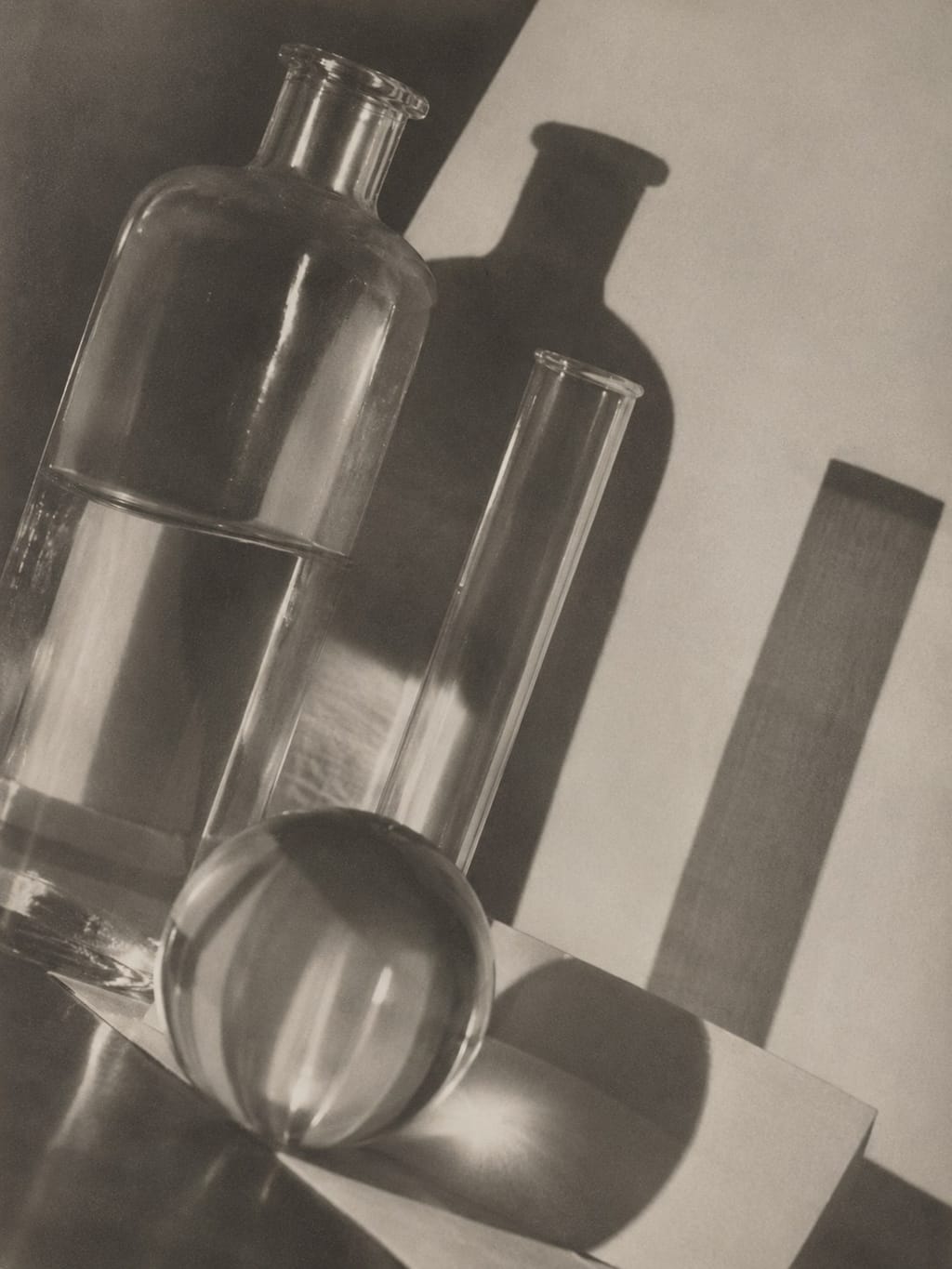
A tilted, warm monochrome still life shows a glass bottle partly filled with liquid, a tall glass tube and a clear glass sphere on a light rectangular board. Strong directional light casts elongated shadows across the background and bright reflections through the glass. What the check saw. The diagonal composition, pronounced cast shadows and grainy monochrome finish give this arranged glass still life the appearance of an experimental vintage photograph.
With other styles
Pairs with New Vision. Borrow its steep tilts and diagonals for outdoor pictures, then bring them indoors to a still-life table.
Pairs with Surrealist photography. Add doubling, mirrors and strange juxtapositions of everyday glass and cards for an uncanny reading.
The opposite: New Objectivity photography. Where it isolates a thing in plain, even light, shape the shadow and the diagonal into the subject.
The opposite: Flat lay. Where it arranges objects top-down in even light for display, lay them for shadow, overlap and diagonal as a photogram does.
Sources
- https://en.wikipedia.org/wiki/Jarom%C3%ADr_Funke (born 1896 in Skuteč, died 1945 in Kolín; co-founded the Czech Photographic Society with Sudek and Schneeberger; Bad Living, 1930–31; Bratislava photography department 1931–35; Fotografie vidí povrch, 1935, with Ladislav Sutha; exhibitions in Washington 2009 and Tallinn 2015)
- https://cs.wikipedia.org/wiki/Jarom%C3%ADr_Funke (Czech Photographic Society founded 1924 for purely photographic processes, free of graphic-art influence; Bratislava from 1931; professor in Prague from 1935 to 1944; modernist circle with Sudek and Rössler)
- https://en.wikipedia.org/wiki/Josef_Sudek (1896–1976, co-founder of the Czech Photographic Society)
- https://en.wikipedia.org/wiki/Jaroslav_R%C3%B6ssler (Devětsil from 1923; among the first abstract photographs; photogram, photomontage and collage; moved to Paris in 1927)
- https://www.metmuseum.org/art/collection/search/265505 (Funke, Photogram; Laboratory Equipment, 1926, 1987.1100.435)
- https://www.metmuseum.org/art/collection/search/286025 (Funke, Abstraction, ca. 1924, 2005.100.509)
- https://www.metmuseum.org/art/collection/search/265474 (Funke, [Wooded Hills and Lake, Seen from above on a Diagonal through Suspended Bridge Cables (?)], 1920s, 1987.1100.408)