Styles / Modernist
Focus-stacked natural-history macro
- Key: a softbox, about 40° to the camera’s left, high, soft.
Key high: about 30–45° above eye level, angled down.
Schematic, not to scale: worked out from the style’s choices. No set-up of this style has been rendered yet.
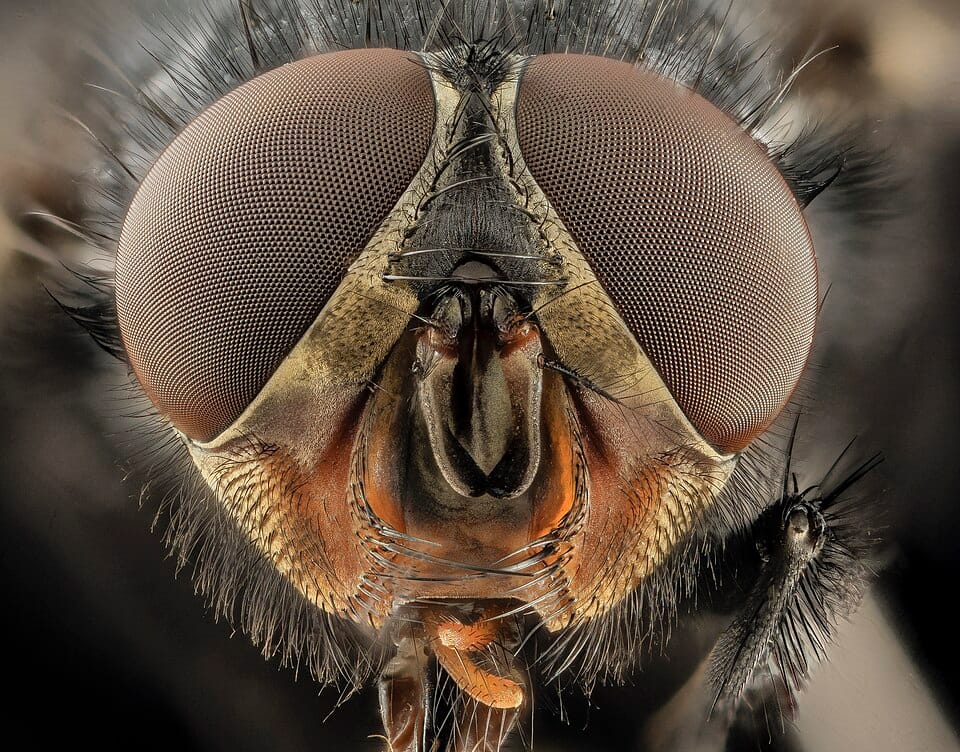
Calliphora vicina, face
USGS Bee Inventory and Monitoring Lab, Calliphora vicina, face, 2014. Public domain (US government work), via Wikimedia Commons. Source: Calliphora vicina, face at Wikimedia Commons, from the USGS Bee Inventory and Monitoring Lab

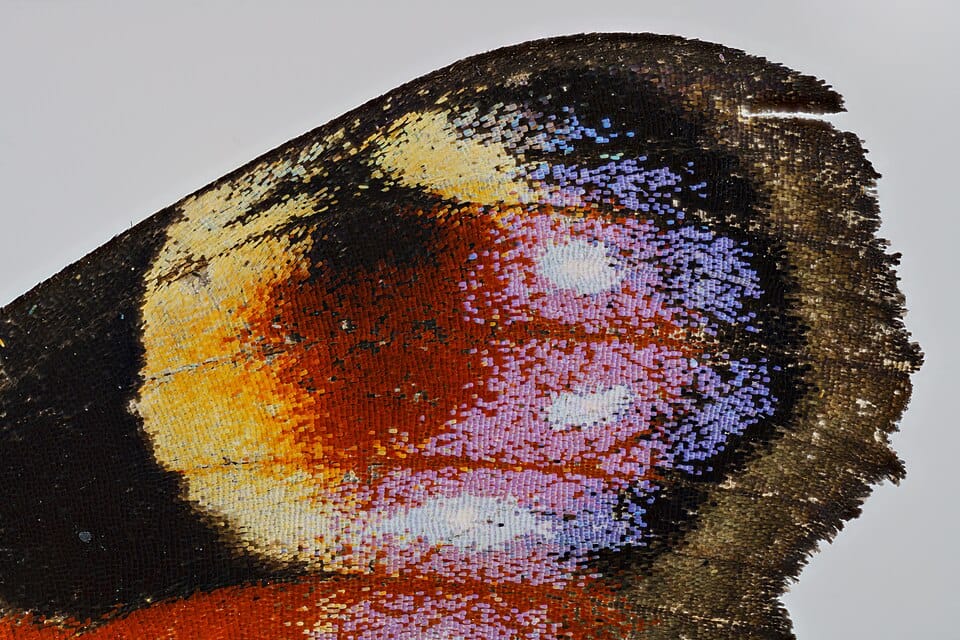
Peacock butterfly (Aglais io), eyespot on forewing, colourful scales
Franz van Duns, 2021, CC BY-SA 4.0, via Wikimedia Commons. Source: Peacock butterfly (Aglais io), eyespot on forewing, colourful scales at Wikimedia Commons

Insects, scales, pollen, moulds and other small natural specimens photographed at high magnification and made sharp from nearest to farthest edge by merging many frames shot at successive focus planes. The specimen is centred and fills the frame, lit softly and evenly with its surface, hairs and iridescence resolved, against a plain or dark, featureless ground. Nobody is posed and nothing is styled; the print is shown large, or the image circulates as a specimen portrait.
Built mostly on one system: Macro on black. What systems are.
Shoot sheet for your kit A prompt for an image model The photographs
How the look is made
- Fill the frame with one specimen, centred, and keep the ground plain or dark and featureless, with nothing else in it.
- Shoot a stack: fix the camera and specimen, step the focus a small, even distance between frames, and cover the whole depth from nearest to farthest surface.
- Light the specimen with large, diffused sources close in, so ridges, hairs and scales model softly; light a large specimen section by section if one light cannot hold it all.
- Hold the highlights on glossy cuticle and wet or iridescent surfaces just below clipping, and keep the colours the specimen really has.
- Keep the specimen and camera still: use a rail, a stable stand and flash or a held light, so no frame moves against the next.
- Disclose that the picture is a composite of many frames, and keep retouching to the seams and dust, so the structure stays a faithful record.
Shoot sheet for your kit
Fill in your camera, lenses and lights, and the sheet says which light plays each part, what to work around and where to start on your camera. Without a kit it starts on a full-frame camera.
Light
Key: a softbox, about 40° to the camera’s left, high, soft.
- Key high: about 30–45° above eye level, angled down.
- Shape & form
- Light turning gradually into shade across faces and objects, so their volume shows.
- Highlights
- Small, bright glints where the light reflects off wet, oily or polished surfaces: glistening food, dewy skin, the sparkle of jewellery or chrome.
How the style is lit
- Large diffusers, a cooler dome or white-card tent around a pinned or mounted specimen, giving soft, even light with a short highlight on each glossy surface, against a plain or dark featureless ground.
- Twin small flash heads or a continuous source held close on each side, diffused through foam or tissue, fired at a short flash duration so each frame in the stack is frozen.
- For a large specimen, lit one section at a time with a light moved to suit that part's texture, gloss and shape, then merged.
This plan is worked out from the style’s choices, so it is drawn as a schematic. One way to get the light, not a record of how any photograph was lit.
Lens and settings
Start at
On a full-frame camera: the same depth of field and exposure as the style’s own numbers, in the same light. Then meter and adjust.
- Then
- 50–150 mm · f/4–f/8 · ISO 50–200 on full frame, inferred from the gear and the look. Inferred from one published file's description (a USGS bee-lab fly portrait: Canon EOS 5D Mark II, a 65 mm macro lens, twin diffused macro flash, f/5, ISO 100, assembled in Zerene Stacker) and from the Microsculpture description of strobe-lit sections. Stopping down much beyond f/8 loses sharpness to diffraction at high magnification; the depth comes from the number of frames, not the f-number. Shutter speed is not given: with flash, the flash duration, not the shutter, freezes each frame. Microscope-objective rigs such as the one Microsculpture describes sit outside the focal-length range. Frame counts run from a dozen to thousands.
- White balance
- Daylight-balanced flash or a fixed 5500 K setting for every frame in the stack; leave the specimen's own colours alone and let the neutral ground stay neutral.
- Focal length
- Very close focus: small things at life size or larger.
- Focus
- Everything sharp from the nearest stone to the horizon.
- Distance
- Within arm’s reach: faces, hands and details fill the frame.
- Balance
- The subject in the middle, the frame balanced around it.
- Crop & fill
- The edges cut into the subject: heads, limbs or objects run out of frame.
- Duration
- An unmoving scene, exposed slowly and carefully.
Direct
Nobody in the picture.
- Without a pose
- No people at all, or people so small or far off that their pose does not read (hands alone are Hands alone).
- With the sitter
- Neutral, unemotional and distant.
Style the set
Nothing is dressed or decorated. The specimen is cleaned, mounted and set on a plain neutral ground or held in the air, with no props, labels or setting in the frame; a museum specimen may keep its pin out of sight. Colour is the specimen's own.
- Look of the styling
- Few, simple elements on clean surfaces, with space around them.
Finish
- Colour
- The colour of ordinary things treated as the point of the picture.
- Digital & other
- A modern digital camera: clean, detailed, neutral.
- Texture
- Every surface resolved, more than the eye would see. Smooth tones with no visible grain.
- Post-production
- Several photographs combined into one picture.
- Shown in
- Large prints on the wall, like paintings.
Stay away from shallow depth of field, soft focus & diffusion, hdr & tone-mapped, multiple exposure, painted, scratched or drawn on, tilted angle, theatrical & acted, dressed up for the picture, wide angle and lyrical & poetic.
Before you shoot it
The pictures are composites of many frames and do not show a single instant or one lens view, so never present one as an unprocessed record, a scientific measurement or evidence of a species identification without saying that it is a stack. Specimens may be museum or collection material: credit the collection, do not kill, collect or chill live or protected animals for a frame (use already-dead, legally held or cultured material), and follow permits and local rules. Competition and exhibition photographers are living, and their lighting methods and compositions are their own work: learn the principle, do not copy a named maker's look or image.
A prompt for an image model
No prompt for this style
Behind its pictures: a generated "specimen" would pass as a photographed animal or scientific record.
The caution calls that a fake.
The pictures are composites of many frames and do not show a single instant or one lens view, so never present one as an unprocessed record, a scientific measurement or evidence of a species identification without saying that it is a stack. Specimens may be museum or collection material: credit the collection, do not kill, collect or chill live or protected animals for a frame, and follow permits and local rules. Competition and exhibition photographers are living, and their lighting methods and compositions are their own work: learn the principle, do not copy a named maker's look or image. Do not make or share generated images in this style as real specimens or records. Competition entries should disclose the stack and any retouching, and a generated 'macro' image passed off as a photographed specimen is a fake.
Work with photographers of this tradition, or take only its light and lens (the shoot sheet above) without its people, places or rituals.
Photographs that define it
From open collections, shown whole with their credits. Later photographs are linked, not shown, while they are in copyright.
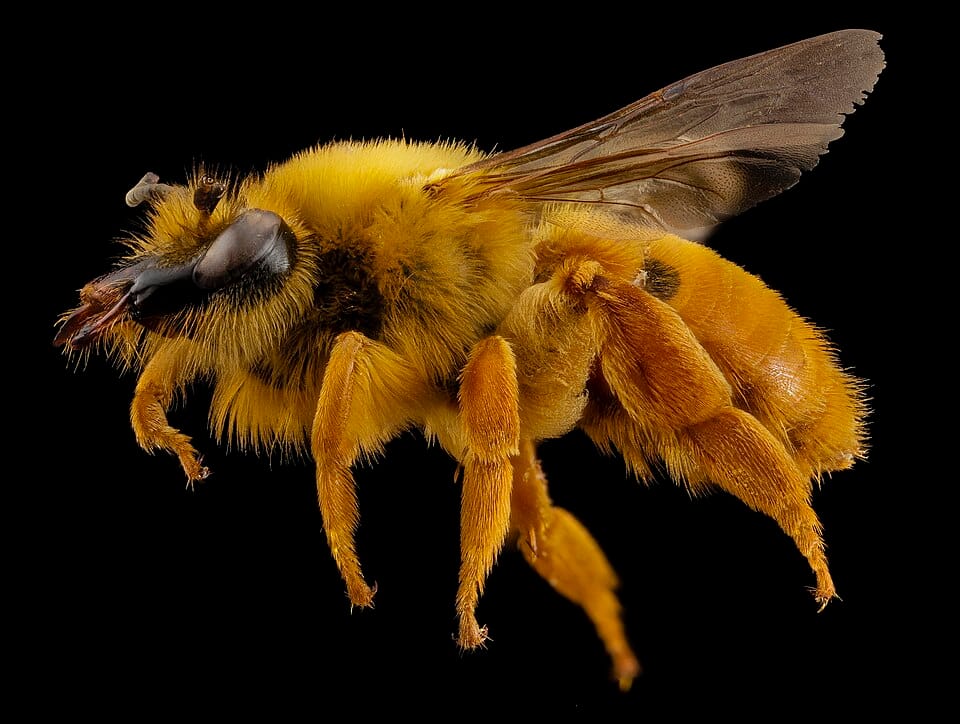
Diphaglossa gayi, female, side view
USGS Bee Inventory and Monitoring Lab (posted to Flickr by Sam Droege; transferred to Wikimedia Commons by Geo Swan), Diphaglossa gayi, 2014. CC BY 2.0, with a US public-domain notice (USGS work), via Wikimedia Commons. Source: Diphaglossa gayi, female, side view at Wikimedia Commons, from the USGS Bee Inventory and Monitoring Lab

With other styles
The opposite: Blackwater macro photography. Blackwater macro freezes a living drifting animal in a single flash frame; take its black ground but lock the specimen still and build the depth from many frames.
Pairs with New Objectivity photography. Take its frontal, centred, specimen-like address of a plant or object, and carry it to a scale and sharpness the plate camera could not reach.
Pairs with Straight photography. Borrow its trust in the unmanipulated record of a natural form, then state plainly that the frames were merged.
Pairs with E-commerce packshot on white. Share its even, shadowless light and clean ground; swap the product for a specimen and keep its texture instead of removing it.
Sources
- Microsculpture, Oxford University Museum of Natural History: https://oumnh.ox.ac.uk/microsculpture (photographic exhibition of insect specimens by Levon Biss, 27 May 2016 to 29 January 2017)
- About Microsculpture: https://microsculpture.net/about-microsculpture (each picture built from over 8,000 photographs, about 30 sections, each lit separately with strobes; microscope lenses; a bespoke rig)
- Nikon Small World, Image Stacking: https://www.nikonsmallworld.com/techniques/image-stacking (competition entries tagged Image Stacking, including Geir Drange 2012, ninth, and Alison Pollack 2022, fifth; earliest listed year checked: 2011)
- Calliphora vicina, face, USGS Bee Inventory and Monitoring Lab, Wikimedia Commons: https://commons.wikimedia.org/wiki/File:Calliphora_vicina,_u,_Face,_DC_2014-04-24_-17.46.02_ZS_PMax_-_USGS_Bee_Inventory_and_Monitoring_Laboratory.jpg (public domain; Canon 5D Mark II, Zerene Stacker, StackShot sled, 65 mm MP-E macro lens, twin macro flash, f/5, ISO 100)
- Peacock butterfly eyespot, Franz van Duns, Wikimedia Commons: https://commons.wikimedia.org/wiki/File:2021-08-16_-_Peacock_butterfly_(Aglais_io)_-_eyespot_on_forewing_-_colourful_scales_-_DSG3404-1_(magnif._ratio_2.2x,_HiRes_focus_stack).jpg (CC BY-SA 4.0; 51-image stack, magnification 2.2x, image width about 16 mm)