Styles / Staged & conceptual
Fotonovela (photo-romance)
- Lamp: a small hard source, 10 cm across, 1.2 m from the face, about 35° to the camera’s right, 52 cm above the eyes.
To scale, from the render’s scene file. One way to get this light, not a record of how any photograph was lit.
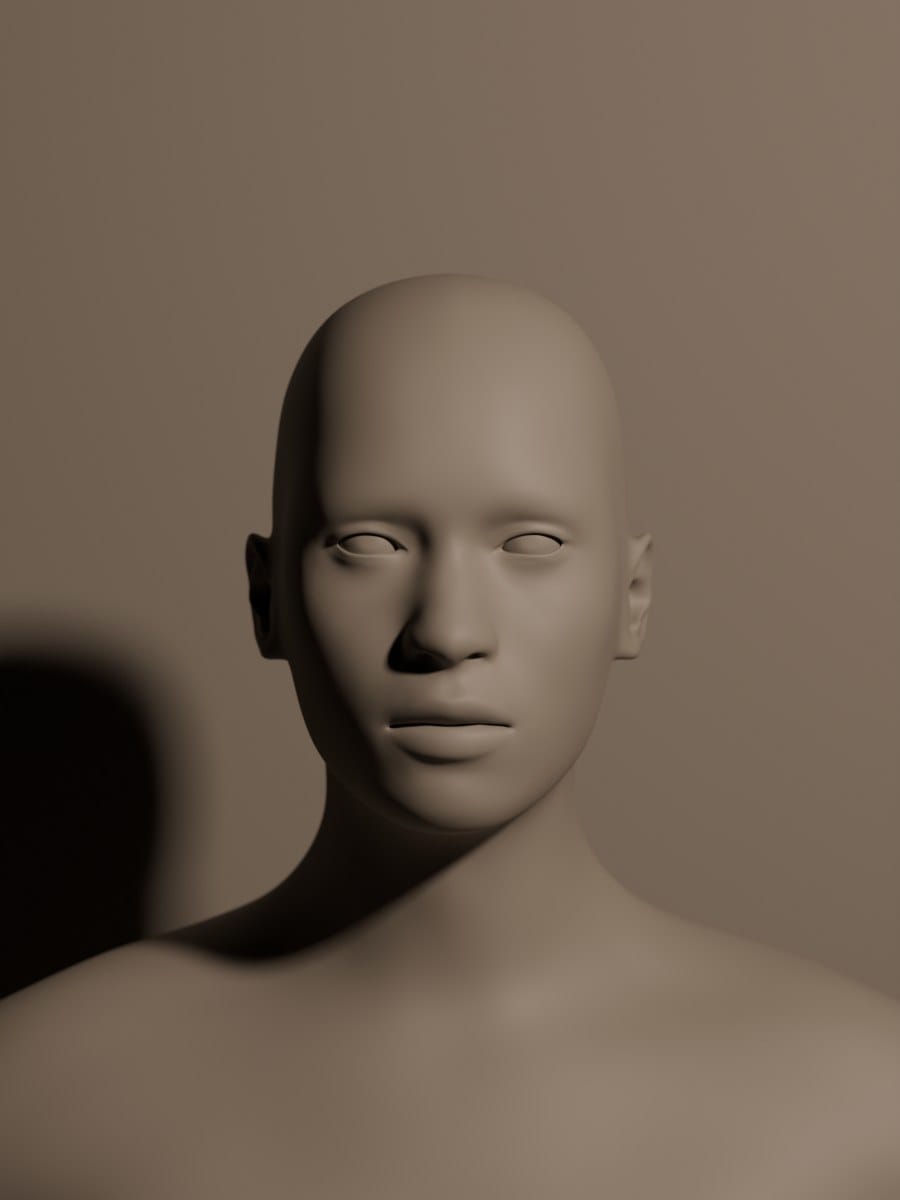
Rendered with this plan. One small lamp above and to the right of the camera, deep cheek shade and a clear shadow on the close grey wall (an interior-light reconstruction, not a magazine panel).
Render: a synthetic clay head made with MakeHuman, not a person, in Blender Cycles, 85 mm, f/5.6.
The photographs that define it are still in copyright, so they are linked below rather than shown.
Scripted romances photographed expressly as still pictures: actors hold readable gestures of longing, distress or reconciliation in recognisable rooms and locations. Close faces alternate with wider encounters; captions and speech balloons turn the photographs into a magazine narrative. The classical idiom favours clear black-and-white modelling, groomed characters and meaningful props. Unlike a documentary picture essay, its actions are invented; unlike a star portrait, each face serves a story rather than standing alone.
Built mostly on one system: Costumed tableau. What systems are.
Shoot sheet for your kit A prompt for an image model The photographs
How the look is made
- Plan a fictional encounter as a sequence of still photographs, giving each image one readable emotional beat rather than pretending to catch a real event.
- Direct the face, hands and body together: turn a head away, cover a face or bring two characters into an embrace so the feeling survives reduction on the page.
- Alternate tight faces with medium-distance interactions, keeping wardrobe, props and spatial relationships consistent between pictures.
- Light faces and gestures so their emotion remains readable; choose filled modelling for a gentle exchange or a small, harder source and deeper wall shadows for a tense interior, rather than imposing one lighting ratio on every scene.
- Choose a few narrative props and a recognisable location, then crop away details that distract from the characters' relationship.
- Compose the photographs for a page sequence with short captions and speech balloons, allowing room for words without covering the decisive face or hand.
Shoot sheet for your kit
Fill in your camera, lenses and lights, and the sheet says which light plays each part, what to work around and where to start on your camera. Without a kit it starts on a full-frame camera.
Light
Key: a spot or bare head, about 40° to the camera’s left, high, hard.
- Key high: about 30–45° above eye level, angled down.
- Shadow edges
- Shadows with crisp outlines, cast by a small or distant light: direct sun, a bare flash, a spotlight.
- Shadow depth
- Dark shadows that still hold some detail (a high lighting ratio, about 4:1 to 8:1: the shadow side two to three stops darker).
- Shape & form
- Light turning gradually into shade across faces and objects, so their volume shows.
- Highlights
- Even the brightest parts (clouds, white cloth, snow) keep texture and detail.
How the style is lit
- Reconstruction of an interior encounter: a moderately small key above and to one side of the camera, with weaker frontal fill or a white reflector; keep facial and clothing shadows readable, not black.
- Reconstruction of a close romantic exchange: a broad, near-frontal key with gentle fill, modelling the cheeks while preserving detail in pale clothing and keeping both faces legible.
- Reconstruction of a contrasting interior: use one small lamp above and to the side of the camera, without added frontal fill; allow a clear wall shadow and deep shade while keeping the important face and hand readable.
This plan is worked out from the style’s choices, so it is drawn as a schematic. The set-up at the top of the page is the one we rendered, to scale. One way to get the light, not a record of how any photograph was lit.
Lens and settings
Start at
On a full-frame camera: the same depth of field and exposure as the style’s own numbers, in the same light. Then meter and adjust.
- The style’s f/9.4 on 6 × 6 cm gives about the depth of field of f/5.1 on full frame.
- Then
- 40–60 mm · f/8–f/11 · 1/125–1/60 s · ISO 100–400 on 6 × 6 cm, inferred from the gear and the look. A practical reconstruction envelope for normal-perspective, posed interior scenes with readable clothing and surroundings, not recovered historical exposures. Historical research documents 6×6 and 35 mm cameras, tripods and artificial lamps; no specimen-specific lens, stop, time or film speed was confirmed. Focal lengths are 35 mm equivalents; apertures are for 6×6.
- White balance
- The classical interior photographs described here are monochrome, so colour balance is not a defining choice; colour covers and later colour production vary and are not assigned a shared balance.
- Focal length
- Roughly the eye’s own perspective; no visible distortion.
- Angle
- The camera at the height of a standing person or of the subject.
- Distance
- Within arm’s reach: faces, hands and details fill the frame. Whole figures and their immediate surroundings.
- Crop & fill
- The edges cut into the subject: heads, limbs or objects run out of frame.
- Many times
- Successive instants shown side by side or in one frame.
Direct
Direct invented adult characters through clearly held emotional gestures: look toward a partner rather than the lens, turn away in hesitation, bring a hand to the face in distress or share a consensual embrace; repeat the gesture consistently for the adjoining close-up and wider view. Do not stage coercion or actual distress.
- Head & gaze
- Eyes off the frame, past the camera or into the distance, as if lost in thought.
- Arms & hands
- Hands touching, framing or cradling the face, the chin, the neck or the hair.
- Line & energy
- Large, readable gestures and attitudes, as on a stage or in a silent film: a feeling or a story acted out.
- Expression
- Tears, grief, anger, fear or elation shown openly on the face and in the body.
- Several people
- People talking, playing, working or dancing together, absorbed in each other rather than the camera. People holding, hugging, kissing, leaning on or carrying one another.
- The set-up
- A scene staged and directed like a film still or a painting.
Style the set
Dress adult performers for their fictional roles in recognisable everyday or smart clothes, with groomed hair and visible but controlled make-up. Choose a domestic or social location and a few continuity props such as a handbag, letter or telephone; let wardrobe and furnishings explain the characters without turning the frame into a fashion advertisement.
- Clothes
- Period dress, fancy dress, stage costume or someone else’s clothes, worn to play a part rather than as one’s own.
- Hair & make-up
- Groomed hair and finished make-up that still look natural: even skin, defined eyes, neat brows.
- Set & props
- A real place picked for its look as the setting for a shoot, not the subjects’ own: a street, a field, a palace, a hotel room. Props chosen and placed for colour, texture and story: linen, ceramics, cutlery, flowers, scattered ingredients.
- How much is styled
- Clothes, hair, make-up, props and set all chosen and placed by a team to one idea.
Finish
- Monochrome
- Rich blacks, clean whites and every grey between.
- Film
- Roll film in a medium-format camera, often square.
- Post-production
- Words or graphic marks added to the photograph.
- Shown as
- A sequence with text that tells a story. Pictures made and shown as a set.
- Shown in
- Pictures made for magazine pages and spreads.
Stay away from candid & unobserved, deadpan, typology, snapshot, unseen camera, neutral face and objective & scientific.
Before you shoot it
The historical works show identifiable performers and belong to photographers, publishers and archives; access to a museum scan is not permission to reuse it. Credit the production teams rather than treating this as one famous photographer's signature. The industry sometimes reproduced class, gender and racial stereotypes and normalised coercion or violence against women, while some stories also challenged social restrictions: neither dismiss its readers nor recycle those stereotypes as harmless nostalgia. Any new exercise must use consenting adults and clearly fictional characters, avoid real actors' likenesses and copied panels, and never present invented scenes as vintage originals, news or evidence of real abuse. Do not reproduce the weapon in the Mexican specimen or erotic, coercive or violent storylines as styling.
A prompt for an image model
A ready prompt that describes this look to an image model: where the lights stand, the lens, the framing and the colour. It starts on the style’s own choices; change any of them and the prompt and the notes follow.
The prompt
Notes on this prompt
- This is the set-up rendered at the top of the page, so the prompt puts its lights where the render has them. Image models put the light in the wrong place more often than anything else, so the prompt says where each light stands: which side of the picture, and how high. Keep to one light pattern per prompt, or the model splits the difference.
- Describe an invented person by age, clothes and pose. Never name a real or famous person, and never write “looks like”.
- Black and white: colour words in the subject (a red dress, green leaves) can pull the model back to colour, so leave them out.
The model makes a new picture, not a photograph of anything that happened. Label it as AI-generated, and don’t pass it off as the style’s history or as a real person.
Where to see it
From open collections, shown whole with their credits. Later photographs are linked, not shown, while they are in copyright.
In copyright, so linked
- Production photograph for Gioventù delusa: woman seated on the floor with a hand over her face , Photographer not individually credited; production for Bolero Film, 1967. Fondazione Arnoldo e Alberto Mondadori, Milan; reproduced by Mucem.
- Production photograph for Qualcosa che si chiama onore: close-up of a kiss , Photographer not individually credited; production for Bolero Film, 1960. Fondazione Arnoldo e Alberto Mondadori, Milan; reproduced by Mucem.
- Anel, fotonovela para la revista Capricho , Antonio Caballero, ca. 1970; reprinted 2007. Museo Universitario Arte Contemporáneo, DiGAV-UNAM, inventory 08-844536.
With other styles
The opposite: Hollywood glamour portraiture. Keep groomed faces if useful, but replace the solitary star, sculpted spotlight and self-contained publicity pose with acted relationships and changing narrative views.
The opposite: Picture-magazine photo essay. Use its sequencing discipline, but label the scenario as fiction: these are scripted performances with dialogue, not witnessed events supported by factual captions.
The opposite: Staged tableau photography. Resolve the story across several captioned panels instead of relying on one large, deliberately ambiguous tableau.
Sources
- Jan Baetens, Carmen Van den Bergh and Bart Van den Bossche, Come scrivere un fotoromanzo, Griseldaonline, University of Bologna: https://site.unibo.it/griseldaonline/it/contaminazioni/jan-baetens-carmen-van-den-bergh-bart-van-den-bossche-come-scrivere-fotoromanzo (1947 magazine launches; distinction from drawn romances and cinema; collective production, posed emotion and page organisation; continuing medium).
- Mucem, Roman-Photo, exhibition 13 December 2017–23 April 2018: https://mucem.org/expositions/roman-photo/ (original production photographs versus cropped magazine reproductions; sentimental tradition, French reception, rights captions and archive provenance).
- Mucem, Roman-Photo, dossier pédagogique, 2017, printed pp. 6–9: https://mucem.org/uploads/2025/07/Dossier_pedagogique_roman_photo_mucem_2017.pdf (Bolero Film nos. 675 and 1043, dates, titles, Mondadori holding and reserved rights).
- Rebeca Monroy Nasr, La entraña visual en la fotonovela, in Melodramas de papel: historias de la fotonovela en México, UNAM, 2021, pp. 347–400, especially pp. 353–354, 375–379 and 397: https://historicas.unam.mx/publicaciones/publicadigital/libros/754/754_05_09_entranavisual.pdf (magazine narrative antecedents, role styling, 35 mm and 6×6 cameras, tripods, artificial lamps, tonal printing and gendered stereotypes; printed p. 397 explicitly describes contrasting interiors, often with a single lamp and unsoftened wall shadows).
- MUAC collection, Antonio Caballero, Anel, fotonovela para la revista Capricho, c. 1970, reprinted 2007, inventory 08-844536: https://coleccionmuac.unam.mx/obra/7224 (maker, production attribution, gelatin silver medium, holder and donation).
- Malba, Conferencia inaugural: George Friedman. Fotonovela: https://malba.org.ar/evento/conferencia-inaugural__george-friedman-fotonovela/ (Friedman's Argentine Idilio production, vintage photographs and magazine contexts).
- Research limitations: the two Italian specimen photographers are not individually credited by the museum; neither their exact shooting locations nor any specimen's exposure settings were established. The displayed production photographs do not themselves show the balloons added for publication. Lighting recipes and numerical settings are explicitly inferred reconstructions, not studio records. Open filled shadows and single-lamp, harder contrasting interiors are alternative reconstructions; neither lighting ratio is universal across the Italian and Latin American examples. Monroy Nasr, printed p. 397, documents the single-lamp alternative, not the reconstructed lamp height or position. The UNAM PDF was rechecked for this revision via curl with certificate verification disabled after a local issuer-certificate failure; this transport limitation does not establish authenticated delivery.