Styles / Vernacular & studio
Haitian studio portraiture
- Key: a softbox, about 40° to the camera’s left, high, soft.
Key high: about 30–45° above eye level, angled down.
Schematic, not to scale: worked out from the style’s choices. No set-up of this style has been rendered yet.
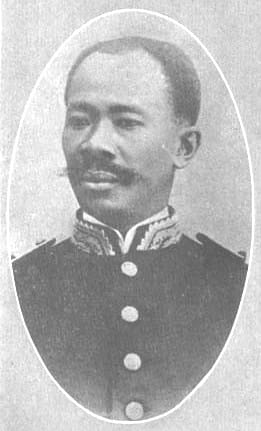
Portrait of Vilbrun Guillaume Sam, President of Haiti
Unknown photographer; scan on Wikimedia Commons, marked public domain there. Source: Portrait of Vilbrun Guillaume Sam, President of Haiti at Wikimedia Commons

Portraits made to order in Port-au-Prince studios, first for the elite and later for everyone: sitters in their best clothes, often full length, before a painted architectural illusion, a locally painted tropical lagoon or an imported theme bed sheet, with wicker chairs, vases of flowers, dolls or a plaster birthday cake with candles. A large studio camera on a wheeled tripod makes black-and-white prints, which one studio calls more artistic than colour, and the darkroom can combine negatives to set the client on an outstretched hand, over a television or banknotes, or inside a bottle.
Built mostly on one system: Painted studio. What systems are.
Shoot sheet for your kit A prompt for an image model The photographs
How the look is made
- Dress the stage before the sitter arrives: hang a painted backdrop (columns, a lagoon with palms) or a printed bed sheet, and set a wicker chair, a vase of flowers or a doll within reach.
- Photograph the client in their best clothes, whole figure where the set allows, facing the camera and held still for the exposure.
- Bring the occasion into the picture: a plaster birthday cake with candles for a child, a doll, a communion or carnival costume.
- Shoot black and white on a large studio camera and print it as the finished picture, not as a stage on the way to colour.
- Combine negatives in the darkroom when the client wants a fantasy: the sitter standing on an outstretched hand, over a fan, a television or a banknote, or shut in a bottle.
Shoot sheet for your kit
Fill in your camera, lenses and lights, and the sheet says which light plays each part, what to work around and where to start on your camera. Without a kit it starts on a full-frame camera.
Light
Key: a softbox, about 40° to the camera’s left, high, soft.
- Key high: about 30–45° above eye level, angled down.
How the style is lit
- Studio lamps or flash set in front of the sitter and set, lighting face and painted backdrop evenly (the lighting is not described in the sources read; this is inferred).
- Daylight from a studio window, where a studio has one (inferred, not documented).
This plan is worked out from the style’s choices, so it is drawn as a schematic. One way to get the light, not a record of how any photograph was lit.
Lens and settings
Start at
On a full-frame camera: the same depth of field and exposure as the style’s own numbers, in the same light. Then meter and adjust.
- The style’s f/11 on 4 × 5 in gives about the depth of field of f/3.2 on full frame.
- Then
- 40–60 mm · f/8–f/16 · 1/10–1 s · ISO 50–200 on 4 × 5 in, inferred from the gear and the look. Only the camera type is documented: a large-format studio camera with an Anastigmat lens (Houlberg 1992). The plate size, focal length, stop, time and film speed are inferred for a full-length portrait at a few metres, with the stop assumed small enough to hold the sitter and the backdrop in focus. Light, shading and lens weights in the genome are inferred, not documented.
- Angle
- The camera at the height of a standing person or of the subject.
- Distance
- Whole figures and their immediate surroundings.
- Balance
- The subject faces the lens; planes run parallel to the picture. The subject in the middle, the frame balanced around it.
- Duration
- An unmoving scene, exposed slowly and carefully.
Direct
Stand the client full length, square or slightly turned, facing the lens and held still, or seat them in a wicker chair; children stand beside a doll or behind a plaster birthday cake with candles. For a fantasy print, pose the client so the second negative can complete the picture: a figure planted as if on an open hand, over a fan or a banknote, or crouched in a jar.
- Body position
- Upright, weight on both feet, shoulders level: the plain, even stance of a formal sitting or a line-up. On a chair or stool, back straight, hands and feet placed: the formal sitting.
- Head & gaze
- Looking straight into the camera, so the subject meets the viewer’s eye.
- Line & energy
- Rigid and motionless, sometimes braced against a head rest or gripping a chair: held for a long exposure or a solemn occasion.
- Expression
- Unsmiling, composed and blank: the face gives nothing away.
- The moment
- Ordinary photographs by and for ordinary people, or images that look like them.
- With the sitter
- The sitter arranged and still, facing the camera. The subject performs for the camera and shapes the picture.
Style the set
Clients bring their best: suits, dresses, first-communion dress or carnival costume. The studio supplies the set: a painted architectural illusion or tropical lagoon, or a patterned theme bed sheet; wicker chairs, flower vases, dolls and the birthday cake. Sets are layered and full rather than spare.
- Clothes
- Best clothes, jewellery and accessories put on for the studio or the occasion.
- Set & props
- A painted, cloth, paper or seamless backdrop behind the subject. The stock furniture of a portrait studio, standing in for a setting: a posing chair, a column, a balustrade, a draped table, a potted palm.
Finish
- Monochrome
- Rich blacks, clean whites and every grey between.
- Film
- A view camera on a tripod: great detail, slow and deliberate.
- Shown as
- Each picture stands on its own.
Stay away from candid & unobserved, snapshot, shallow depth of field, low-key & chiaroscuro, tilted angle, deadpan and unstyled, as found.
Before you shoot it
The photographs show real Haitian families and children, made for the clients to keep, and the studios named (Abraham Photo, Gamma Photo and others) may be living businesses. Do not copy a studio's prints, name a living photographer in a prompt, or use real sitters' portraits without the studio's and the sitters' consent; commission and credit Haitian studios and photographers. The bottle and jar portraits are linked in Houlberg's account to Vodou containers, a religious practice: do not use them as a novelty effect. Photography of Haiti is also heavy with outsider exoticising; keep to what the clients chose for themselves. The specimen kept here is an official-style presidential portrait of unconfirmed maker and studio; no specimen shows the vernacular studio tradition of painted sets, props and combination prints, so rely on the principles and Houlberg's account, not the specimen.
A prompt for an image model
No prompt for this style
Behind its pictures: real families and children from living Haitian studios, with bottle portraits tied to sacred Vodou containers.
Its caution asks to commission and credit the studios.
Do not copy a studio's prints, name a living photographer in a prompt, or use real sitters' portraits without the studio's and the sitters' consent; keep to what the clients chose for themselves. The specimen kept here is an official-style presidential portrait of unconfirmed maker and studio.
Work with photographers of this tradition, or take only its light and lens (the shoot sheet above) without its people, places or rituals.
Where to see it
From open collections, shown whole with their credits. Later photographs are linked, not shown, while they are in copyright.
With other styles
Pairs with Carte-de-visite studio portraits. The nineteenth-century cabinet card is the root: keep the prop-and-backdrop stage, then add the painted lagoon and darkroom fantasy.
Pairs with Malian studio portraiture. Both stage the client against a hung ground in black and white; borrow Bamako's clash of printed cloth with printed dress, but keep Port-au-Prince's painted scenes.
The opposite: Dakar studio portraiture. Dakar turns and crops the sitter close on a diagonal; Port-au-Prince stands the whole figure before a full set, so choose one per frame.
The opposite: Indian small-town studio photography. Both use painted backdrops and lent props, but the Indian studio works on square roll film with tall lamps; here the camera is large-format and the darkroom builds fantasies.
Pairs with Surrealist photography. Combination printing that puts a sitter in a bottle or on a hand is a vernacular cousin of surrealist photomontage; keep the sitter's own wish at the centre.