Styles / Staged & conceptual
Helsinki School: constructed and layered nature
- Key: a lamp, sign or screen, about 30° to the camera’s left, hard.
Schematic, not to scale: worked out from the style’s choices. No set-up of this style has been rendered yet.
The photographs that define it are still in copyright, so they are linked below rather than shown.
Landscapes and nature pictures with nobody in them, made by building the scene or stacking several places and times into one image: scaffolding glowing at dusk or night around a tree, a dark computer-built interior with a floodlit natural centrepiece, a composite that layers like sediment. Printed large in colour and shown in series or pairs, they pair ecological unease with beauty and read as plans or memories rather than records.
Built on two systems: Cinematic colour and Costumed tableau. What systems are.
Shoot sheet for your kit A prompt for an image model The photographs
How the look is made
- Build the nature you photograph: erect the scaffold, model the dome in 3D or combine several landscapes, so that the picture is a proposal rather than a record.
- Leave people out; let the tree, river or forest carry the picture and let any distant figure stay small.
- Layer places and moments into one frame until the join is felt but no single real place can be named.
- Light the construction like a stage, from inside or by hidden lamps: either a glowing gauze set at dusk or night, or a dark computer-built interior with a floodlit natural centrepiece.
- Keep the surface clean and let the uncanny come from what has been added, with an ironic or elegiac edge.
- Make a series, pair or triptych and print it large, so that the viewer reads it as a place to travel through.
Shoot sheet for your kit
Fill in your camera, lenses and lights, and the sheet says which light plays each part, what to work around and where to start on your camera. Without a kit it starts on a full-frame camera.
Light
Key: a lamp, sign or screen, about 30° to the camera’s left, hard.
- Shadow depth
- Dark shadows that still hold some detail (a high lighting ratio, about 4:1 to 8:1: the shadow side two to three stops darker).
How the style is lit
- Night scene with the built structure lit from inside or by a few hidden lamps, so transparent gauze or plastic glows against dark trees.
- A dark interior or night scene in which a natural centrepiece such as a waterfall is floodlit against deep shadow, with saturated colour in the built parts.
This plan is worked out from the style’s choices, so it is drawn as a schematic. One way to get the light, not a record of how any photograph was lit.
Lens and settings
Start at
On a full-frame camera: the same depth of field and exposure as the style’s own numbers, in the same light. Then meter and adjust.
- 1/4 s: on a tripod.
- Then
- 24–70 mm · f/8–f/16 · 1/250–30 s · ISO 100–800 on full frame, inferred from the gear and the look. No source found states camera settings for this strand. The night-lit Restoration pictures are documented as taken at night, so long exposures on a tripod are inferred; composite plates are inferred to be shot from a tripod at a normal angle of view with deep focus, so that layers match.
- Angle
- The camera at the height of a standing person or of the subject.
- Distance
- Whole figures and their immediate surroundings.
- Depth
- Separate events in the foreground, middle ground and background.
- Duration
- An unmoving scene, exposed slowly and carefully.
Direct
Nobody in the picture.
- Without a pose
- No people at all, or people so small or far off that their pose does not read (hands alone are Hands alone).
- The set-up
- Sets, models and miniatures built to be photographed.
Style the set
The set is built or assembled rather than found: scaffolding clad in gauze and plastic, glass shelters and platforms modelled in 3D, or several landscapes joined into one. Keep surfaces clean, with colour from the lamps and the built parts, and no props that date the scene, so the added structure is the only strange thing.
- How much is styled
- Clothes, hair, make-up, props and set all chosen and placed by a team to one idea.
Finish
- Colour
- Strong, dense colours.
- Digital & other
- A modern digital camera: clean, detailed, neutral. An image rendered in software that passes as a photograph.
- Texture
- Smooth tones with no visible grain.
- Post-production
- Several photographs combined into one picture. Perfected skin and surfaces.
- Shown as
- Pictures made and shown as a set.
- Shown in
- Large prints on the wall, like paintings.
Stay away from portrait, candid & unobserved, snapshot, direct on-camera flash, visible grain, document & record, glamour & aspiration and toy, disposable & point-and-shoot.
Before you shoot it
The artists are living and have recognisable bodies of work (Halso's Restoration and Museum of Nature, Sinervo's layered landscapes): describe the shared decisions, credit them, and never prompt by name or clone a specific construction. The school itself says it has no single fixed point of view, so this is one strand, not the whole Helsinki School. The pictures often carry an environmental argument; do not use the look to make a fake photograph of a real place or event, to pass a built scene off as a documentary record of a real forest or river, or to give a greenwashing project a false picture of nature.
A prompt for an image model
A ready prompt that describes this look to an image model: where the lights stand, the lens, the framing and the colour. It starts on the style’s own choices; change any of them and the prompt and the notes follow.
The prompt
Notes on this prompt
- How the style uses it: light the construction like a stage, from inside or by hidden lamps: either a glowing gauze set at dusk or night, or a dark computer-built interior with a floodlit natural centrepiece. Image models put the light in the wrong place more often than anything else, so the prompt says where each light stands: which side of the picture, and how high. Keep to one light pattern per prompt, or the model splits the difference.
- Heavy retouching: ask for smooth skin that keeps its pores, or the model makes it look like plastic.
The model makes a new picture, not a photograph of anything that happened. Label it as AI-generated, and don’t pass it off as the style’s history or as a real person.
Where to see it
From open collections, shown whole with their credits. Later photographs are linked, not shown, while they are in copyright.
In copyright, so linked
- Theatre I (The Museum of Nature) , Ilkka Halso, 2003. Persons Projects, Berlin.
- Restoration (Untitled series) , Ilkka Halso, 2000. designboom, with Galerie Wagner + Partner, Berlin (exhibited 15 January - 6 March 2010).
Made by an AI model
An image gpt-image-2 made from this style’s choices, then checked against them by a vision model. Not a photograph, and not part of the style’s history. All generated images
-
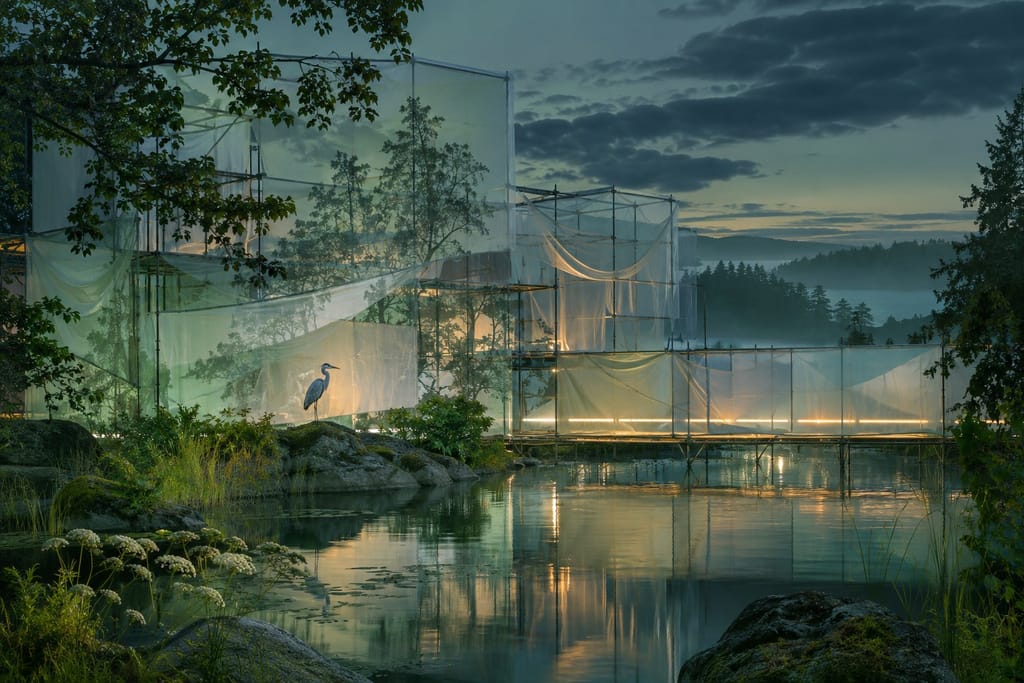
Translucent fabric hangs from tall scaffold-like frames around trees beside a pond, illuminated by warm lights that reflect in the water at twilight. A heron stands on the rocky bank amid grasses and flowers, with misty wooded hills beyond. What the check saw. The wide composition pairs cool twilight and distant mist with warm illuminated fabric and reflections, giving the landscape a quietly theatrical quality.
With other styles
Pairs with Conceptual photography. Take the idea-first logic (the picture as a proposal or system) and make it a colour landscape in which the built structure is the idea.
The opposite: New Topographics. It also shows altered land, but records it flatly; here the alteration is invented or layered in the picture, so keep the construction and drop the record.
Pairs with Düsseldorf School of Photography. Borrow the large, calm colour print and the series, then replace the neutral typology with an invented or composite place; the lighting here is staged, not Düsseldorf-neutral.
The opposite: Subjektive Fotografie. Both are personal and constructed, but this is a later colour, gallery strand built from places and models, not postwar monochrome darkroom graphics.
The opposite: Staged tableau photography. Both are built for the camera and shown big; tableau directs people in a story, while here the scene is empty and the structure or layering is the event.
Sources
- The Helsinki School, history: https://www.helsinkischool.fi/history/history (early 1990s origin, name introduced in 2003 by Boris Hohmeyer, no single fixed point of view)
- Radical Nature, Aalto University virtual exhibitions: https://virtualexhibitions.aalto.fi/en/public-art/radical-nature (Dipoli selection of more than 30 works, reopened 2017; Ilkka Halso, House with Garden - Unique Opportunity, 2011; three approaches; ecological critique)
- The Helsinki School Perspective, Persons Projects, Berlin, 1 July - 9 September 2023: https://www.helsinkischool.fi/exhibitions/the-helsinki-school-perspective (Halso builds structures physically or digitally; Sinervo's landscape photographs layer like sediment)
- Ilkka Halso: nature rescue, designboom: https://www.designboom.com/art/ilkka-halso-nature-rescue/ (Restoration, 2000: scaffolding wrapped in gauze, lit, photographed at night; print sizes)
- Ilkka Halso, Museum of Nature, Persons Projects: https://www.personsprojects.com/artists/ilkka-halso?x=works/museum-of-nature (digital works combining photographs and computer-generated 3D models; building plans the artist does not want realised)
- The Helsinki School, Wikipedia: https://en.wikipedia.org/wiki/The_Helsinki_School (naming in 2003, Persons, Gallery TaiK, Hatje Cantz series from 2005; influences cited include the Düsseldorf School)