Styles / Early processes
Levantine Orientalist studio photography
- Key: the sun, about 45° to the camera’s left, high, hard.
Key high: about 30–45° above eye level, angled down. Open shadows: bright surroundings (walls, ground, sky) fill them; no reflector needed.
Schematic, not to scale: worked out from the style’s choices. No set-up of this style has been rendered yet.
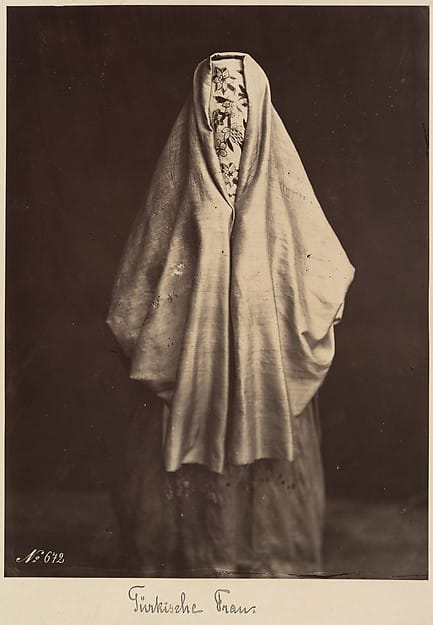
Femme turque en toilette de ville
Félix Bonfils, Femme turque en toilette de ville, 1870s. The Metropolitan Museum of Art, Funds from various donors, 2010 (2010.317). Source: Femme turque en toilette de ville at The Metropolitan Museum of Art
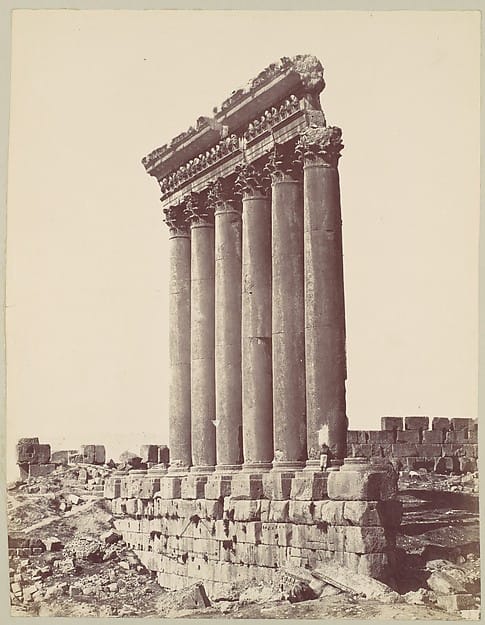
The Temple of the Sun at Baalbec
Félix Bonfils, The Temple of the Sun at Baalbec, ca. 1870. The Metropolitan Museum of Art, Gift of Douglas Dillon, 1981 (1981.1128.1). Source: The Temple of the Sun at Baalbec at The Metropolitan Museum of Art
Albumen prints sold as souvenirs of the Ottoman Levant and Egypt: ruins, mosques, city panoramas and biblical sites photographed square-on and sharp from front to back on large glass plates, plus studio scenes in which hired models in 'Oriental' dress stand for 'types' before a backdrop. Each print carries a number and a caption, and was sold singly, in albums or from a printed catalogue to travellers who wanted proof of the places they had been.
Built on two systems: Albumen view and Deadpan document. What systems are.
Shoot sheet for your kit A prompt for an image model The photographs
How the look is made
- Photograph the famous monument whole: stand back from a ruin, mosque or skyline, centre it, keep verticals upright and let a small figure or two give the scale.
- Stop the lens down so everything is sharp from the foreground stones to the far horizon, and wait for bright, high sun or open sky that leaves the stone pale against a blank sky.
- Join several plates side by side for a panorama of a city or a site, so the view reads as a long strip.
- In the studio, place one hired model in costume square to the camera against a plain or painted backdrop, still and full-length, lit from a skylight so the dress and its folds are fully visible.
- Number every negative and write the caption in the image, then sell the prints in a catalogue and bind them in an album, so views and 'types' are a stock list for the buyer.
Shoot sheet for your kit
Fill in your camera, lenses and lights, and the sheet says which light plays each part, what to work around and where to start on your camera. Without a kit it starts on a full-frame camera.
Light
Key: the sun, about 45° to the camera’s left, high, hard.
- Key high: about 30–45° above eye level, angled down.
- Open shadows: bright surroundings (walls, ground, sky) fill them; no reflector needed.
- Shadow depth
- Shadows kept light and full of detail by a reflector, a fill light, bounce or bright surroundings (a low lighting ratio, up to about 3:1: the shadow side at most a stop and a half darker).
How the style is lit
- High, open daylight on ruins and city views: pale stone against a bare sky, with the shadows short and kept open by the bright surroundings.
- Studio skylight or open-door daylight on a costumed model before a backdrop, even enough to show every fold of the dress.
This plan is worked out from the style’s choices, so it is drawn as a schematic. One way to get the light, not a record of how any photograph was lit.
Lens and settings
Start at
On a full-frame camera: the same depth of field and exposure as the style’s own numbers, in the same light. Then meter and adjust.
- The style’s f/27 on 8 × 10 in gives about the depth of field of f/3.6 on full frame.
- Then
- 28–50 mm · f/16–f/45 · 0.5–10 s · ISO 1–3 on 8 × 10 in, inferred from the gear and the look. Worked out from the process (albumen prints from collodion glass plates, sensitive mainly to blue light, which needs seconds in sun and longer in a studio), tripod-mounted large plates and the depth of field in the surviving prints; no source consulted gives the studios' settings. F-numbers are for 8 x 10 inch plates, and focal length is an estimate for lenses of roughly 12 to 16 inches on such plates.
- White balance
- Not applicable to the process: the plate records only the blue end of the spectrum, so skies print blank white and the albumen print gives the warm brown tone.
- Focal length
- Roughly the eye’s own perspective; no visible distortion.
- Focus
- Everything sharp from the nearest stone to the horizon.
- Angle
- The camera at the height of a standing person or of the subject.
- Distance
- Standing well back; people are small. Whole figures and their immediate surroundings.
- Balance
- The subject in the middle, the frame balanced around it. The subject faces the lens; planes run parallel to the picture.
- Duration
- An unmoving scene, exposed slowly and carefully.
Direct
Hired models hold one full-length pose for the long exposure: the figure stands straight and square to the camera (or turned three-quarter, or seated on a divan or cushion), with arms at rest or holding a prop such as a pipe or water jar, and a calm, closed expression with the eyes on the lens or just past it. In the views a guide or local man may be placed beside a column or the Sphinx to give scale.
- Body position
- Upright, weight on both feet, shoulders level: the plain, even stance of a formal sitting or a line-up.
- Line & energy
- Rigid and motionless, sometimes braced against a head rest or gripping a chair: held for a long exposure or a solemn occasion.
- Without a pose
- No people at all, or people so small or far off that their pose does not read (hands alone are Hands alone).
- The set-up
- A scene staged and directed like a film still or a painting. The same kind of subject, photographed the same way, many times.
Style the set
Dress is the content of the studio pictures: veils, turbans, embroidered jackets, wide trousers and sashes, caption-labelled as 'types' of a place or class and often assembled by the studio from a costume stock. Sets are painted cloths, rugs, divans, low tables and potted plants; views are left as found, with no touched-up scene, though the sky is often blank paper.
- Clothes
- Period dress, fancy dress, stage costume or someone else’s clothes, worn to play a part rather than as one’s own.
- Set & props
- A painted, cloth, paper or seamless backdrop behind the subject.
Finish
- Monochrome
- A monochrome image tinted sepia, brown, selenium purple or cyanotype blue.
- Colour
- An overall yellow, orange or red cast.
- Early processes
- Warm-brown prints of the 19th century, made from negatives.
- Film
- A view camera on a tripod: great detail, slow and deliberate.
- Post-production
- Words or graphic marks added to the photograph. Nothing changed beyond exposure and development.
- Shown as
- Pictures made and shown as a set.
- Shown in
- Prints for an album, a card or a frame at home.
Stay away from candid & unobserved, snapshot, tilted angle, direct on-camera flash, hand-coloured and visible grain.
Before you shoot it
These pictures were made for a foreign buyer's taste: hired models in costume were captioned as 'types' of peoples and classes, staged biblical and 'Oriental' scenes were sold as records, and the people in them were mostly unnamed. Show originals with that context and with the studios' names; never present the staged scenes as documents of how people lived. Several of the sites (mosques, churches, the biblical sites) are sacred: keep the monument view and drop the costume 'type'. Some of the sitters were women photographed in veils or in a harem set; treat them as real people who may not have chosen the picture. For new work, commission and credit photographers from the region.
A prompt for an image model
No prompt for this style
Behind its pictures: costumed "types" of real, unnamed people, veiled women and sacred sites among them.
Its caution asks to commission and credit regional photographers.
Show originals with that context and with the studios' names; never present the staged scenes as documents of how people lived. Several of the sites are sacred: keep the monument view and drop the costume 'type'. Some of the sitters were women photographed in veils or in a harem set; treat them as real people who may not have chosen the picture. For new work, commission and credit photographers from the region.
Work with photographers of this tradition, or take only its light and lens (the shoot sheet above) without its people, places or rituals.
Photographs that define it
From open collections, shown whole with their credits. Later photographs are linked, not shown, while they are in copyright.
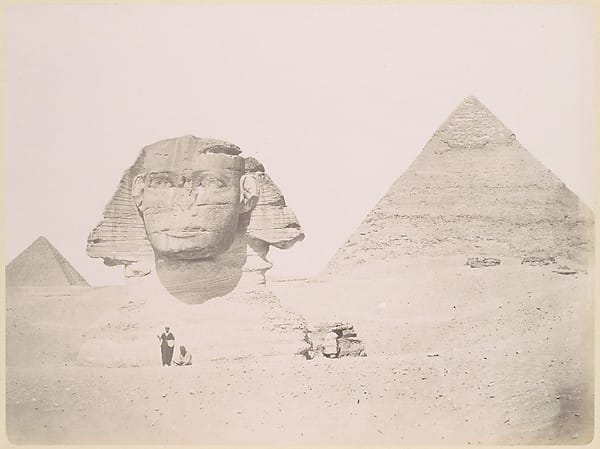
Pyramides et le Sphinx
Félix Bonfils, Pyramides et le Sphinx, 1860s-70s, printed ca. 1870. The Metropolitan Museum of Art, Gift of Daniel Wolf, in memory of Diane R. Wolf, 1976 (1976.561.2). Source: Pyramides et le Sphinx at The Metropolitan Museum of Art
With other styles
The opposite: Yokohama photography. The East Asian twin sold the same views and 'types' to visitors, but colours every print by hand in pastel washes; the Levantine print is mostly monochrome brown (some prints and later photochroms were coloured) and put the weight on monumental ruins and city panoramas.
Pairs with Carte-de-visite studio portraits. Both stand a full-length sitter against a studio backdrop and print on albumen; borrow the plain, even skylight and held pose, but let the sitter choose the clothes, unlike the studio's costume stock.
The opposite: New Topographics. Both stand back and level with everything sharp, but New Topographics withholds any opinion in a deadpan series of the ordinary built landscape; keep the Levantine picture centred on the famous monument and captioned for a buyer.
The opposite: Calotype and paper-negative photography. The calotype records ruins on soft paper negatives; the albumen-on-glass view has a sharper, glossier surface and shows every column drum.
Sources
- Maison Bonfils, Wikipedia: https://en.wikipedia.org/wiki/Maison_Bonfils (Beirut studio 1867; F. Bonfils et Cie 1878; Félix, Lydie and Adrien Bonfils; landscapes, studio portraits, posed scenes in Middle Eastern dress, staged biblical scenes, panoramas of Constantinople and Damascus; albumen prints; Architecture antique 1872, Souvenirs d'Orient 1878, Catalogue général 1907; sold to tourists as souvenirs; Lydie died in 1918, the company continued into the 1930s)
- Pascal Sébah, Wikipedia: https://en.wikipedia.org/wiki/Pascal_S%C3%A9bah (El Chark studio in Pera 1857; Cairo 1873; Sébah & Joaillier 1888; photographs for Osman Hamdi Bey's Les Costumes populaires de la Turquie en 1873; tourist trade; competitors Bonfils and the Zangaki brothers; the page warns that Pascal and his son Jean Pascal Sébah are often confused)
- Abdullah Frères, Wikipedia: https://en.wikipedia.org/wiki/Abdullah_Fr%C3%A8res (brothers took over a studio in 1858; court photographers to Sultan Abdulaziz from 1863 until the shop closed in 1899; moved to Pera 1867; Cairo branch 1886; sultans, statesmen, views of Galata)
- Femme turque en toilette de ville, Félix Bonfils, The Metropolitan Museum of Art: https://www.metmuseum.org/art/collection/search/292057 (albumen silver print from glass negative, 1870s; Open Access)
- The Temple of the Sun at Baalbec, Félix Bonfils, The Metropolitan Museum of Art: https://www.metmuseum.org/art/collection/search/262989 (albumen silver print, ca. 1870; Open Access)
- Pyramides et le Sphinx, Félix Bonfils, The Metropolitan Museum of Art: https://www.metmuseum.org/art/collection/search/261777 (albumen silver print, printed ca. 1870; Open Access)