Styles / Staged & conceptual
Contemporary levitation photography
- Key: the sun, from the camera’s left, at the side, low, hard.
Low sun: shoot near sunrise or sunset.
Schematic, not to scale: worked out from the style’s choices. No set-up of this style has been rendered yet.
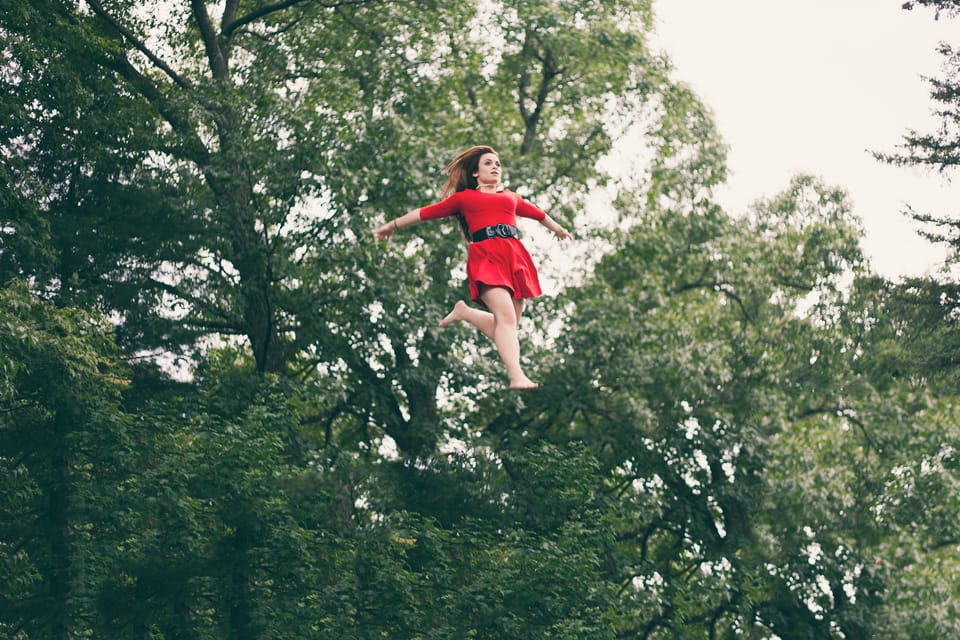
Up in the Air
Gabriela Pinto, Up in the Air, 2013 (CC BY 2.0, via Wikimedia Commons). Source: Up in the Air at Wikimedia Commons (from Flickr)

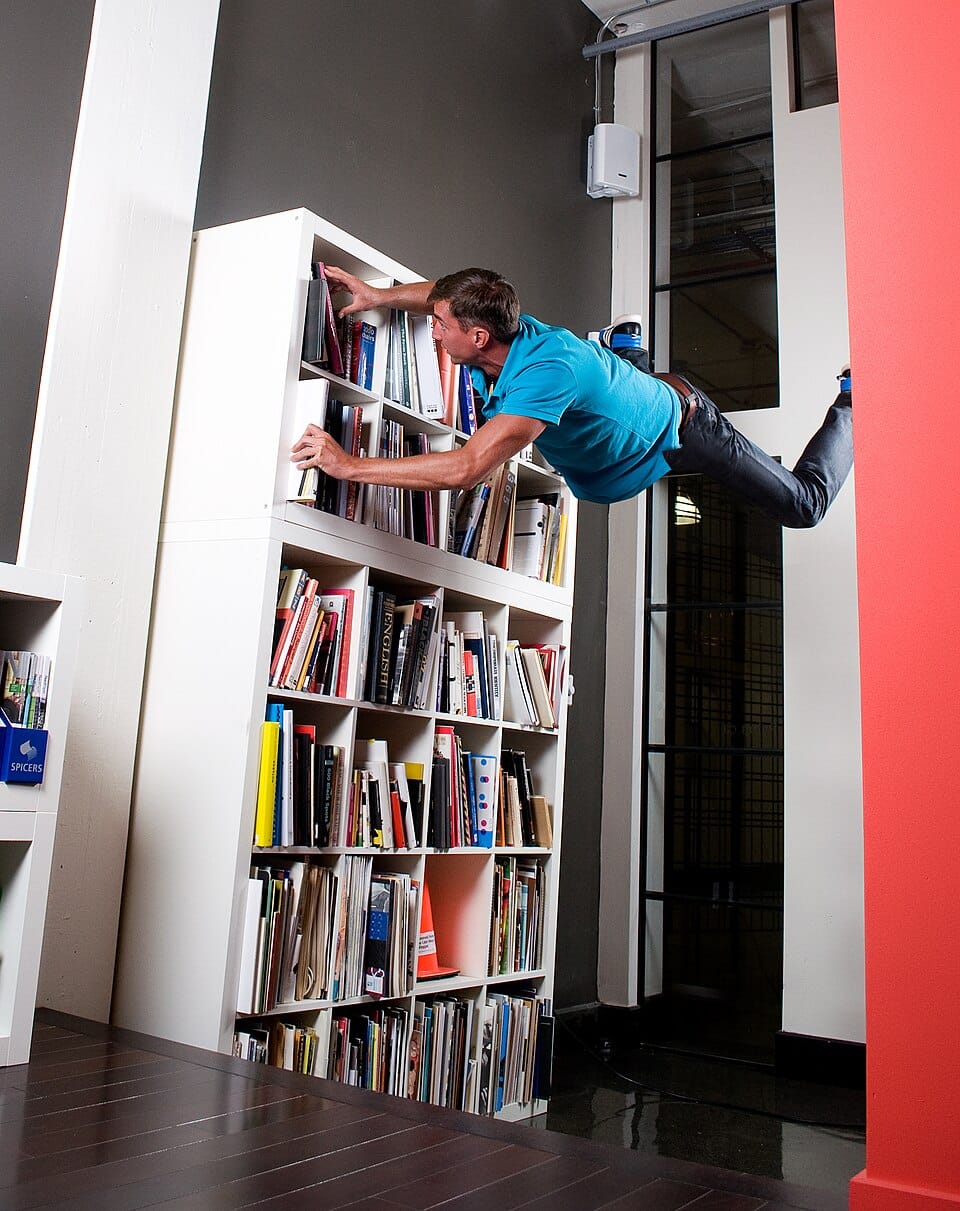
Just looking for a book
Colin Payson, Just looking for a book, 2011 (CC BY 2.0, via Wikimedia Commons). Source: Just looking for a book at Wikimedia Commons (from Flickr)

A single figure hangs in mid-air in a believable ordinary place: a street, a stair, a room, a wood. The body is slack or caught mid-fall or mid-jump, with a readable gap between feet and ground; the relaxed float is one common variant. The effect comes from a jump caught at its peak, a hidden support, or a composite of two frames; the setting stays plain and sharp so the one impossible thing reads at once. Shot as a single, often vertical, colour image.
Built mostly on one system: Body in flight. What systems are.
Shoot sheet for your kit A prompt for an image model The photographs
How the look is made
- Place the figure in a credible, sharply rendered everyday setting so that the floating is the only impossible thing.
- Leave a clear gap between the feet and the ground, with a shadow, a floor line or a step below, so the viewer can measure the lift.
- Pose the body slack or mid-fall: resting on air, diving or soaring, or a jump caught at its peak with hair and clothes flying; the relaxed float is one common variant, so choose one and commit to it.
- Make the lift by one honest method: freeze a jump at its peak with a fast shutter, hide a support you then remove, or composite two frames from a locked-off tripod.
- Keep camera and light constant between frames, shoot a clean plate of the empty place, and match shadows to the figure's new height.
- Compose for the float: leave room around the body, and place it where the eye sees it first.
Shoot sheet for your kit
Fill in your camera, lenses and lights, and the sheet says which light plays each part, what to work around and where to start on your camera. Without a kit it starts on a full-frame camera.
Light
Key: the sun, from the camera’s left, at the side, low, hard.
- Low sun: shoot near sunrise or sunset.
- Shape & form
- Shadows thrown away from what casts them (a figure’s long shadow, railings on a wall) that become shapes of their own in the composition.
How the style is lit
- Open daylight or overcast sky, identical in every frame so a composite matches.
- Window light in a room, with a reflector or bounce keeping the shadow side soft.
- A single off-camera flash to freeze a jump and light the body evenly against dim ambient.
This plan is worked out from the style’s choices, so it is drawn as a schematic. One way to get the light, not a record of how any photograph was lit.
Lens and settings
Start at
On a full-frame camera: the same depth of field and exposure as the style’s own numbers, in the same light. Then meter and adjust.
- Then
- 24–50 mm · f/5.6–f/11 · 1/2000–1/125 s · ISO 100–400 on full frame, inferred from the gear and the look. Fast shutter speeds freeze a jump at its peak; composite work can use any shutter on a tripod, with identical exposure in every frame. Numbers rest on the gear and method of the exemplars and on the Pinto and Payson EXIF data (Pinto lists camera and lens only); they vary with light. Colour tendency is mixed, from muted woodland to saturated interiors.
- White balance
- Daylight or auto balance, held identical in every frame of a composite; leave ambient light as found and keep warm or cool casts the same across figure and plate.
- Focus
- Everything sharp from the nearest stone to the horizon.
- Crop & fill
- The subject shown small within its setting, which explains it.
Direct
Ask the figure to go slack and look as if resting on air (one knee bent, a hand trailing, head turned away or eyes down, hair and clothes hanging or lifting), or to fall, dive or soar with limbs and clothes flying; eyes to camera are acceptable. The relaxed float is one common variant. For a jump, rehearse many takes and choose the frame at the peak; for a rig, brief the support person and plan the removal.
- Body position
- Feet off the ground: leaping, jumping or dancing at full stretch.
- Line & energy
- Loose and unforced, as people stand and sit when they forget the camera, whether caught or coaxed by prompts.
- The set-up
- A scene staged and directed like a film still or a painting.
Style the set
Dress the figure in ordinary clothes or one clear colour, such as a red dress against green, so the body separates from the setting. Keep the place as found and uncluttered, with floor lines, stairs or shelves that give a scale for the gap.
- Clothes
- What people happened to be wearing; nothing chosen for the picture.
Finish
- Post-production
- Several photographs combined into one picture.
- Shown as
- Each picture stands on its own.
Stay away from motion blur, document & record, testimony & advocacy, found & vernacular imagery, visible grain, low-key & chiaroscuro and soft focus & diffusion.
Before you shoot it
The pictures often show real people, often the photographer, in apparent danger. Never copy the support methods of the cable and rigged performances: do not suspend anyone from heights, cranes, roofs or unqualified rigs, and do not jump from ledges; use a low jump, a composite or a trained rigging professional. Li Wei and Natsumi Hayashi are living artists with signature images: credit and commission them, do not imitate individual pictures, and do not pass a stunt or composite off as documentary or news. Get consent from anyone shown and respect their privacy when posting. The specimen photographs show identifiable private individuals posted under CC BY: do not use them to imply endorsement.
A prompt for an image model
No prompt for this style
Behind its pictures: real people shown in apparent danger.
Its caution asks to credit and commission the living artists rather than imitate them.
The pictures often show real people, often the photographer, in apparent danger. Never copy the support methods of the cable and rigged performances: do not suspend anyone from heights, cranes, roofs or unqualified rigs, and do not jump from ledges; use a low jump, a composite or a trained rigging professional. Get consent from anyone shown and respect their privacy when posting. Do not generate images of real people in this style. The specimen photographs show identifiable private individuals posted under CC BY: do not use them to imply endorsement.
Work with photographers of this tradition, or take only its light and lens (the shoot sheet above) without its people, places or rituals.
Where to see it
From open collections, shown whole with their credits. Later photographs are linked, not shown, while they are in copyright.
With other styles
Pairs with Surrealist photography. Borrow its sense of the uncanny, but replace dark close-ups with a plain, sharp, daylit place so the single impossible gesture reads clearly.
Pairs with Staged tableau photography. Plan the scene like a tableau, with cast, location and light, then reduce the story to one suspended body.
The opposite: Diaristic snapshot photography. Where the snapshot accepts what happens, levitation plans every frame; use its everyday settings but not its chance. Hayashi's project began as a daily diary on her blog, so the two share a habit of daily self-portraiture.