Styles / Vernacular & studio
Lomographic lo-fi snapshot aesthetic
- Key: the sun, about 45° to the camera’s left, high, hard.
Key high: about 30–45° above eye level, angled down.
Schematic, not to scale: worked out from the style’s choices. No set-up of this style has been rendered yet.
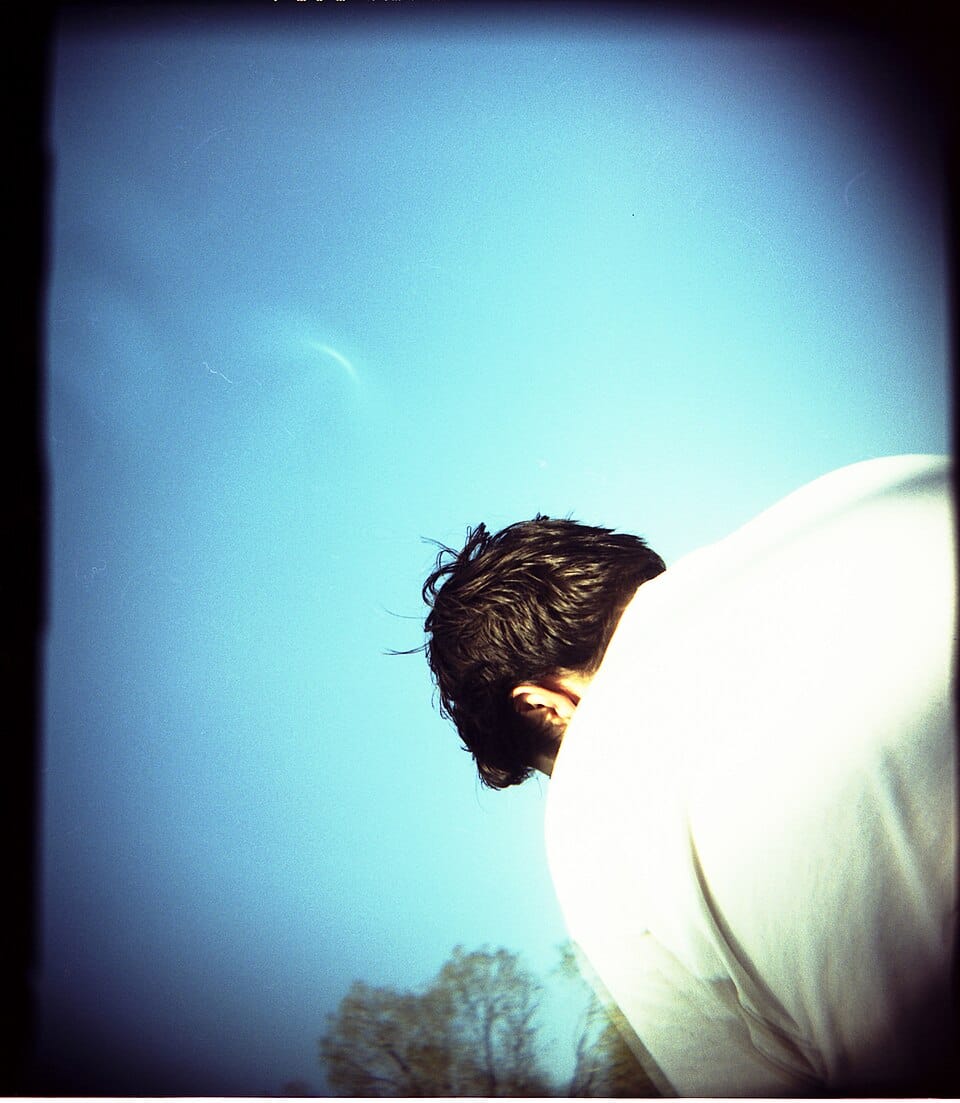
Holga sample photograph
Clngre, Holga sample, Wikimedia Commons, CC BY-SA 3.0. Source: Holga sample photograph at Wikimedia Commons

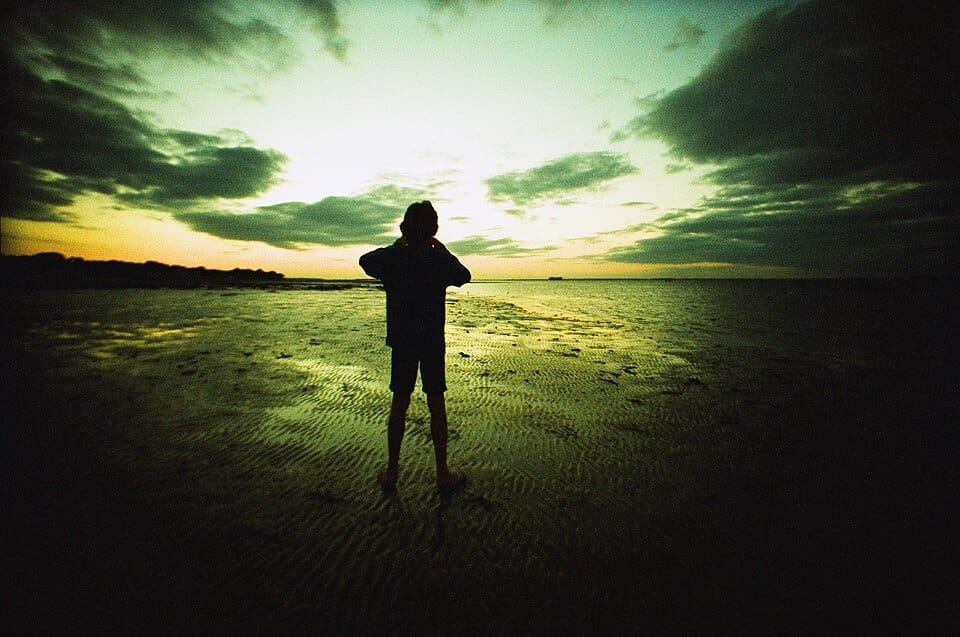
Beach figure, cross processed
Nick Page, Beach figure Cross Processed, Wikimedia Commons, CC BY 2.0. Source: Beach figure, cross processed at Wikimedia Commons (from Flickr)

Fast, unplanned snapshots made with cheap or quirky film cameras and then celebrated for their faults: dark vignetted corners, light leaks, soft plastic lenses, double exposures and saturated, colour-shifted cross-processed film. Cameras are held low, at arm's length or without looking through the finder; the surprise of the result is the point.
Built mostly on one system: Rough and unseen. What systems are.
Shoot sheet for your kit A prompt for an image model The photographs
How the look is made
- Shoot from the hip and without composing: hold the camera low, at arm's length or pointed at the sky, and accept an accidental tilt or crop.
- Choose a camera with faults, such as a plastic lens or a wide fixed-focus lens, and let corner darkening, soft edges and light leaks stay in the frame.
- Move in close or use the widest lens so that the subject fills the centre and the surroundings fall away into dark corners.
- Process the film against its design: develop slide film in negative chemistry, or push and pull it, so that colours shift to greens, magentas and blues with high contrast.
- Expose in strong, simple light and keep colour loud; let shadows block up and skies and highlights burn.
- Shoot freely and edit lightly, doubling frames on purpose or by accident, and let the faults of the camera and film stay in the print.
Shoot sheet for your kit
Fill in your camera, lenses and lights, and the sheet says which light plays each part, what to work around and where to start on your camera. Without a kit it starts on a full-frame camera.
Light
Key: the sun, about 45° to the camera’s left, high, hard.
- Key high: about 30–45° above eye level, angled down.
- Shadow depth
- Dark shadows that still hold some detail (a high lighting ratio, about 4:1 to 8:1: the shadow side two to three stops darker).
How the style is lit
- Strong direct daylight, with the sun in or near the frame, so skies burn and corners and shadows block up.
- Low sun or sunset behind a figure, which turns it into a silhouette against saturated colour.
- Occasional on-camera flash from other compacts at night or indoors (the LC-A has none), with the background dropping to dark and colour-spilled lamps.
This plan is worked out from the style’s choices, so it is drawn as a schematic. One way to get the light, not a record of how any photograph was lit.
Lens and settings
Start at
On a full-frame camera: the same depth of field and exposure as the style’s own numbers, in the same light. Then meter and adjust.
- Then
- 17–35 mm · f/2.8–f/16 · 1/500–1/33 s · ISO 100–400 on full frame, inferred from the gear and the look. Worked out from the cameras the look grew from: a wide compact lens for the LC-A and a roughly 60 mm fixed plastic lens on 6x6 (about 33 mm equivalent) for the Holga, which Wikipedia gives as f/13 at about 1/100 s. Compacts expose automatically, so the numbers vary widely and toy cameras give almost no control. The stated f-numbers are for 35 mm film. The range runs to 17 mm for the Lomo LC-Wide used in one specimen. The LC-A has no flash; flash use comes from other compacts and is minor. Aperture and shutter ranges are inferred.
- White balance
- Daylight film, uncorrected; cross-processing shifts colour towards green or magenta, and lamps stay warm or green against cooler daylight.
- Focal length
- A wide view; near things loom and lines stretch towards the edges.
- Focus
- A soft glow around highlights; edges never quite sharp.
- Rendering
- The corners fall into darkness.
- Angle
- The horizon deliberately off level (Dutch angle).
- Distance
- Within arm’s reach: faces, hands and details fill the frame.
- The photographer
- Shot from the hip, hidden or unnoticed.
- Balance
- The subject in the middle, the frame balanced around it.
- Instant
- A casual, unplanned instant, taken quickly.
- Many times
- Several exposures laid over each other in one frame.
Direct
People are rarely directed. They are caught mid-gesture, turned away, silhouetted, cropped at the edge, or shot from below with a head tilted out of the frame; a friend might hold still for a second at arm's length, and a grin to the lens is usual only when the photographer asks for one. Most frames have no clear person at all.
- The moment
- Ordinary photographs by and for ordinary people, or images that look like them. People photographed as they are, unaware or unconcerned.
Style the set
Nothing is styled. Subjects wear what they have on, and places, tables, skies and objects are shot as found, in the surroundings the photographer is passing through. Colour comes from the film and process rather than from the set.
- Clothes
- What people happened to be wearing; nothing chosen for the picture.
- How much is styled
- Nothing dressed, made up, moved or added for the picture.
Finish
- Colour
- Shifted, clashing colours from mismatched chemistry or imitations of it. Strong, dense colours.
- Film
- A small handheld camera: quick, mobile, grainy when pushed. Printed colour negatives: soft, forgiving colour. Transparencies: dense, saturated colour.
- Digital & other
- Cheap cameras and their flaws: leaks, soft corners, built-in flash.
- Texture
- Film grain or noise you can see at normal size.
Stay away from hyper-detailed, heavy retouching, filter & preset look, hdr & tone-mapped, corrected perspective, clean digital capture, neutral, true colour and constructed set & miniature.
Before you shoot it
Snapshots often show real people, including strangers and children, who did not agree to be photographed or shared; the shoot-from-the-hip habit makes consent easy to skip, so ask, and avoid posting identifiable strangers. The movement is tied to a commercial brand, whose cameras and name are trademarks; this entry covers the look, not the product, and no living photographer's signature should be copied.
A prompt for an image model
A ready prompt that describes this look to an image model: where the lights stand, the lens, the framing and the colour. It starts on the style’s own choices; change any of them and the prompt and the notes follow.
The prompt
Notes on this prompt
- How the style uses it: choose a camera with faults, such as a plastic lens or a wide fixed-focus lens, and let corner darkening, soft edges and light leaks stay in the frame. Image models put the light in the wrong place more often than anything else, so the prompt says where each light stands: which side of the picture, and how high. Keep to one light pattern per prompt, or the model splits the difference.
- Soft focus is a glow round the highlights, not a blurred picture. If it comes back blurred, ask for sharp detail under the glow.
- Image models smooth grain away; ask for it to be visible at full size.
The model makes a new picture, not a photograph of anything that happened. Label it as AI-generated, and don’t pass it off as the style’s history or as a real person.
Photographs that define it
From open collections, shown whole with their credits. Later photographs are linked, not shown, while they are in copyright.
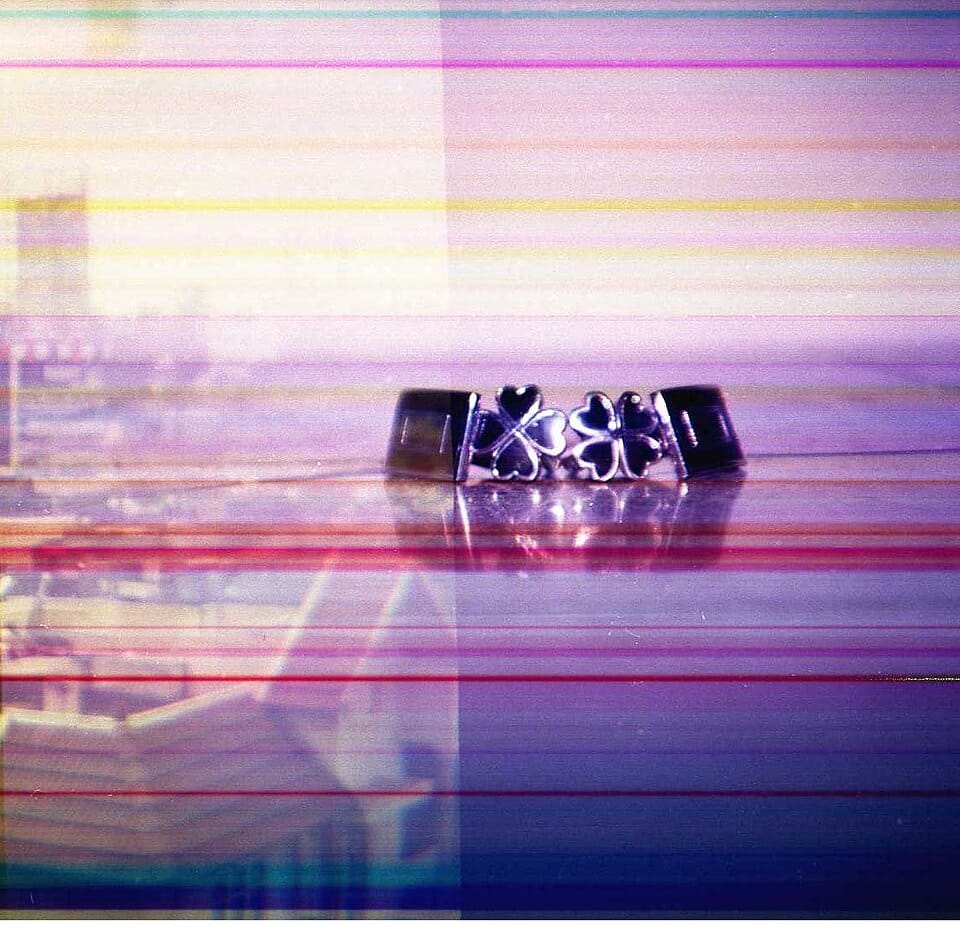
Cuff links shot with Diana F+
Veera.sj, Cuff links shot with Diana F+, Wikimedia Commons, CC BY-SA 3.0. Source: Cuff links shot with Diana F+ at Wikimedia Commons

With other styles
Pairs with Diaristic snapshot photography. Borrow the habit of shooting everything around you and sequencing by feeling, but replace the intimate subject with a playful treatment of the process.
The opposite: Everyday colour-negative film revival. Where the revival aims for a natural everyday negative, push colour, corners and leaks past naturalism and treat them as the picture.
The opposite: VSCO film-preset look. Get the effects in the exposure and chemistry, which do not repeat, instead of applying a matte preset that does.
The opposite: Y2K digicam and flash revival. Both use direct flash and imperfection, but this look comes from analogue lenses and chemistry, not small-sensor noise and JPEG artefacts.
Sources
- Wikipedia, Lomography: https://en.wikipedia.org/wiki/Lomography (LOMO LC-A, 1992 founding of the Lomographic Society International by Viennese students, 1995 distribution, end of original LC-A production in 2005; secondary source, company history pages returned 403).
- The Darkroom, What is Lomography: https://thedarkroom.com/what-is-lomography/ (light leaks, lens misalignment, cross-processing, push and pull processing, spontaneous point-and-shoot, reaction against formal photography).
- Wikipedia, Holga: https://en.wikipedia.org/wiki/Holga (designed 1982, 120 film, 60 mm plastic meniscus lens, about f/13 and 1/100 s).
- Wikipedia, Cross processing: https://en.wikipedia.org/wiki/Cross_processing (slide film in C-41 chemistry and the reverse; unnatural colour and high contrast that vary by film and chemistry).
- Wikipedia, Diana (camera): https://en.wikipedia.org/wiki/Diana_(camera) (plastic-bodied 120 toy camera, plastic meniscus lens, vignetting, light leaks, multiple exposure, Diana F+ revived by Lomography).
- Wikimedia Commons file pages for the three specimens, checked for licence and described camera: https://commons.wikimedia.org/wiki/File:Holga_sample.jpg, https://commons.wikimedia.org/wiki/File:Beach_figure_Cross_Processed_-_Flickr_-_Nick_Page_Photos.jpg, https://commons.wikimedia.org/wiki/File:Cuff_links_shot_with_Diana_F%2B.jpg

