Styles / Vernacular & studio
Māori tūpuna portrait photography
- Key: the open sky, all around and above, soft.
Schematic, not to scale: worked out from the style’s choices. No set-up of this style has been rendered yet.
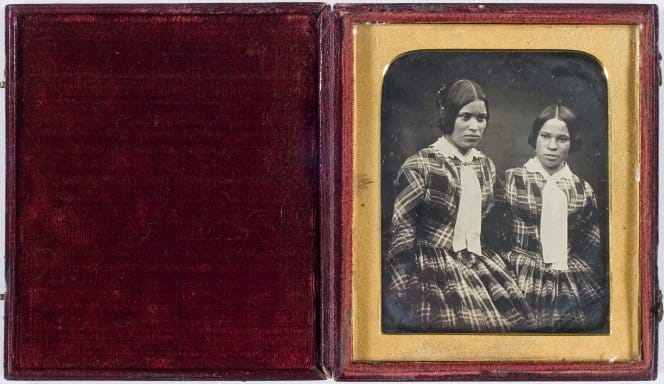
Caroline and Sarah Barrett
Lawson Insley, Caroline and Sarah Barrett, 1852-3, daguerreotype; Wikimedia Commons, public domain in New Zealand and the United States. Source: Caroline and Sarah Barrett at Wikimedia Commons (image from the National Library of New Zealand's marae photographs collection)

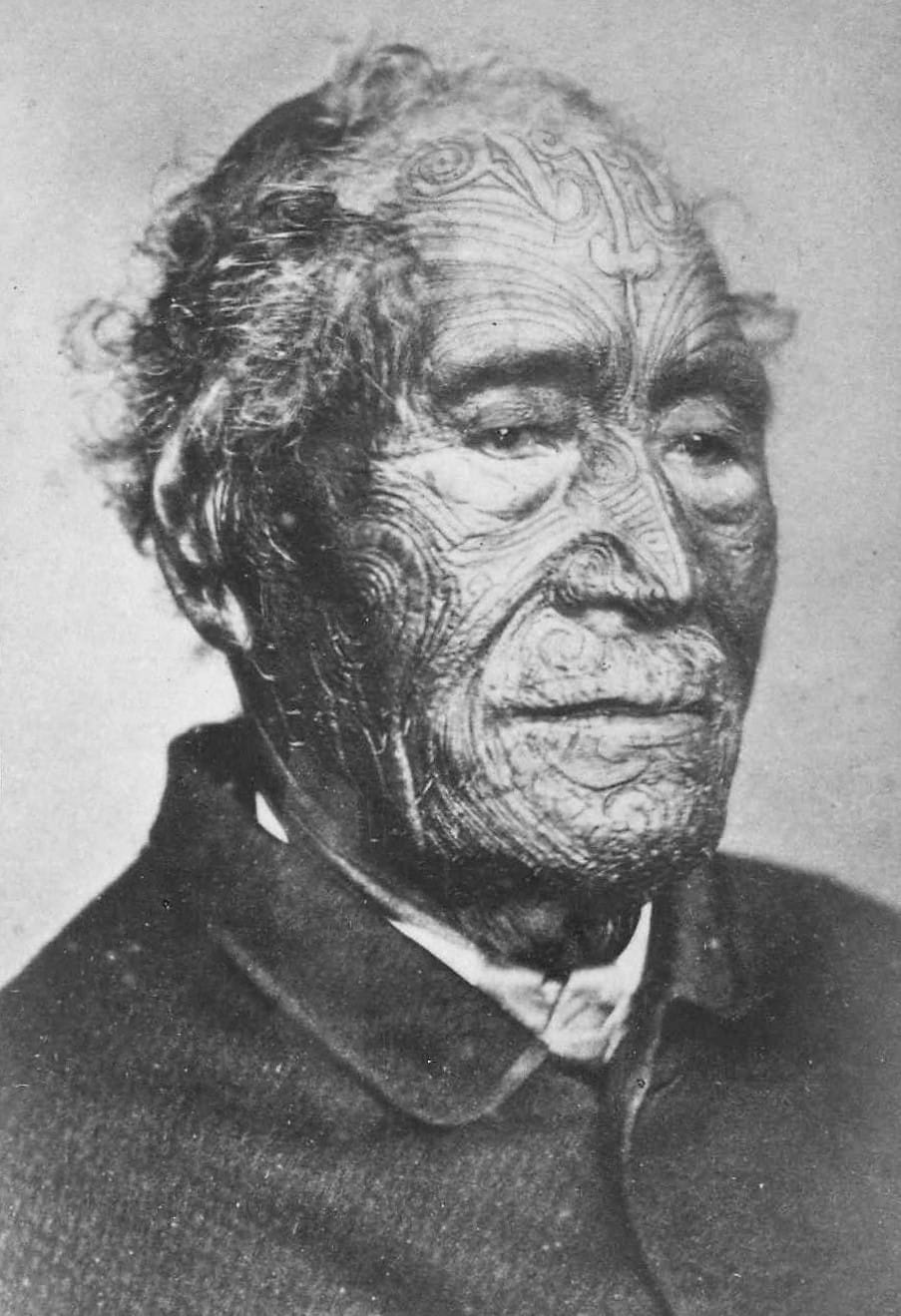
Tāmati Wāka Nene
Elizabeth Pulman, Tāmati Wāka Nene, 1870s; Alexander Turnbull Library PA2-1357, via Wikimedia Commons, public domain in New Zealand (may not be in countries with longer terms). Source: Tāmati Wāka Nene at Wikimedia Commons (Alexander Turnbull Library PA2-1357)

Studio portraits of Māori kept as ancestors: a single sitter or a pair, still and near square to the lens in best clothes or cloak, made in a European-style studio, then enlarged, framed and hung in a meeting house (retouching is inferred, not sourced). The picture is treated as the person, so its use defines it. Lineage is studio portraiture from the daguerreotype on; carte and later prints are an influence.
Built mostly on one system: Painted studio. What systems are.
Shoot sheet for your kit A prompt for an image model The photographs
How the look is made
- Seat or stand the sitter square to the camera, still, with a steady direct gaze or a composed look aside; the face is the whole subject.
- Let the sitter choose how they appear: best European dress, a woven cloak, greenstone and feather ornament, and moko left plain and unretouched in meaning.
- Light the face evenly from a window or skylight and keep a plain, uncluttered ground so the likeness reads from across a room.
- Make the negative for enlargement: a sharp, finely recorded face that will hold when printed large and worked over by hand.
- Print and finish for hanging: enlarge, frame under glass and make it fit the wall of the whare among the carvings; retouching or painting over the print is inferred from studio practice and one documented moko enhancement, not sourced for tūpuna pictures.
Shoot sheet for your kit
Fill in your camera, lenses and lights, and the sheet says which light plays each part, what to work around and where to start on your camera. Without a kit it starts on a full-frame camera.
Light
Key: the open sky, all around and above, soft.
How the style is lit
- North or side window or skylight in a studio, a pale reflector or wall opposite so the face is open and the moko readable.
- Soft overcast daylight in the open air, in front of a wall or a carved house, for pictures made on the marae.
This plan is worked out from the style’s choices, so it is drawn as a schematic. One way to get the light, not a record of how any photograph was lit.
Lens and settings
Start at
On a full-frame camera: the same depth of field and exposure as the style’s own numbers, in the same light. Then meter and adjust.
- The style’s f/6.6 on Quarter plate gives about the depth of field of f/2.1 on full frame.
- Then
- 45–85 mm · f/4–f/11 · 1–10 s · ISO 0.5–2 on Quarter plate, inferred from the gear and the look. Inferred from the processes: a plate camera with a portrait lens, a still sitter in studio daylight, daguerreotype or wet collodion at about ISO 1 needing seconds. Later gelatin plates were much faster. Enlargements were made from the negative. Later gelatin plates were much faster; the vocabulary has no gelatin trait, so no later-print process trait is set.
- Angle
- The camera at the height of a standing person or of the subject.
- Balance
- The subject faces the lens; planes run parallel to the picture.
Direct
Seat the sitter upright or stand them square to the lens, still for the exposure, hands resting or holding a cloak, eyes to the camera or settled just aside, and a composed unsmiling face. Let the sitter or the whānau decide dress, ornament and who sits beside them; do not direct a gesture or a story.
- Body position
- On a chair or stool, back straight, hands and feet placed: the formal sitting.
- Turn to the camera
- Shoulders and hips face the lens straight on: direct, symmetrical, sometimes confrontational.
- Head & gaze
- Looking straight into the camera, so the subject meets the viewer’s eye.
- Line & energy
- Rigid and motionless, sometimes braced against a head rest or gripping a chair: held for a long exposure or a solemn occasion.
- Expression
- Unsmiling, composed and blank: the face gives nothing away.
- With the sitter
- The sitter arranged and still, facing the camera.
Style the set
The sitter's own best clothes: European dress or suit, or a woven cloak with feather or greenstone ornament, moko left as it is. A plain, near-empty studio ground, a chair or a draped table at most, and no props that tell a story about the sitter.
- Clothes
- The wearers’ own festive, religious or wedding clothes: saris and lehengas, boubous, robes, kimono. Best clothes, jewellery and accessories put on for the studio or the occasion.
Finish
- Shown as
- Each picture stands on its own.
- Shown in
- Large prints on the wall, like paintings.
Stay away from candid & unobserved, snapshot, laughing, tilted angle, direct on-camera flash, sell & persuade, glamour & aspiration, unstyled, as found, shallow depth of field, leaning against something and environmental.
Before you shoot it
These photographs are tūpuna: for many Māori, an image of a person is the person, and photographs of the dead are addressed, carried and cared for as ancestors. Most surviving makers were Pākehā studios, and the pictures have been traded at auction away from the iwi and hapū who hold them. Show real photographs only with attribution, the sitter's name where known, and the consent of the descendants; look for Māori-authored guidance before using or writing about them.
A prompt for an image model
No prompt for this style
Behind its pictures: tūpuna portraits are ancestors to their descendants.
Caution forbids generated imitations, moko, cloaks or named iwi.
These photographs are tūpuna: for many Māori, an image of a person is the person, and photographs of the dead are addressed, carried and cared for as ancestors. Most surviving makers were Pākehā studios, and the pictures have been traded at auction away from the iwi and hapū who hold them. Do not generate pictures that imitate them, never present a generated image as a tūpuna portrait or as anyone's ancestor, and do not generate moko, cloaks or a named iwi. Show real photographs only with attribution, the sitter's name where known, and the consent of the descendants; look for Māori-authored guidance before using or writing about them.
Work with photographers of this tradition, or take only its light and lens (the shoot sheet above) without its people, places or rituals.
Where to see it
From open collections, shown whole with their credits. Later photographs are linked, not shown, while they are in copyright.
With other styles
Pairs with Carte-de-visite studio portraits. The carte-era studio print is an influence: most surviving portraits were made as such prints, but a tūpuna portrait is enlarged, framed and hung as one likeness whose use gives it standing, where the carte was a small card swapped in albums.
Pairs with Daguerreotype portraiture. Both start from a still, sharp, close likeness; the daguerreotype is the origin plate of Māori portraiture and the parent practice, while the hung portrait is a later print.
The opposite: Indian painted photographs. Both are studio portraits that may be finished by hand; the Indian kind is documented as paint over costume and colour, while hand finishing of tūpuna portraits is inferred.
Sources
- How much would you pay for a photo of our ancestors?, The Spinoff (29 November 2020): https://thespinoff.co.nz/atea/29-11-2020/how-much-would-you-pay-for-a-photo-of-our-ancestors (portraits of the dead on wharenui walls, photographs addressed as the person at tangihanga, 1890s Māori commissioning portraits, Ngarino Ellis and Ngahuia Harrison on images as ancestors, the 2020 Webb's sale including a photograph of a Sam Stuart painting of Tāmati Wāka Nene)
- Photography in New Zealand, Wikipedia: https://en.wikipedia.org/wiki/Photography_in_New_Zealand (Lawson Insley's 1853 portrait of Kararaina and Hera Barrett; Elizabeth Pulman; Katarina Hansard and Cromwell Shepherd among the first Māori photographers)
- Ngā Taonga Tūturu: Treasured Māori Portraits, Auckland Art Gallery: https://www.aucklandartgallery.com/whats-on/exhibition/nga-taonga-tuturu-treasured-maori-portraits (portraits of tūpuna, painted and photographic, taken up from the mid-19th century into whare tūpuna; the show itself is whakairo and paintings)
- More than a photograph, Waatea News (21 June 2026): https://waateanews.com/2026/06/21/more-than-a-photograph-how-maori-wove-images-of-the-deceased-into-tangihanga/ (photograph of the deceased beside the coffin or hung in the wharenui; galleries of tūpuna on marae walls)
- Tuterei Karewa, Wikipedia: https://en.wikipedia.org/wiki/Tuterei_Karewa (photographer Arthur James Iles, c. 1890-1920, moko enhanced by the photographer after exposure)
- File: Caroline and Sarah Barrett 1852 or 3.jpg, Wikimedia Commons: https://commons.wikimedia.org/wiki/File:Caroline_and_Sarah_Barrett_1852_or_3.jpg (Lawson Insley daguerreotype in a case; public domain in New Zealand)
- Hemi Pomare, Wikipedia: https://en.wikipedia.org/wiki/Hemi_Pomare (1846 hand-tinted daguerreotype by Antoine Claudet, the oldest known photograph of a Māori person)
- File: TamatiWakaNene1870s.jpg, Wikimedia Commons: https://commons.wikimedia.org/wiki/File:TamatiWakaNene1870s.jpg (Elizabeth Pulman, 1870s, Alexander Turnbull Library PA2-1357; public domain in New Zealand)