Styles / Digital & social
Milky Way nightscape photography
- Key: a lamp, sign or screen, from behind the subject, soft.
Silhouette: expose for the bright background and leave the subject unlit. No reflector or fill: let the shadows fall to black.
Schematic, not to scale: worked out from the style’s choices. No set-up of this style has been rendered yet.
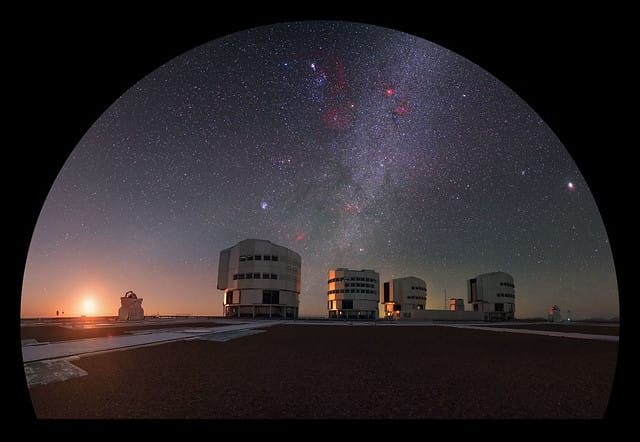
The Moon sets over Paranal
P. Horálek/ESO, The Moon sets over Paranal, ESO Flickr record dated 27 April 2015. European Southern Observatory. CC BY 2.0 (https://creativecommons.org/licenses/by/2.0/). Source: The Moon sets over Paranal at European Southern Observatory's official Flickr account
Compose the Milky Way together with a terrestrial foreground: a tree, ridge, village or observatory gives the star field scale and a place. Fast wide lenses, a steady support and long digital exposures reveal dust lanes and star colour above dark land. Stars remain points rather than trails. Single captures, tracked exposures and disclosed panoramas or foreground blends coexist; this is not telescope-only deep-sky imaging.
Built mostly on one system: Cinematic colour. What systems are.
Shoot sheet for your kit A prompt for an image model The photographs
How the look is made
- Compose land and sky together: give a ridge, tree or building enough space to locate the star field, and let the Milky Way carry the upper frame.
- Choose a clear, dark location and plan the galactic band's position against the foreground rather than pointing at an empty patch of sky.
- Use a fast wide lens on firm support, focus carefully on a bright star and expose long enough to reveal the band without turning the stars into trails. For a tracked sky exposure, either accept and disclose terrestrial blur or disclose a separately exposed foreground.
- Keep the land darker than the sky; accept a silhouette or limited shadow detail rather than making the foreground look sunlit.
- Use a vertical frame for a rising band or an explicitly disclosed stitched panorama for a broad sweep; preserve the relationship between the sky and the place.
- Distinguish single exposures, tracked frames and combined exposures in the caption; never silently transplant a sky, enlarge the Moon or claim an invented celestial alignment.
Shoot sheet for your kit
Fill in your camera, lenses and lights, and the sheet says which light plays each part, what to work around and where to start on your camera. Without a kit it starts on a full-frame camera.
Light
Key: a lamp, sign or screen, from behind the subject, soft.
- Silhouette: expose for the bright background and leave the subject unlit.
- No reflector or fill: let the shadows fall to black.
- Shadow depth
- Dark shadows that still hold some detail (a high lighting ratio, about 4:1 to 8:1: the shadow side two to three stops darker). Shadows with no fill at all that fall to pure black with no detail, so parts of the subject disappear.
How the style is lit
- A dark, clear night with the Moon absent or low: available sky light above an unlit ridge, tree or building; leave the foreground as a silhouette or in deep shadow.
- A setting Moon low on one side lights a little of the foreground while the star field remains visible overhead; retain the warm horizon against the cooler sky.
- For the optional light-painted variant, sweep a small continuous lamp gently across a nearby tree or rock during the exposure; keep it subordinate to the sky and disclose the added light.
This plan is worked out from the style’s choices, so it is drawn as a schematic. One way to get the light, not a record of how any photograph was lit.
Lens and settings
Start at
On a full-frame camera: the same depth of field and exposure as the style’s own numbers, in the same light. Then meter and adjust.
- 15 s: on a tripod.
- Then
- 14 mm · f/2.8 · 15–25 s · ISO 2500–5000 on full frame, documented. A documented untracked starting range, not a rule for every specimen: the cited first-hand teaching article specifies a 14–24 mm zoom used at 14 mm, f/2.8, 15–25 s and examples at ISO 2500–5000. Tracked sky captures and separately exposed foregrounds can run for minutes; their exposure times must not be used on a stationary camera as though the stars would stay sharp.
- White balance
- Start around 4000 K and adjust in RAW; keep warm horizon light distinct from the cooler sky without forcing a saturated blue or magenta cast.
- Focal length
- A wide view; near things loom and lines stretch towards the edges.
- Angle
- Looking up: the subject towers.
- Distance
- Standing well back; people are small.
- Balance
- Tilted lines and oblique movement drive the picture.
- Depth
- A strong horizon splits the frame into bands. Separate events in the foreground, middle ground and background.
- Duration
- Seconds or more: water turns to mist, lights become trails. An unmoving scene, exposed slowly and carefully.
Direct
Usually leave figures out or small against the land and sky. For the optional human-scale silhouette, ask an adult participant to stand upright and hold still through the exposure, without letting the figure replace the Milky Way as the subject; never manufacture a named person or a documentary encounter.
- Without a pose
- No people at all, or people so small or far off that their pose does not read (hands alone are Hands alone).
Style the set
Choose an existing ridge, tree, village edge or observatory without moving natural features or constructing a set. Staging is occasional: direct an optional human-scale silhouette to hold still or deliberately illuminate a foreground feature in the light-painted variant; neither is a defining arrangement of the land.
- Set & props
- A real place picked for its look as the setting for a shoot, not the subjects’ own: a street, a field, a palace, a hotel room.
- How much is styled
- Nothing dressed, made up, moved or added for the picture.
Finish
- Colour
- White balanced to the light, so whites stay white and skin, food and products keep their real colour, with no overall cast.
- Digital & other
- A modern digital camera: clean, detailed, neutral.
- Texture
- Smooth tones with no visible grain.
- Shown as
- Each picture stands on its own.
- Frame
- A very wide frame.
Stay away from snapshot, soft focus & diffusion, high-key, portrait and inverted tones (negative).
Before you shoot it
TWAN does not ban every composite: it excludes combinations from different places or lenses and permits some fully explained multi-exposure work. Do not treat that documentary standard as permission to transplant skies. Respect access and cultural protocols at chosen sites and avoid disturbing other observers or wildlife with added light; no sacred or ceremonial site is required by this style.
A prompt for an image model
No prompt for this style
Behind its pictures: Earth-and-sky photographs can be astronomical records.
A generated sky or alignment would pass as documentary evidence of a real place and date.
The exemplars are the work of living photographers: credit them, do not copy their compositions or use their names as generation instructions. Nightscapes can be astronomical records: disclose tracking, stitching, stacking, foreground lighting and exposure blending, and never pass an invented sky, alignment or generated image off as evidence from a real place or date. TWAN does not ban every composite: it excludes combinations from different places or lenses and permits some fully explained multi-exposure work. Do not treat that documentary standard as permission to transplant skies. Respect access and cultural protocols at chosen sites and avoid disturbing other observers or wildlife with added light; no sacred or ceremonial site is required by this style.
Work with photographers of this tradition, or take only its light and lens (the shoot sheet above) without its people, places or rituals.
Where to see it
From open collections, shown whole with their credits. Later photographs are linked, not shown, while they are in copyright.
In copyright, so linked
- Winter Milky Way , Babak Tafreshi, 2010, Oct 01. The World at Night (TWAN).
- The planet, the galaxy and the laser , Yuri Beletsky, 21 July 2007. European Southern Observatory (ESO), caption preserved by Wikimedia Commons.
With other styles
The opposite: Straight photography. Keep its care for a legible landscape, but replace stopped-down daylight and monochrome with a fast wide lens, a dark foreground and star-colour exposures; do not call a disclosed composite a straight single capture.
The opposite: New Topographics. A distant building can anchor either picture, but choose between an ordinary built landscape in plain daylight and a sky-led nocturnal spectacle rather than treating their empty land as the same look.
Sources
- The World at Night, About Us: https://twanight.org/about/ (first-party chronology: Tehran/Los Angeles proposal in December 2006, launch 25 December 2007; shared Earth-and-sky approach and documentary boundaries; panoramas and some disclosed multi-exposure composites are allowed, unlike the scout's blanket assertion).
- Nikon Canada, How to Photograph the Milky Way, featuring Diana Robinson and Tony Krup: https://en.nikon.ca/learn-and-explore/c/tips-and-techniques/how-to-photograph-the-milky-way (first-hand methods and individually captioned photographs: fast wide lenses, tripod, careful star focus, 15–25 s sky exposures, f/2.8, ISO 2500–5000, 4000 K starting balance, separate foreground exposures and optional lamp lightpainting).
- European Southern Observatory via Wikimedia Commons, The planet, the galaxy and the laser, eso0733a: https://commons.wikimedia.org/wiki/File:The_planet,_the_galaxy_and_the_laser_(eso0733a).tiff (file metadata and underlying wikitext checked through the Commons API: ESO caption credits Yuri Beletsky and gives 21 July 2007, Paranal, a five-minute exposure with star tracking and blurred telescopes. The file uses the ESO licence template, but direct ESO object and copyright pages returned 502/503; retain link-only pending primary licence verification rather than assume that template establishes permission).
- European Southern Observatory's official Flickr account, The Moon sets over Paranal: https://www.flickr.com/photos/esoastronomy/17280412676/ (Flickr oEmbed explicitly returns author European Southern Observatory, this exact photograph and CC BY 2.0 with licence URL https://creativecommons.org/licenses/by/2.0/; the matching Commons record https://commons.wikimedia.org/wiki/File:The_Moon_sets_over_Paranal_(17280412676).jpg preserves P. Horálek/ESO credit and the 27 April 2015 record date. No capture date or settings asserted).
- TWAN, Winter Milky Way: https://twanight.org/gallery/winter-milky-way/ (object record checked directly: Babak Tafreshi, Alborz Mountains, Iran; displayed date 2010, Oct 01; exact-file copyright retained, link-only).
- TWAN, Darkness during a Total Lunar Eclipse: https://twanight.org/gallery/darkness-during-a-total-lunar-eclipse/ (first-party object record: Oshin Zakarian, Alborz Mountains, Iran, 15 June 2011; expressly identifies a silhouette self-portrait beneath the Milky Way. Evidence that a human-scale figure is an optional variant, not excluded from the broad idiom).
- TWAN, How to Submit Images: https://twanight.org/submit/ (first-party natural-colour guidance favours a natural-looking pale-yellow Milky Way over artificially blue, purple, red or green treatments. Supports neutral colour as characteristic and a global cool cast as only occasional; this is TWAN's documentary standard, not a claim that every nightscape follows it).