Styles / Street & snapshot
Paparazzi photography
- Key: a flash on the camera, from the camera, hard.
- Lamp in the scene: a lamp, sign or screen, from the camera’s left, at the side, hard.
Schematic, not to scale: worked out from the style’s choices. No set-up of this style has been rendered yet.
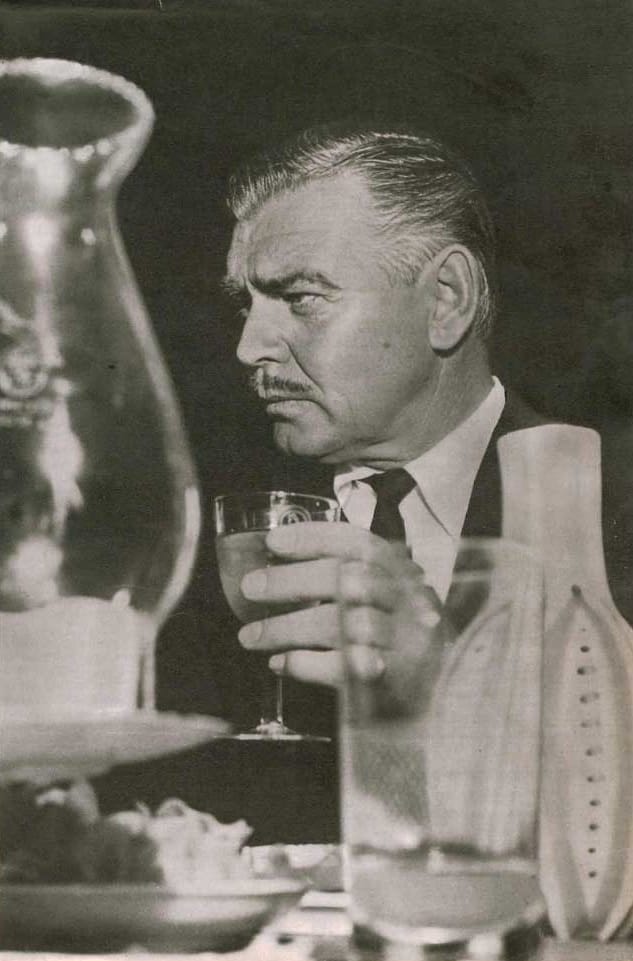
Clark Gable dining in a restaurant in Rome
Tazio Secchiaroli, Clark Gable dinner in Rome, 1959, from La fiera del cinema no. 1 (Wikimedia Commons; public domain tag under Italy's 20-year rule for simple photographs, which may not hold in countries without that rule). Source: Clark Gable dining in a restaurant in Rome at Wikimedia Commons, from La fiera del cinema no. 1, September 1959

Famous people photographed in public without their consent: caught at a restaurant table, on a pavement, outside a premiere or in a car, from a distance with a long lens or point-blank with electronic flash, often as they turn, scowl, shield their faces or lash out. The frames are quick and imperfect, on 35 mm and later digital cameras, cropped tight and cluttered with glass, hands and rival photographers. Agencies sell them to gossip weeklies, tabloids and websites, where the picture is worth what the star did not want shown.
Built on two systems: Rough and unseen and Event reportage. What systems are.
Shoot sheet for your kit A prompt for an image model The photographs
How the look is made
- Photograph the famous person where they are not performing: at a table, on a kerb, at a car door or leaving a venue, never in a booked sitting.
- Stay unseen at a distance with a long lens, or step in close and fire direct flash at the moment of surprise; take the glare, the flinch or the raised hand rather than a smile.
- Shoot fast and keep the imperfect frame: tight, tilted, half blocked by glass, shoulders or other photographers, with the subject still readable in one glance.
- Fire on instinct and keep shooting through the reaction; the reaction is the picture, so do not stop to compose.
- Light with whatever is there: flash against dark night streets and restaurants, hard sun at the entrance, no reflectors or retouching.
- Make each frame stand alone as a caption-ready single for a magazine page or a news desk, with the person identifiable at once.
Shoot sheet for your kit
Fill in your camera, lenses and lights, and the sheet says which light plays each part, what to work around and where to start on your camera. Without a kit it starts on a full-frame camera.
Light
Key: a flash on the camera, from the camera, hard.
Lamp in the scene: a lamp, sign or screen, from the camera’s left, at the side, hard.
- Shadow edges
- Shadows with crisp outlines, cast by a small or distant light: direct sun, a bare flash, a spotlight.
How the style is lit
- On-camera electronic flash fired point-blank at night or indoors, leaving a hard-edged face, bright skin and a black background.
- Available light only (street lamps, shop windows, restaurant lamps) for long-lens frames from across the street.
- Hard daylight at an entrance or kerb, unfilled, with flash as fill when the face falls into shadow.
This plan is worked out from the style’s choices, so it is drawn as a schematic. One way to get the light, not a record of how any photograph was lit.
Lens and settings
Start at
On a full-frame camera: the same depth of field and exposure as the style’s own numbers, in the same light. Then meter and adjust.
- With flash, 1/125 s stays under every camera’s flash sync speed (1/160–1/250 s, by camera): set the exposure with the flash power and the f-number.
- Then
- 28–400 mm · f/2.8–f/11 · 1/1000–1/30 s · ISO 400–3200 on full frame, inferred from the gear and the look. Inferred from the gear and the look: a wide or normal lens with flash at a few metres, f/5.6-f/11 at 1/60-1/125 s with flash; a long lens wide open and 1/250 s or faster from a distance. Nothing documents typical numbers, and they vary widely with the lens and the distance.
- White balance
- Flash-balanced daylight (about 5500 K) or auto: the flash lights the subject neutral to cool while street lamps and shop windows behind stay orange; colour film is daylight-balanced.
- Focal length
- A long lens stacks distant planes close together.
- Focus
- One plane sharp, the rest melting into blur and bokeh.
- Angle
- The camera at the height of a standing person or of the subject.
- Distance
- Within arm’s reach: faces, hands and details fill the frame.
- The photographer
- Shot from the hip, hidden or unnoticed.
- Crop & fill
- The edges cut into the subject: heads, limbs or objects run out of frame.
- Depth
- Separate events in the foreground, middle ground and background.
- Instant
- A casual, unplanned instant, taken quickly. Gesture and geometry peak together in one instant.
Direct
Nobody is posed: the subject is caught walking, getting into a car, eating, turning or shielding the face with a hand. Frames that keep the glare, the flinch, a raised arm, a startled or angry stare past the lens, or a mid-sentence mouth are the ones that sell; the photographer directs nothing and keeps firing as the person reacts.
- Head & gaze
- Eyes off the frame, past the camera or into the distance, as if lost in thought.
- Line & energy
- In-between moments a conventional photographer would throw away, kept on purpose: half-blinks, mid-chew, limbs at odd angles.
- Expression
- A hard, searching stare or a set jaw: gravity, strength or defiance.
- The moment
- People photographed as they are, unaware or unconcerned.
- With the sitter
- The subject sees the camera and reacts to it.
Style the set
Nothing is styled or arranged: the star's own evening dress, suit, sunglasses and coat, as seen at a restaurant, on a pavement or at a premiere, with whatever make-up or hair they have on at that moment. Glasses, table clutter, car doors and other photographers' lenses stay in the frame.
- How much is styled
- Nothing dressed, made up, moved or added for the picture.
Finish
- Film
- A small handheld camera: quick, mobile, grainy when pushed.
- Post-production
- Nothing changed beyond exposure and development.
- Shown as
- Each picture stands on its own.
- Shown in
- Pictures made for magazine pages and spreads.
Stay away from soft studio light, three-point light, heavy retouching, formal posed portrait, directed scene & tableau, fully art-directed, studio backdrop, soft focus & diffusion, rounded, modelled form, smouldering look and deliberate stillness.
Before you shoot it
The photographs show real people, often their most private or distressed moments, taken without consent and sold for money; the pursuit has led to harassment, restraining orders and, in the case of Princess Diana's 1997 death, a fatal car crash that an inquest linked to following vehicles. The style glamorises that intrusion, and children of public figures are especially exposed.
A prompt for an image model
No prompt for this style
Behind its pictures: intrusion on real people's private moments, tied to harassment.
An imitation invites lookalikes of real people.
The photographs show real people, often their most private or distressed moments, taken without consent and sold for money. The style glamorises that intrusion, and children of public figures are especially exposed. Practise or generate the look only with consenting, hired or fictional subjects: the flash, long-lens and caught-off-guard look can be made without stalking anyone. Never name a celebrity or a living photographer in an image prompt, never make a lookalike of a real person, never present a generated image as a real paparazzi, news or documentary photograph, and never photograph children this way.
Work with photographers of this tradition, or take only its light and lens (the shoot sheet above) without its people, places or rituals.
Where to see it
From open collections, shown whole with their credits. Later photographs are linked, not shown, while they are in copyright.
With other styles
Pairs with New York street photography. Borrow its tight, flash-lit, off-balance street frames, but point them at a named person rather than a stranger.
The opposite: Hollywood glamour portraiture. The same stars, opposite control: choose the lit, posed, retouched studio portrait when the sitter has agreed to the picture.
The opposite: Street-style fashion photography. Street style stops willing subjects for a frontal outfit portrait; paparazzi pictures keep what the subject did not offer.
Sources
- Paparazzi, Wikipedia: https://en.wikipedia.org/wiki/Paparazzi (the word from the photographer Paparazzo in La Dolce Vita; telephoto lenses and flash; sold to tabloids; Diana's 1997 death; California laws; Galella's restraining order)
- Tazio Secchiaroli, Wikipedia: https://en.wikipedia.org/wiki/Tazio_Secchiaroli (born 1925, died 1998; founded Roma Press Photo in 1955; photographed Aiche Nana's striptease in 1958; inspired the Paparazzo character; later candid portraits of stars at studios and homes)
- Tazio Secchiaroli, Italian Wikipedia: https://it.wikipedia.org/wiki/Tazio_Secchiaroli (founded Roma Press Photo in 1955; first to photograph the nights of Via Veneto in 1958; Fellini created Paparazzo on him; the page itself lacks adequate sources, so the Paparazzo claim remains thinly sourced)
- La Dolce Vita, Wikipedia: https://en.wikipedia.org/wiki/La_Dolce_Vita (premiered 5 February 1960; Paparazzo played by Walter Santesso, inspired by Secchiaroli; Via Veneto set)
- Ron Galella, Wikipedia: https://en.wikipedia.org/wiki/Ron_Galella (1931-2022; Galella v. Onassis restraining order; Windblown Jackie in Time's 2016 list; books Jacqueline 1974, Offguard 1976; exhibited at MoMA, SFMOMA, Tate Modern)
- File:1959 Clark Gable dinner in Rome.jpg, Wikimedia Commons: https://commons.wikimedia.org/wiki/File:1959_Clark_Gable_dinner_in_Rome.jpg (credited to Tazio Secchiaroli, La fiera del cinema no. 1, September 1959; public domain under the Italian 20-year rule for simple photographs, which may not hold in countries without that rule)