Styles / Modernist
Polish elementary photography
- Key: the open sky, all around and above, soft.
Schematic, not to scale: worked out from the style’s choices. No set-up of this style has been rendered yet.
The photographs that define it are still in copyright, so they are linked below rather than shown.
Black-and-white 'pure photography' from 1980s Poland: stone, dead trees, water, mountain forest, worn interiors and still lifes, tightly framed as fragments of nature without a horizon and printed with a full range of half-tones, often small, as contact prints, sometimes warm or sepia-toned, with a black frame edge. No people, no staging, no darkroom tricks: the photograph is meant to show what photography itself can do, as a quiet, lyrical reaction against the analytical, post-conceptual fotomedia of the 1970s.
Built mostly on one system: Deadpan document. What systems are.
How the look is made
- Choose an ordinary natural or worn thing (a rock, a dead tree, a stream, a wall, a table with dust) and take it as found, with nothing added, moved or posed.
- Crop tight on a fragment and fill the frame from edge to edge; drop the horizon rather than split sky and ground.
- Light it plainly and build the picture from half-tones: soft daylight, overcast or window light, with real blacks and clean whites at the ends of a long scale.
- Make the picture in the negative and print it straight: no composite, no multiple exposure, no staged effect; let the print show only what the lens and the paper can do.
- Print by contact or small, on warm or toned silver paper, and keep the black edge of the negative as the frame.
- Show the work as a quiet series or exhibition of a few prints that rest on looking, with no caption doing the reporting.
Shoot sheet for your kit
Fill in your camera, lenses and lights, and the sheet says which light plays each part, what to work around and where to start on your camera. Without a kit it starts on a full-frame camera.
Light
Key: the open sky, all around and above, soft.
- Shadow edges
- Shadows that fade gradually from light to dark, cast by a large or diffused light: a window, a softbox, a cloudy sky.
- Shape & form
- Light turning gradually into shade across faces and objects, so their volume shows.
How the style is lit
- Overcast or soft open daylight on rock, wood and water, with no fill.
- North-facing window light on a still life in a bare room, exposures of seconds.
This plan is worked out from the style’s choices, so it is drawn as a schematic. One way to get the light, not a record of how any photograph was lit.
Lens and settings
Start at
On a full-frame camera: the same depth of field and exposure as the style’s own numbers, in the same light. Then meter and adjust.
- Stop down as far as the lens goes, focus a third of the way into the scene, and check the corners.
- 1 s: on a tripod.
- Then
- 28–90 mm · f/16–f/45 · 1/4–8 s · ISO 50–125 on full frame, inferred from the gear and the look. Inferred, not evidenced: the large-format (9x12 cm, 4x5 in) and medium-format cameras are named for Zawadzki's and Konopka's careers generally, and a Nikon with a 20 mm lens is also attested for Zawadzki; no source ties either to the 1983-89 programme or gives exposures. Apertures and ISO assume deep focus and slow film.
- Focus
- Everything sharp from the nearest stone to the horizon.
- Angle
- The camera at the height of a standing person or of the subject.
- Distance
- Within arm’s reach: faces, hands and details fill the frame.
- Crop & fill
- The edges cut into the subject: heads, limbs or objects run out of frame. Detail runs to every edge with no single centre.
- Duration
- An unmoving scene, exposed slowly and carefully.
Direct
Nobody in the picture.
- Without a pose
- No people at all, or people so small or far off that their pose does not read (hands alone are Hands alone).
Style the set
Nothing is styled. A rock, a tree, a stream, a wall or a table of dust is photographed where it stands; a still life is one or a few ordinary objects left as they are, in daylight, without props or a set.
- How much is styled
- Nothing dressed, made up, moved or added for the picture.
Finish
- Monochrome
- Rich blacks, clean whites and every grey between.
- Film
- A view camera on a tripod: great detail, slow and deliberate.
- Texture
- The film edge, rebate or frame left in the picture.
- Post-production
- Nothing changed beyond exposure and development.
- Shown as
- Pictures made and shown as a set. The frames of a roll, or a photo-booth strip, shown in order.
Stay away from composite & montage, heavy retouching, solarisation, directed scene & tableau, constructed set & miniature, document & record, testimony & advocacy, direct on-camera flash, saturated colour, fully art-directed and horizon as divider.
Before you shoot it
The picture of a movement is secondary: the term elementarna was disputed within the group and later discredited, and its makers include living photographers whose later work should not be read back into 1983-89. Konopka and others may be living or recently active (not verified here). The pictures show no people, so there is little risk of exposure.
A prompt for an image model
A ready prompt that describes this look to an image model: where the lights stand, the lens, the framing and the colour. It starts on the style’s own choices; change any of them and the prompt and the notes follow.
The prompt
Notes on this prompt
- How the style uses it: light it plainly and build the picture from half-tones: soft daylight, overcast or window light, with real blacks and clean whites at the ends of a long scale. Image models put the light in the wrong place more often than anything else, so the prompt says where each light stands: which side of the picture, and how high. Keep to one light pattern per prompt, or the model splits the difference.
- Black and white: colour words in the subject (a red dress, green leaves) can pull the model back to colour, so leave them out.
- Say what the crop cuts: the top of the head, the hands at the edge. A model left to itself centres everything with room to spare.
The model makes a new picture, not a photograph of anything that happened. Label it as AI-generated, and don’t pass it off as the style’s history or as a real person.
Made by an AI model
An image gpt-image-2 made from this style’s choices, then checked against them by a vision model. Not a photograph, and not part of the style’s history. All generated images
-
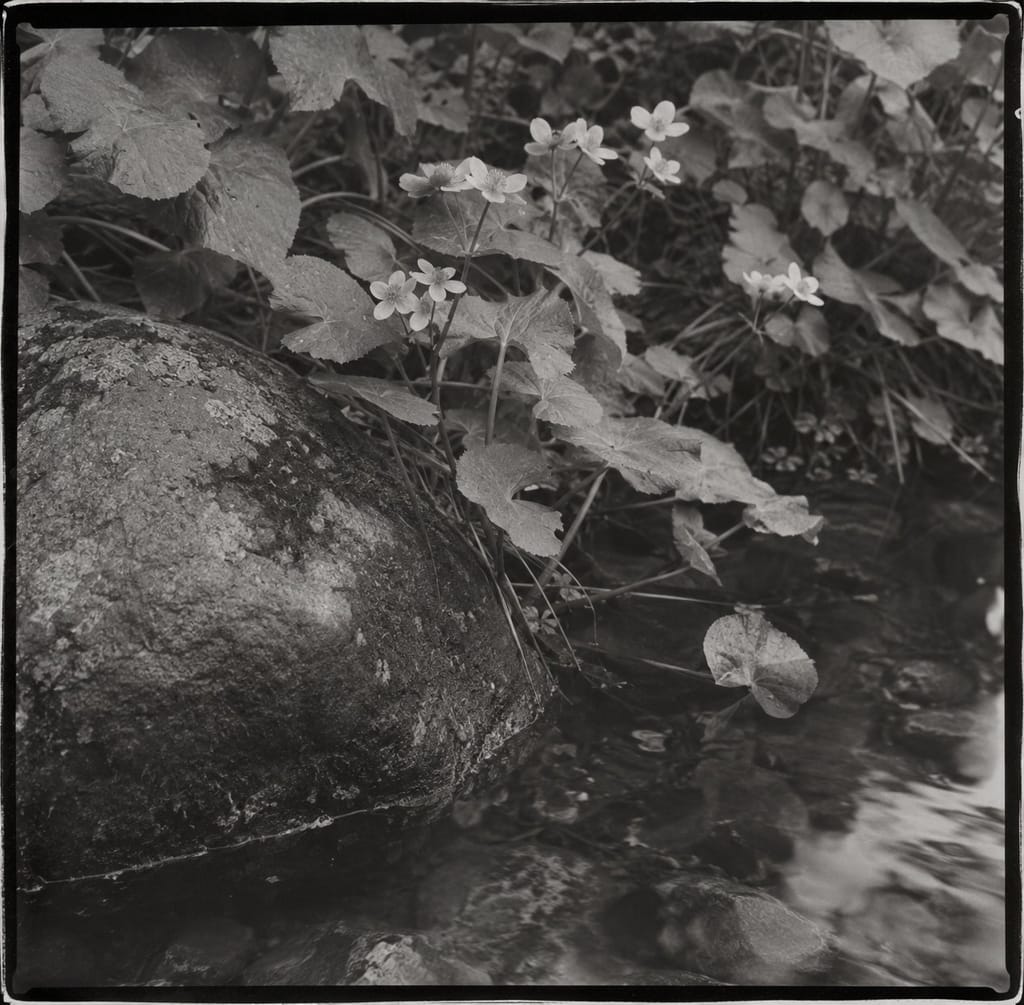
Small pale wildflowers and broad, toothed leaves grow beside a large mottled rock at the edge of a shallow stream. The black-and-white image includes submerged stones, rippling water and an irregular black border. What the check saw. Soft natural light and a rich monochrome tonal range emphasize the contrasting textures of delicate flowers, rough stone and moving water.
With other styles
Pairs with Straight photography. Borrow its tonal care, close viewpoint and plain print, then soften the ending: half-tones over the monumental black, a tight lyrical fragment instead of a monument, a small toned print instead of a large one.
The opposite: New Topographics. Both are plain, still and unstaged, but the topographic picture stands back to survey the built landscape; elementary photography goes close to stone, wood and water and does not inventory.
The opposite: Conceptual photography. The programme answered the post-conceptual photograph-as-idea with the photograph-as-photograph; use conceptual work as the foil when the picture should offer a look, not an argument.
Sources
- Bliżej Fotografii (Gdańskie Towarzystwo Fotograficzne): https://gtf.com.pl/blizej-fotografii/ (term coined by Olek in 1984; 60 furtek March 1983; Konopka April 1983, Zawadzki March 1984; Karkonosze 1984, Fotografia elementarna 1986, Fotografia fotograficzna 1988; disputes and Elementarność fotografii 1989; contact prints, landscape, still life, restraint; no mention of sepia; Fotografia elementarna is dated 1986 in the essay but Szczecin 1985 in Lech's biography)
- Andrzej Jerzy Lech, Fototapeta: https://www.fototapeta.art.pl/2025/ajl.php (60 furtek dedicated to Edward Weston; Olek took over the gallery in 1978; links to Sudek, Bułhak and Group f/64)
- Bogdan Konopka, PAP interview, dzieje.pl: https://dzieje.pl/kultura-i-sztuka/bkonopka-fotografia-polega-na-pisaniu-cieniem-ktory-okresla-swiatlo (large-format 20x25 cm negatives, still life in daylight, shadow and half-tones, silver and platinum)
- Bogdan Konopka (fotograf), Wikipedia: https://pl.wikipedia.org/wiki/Bogdan_Konopka_(fotograf) (developed the programme 1982-1985; large-format cameras, contact prints; the source for sepia toning; Lech says the movement never really existed)
- Wojciech Zawadzki, Słownik Biograficzny Ziemi Jeleniogórskiej: https://jbc.jelenia-gora.pl/Content/35476/zawadzki.html (Samotnia plein-air, September 1983; landscape of the Karkonosze; 9x12 cm, 4x5 in, Sinar, Mamiya RB67, Nikon with 20 mm; tight crops, no horizon, wide tonal range, black frame edge)
- Karkonosze catalogue, Cyfrowy Dolny Śląsk: https://jbc.jelenia-gora.pl/dlibra/publication/67690/edition/63993 (title and ten authors confirmed; date, place and Biennale number not given on the record page)