Styles / Early processes
Qajar court photography
- Key: the sun, about 45° to the camera’s left, high, hard.
Key high: about 30–45° above eye level, angled down.
Schematic, not to scale: worked out from the style’s choices. No set-up of this style has been rendered yet.
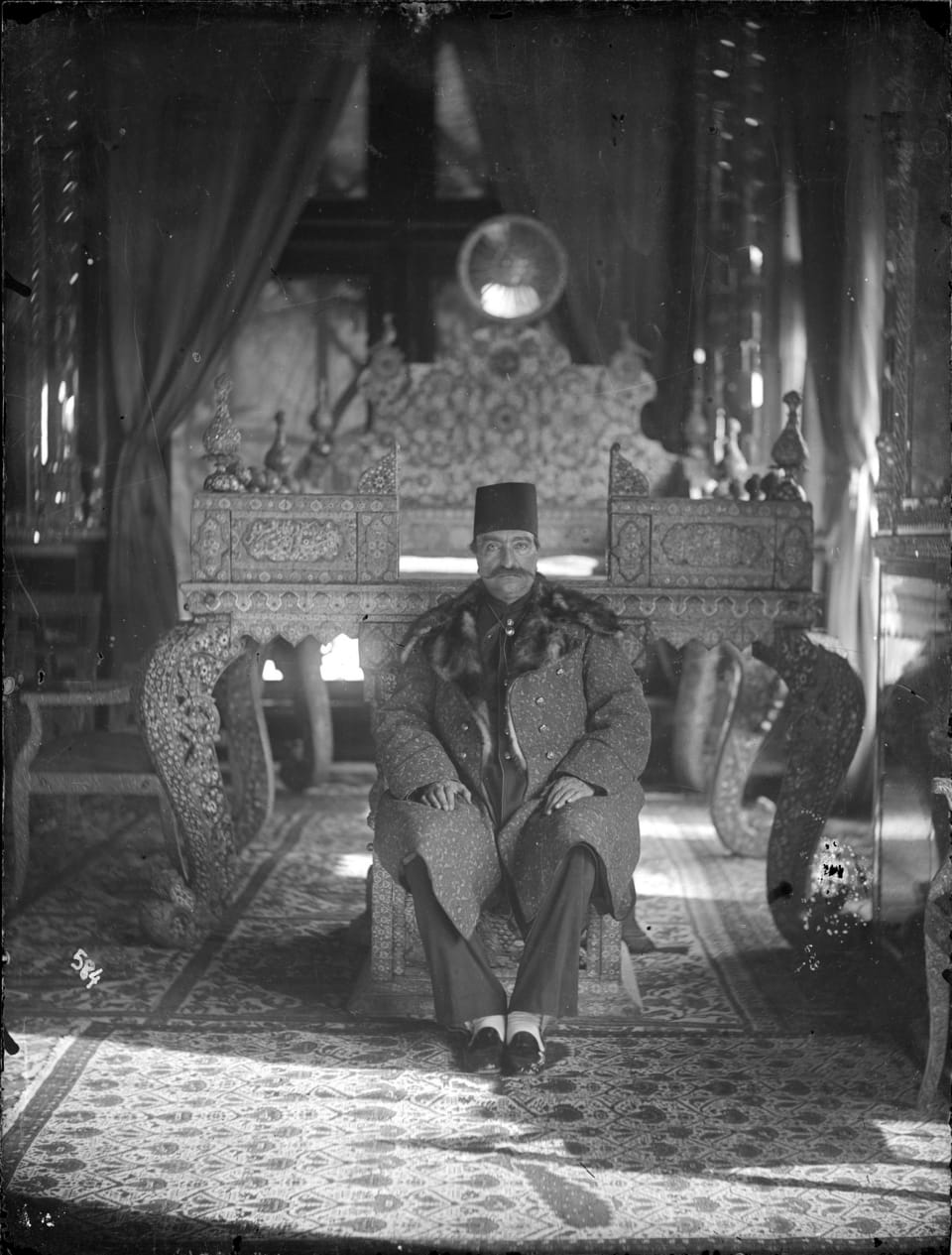
Naser al-Din Shah seated on the Sun Throne in the Mirror Hall, Golestan Palace
Antoin Sevruguin (attributed), Naser al-Din Shah seated on the Sun Throne, before 1896; Myron Bement Smith Collection, Smithsonian, via Wikimedia Commons (public domain in Iran (PD-Iran); US status per Commons tag, verify). Commons requires a separate US public-domain tag for this file. Source: Naser al-Din Shah seated on the Sun Throne in the Mirror Hall, Golestan Palace at Wikimedia Commons, from the Myron Bement Smith Collection, Smithsonian Institution

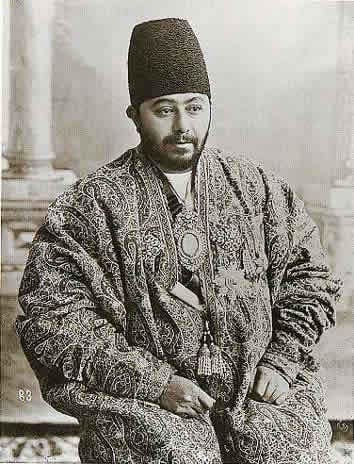
Portrait of a seated man in a brocade robe (Commons: Nizam al-Molk)
Antoin Sevruguin (attributed), portrait of a seated man (Commons caption inconsistent on the sitter), undated; Golestan Palace Library, via Wikimedia Commons (public domain in Iran (PD-Iran); US status per Commons tag, verify). Source: Portrait of a seated man in a brocade robe (Commons: Nizam al-Molk) at Wikimedia Commons, Photographs by Antoin Sevruguin in the collection of the Golestan Palace Library

A ruler's photography: the shah, princes, ministers, wives and entertainers sit square to the camera in palace rooms or before painted backdrops, wrapped in brocade and shawls on patterned carpets, holding still for seconds. Albumen prints from glass negatives were pasted into albums beside surveys of ruins, railways, the army and the post, and the same eye turned to dervishes, wrestlers and vendors. Meant to show power and to record the country.
Built on two systems: Painted studio and Albumen view. What systems are.
Shoot sheet for your kit A prompt for an image model The photographs
How the look is made
- Seat the sitter square to the camera, shoulders level, hands resting on the knees, and let the stillness read as authority.
- Build the picture from textiles and furnishings: patterned carpet underfoot, a brocade or shawl robe, a throne, curtain or painted backdrop behind, filling the frame with ornament.
- Use daylight from a courtyard, window or open door and expose for the face; let the lit carpet and robes fall into hard-edged patches.
- Stand back at middle distance on a tripod with a large plate camera, level and frontal, so the whole figure and its setting stay sharp.
- Treat the same method as a survey: make plain frontal records of ruins, soldiers, railways and trades, and keep the prints together in numbered albums.
Shoot sheet for your kit
Fill in your camera, lenses and lights, and the sheet says which light plays each part, what to work around and where to start on your camera. Without a kit it starts on a full-frame camera.
Light
Key: the sun, about 45° to the camera’s left, high, hard.
- Key high: about 30–45° above eye level, angled down.
- Shadow edges
- Shadows with crisp outlines, cast by a small or distant light: direct sun, a bare flash, a spotlight.
How the style is lit
- Daylight from a courtyard, a high window or an open door falling on the sitter, the carpet and the robe in hard-edged patches.
- A palace hall or covered veranda with sun on one side and dim, dark curtains behind.
This plan is worked out from the style’s choices, so it is drawn as a schematic. One way to get the light, not a record of how any photograph was lit.
Lens and settings
Start at
On a full-frame camera: the same depth of field and exposure as the style’s own numbers, in the same light. Then meter and adjust.
- The style’s f/27 on Whole plate gives about the depth of field of f/4.3 on full frame.
- Then
- 40–70 mm · f/16–f/45 · 0.5–8 s · ISO 1–25 on Whole plate, inferred from the gear and the look. Worked out from large glass-plate cameras, slow plates and albumen printing, not from records of individual exposures; indoors under window light exposures run to several seconds, outdoors to a fraction of a second or a second.
- Focal length
- Roughly the eye’s own perspective; no visible distortion.
- Focus
- Everything sharp from the nearest stone to the horizon.
- Angle
- The camera at the height of a standing person or of the subject.
- Distance
- Whole figures and their immediate surroundings.
- Balance
- The subject faces the lens; planes run parallel to the picture. The subject in the middle, the frame balanced around it.
- Crop & fill
- Detail runs to every edge with no single centre.
- Duration
- An unmoving scene, exposed slowly and carefully.
Direct
Rulers sit square to the camera on a throne, chair or carpet, hands on the knees, in a fur-collared coat or brocade robe, looking straight at the lens with a fixed, serious face. Princes, ministers and wives are arranged in rows or clusters, women veiled or in layered skirts, entertainers and wrestlers posed in the trade's own stance. Everyone holds still for seconds.
- Body position
- On a chair or stool, back straight, hands and feet placed: the formal sitting.
- Turn to the camera
- Shoulders and hips face the lens straight on: direct, symmetrical, sometimes confrontational.
- Head & gaze
- Looking straight into the camera, so the subject meets the viewer’s eye.
- Arms & hands
- Arms by the sides, hands folded in the lap or resting on a chair: quiet and formal.
- Line & energy
- Rigid and motionless, sometimes braced against a head rest or gripping a chair: held for a long exposure or a solemn occasion.
- Expression
- Unsmiling, composed and blank: the face gives nothing away.
- With the sitter
- The sitter arranged and still, facing the camera.
Style the set
Dense ornament: patterned carpets, shawl and brocade robes, inlaid thrones, curtains, hookahs, mirrors and cushions, or a painted garden backdrop in a commercial studio. Insignia, medals and a fez or tall hat mark rank. Survey pictures are left as found: a ruin, a bridge, a line of soldiers.
- Clothes
- The wearers’ own festive, religious or wedding clothes: saris and lehengas, boubous, robes, kimono.
- Set & props
- Things shown to say who the sitter is or wants to be, their own or lent by the studio: a radio, a bicycle, a watch, books, tools. A painted, cloth, paper or seamless backdrop behind the subject.
- Look of the styling
- Patterns, objects and textures piled together: pattern on pattern, flowers on brocade.
Finish
- Monochrome
- A monochrome image tinted sepia, brown, selenium purple or cyanotype blue.
- Colour
- An overall yellow, orange or red cast.
- Early processes
- Warm-brown prints of the 19th century, made from negatives.
- Film
- A view camera on a tripod: great detail, slow and deliberate.
- Post-production
- Nothing changed beyond exposure and development.
- Shown in
- Prints for an album, a card or a frame at home.
Stay away from snapshot, candid & unobserved, tilted angle, shallow depth of field, visible grain, direct on-camera flash, smiling and everyday clothes.
Before you shoot it
These photographs show real people: a ruling dynasty, its wives and children, servants, and ordinary Iranians sold as 'types' to foreign buyers. Court portraiture served the ruler's image, and the 'types' trade fixed stereotypes of Easterners; do not repeat the exoticising gaze on new subjects. Dervishes, wrestlers in the zoorkhaneh and religious dress belong to sacred and ritual life: do not stage them as costume or spectacle. The sitters are named historical individuals: do not put royal insignia, medals or a ruler's regalia on invented people as if they were real, and do not caption an AI image as an archive photograph.
A prompt for an image model
No prompt for this style
Behind its pictures: real royal sitters, women of a private household and "types" sold to foreigners, with sacred and ritual dress.
Caution forbids invented court photographs.
Photographs of the women of the andarun were made inside a private world; do not generate sitters in the likeness of real royal women or present an invented picture as a historical court photograph or a family record. do not repeat the exoticising gaze on new subjects. Dervishes, wrestlers in the zoorkhaneh and religious dress belong to sacred and ritual life: do not stage them as costume or spectacle. The sitters are named historical individuals: do not put royal insignia, medals or a ruler's regalia on invented people as if they were real, and do not caption an AI image as an archive photograph.
Work with photographers of this tradition, or take only its light and lens (the shoot sheet above) without its people, places or rituals.
Photographs that define it
From open collections, shown whole with their credits. Later photographs are linked, not shown, while they are in copyright.
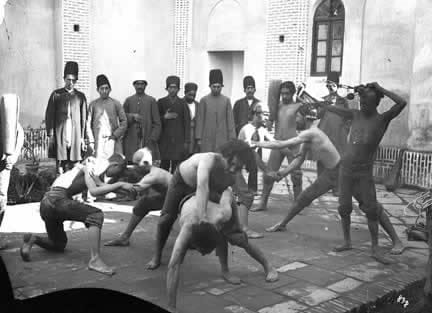
Wrestlers and spectators in a zoorkhaneh
Antoin Sevruguin (attributed), wrestlers in a zoorkhaneh, undated; Golestan Palace Library, via Wikimedia Commons (public domain in Iran (PD-Iran); US status per Commons tag, verify). Source: Wrestlers and spectators in a zoorkhaneh at Wikimedia Commons, Photographs by Antoin Sevruguin in the collection of the Golestan Palace Library

With other styles
Pairs with Carte-de-visite studio portraits. Borrow the carte's full-length stage of curtain, carpet and prop, then make the sitter the ruler and the room the palace, with brocade filling the frame.
The opposite: Yokohama photography. Yokohama sells hand-coloured types to visitors; keep Qajar pictures monochrome and sepia, made for the court and its albums first.
The opposite: Daguerreotype portraiture. Choose the daguerreotype for a single close, mirror-bright likeness; choose Qajar albumen for a seated figure in a full ornamented room.
The opposite: Indian painted photographs. Indian painted photography paints over the print to flatter the sitter; keep Qajar pictures unpainted, monochrome and sepia, with ornament coming from real carpets, robes and rooms.
Sources
- The Eye of the Shah, ISAW, New York University: https://isaw.nyu.edu/exhibitions/shah (22 October 2015 to 17 January 2016; about 200 prints, albums and memorabilia; the shah, his wives and children, entertainers, ancient sites, army, railway, post, everyday types; albumen print)
- Naser al-Din Shah Qajar, Wikipedia: https://en.wikipedia.org/wiki/Naser_al-Din_Shah_Qajar (reign 1848-1896; photographed hundreds of times; one of the first photographers in Iran; studio in the Golestan Palace; Luigi Pesce portrait of the 1850s)
- Abdullah Mirza Qajar, Wikipedia: https://en.wikipedia.org/wiki/Abdullah_Mirza_Qajar (1850-1912; Dar al-Fonun photography teacher from 1883; photographic trips for the shah 1883-1896)
- Antoin Sevruguin, Wikipedia: https://en.wikipedia.org/wiki/Antoin_Sevruguin (1851-1933; studio on Ala al-Dawla Avenue; painted backdrops, glass negatives, albumen prints; court, harem and ethnographic types; Smithsonian archive; the stereotype critique)
- Naser al-Din Shah on the Sun Throne, Wikimedia Commons: https://commons.wikimedia.org/wiki/File:Nasseraldinshah3.png (Myron Bement Smith Collection, Smithsonian; before 1896)