Styles / Fashion & commercial
Real-estate HDR and flambient interiors
- Key: a window, about 60° to the camera’s left, soft.
- Fill: a flash on the camera, from the camera, hard.
- Ambient light: a lamp, sign or screen, from behind the subject, low, soft.
Open shadows: bright surroundings (walls, ground, sky) fill them; no reflector needed. Bounce the key off a ceiling, a wall or a big white card rather than aiming it at the subject.
Schematic, not to scale: worked out from the style’s choices. No set-up of this style has been rendered yet.
The photographs that define it are still in copyright, so they are linked below rather than shown.
Bright, empty rooms made legible for a property listing: a level wide-angle view, straight verticals, deep focus, open shadows and readable windows. Ambient exposure brackets produce the HDR strand; flash and ambient frames blended together produce the flambient strand, usually with cleaner wall colour. Unlike a packshot, the saleable subject is the connected space itself, not an isolated object on white.
Built on two systems: Cinematic colour and Clean packshot. What systems are.
Shoot sheet for your kit A prompt for an image model The photographs
How the look is made
- Set a level camera on a tripod and show the room's layout with a wide view, keeping verticals parallel rather than tilting up.
- Keep foreground furniture, the far wall and connecting rooms sharp; include enough floor and ceiling to explain the space without stretching it misleadingly.
- For ambient HDR, bracket shutter speeds without changing focus or aperture, holding both the room and the window view before merging.
- For flambient, record the room's ambient light and bounced-flash frames separately, then blend neutral colour and open shadows with the ambient direction of light.
- Keep whites and window highlights readable, retain small grounding shadows, and avoid crunchy halos or an obviously flashed foreground.
- Tidy the real room and sequence complementary views for the listing; preserve its actual dimensions, fixtures and condition.
Shoot sheet for your kit
Fill in your camera, lenses and lights, and the sheet says which light plays each part, what to work around and where to start on your camera. Without a kit it starts on a full-frame camera.
Light
Key: a window, about 60° to the camera’s left, soft.
Fill: a flash on the camera, from the camera, hard.
Ambient light: a lamp, sign or screen, from behind the subject, low, soft.
- Open shadows: bright surroundings (walls, ground, sky) fill them; no reflector needed.
- Bounce the key off a ceiling, a wall or a big white card rather than aiming it at the subject.
- Shadow edges
- Shadows that fade gradually from light to dark, cast by a large or diffused light: a window, a softbox, a cloudy sky.
- Shadow depth
- Shadows kept light and full of detail by a reflector, a fill light, bounce or bright surroundings (a low lighting ratio, up to about 3:1: the shadow side at most a stop and a half darker).
- Highlights
- Even the brightest parts (clouds, white cloth, snow) keep texture and detail.
How the style is lit
- Ambient-only interior: window daylight with the room's existing lamps where appropriate; make shutter-speed brackets from one fixed camera position and merge for open room shadows and a readable exterior.
- Flambient interior: bounce an off-camera flash into a neutral wall or ceiling, record ambient frames separately, and blend so the flash corrects colour and fills shadows without erasing the window's direction; add a window exposure only when needed.
This plan is worked out from the style’s choices, so it is drawn as a schematic. One way to get the light, not a record of how any photograph was lit.
Lens and settings
Start at
On a full-frame camera: the same depth of field and exposure as the style’s own numbers, in the same light. Then meter and adjust.
- Then
- 12–24 mm · f/8–f/11 · 1/200–2 s · ISO 100–400 on full frame, inferred from the gear and the look. Inferred full-frame planning ranges, not specimen measurements: HDRsoft recommends f/8, ISO 400 and shutter-speed-only brackets; its equipment guide specifies 12–24 mm full-frame-equivalent lenses. SLR Lounge documents examples at ISO 100 with exposures from 1/80 s to 20 s. The narrower f/8–f/11, ISO 100–400 and 1/200–2 s ranges here are starting ranges, not a claim that every exposure fits them. Keep aperture fixed within a bracket; longer ambient frames are often needed.
- White balance
- Balance walls to neutral daylight or flash; correct mixed-light casts locally, keeping actual lamps gently warm without turning white surfaces blue-grey.
- Focal length
- A wide view; near things loom and lines stretch towards the edges.
- Focus
- Everything sharp from the nearest stone to the horizon.
- Rendering
- Verticals kept vertical with camera movements or correction.
- Angle
- The camera at the height of a standing person or of the subject.
- Distance
- Whole figures and their immediate surroundings.
- Depth
- Separate events in the foreground, middle ground and background. Doors, windows, mirrors or arches frame the subject again.
- Duration
- An unmoving scene, exposed slowly and carefully.
Direct
Nobody in the picture.
- Without a pose
- No people at all, or people so small or far off that their pose does not read (hands alone are Hands alone).
- The set-up
- A scene staged and directed like a film still or a painting.
Style the set
Clear loose clutter, straighten furniture and cushions, and leave clean worktops with a few restrained furnishings or props; show the actual room rather than replacing it with a studio backdrop. Empty rooms remain empty unless any virtual furnishing is separately disclosed.
- How much is styled
- A few small touches (a tidied table, a straightened collar, a chosen outfit) that still look unplanned.
- Look of the styling
- Few, simple elements on clean surfaces, with space around them.
Finish
- Colour
- White balanced to the light, so whites stay white and skin, food and products keep their real colour, with no overall cast.
- Digital & other
- A modern digital camera: clean, detailed, neutral.
- Texture
- Smooth tones with no visible grain.
- Post-production
- Several photographs combined into one picture. Shadows and highlights both opened up, with a processed look.
- Shown as
- Pictures made and shown as a set.
- Shown in
- Pictures made to sell, shown large.
Stay away from fisheye, shallow depth of field, tilted angle, black shadows, blown highlights, visible grain, studio backdrop and cross-processed colour.
Before you shoot it
These are photographs of private homes and commercial work by living practitioners. Obtain permission to photograph and publish interiors, remove identifying documents and sensitive possessions, credit the maker, and do not copy a particular studio's pictures. A listing must not misrepresent room dimensions, remove defects or fixtures, or invent a view through a window. Any atlas illustration must depict a clearly labelled fictional space, not a real address. The specimens remain link-only unless an exact-file open licence is established.
A prompt for an image model
A ready prompt that describes this look to an image model: where the lights stand, the lens, the framing and the colour. It starts on the style’s own choices; change any of them and the prompt and the notes follow.
The prompt
Notes on this prompt
- How the style uses it: for ambient HDR, bracket shutter speeds without changing focus or aperture, holding both the room and the window view before merging. Image models put the light in the wrong place more often than anything else, so the prompt says where each light stands: which side of the picture, and how high. Keep to one light pattern per prompt, or the model splits the difference.
The model makes a new picture, not a photograph of anything that happened. Label it as AI-generated, and don’t pass it off as the style’s history or as a real person.
Where to see it
From open collections, shown whole with their credits. Later photographs are linked, not shown, while they are in copyright.
In copyright, so linked
- Living room with green chairs and glazed staircase, Kenwood (portfolio file 05.jpg) , Igor / K94 Production, July 2026. K94 Production, Recent work portfolio.
- White kitchen opening toward a dining area, Aurora (portfolio file 01.jpg) , Igor / K94 Production, June 2026. K94 Production, Recent work portfolio.
- Bedroom with white bed, teal cushions and window blinds (finished flambient tutorial photograph) , Jose Barrios, By 6 February 2021. RE Photo Journal, Jose Barrios's illustrated flambient tutorial.
Made by an AI model
An image gpt-image-2 made from this style’s choices, then checked against them by a vision model. Not a photograph, and not part of the style’s history. All generated images
-
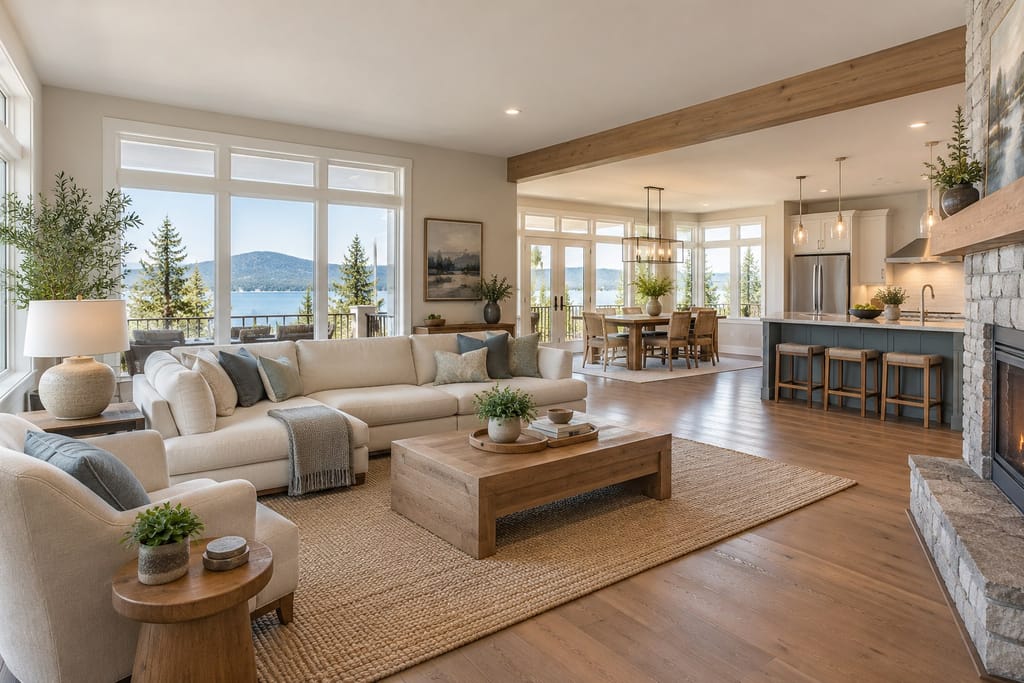
A bright open-plan living room has a cream sectional sofa and armchair around a wooden coffee table on a woven rug, with a stone fireplace at the right. Beyond are a dining table and kitchen with an island and stools, while large windows overlook trees, a lake and wooded hills. What the check saw. The image uses a wide, deep-focus view and soft daylight to present a meticulously staged interior in coordinated cream, wood and muted blue-green tones.
With other styles
The opposite: E-commerce packshot on white. Keep neutral colour and commercial clarity, but show connected rooms with a wide lens and retained window detail rather than isolating an object against clipped white.
Pairs with Modernist architectural photography. Pair level verticals and deliberate interior-light balancing with digital exposure blends and a room-by-room listing sequence instead of a heroic magazine view; this is a comparison of choices, not a claim of descent.
The opposite: New Topographics. For a critical survey, keep the spatial clarity but drop the tidying, persuasive brightness and exposure-blended sales finish.
Sources
- https://www.hdrsoft.com/download/history/photomatix-pro-win.html — release log: 30 April 2012, v4.2 introduces Fusion/Realistic for natural-looking interiors with bright windows; 20 November 2013, v5.0 replaces it with Fusion/Real-Estate for interiors with a window view. The period uses the earlier documented boundary, not an invention date; neither release dates the flambient term. The 2017 Tone Balancer is a later refinement, not the earliest evidence.
- https://www.hdrsoft.com/real-estate/photographing-interiors-with-hdr-simple-technique.html — software maker's practical HDR tutorial: flash off, ISO 400, f/8, fixed aperture and bracketed shutter speeds.
- https://www.hdrsoft.com/real-estate/equipment-hdr-photography.html — camera, tripod and 12–24 mm full-frame-equivalent interior lenses.
- https://www.hdrsoft.com/real-estate/tips-shooting-interior-with-bright-windows.html — level camera, room preparation, horizontal whole-room framing, fixed ISO/aperture and retained window views.
- https://www.slrlounge.com/hdr-versus-flash-in-real-estate-photography/ — first-party staff tutorial with actual exposure captions and illustrated bracket, flash and layer-mask workflows. Page currently dated 9 August 2026, despite image paths containing 2019/06; no original publication date is inferred from the file paths. Sponsored by HDRsoft; commercial claims are not adopted.
- https://k94realestate.com/blog/flambient-vs-hdr-real-estate-photography/ — practitioner comparison dated 11 May 2026, distinguishes ambient HDR from bounced-flash/ambient stacks; vendor pricing and superiority claims are not treated as independent evidence.
- https://k94realestate.com/portfolio/ — named, located and month-dated real listing projects; credits all photography and processing to Igor. Kenwood July 2026 and Aurora June 2026, tagged HDR, supply two specimens. Project months are not EXIF capture dates.
- https://rephotojournal.com/how-to-shoot-a-flambient-for-real-estate-photography/ — Jose Barrios's first-person illustrated tutorial, updated 6 February 2021: ceiling-bounced flash, separate ambient exposure, window pull and masked layer blending. The finished bedroom image under Apply any additional corrections in Lightroom supplies the flambient specimen. Exact capture date and room location are unstated; the author biography places the practitioner in Orlando, Florida, not necessarily this room. No exact-file open licence or photograph-specific capture settings were established.
- https://www.hdrsoft.com/real-estate/gallery.php — identifies its examples as bracketed photographs merged in Photomatix, not AI-generated. Dates and locations were not established for gallery files, so none is used as a specimen. Earlier scout dates and unreachable practitioner pages were omitted rather than asserted.