Styles / Street & snapshot
Skate photography
- Key: the sun, about 45° to the camera’s left, high, hard.
- Fill: a flash on the camera, from the camera, hard.
Key high: about 30–45° above eye level, angled down.
Schematic, not to scale: worked out from the style’s choices. No set-up of this style has been rendered yet.
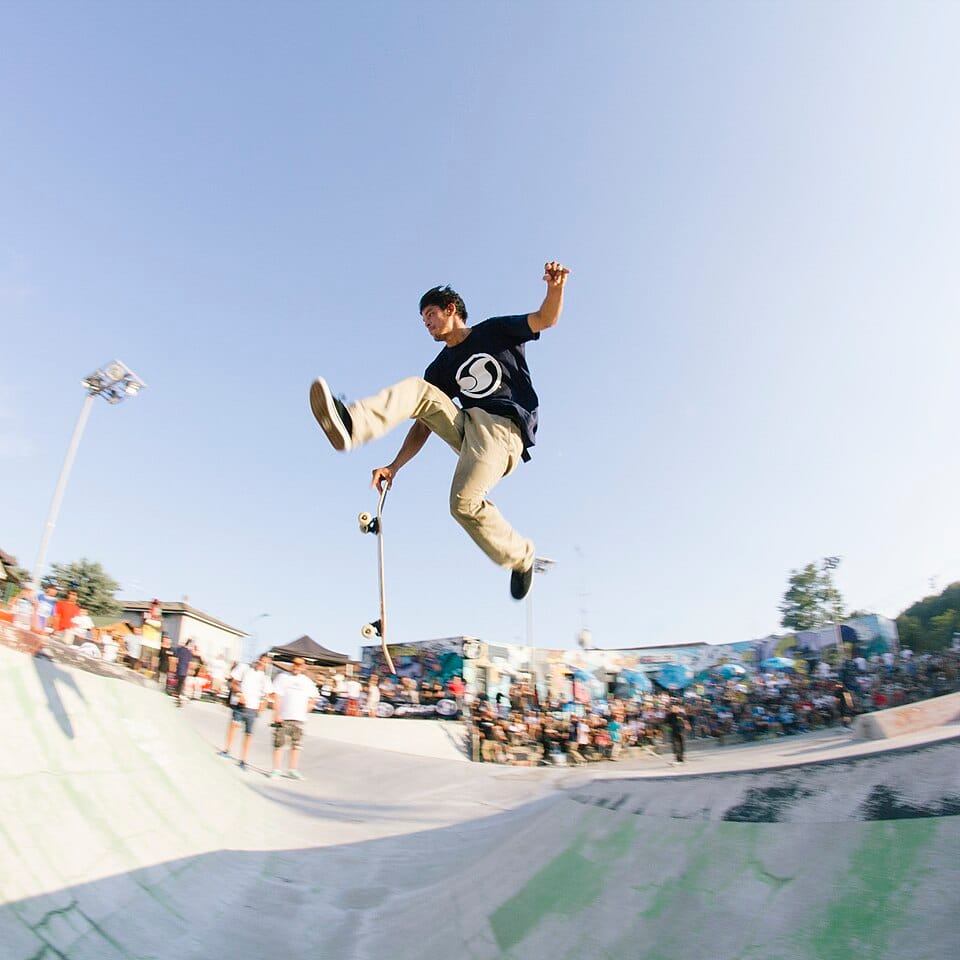
Dvs Team Railway Skatepark
Giovanni Cioli, CC BY 3.0, via Wikimedia Commons. Source: Dvs Team Railway Skatepark at Wikimedia Commons (imported from 500px)

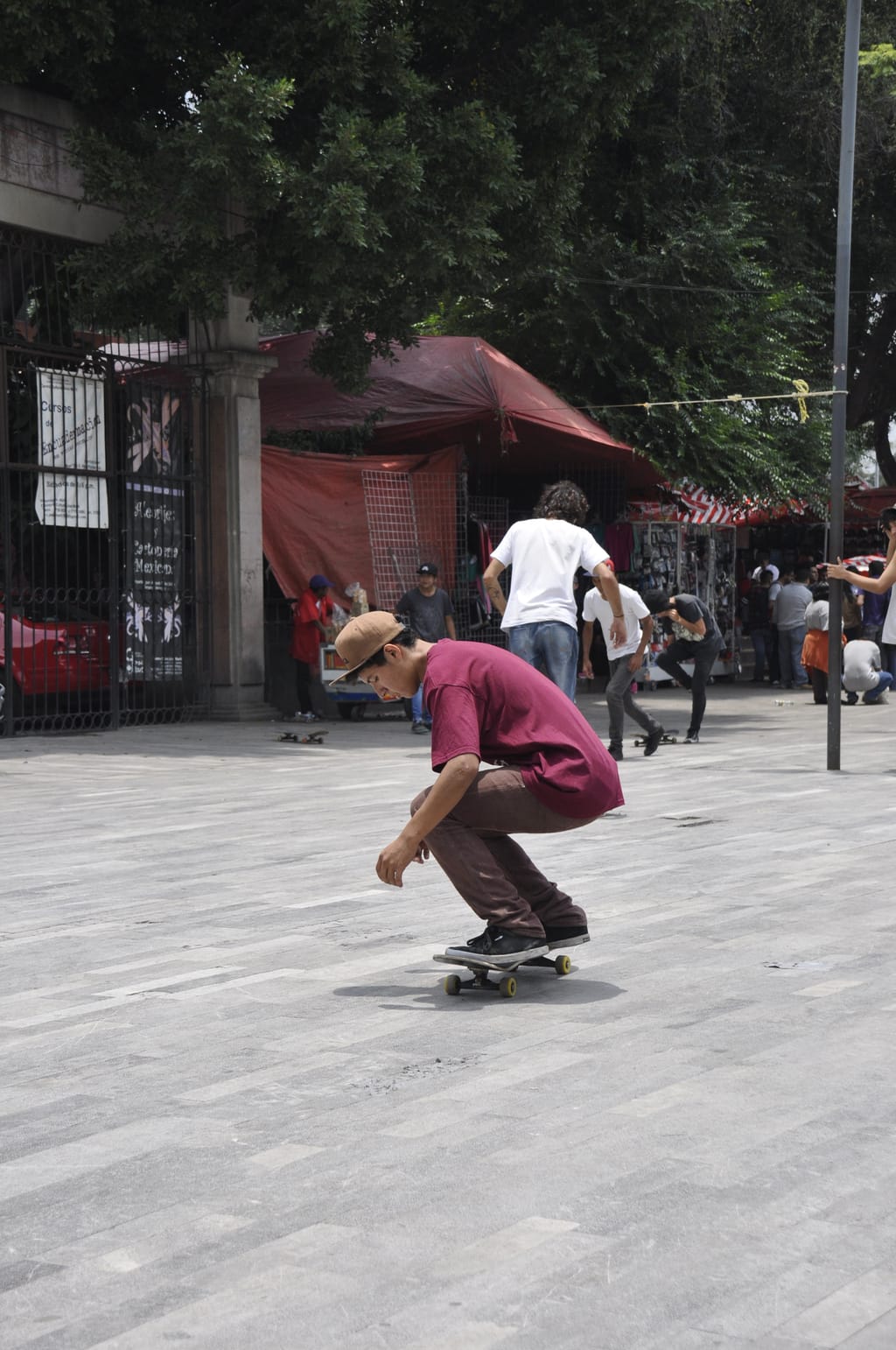
Skateboarding at Mexico City - Ollie - 031
Jarek Tuszyński, CC BY 4.0, via Wikimedia Commons. Source: Skateboarding at Mexico City - Ollie - 031 at Wikimedia Commons

A skater caught at the peak of a trick, seen from a few feet away and below through a fisheye lens, so that board, body and the curving architecture around them bend toward the frame. Flash freezes the move and lifts the rider out of hard daylight; the shutter is fast, the horizon tilts and the spot (a pool, rail, stair set or plaza) stays legible. Made with the skater's help, over repeated attempts, for magazine pages, and now for feeds.
Built on two systems: Event reportage and Body in flight. What systems are.
Shoot sheet for your kit A prompt for an image model The photographs
How the look is made
- Get within a metre or two of the trick and below it, so the board and body tower over the spot.
- Typically use a fisheye of about 15-16 mm, level the camera on the skater and let the horizon bend; keep the edge of the frame free of stray feet and fingers.
- Pre-focus by zone (typically about 1-2 m, stopped down), choose your position by moving your body, and fire at the peak of the trick, not before it.
- Add flash, fired from a hand-held or stand-mounted unit, to freeze the move and separate the rider from hard sun; keep the shutter at or below the camera's sync speed and let the sky go darker.
- Choose the spot as part of the picture: keep the stair, rail, bowl lip or wall in frame so that the trick can be read as hard.
- Shoot the same trick over many attempts, with the skater's consent, and pick the frame where the body, board and landing all read.
Shoot sheet for your kit
Fill in your camera, lenses and lights, and the sheet says which light plays each part, what to work around and where to start on your camera. Without a kit it starts on a full-frame camera.
Light
Key: the sun, about 45° to the camera’s left, high, hard.
Fill: a flash on the camera, from the camera, hard.
- Key high: about 30–45° above eye level, angled down.
- Shadow edges
- Shadows with crisp outlines, cast by a small or distant light: direct sun, a bare flash, a spotlight.
- Shape & form
- Shadows thrown away from what casts them (a figure’s long shadow, railings on a wall) that become shapes of their own in the composition.
How the style is lit
- Hard daylight with one off-camera flash at a typical low-to-medium power (inferred starting point, about 1/4 to 1/2), hand-held or on a stand just outside the fisheye's view, to freeze the rider and hold the sky darker.
- Dusk or night at a spot: street light or park floodlight as the background, with flash on the skater and a slower shutter for a streak of ambient light.
- Unlit available sun at a pool or plaza, with the rider's shadow thrown on the concrete and no flash.
This plan is worked out from the style’s choices, so it is drawn as a schematic. One way to get the light, not a record of how any photograph was lit.
Lens and settings
Start at
On a full-frame camera: the same depth of field and exposure as the style’s own numbers, in the same light. Then meter and adjust.
- With flash, 1/125 s stays under every camera’s flash sync speed (1/160–1/250 s, by camera): set the exposure with the flash power and the f-number.
- Then
- 15–16 mm · f/8–f/11 · 1/1000–1/250 s · ISO 100–400 on full frame, inferred from the gear and the look. An inferred, typical daylight-with-flash starting point drawn from skate-photography tutorials and a magazine buyer's guide (15-16 mm fisheyes, 1/250 s sync, f/8, ISO 200-400, focus pre-set to about 1-2 m, flash at 1/4-1/2 power; only search summaries of those pages were seen) and from the sync speeds of the cameras. It is not any one photograph's exposure. Without flash, shutters of 1/1000 s and faster are used; fisheye work on an APS-C body is much less distorted than on full frame.
- White balance
- Daylight balance with the flash unfiltered: the rider stays neutral and the sky deepens; at night leave street light warm against the cooler flash.
- Focal length
- An extreme wide angle that bends straight lines into curves. A wide view; near things loom and lines stretch towards the edges.
- Focus
- Everything sharp from the nearest stone to the horizon.
- Angle
- Looking up: the subject towers. The horizon deliberately off level (Dutch angle).
- Distance
- Within arm’s reach: faces, hands and details fill the frame.
- Balance
- Tilted lines and oblique movement drive the picture.
- Crop & fill
- The subject shown small within its setting, which explains it.
- Instant
- Movement stopped dead by a fast shutter or flash. Gesture and geometry peak together in one instant.
Direct
The skater is not posed but performs: a trick is attempted over and over while the photographer holds a position, and the frame is chosen from the attempts. Bodies are in mid-air or crouched and compressed, arms out for balance, eyes on the landing or the board rather than the lens; the rider is lost in the trick and mostly looks away. Between attempts friends and other skaters wait at the edge of the spot and can be in the frame. Agree the line and the attempts with the skater, and never ask for a trick beyond their level.
- Body position
- Feet off the ground: leaping, jumping or dancing at full stretch. The body folded low to the ground. Feet planted apart, chest open, taking up space: the power pose of streetwear, sport and authority.
- Head & gaze
- Attention on what the hands are doing or on a thing (working, reading, eating, playing), not on the camera.
- Line & energy
- Running, dancing, spinning or tumbling, with hair and clothes flying; an ordinary walk is Walking & mid-stride.
- With the sitter
- The subject performs for the camera and shapes the picture.
Style the set
Nothing is dressed for the camera: skate shoes, T-shirts, jeans or work trousers, caps and pads as the skater wears them, with a board whose graphic and wear stay visible. The set is the spot as found (a pool, kerb, stair set, ledge, bowl, plaza), with its graffiti, stickers, crowd and wear left in, and the skater's clothes chosen by the skater. Brand logos on shirts and boards are common; commercial shoots add sponsor products, but the clothes are still ordinary.
- Clothes
- What people happened to be wearing; nothing chosen for the picture.
- How much is styled
- Nothing dressed, made up, moved or added for the picture.
Finish
- Monochrome
- A black-and-white scale pushed towards pure black and pure white, with few middle greys.
- Colour
- Strong, dense colours.
- Film
- A small handheld camera: quick, mobile, grainy when pushed.
- Digital & other
- A modern digital camera: clean, detailed, neutral.
- Post-production
- Nothing changed beyond exposure and development.
- Shown as
- Each picture stands on its own.
- Shown in
- Pictures made for magazine pages and spreads.
Stay away from soft focus & diffusion, corrected perspective, eye level, soft studio light, deadpan, full glamour make-up, long exposure and hdr & tone-mapped.
Before you shoot it
The photographs show real skaters, many of them teenagers, performing tricks that can cause injury, often at spots where they have no permission to be. Credit and obtain consent from the people shown, take extra care with minors, and never ask a skater to try a trick beyond their ability for the sake of a picture. Respect owners, residents and passers-by at spots, and ask before publishing a spot's location if skaters may be moved on or fined. Several of the best-known photographers, such as Atiba Jefferson, J. Grant Brittain and Glen E. Friedman, are alive, and their frames are in copyright: never prompt by name, and do not imitate a named photographer's signature image.
A prompt for an image model
A ready prompt that describes this look to an image model: where the lights stand, the lens, the framing and the colour. It starts on the style’s own choices; change any of them and the prompt and the notes follow.
The prompt
Notes on this prompt
- How the style uses it: get within a metre or two of the trick and below it, so the board and body tower over the spot. Image models put the light in the wrong place more often than anything else, so the prompt says where each light stands: which side of the picture, and how high. Keep to one light pattern per prompt, or the model splits the difference.
- Black and white: colour words in the subject (a red dress, green leaves) can pull the model back to colour, so leave them out.
- Give the camera height in plain words: from knee height looking up, from a stepladder looking down, straight down onto the table.
The model makes a new picture, not a photograph of anything that happened. Label it as AI-generated, and don’t pass it off as the style’s history or as a real person.
Where to see it
From open collections, shown whole with their credits. Later photographs are linked, not shown, while they are in copyright.
With other styles
Pairs with Surf-magazine action photography. Take the surf shot's habit of keeping the athlete and a hostile surface in one frame, but swap the long shore lens for a close fisheye and the wave for built concrete.
Pairs with New York street photography. Borrow the wide-angle, close, tilted street frame for the spot and the people watching, then add the performer and flash that the street school lacked. Life's 1965 Eppridge skateboarding pictures are an early precursor.
Pairs with Y2K digicam and flash revival. Both fire direct flash against a dim or bright setting; use the digicam's flash look for a rawer, snapshot version of a skate session.
The opposite: New Topographics. New Topographics shows the same car parks and plazas flat, level and empty; photograph the spot that way for a calm record, then fill it with the trick.
Sources
- Skate photography, Wikipedia: https://en.wikipedia.org/wiki/Skate_photography (Life, 1965, Bill Eppridge in Central Park; print Transworld ceased March 2019; Thrasher publishes over 10,000 skate photos a year, citing Wired 2011; says nothing on gear)
- Warren Bolster, Wikipedia: https://en.wikipedia.org/wiki/Warren_Bolster (1947-2006; given the job of reviving Skateboarder in 1976 (six months to get it running again); among the first to use fisheye lenses, motor-drive sequences and strobes on California skateboarding)
- J. Grant Brittain, Wikipedia: https://en.wikipedia.org/wiki/J._Grant_Brittain (born 1955; began photographing skateboarding at Del Mar in 1979 (no Skate Ranch job year given); helped found Transworld Skateboarding in 1983; relies largely on one source)
- Glen E. Friedman, Wikipedia: https://en.wikipedia.org/wiki/Glen_E._Friedman (born 1962; late 1976 pool photographs; youngest staff member of SkateBoarder; Dogtown: The Legend of the Z-Boys, 2000)
- Atiba Jefferson, Wikipedia: https://en.wikipedia.org/wiki/Atiba_Jefferson (born 1976; staff photographer for Thrasher; living; says nothing on gear)
- Gear and technique (search summaries only; the pages returned HTTP 403 and were not read): Transworld Skateboarding, A Photographer's Buyer's Guide, https://skateboarding.transworld.net/features/a-photographers-buyers-guide/ (15 or 16 mm fisheyes, flash sync 1/250 s, small flashes on radio triggers); Canon Ireland, Atiba Jefferson on the fisheye, https://www.canon.ie/pro/stories/atiba-jefferson-fisheye-lens-skateboarding/ (a 15 mm fisheye used from 1995 to 2022; flash is hard to place close to the subject with so wide a lens)
- Scout brief page, SurferToday, https://www.surfertoday.com/skateboarding/fisheye-lens-in-skate-photography, returned HTTP 403 and is not relied on.