Styles / Documentary & reportage
South African struggle photography (Afrapix)
- Key: the sun, about 45° to the camera’s left, high, hard.
Key high: about 30–45° above eye level, angled down.
Schematic, not to scale: worked out from the style’s choices. No set-up of this style has been rendered yet.
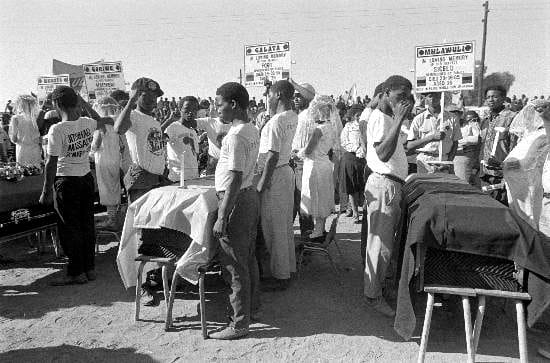
Funeral of the Cradock Four
Gille de Vlieg, Funeral of the Cradock Four, presumably 20 July 1985; South African History Archives, CC BY 4.0 via Wikimedia Commons. Source: Funeral of the Cradock Four at South African History Archives, via Wikimedia Commons

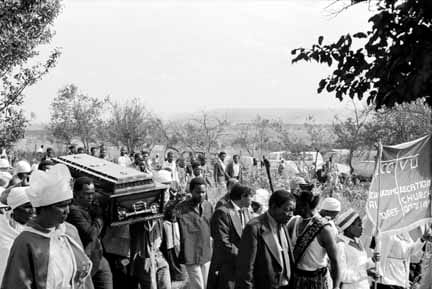
Vusimusi Saul Mkhize's funeral, Driefontein
Gille de Vlieg (metadata author: African Image Pipeline), Vusimusi Saul Mkhize's funeral, Driefontein, 16 April 1983, CC BY-SA 4.0 via Wikimedia Commons. Source: Vusimusi Saul Mkhize's funeral, Driefontein at Wikimedia Commons, uploaded by the photographer

Black-and-white documentary made by photographers who took the side of the communities they showed: mass funerals, rallies with banners, evictions, strikes, troops in the townships, and the ordinary life of township and rural homes. Shot on handheld 35 mm in the middle of crowds, in hard light and contrasty prints, and published as essays, exhibitions and books as testimony against apartheid.
Built mostly on one system: Event reportage. What systems are.
Shoot sheet for your kit A prompt for an image model The photographs
How the look is made
- Work inside the event: walk with the funeral or rally, stand among the people and shoot from within the crowd, not from a press line.
- Show the banners, placards and slogans legibly in the frame; they tell the viewer what the day was for.
- Layer the frame: mourners in front, a coffin or a speaker in the middle, marchers and the horizon behind, so that the crowd's size and purpose read at once.
- Shoot handheld on fast black-and-white film at 1/250 s or faster; accept grain, tilt and hard sun, and print with strong contrast and clear blacks.
- Also photograph the quiet days: meetings under a tree, a marked house, a family at home, with the same plain, level directness.
- Stay with a place and its people over months, and edit the work into a captioned essay, exhibition or book that argues a case.
Shoot sheet for your kit
Fill in your camera, lenses and lights, and the sheet says which light plays each part, what to work around and where to start on your camera. Without a kit it starts on a full-frame camera.
Light
Key: the sun, about 45° to the camera’s left, high, hard.
- Key high: about 30–45° above eye level, angled down.
- Shadow edges
- Shadows with crisp outlines, cast by a small or distant light: direct sun, a bare flash, a spotlight.
- Shadow depth
- Dark shadows that still hold some detail (a high lighting ratio, about 4:1 to 8:1: the shadow side two to three stops darker).
How the style is lit
- Hard midday or afternoon sun in open ground, with bright white sky and deep shadows under hats and trees, exposed for the faces and accepting burnt-out sky.
- Open shade or overcast light at a graveside, meeting or home, flat and even enough to read every face and banner.
- On-camera flash, or available light at night and indoors, for evening meetings, vigils and raids, accepting hard shadows and grain.
This plan is worked out from the style’s choices, so it is drawn as a schematic. One way to get the light, not a record of how any photograph was lit.
Lens and settings
Start at
On a full-frame camera: the same depth of field and exposure as the style’s own numbers, in the same light. Then meter and adjust.
- Then
- 28–50 mm · f/5.6–f/11 · 1/500–1/125 s · ISO 400–1600 on full frame, inferred from the gear and the look. Inferred from the handheld, black-and-white 35 mm work in crowds and the sunlit pictures it produced; the sources read give the medium (black-and-white essays and prints) but no cameras, lenses or exposures, so they vary by photographer and event. 35 mm is inferred, not sourced, though it was the working medium of most documentary photographers of the period.
- Focal length
- A wide view; near things loom and lines stretch towards the edges.
- Focus
- Everything sharp from the nearest stone to the horizon.
- Angle
- The camera at the height of a standing person or of the subject.
- Distance
- Within arm’s reach: faces, hands and details fill the frame.
- Crop & fill
- The subject shown small within its setting, which explains it.
- Depth
- Separate events in the foreground, middle ground and background.
- Instant
- Movement stopped dead by a fast shutter or flash.
Direct
Nobody is posed. People march, carry coffins, sing, raise fists, argue, sit in meetings and go about their day, mostly absorbed in the event and seldom looking at the camera; bystanders, children and mourners are caught in groups, close together and overlapping. Some photographers worked with subjects they knew and who understood the pictures would be shown, so a few sitters look straight into the lens.
- Body position
- Caught or posed in mid-step, one foot lifted, clothes swinging.
- Head & gaze
- Attention on what the hands are doing or on a thing (working, reading, eating, playing), not on the camera.
- Arms & hands
- Arms stretched out, pointing or waving, or hands caught mid-gesture while talking.
- Several people
- Bodies close together, overlapping and leaning in: friends, a band, a family on a sofa.
- The moment
- People photographed as they are, unaware or unconcerned.
Style the set
Nothing is styled. People wear their own clothes (T-shirts printed with slogans, church dress and uniforms, Sunday best at funerals), carry hand-lettered placards, banners and coffins on trestles, and stand in real streets, yards, hillsides and township houses left as they are.
- Clothes
- What people happened to be wearing; nothing chosen for the picture. The clothes of a trade, a rank, a team or an institution.
- Set & props
- A real home, workplace or street that belongs to the people in it, not a set, with their own things and traces of use.
- How much is styled
- Nothing dressed, made up, moved or added for the picture.
Finish
- Monochrome
- A black-and-white scale pushed towards pure black and pure white, with few middle greys. Rich blacks, clean whites and every grey between.
- Film
- A small handheld camera: quick, mobile, grainy when pushed.
- Texture
- Film grain or noise you can see at normal size.
- Post-production
- Nothing changed beyond exposure and development.
- Shown as
- A sequence with text that tells a story.
- Shown in
- The book as the main form of the work. Pictures made for magazine pages and spreads.
Stay away from constructed set & miniature, heavy retouching, composite & montage, glamour & aspiration, sell & persuade, colour as subject, soft focus & diffusion, fully art-directed and theatrical & acted.
Before you shoot it
These are photographs of real people under apartheid: mourners at political funerals, protesters, families facing eviction, and people at risk from the police and the state. Many are named, grieving or exposed to harm, and the photographs were often made and circulated at real risk to the photographers, who were themselves targeted. Critics have noted that struggle pictures could show black South Africans mainly as powerless victims, so keep names, captions and the people's own words with the pictures. Many photographers are living and the photographs are in copyright: license them from the photographers, their estates or the South African History Archives, credit them, and for new work commission South African photographers and ask the people shown.
A prompt for an image model
No prompt for this style
Behind its pictures: real mourners, protesters and people at risk under apartheid.
Its caution asks to license or commission living South African photographers rather than imitate.
These are photographs of real people under apartheid: mourners at political funerals, protesters, families facing eviction, and people at risk from the police and the state. Many are named, grieving or exposed to harm, and the photographs were often made and circulated at real risk to the photographers, who were themselves targeted. The specimens show mourners at the funerals of named people killed under apartheid; never generate imitations of funerals of real victims. Do not generate images that pass as struggle-era photographs, of real or invented people, and no fake funerals, rallies, police violence or massacres.
Work with photographers of this tradition, or take only its light and lens (the shoot sheet above) without its people, places or rituals.
Photographs that define it
From open collections, shown whole with their credits. Later photographs are linked, not shown, while they are in copyright.
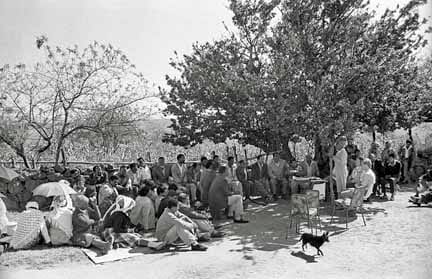
Community meeting under a tree, Driefontein
Gille de Vlieg, Community meeting under a tree to discuss how to remain on Driefontein land, 10 May 1984, CC BY-SA 4.0 via Wikimedia Commons. Source: Community meeting under a tree, Driefontein at Wikimedia Commons, uploaded by the photographer

With other styles
The opposite: FSA/OWI documentary photography. Pair its frontal, patient, state-commissioned portraits of the poor with these fast, partisan pictures made from inside the event to see what slowing down and standing outside changes.
The opposite: French humanist photography. Take its handheld 35 mm candid eye but swap tenderness and decisive geometry for banners, crowds and testimony.
Pairs with Drum magazine photography. Combine this with an earlier South African black-and-white tradition by following the people of the township from daily life to the protest, keeping captions and names.
Sources
- https://en.wikipedia.org/wiki/Afrapix
- https://sahistory.org.za/article/afrapix-chronology-1981-1991
- https://commons.wikimedia.org/wiki/File:Funeral_of_the_Cradock_Four.jpg
- https://commons.wikimedia.org/wiki/File:830315_Vusimusi_Saul_Mkhize%27s_funeral_Driefontein_Mpumalanga_South_Africa_16_April.jpg