Styles / Fashion & commercial
Swinging London fashion photography
- Key: the open sky, all around and above, soft.
Daylight studio: a skylight, a glasshouse or a courtyard, with a backdrop behind the sitter. Open shadows: bright surroundings (walls, ground, sky) fill them; no reflector needed.
Schematic, not to scale: worked out from the style’s choices. No set-up of this style has been rendered yet.
The photographs that define it are still in copyright, so they are linked below rather than shown.
Fashion taken out of the salon by a new generation of London photographers, mostly from working-class backgrounds. Models move, stare at the lens or look up and away, in square medium-format frames or on 35 mm, shot either against a stark white or grey seamless with hair and face cropped close, or outdoors in power stations, flats, empty motorways and bomb-damaged streets. High-contrast black and white, hard light, little retouching: the clothes sell through the model's youth and attitude, and the photographer becomes a celebrity.
Built on two systems: Glamour studio and Event reportage. What systems are.
Shoot sheet for your kit A prompt for an image model The photographs
How the look is made
- Take the clothes out of the salon: shoot on a street, a motorway, a power station or a council estate, and let the plain, gritty place set off the new clothes.
- In the studio use a plain white or grey seamless and crop in tight, so that the hair, eyes and mouth fill the frame and the head becomes a graphic shape. Treat studio and location as alternate modes (studio: seamless, tight crop, close, high-key; location: low angle, flat daylight, environmental): use one per picture.
- Light hard and simple: one big flash or window light, or flat overcast daylight outdoors, with no fill games, and print black and white with deep blacks and bright paper whites.
- Keep the model moving on location: ask for a walk, a swing of a map or a scarf, and shoot fast so that the pose is a gesture, not a held shape; the studio mode is static and tight.
- Direct the model as a collaborator and a personality: a steady stare, a look up or away, or a gesture, with makeup and hair of the day and only light retouching. Men and women are both cast.
- Pick an exaggerated angle (low from the road, steep from a gantry) and keep the film rebate or a rough print edge when it shows the picture was made fast.
Shoot sheet for your kit
Fill in your camera, lenses and lights, and the sheet says which light plays each part, what to work around and where to start on your camera. Without a kit it starts on a full-frame camera.
Light
Key: the open sky, all around and above, soft.
- Daylight studio: a skylight, a glasshouse or a courtyard, with a backdrop behind the sitter.
- Open shadows: bright surroundings (walls, ground, sky) fill them; no reflector needed.
- Shadow edges
- Shadows with crisp outlines, cast by a small or distant light: direct sun, a bare flash, a spotlight.
- Shadow depth
- Shadows kept light and full of detail by a reflector, a fill light, bounce or bright surroundings (a low lighting ratio, up to about 3:1: the shadow side at most a stop and a half darker).
How the style is lit
- One large flash head or a window on a white or grey seamless, light kept hard and from the front, so the background goes white behind the hair.
- Flat overcast or hard midday daylight on a street, power station or motorway, no fill and no reflector.
- Available light on location with a fast shutter to freeze a moment of movement.
This plan is worked out from the style’s choices, so it is drawn as a schematic. One way to get the light, not a record of how any photograph was lit.
Lens and settings
Start at
On a full-frame camera: the same depth of field and exposure as the style’s own numbers, in the same light. Then meter and adjust.
- The style’s f/8 on 6 × 6 cm gives about the depth of field of f/4.4 on full frame.
- Then
- 28–100 mm · f/4–f/16 · 1/500–1/125 s · ISO 100–400 on 6 × 6 cm, inferred from the gear and the look. Cameras are documented only loosely (Bailey took up a Rolleiflex in the 1950s; the Duffy print shows a square frame with Kodak Safety Film edge markings). Apertures, shutter times and film speeds are inferred from sharp, frozen movement in daylight and flash on roll film. 28 mm to 100 mm covers 35 mm lenses to the long end of 6 x 6 lenses in 35 mm equivalent. The Swinging London Wikipedia page is cited for context only (it mentions Bailey, not Donovan or Duffy).
- Angle
- Looking up: the subject towers.
- Distance
- Within arm’s reach: faces, hands and details fill the frame.
- Crop & fill
- The edges cut into the subject: heads, limbs or objects run out of frame. The subject shown small within its setting, which explains it.
- Instant
- Movement stopped dead by a fast shutter or flash. A casual, unplanned instant, taken quickly.
Direct
Let the model move: on location walk, swing a scarf or a map held aloft, or fold arms and stand loose; the model gives a steady stare, or looks up or away, face open or cheeky, not composed. In the studio, a close head shot with the chin lifted, eyes on or just past the lens. Men and women alike are treated as personalities, not mannequins.
- Body position
- Caught or posed in mid-step, one foot lifted, clothes swinging.
- Head & gaze
- Looking straight into the camera, so the subject meets the viewer’s eye.
- Line & energy
- Running, dancing, spinning or tumbling, with hair and clothes flying; an ordinary walk is Walking & mid-stride.
- With the sitter
- The subject performs for the camera and shapes the picture.
- The set-up
- A scene staged and directed like a film still or a painting.
Style the set
The clothes of the young London designers and boutiques (short skirts, suits, sunglasses, scarves) worn with big backcombed hair, pale lips and heavy eye makeup in the manner of the day; backdrops are bare white or grey paper in the studio, and outdoors a real, unprepared place: power station, gasometers, council flats, empty motorway, with an E-Type car or a plume of steam as the only prop.
- Hair & make-up
- Groomed hair and finished make-up that still look natural: even skin, defined eyes, neat brows.
- Set & props
- A painted, cloth, paper or seamless backdrop behind the subject. A real place picked for its look as the setting for a shoot, not the subjects’ own: a street, a field, a palace, a hotel room.
- Look of the styling
- Few, simple elements on clean surfaces, with space around them.
Finish
- Monochrome
- A black-and-white scale pushed towards pure black and pure white, with few middle greys. Rich blacks, clean whites and every grey between.
- Film
- Roll film in a medium-format camera, often square. A small handheld camera: quick, mobile, grainy when pushed.
Stay away from side-on profile, contrapposto & s-curve, neutral face, soft studio light, butterfly light, rembrandt light, maximal & patterned, heavy retouching, melancholy, lyrical & poetic and formal posed portrait.
Before you shoot it
The photographs show real, named people: models such as Jean Shrimpton and Twiggy, and sitters in Box of Pin-Ups who could be recognised. David Bailey is still living and his signature look is his own; Donovan and Duffy's estates hold their work. The ideal on show is narrow: young, very slim and almost entirely white, in a mostly male-run, class-and-celebrity-conscious industry. Cast and style varied bodies and skin tones on their own terms. The V&A prints of identifiable sitters (Shrimpton, Davies or Anthony, Duffy's models) are in-copyright museum images: link to them, never reproduce them.
A prompt for an image model
A ready prompt that describes this look to an image model: where the lights stand, the lens, the framing and the colour. It starts on the style’s own choices; change any of them and the prompt and the notes follow.
The prompt
Notes on this prompt
- How the style uses it: light hard and simple: one big flash or window light, or flat overcast daylight outdoors, with no fill games, and print black and white with deep blacks and bright paper whites. Image models put the light in the wrong place more often than anything else, so the prompt says where each light stands: which side of the picture, and how high. Keep to one light pattern per prompt, or the model splits the difference.
- Describe an invented person by age, clothes and pose. Never name a real or famous person, and never write “looks like”.
- Black and white: colour words in the subject (a red dress, green leaves) can pull the model back to colour, so leave them out.
The model makes a new picture, not a photograph of anything that happened. Label it as AI-generated, and don’t pass it off as the style’s history or as a real person.
Where to see it
From open collections, shown whole with their credits. Later photographs are linked, not shown, while they are in copyright.
In copyright, so linked
- E-Type Jag on the M1 motorway , Brian Duffy, 1961. Victoria and Albert Museum.
- David Bailey's box of pin-ups: Jean Shrimpton , David Bailey, 1965. Victoria and Albert Museum.
- Thermodynamic , Terence Donovan, photographed 31 October 1960, printed May 2011. Victoria and Albert Museum.
Made by an AI model
An image gpt-image-2 made from this style’s choices, then checked against them by a vision model. Not a photograph, and not part of the style’s history. All generated images
-
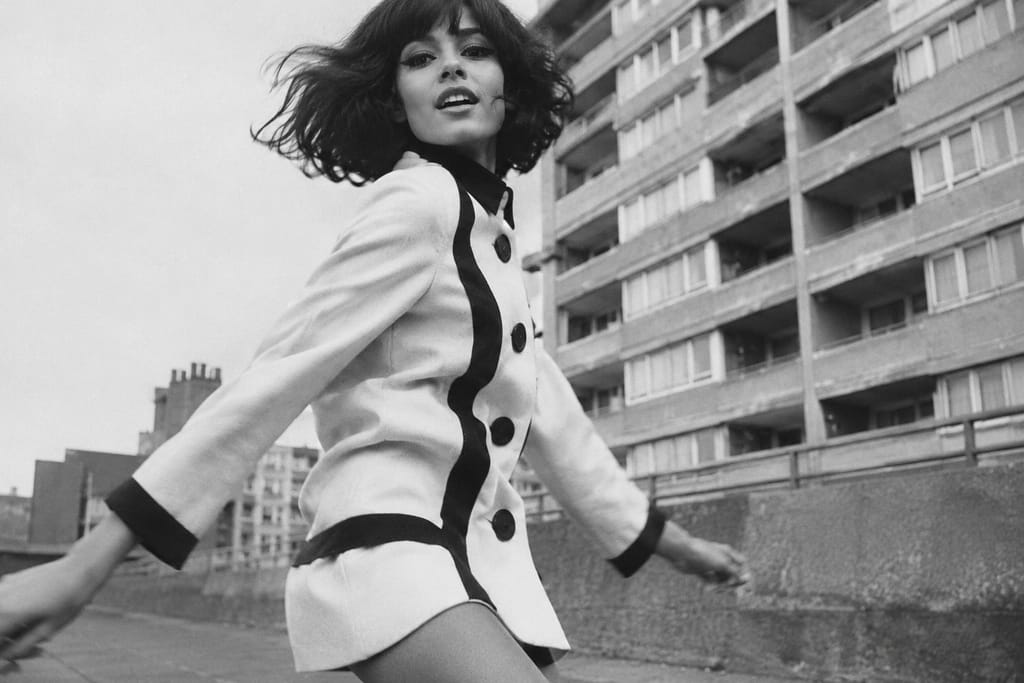
A woman with a swinging dark bob looks toward the camera with her arms extended, wearing a short white outfit with bold black trim and large black buttons. Concrete apartment blocks rise behind her in this low-angle black-and-white image. What the check saw. Grainy monochrome, a close low viewpoint and swinging hair give this fashion photograph an energetic, retro street-shoot appearance.
With other styles
The opposite: Postwar couture fashion photography. Use the couture page as the foil: swap its held, profile poise and retouching for movement and a stare at the lens.
The opposite: Hollywood glamour portraiture. Hollywood sculpts a star with spotlights and retouching; here the same face is lit hard, flat and plain on white, with the freckles and hair left in.
Pairs with New York street photography. Borrow the wide lens, grain and tilted angles of the street school, but cast and clothe the people yourself.
Pairs with Street-style fashion photography. Street style shares the pavement and the youth but finds its clothes on strangers; this look commissions them and directs the model.
Sources
- https://en.wikipedia.org/wiki/David_Bailey
- https://en.wikipedia.org/wiki/Terence_Donovan_(photographer)
- https://en.wikipedia.org/wiki/Brian_Duffy_(photographer)
- https://en.wikipedia.org/wiki/Swinging_London
- https://collections.vam.ac.uk/item/O1240566/
- https://collections.vam.ac.uk/item/O92748/
- https://collections.vam.ac.uk/item/O1223460/
- https://amateurphotographer.com/technique/portrait_photography/a-look-back-at-terence-donovans-editorial-photography/