Styles / Documentary & reportage
Tabloid flash press photography
- Key: a flash on the camera, from the camera, hard.
The flash reaches only what is near it, so shadows and background fall to black.
Schematic, not to scale: worked out from the style’s choices. No set-up of this style has been rendered yet.
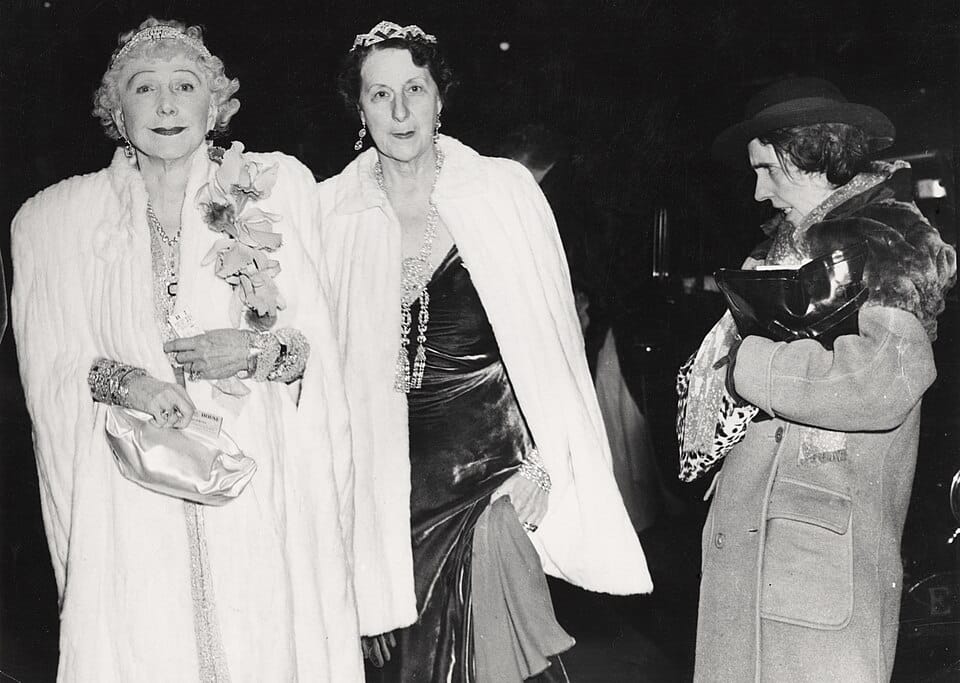
The Critic
Weegee, The Critic (1943); public domain in the US (published without notice), via Wikimedia Commons. Source: The Critic at Wikimedia Commons

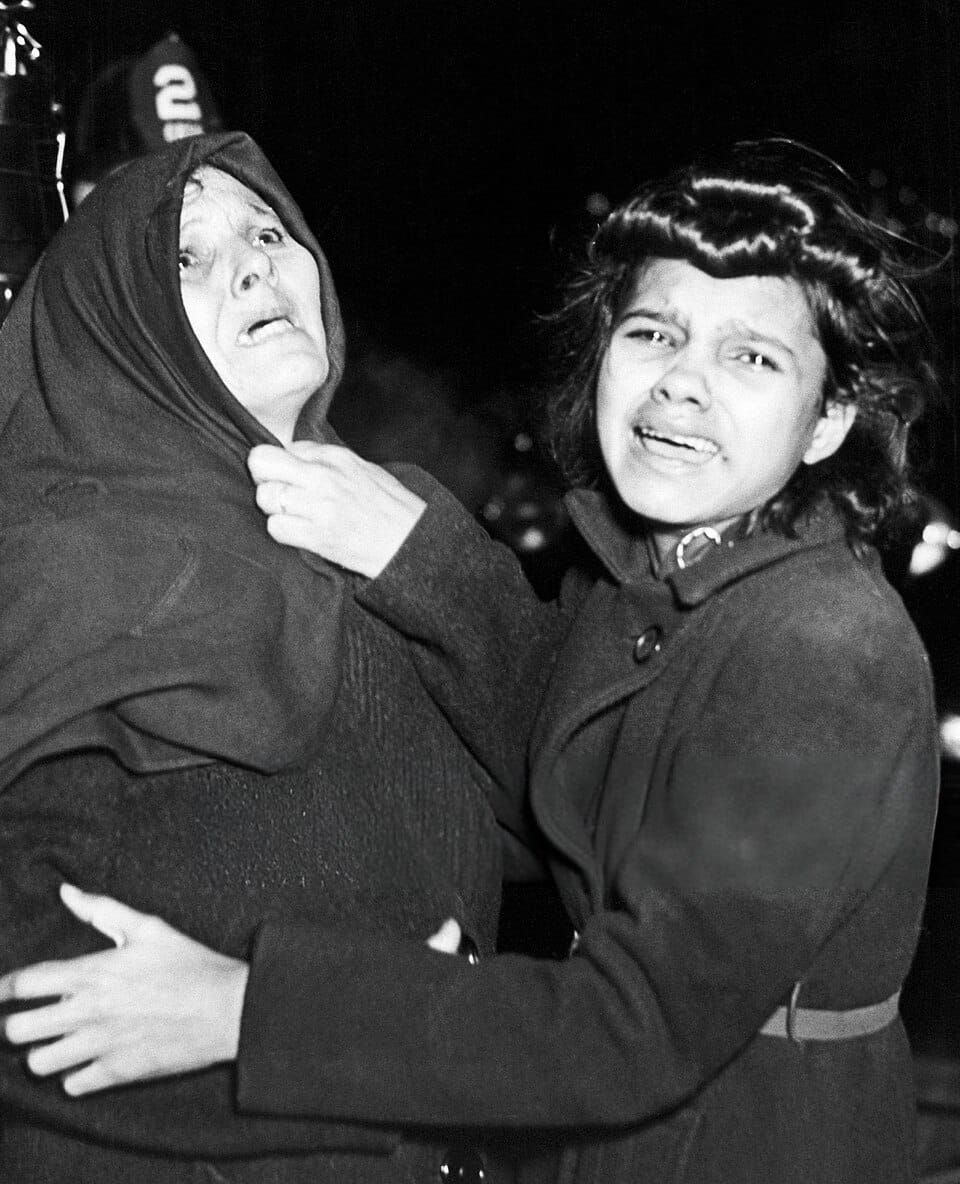
"I cried when I took this picture"
Weegee, ACME Newspictures (1939); public domain in the US (published without notice), via Wikimedia Commons. Source: "I cried when I took this picture" at Wikimedia Commons

Night-time news pictures for the tabloid front page: crimes, fires, accidents, arrests and the crowds that gather, shot on a 4x5 press camera with a single flashbulb at close range. The bulb makes faces and coats leap out white and hard-edged against a night that falls to black; shock, grief and gawking are frozen at middle distance, mostly straight on. Prints were cropped, retouched and headlined for the newspaper page, and some celebrated pictures were quietly set up.
Built mostly on one system: Event reportage. What systems are.
Shoot sheet for your kit A prompt for an image model The photographs
How the look is made
- Fit one flashbulb on the camera, set the lens to about f/16 and the focus to about ten feet, and work at that distance so the exposure is already made when the event happens.
- Arrive at the scene before the authorities, at night, and shoot the event and the people who gather around it rather than the place.
- Let the single flash blow the subject out bright and send everything beyond its reach to black; do not fill, soften or bounce it.
- Frame at middle distance, eye level and near the centre, and aim at faces: grief, shock and gawking read as the story.
- Take the frame on the instant and crop the print hard afterwards for the page; dodge, retouch and write the caption and headline for the newspaper.
- Stay open to staging a picture or choosing an angle that sharpens the story, but never present a set-up as an unposed event.
Shoot sheet for your kit
Fill in your camera, lenses and lights, and the sheet says which light plays each part, what to work around and where to start on your camera. Without a kit it starts on a full-frame camera.
Light
Key: a flash on the camera, from the camera, hard.
- The flash reaches only what is near it, so shadows and background fall to black.
- Shadow edges
- Shadows with crisp outlines, cast by a small or distant light: direct sun, a bare flash, a spotlight.
- Shadow depth
- Shadows with no fill at all that fall to pure black with no detail, so parts of the subject disappear.
- Highlights
- The brightest parts burn out to pure white with no detail, on purpose or because the light was too strong. Small, bright glints where the light reflects off wet, oily or polished surfaces: glistening food, dewy skin, the sparkle of jewellery or chrome.
How the style is lit
- One flashbulb on the camera, about ten feet from the subject, against a dark street.
- Flashbulb held off to the side on a bracket, hard shadows thrown on a wall or pavement.
- A flash fired at an event lit only by street lamps, headlights or fire.
This plan is worked out from the style’s choices, so it is drawn as a schematic. One way to get the light, not a record of how any photograph was lit.
Lens and settings
Start at
On a full-frame camera: the same depth of field and exposure as the style’s own numbers, in the same light. Then meter and adjust.
- The style’s f/13 on 4 × 5 in gives about the depth of field of f/3.7 on full frame.
- With flash, 1/125 s stays under every camera’s flash sync speed (1/160–1/250 s, by camera): set the exposure with the flash power and the f-number.
- Then
- 35–50 mm · f/11–f/16 · 1/200–1/50 s · ISO 100–400 on 4 × 5 in, documented. Weegee's Speed Graphic was preset at f/16, 1/200 s and a focus distance of ten feet, with flashbulbs. The focal-length equivalent (a 135-150 mm lens on 4x5 is roughly a normal lens, about 40-50 mm) and the film speed are inferred; shutter speeds on the Speed Graphic's focal-plane shutter run from about 1/10 to 1/1000 s.
- Focal length
- Roughly the eye’s own perspective; no visible distortion.
- Focus
- Everything sharp from the nearest stone to the horizon.
- Angle
- The camera at the height of a standing person or of the subject.
- Distance
- Whole figures and their immediate surroundings. Within arm’s reach: faces, hands and details fill the frame.
- Balance
- The subject in the middle, the frame balanced around it.
- Crop & fill
- The edges cut into the subject: heads, limbs or objects run out of frame.
- Instant
- Movement stopped dead by a fast shutter or flash. A casual, unplanned instant, taken quickly. Gesture and geometry peak together in one instant.
Direct
Nobody is posed in the usual sense: victims, relatives, suspects and onlookers are caught in the instant of shock, grief or bluster, often with eyes and mouths wide and hands to the face, and many turn and stare straight into the flash. Suspects hiding their faces and crowds pressing into the frame are kept; a few celebrated pictures were arranged, so any set-up should be disclosed.
- Head & gaze
- Looking straight into the camera, so the subject meets the viewer’s eye.
- Expression
- Tears, grief, anger, fear or elation shown openly on the face and in the body.
- The moment
- People photographed as they are, unaware or unconcerned.
- With the sitter
- The subject sees the camera and reacts to it.
Style the set
Nothing is styled: coats, hats, work clothes, uniforms, evening dress and nightclothes as the people stood when the event found them, on pavements, in doorways and tenement stairs, with fire engines, police cars and wet streets behind. Any retouching is done afterwards on the print, to clean the background, sharpen the cut-out and suit the page.
- Clothes
- What people happened to be wearing; nothing chosen for the picture.
- How much is styled
- Nothing dressed, made up, moved or added for the picture.
Finish
- Monochrome
- A black-and-white scale pushed towards pure black and pure white, with few middle greys. Rich blacks, clean whites and every grey between.
- Film
- A view camera on a tripod: great detail, slow and deliberate.
- Post-production
- Areas lightened and darkened by hand in printing. Perfected skin and surfaces. Words or graphic marks added to the photograph.
- Shown in
- Pictures made for magazine pages and spreads.
Stay away from 35 mm film, soft studio light, shallow depth of field, soft focus & diffusion, golden hour, saturated colour, hdr & tone-mapped, glamour & aspiration, deadpan and relaxed & natural.
Before you shoot it
The photographs show real people at their worst moments: murder and accident victims, bereaved families, people under arrest, and in some cases the dead or dying, published without consent and to sell newspapers; Howard's Snyder picture was taken in secret at an execution. The look can glamorise violence and sensationalism; use it for staged, clearly labelled fiction with adult actors, name no living photographer, and credit the estates of Weegee and the press photographers where their work is shown. Some celebrated pictures were staged, so treat captions with care.
A prompt for an image model
No prompt for this style
Behind its pictures: real victims, arrestees and the dead.
Caution forbids generating real people, invented crimes or images passed off as vintage news.
The photographs show real people at their worst moments: murder and accident victims, bereaved families, people under arrest, and in some cases the dead or dying, published without consent and to sell newspapers. Never generate identifiable real people, a fake crime, fire or accident, or any image of a death, and never present a generated image as a vintage news photograph. The look can glamorise violence and sensationalism. Some celebrated pictures were staged, so treat captions with care.
Work with photographers of this tradition, or take only its light and lens (the shoot sheet above) without its people, places or rituals.
Where to see it
From open collections, shown whole with their credits. Later photographs are linked, not shown, while they are in copyright.
With other styles
Pairs with New York street photography. Both work New York at close range with a flash and stare-back faces; use the 1960s school's wide angle and grain when the brief wants unease without a news event.
The opposite: Diaristic snapshot photography. Same on-camera flash and black backgrounds, but intimate, colour and about friends; choose it when the flash should describe belonging, not strangers' crises.
The opposite: Picture-magazine photo essay. A photo essay builds a story across many pictures with text; the tabloid picture is one hard frame that carries the front page alone.
The opposite: FSA/OWI documentary photography. Patient daylight documents of poverty on large and medium negatives set off the flash's instant of crisis; borrow its dignity when the subject is the victim.
Sources
- Weegee, Wikipedia: https://en.wikipedia.org/wiki/Weegee (1899-1968; 4x5 Speed Graphic 'preset at f/16 at 1/200 of a second', flashbulbs, ten feet; Naked City 1945; MoMA acquired five photographs in 1943 for Action Photography; The Critic later revealed as staged; 1938 police-radio permit)
- Speed Graphic, Wikipedia: https://en.wikipedia.org/wiki/Speed_Graphic (made 1912-1973; 4x5 the most common size; Pulitzer photographs of 1942-1953 made with Speed Graphics; focal-plane shutter about 1/10 to 1/1000 s)
- New York Daily News, Wikipedia: https://en.wikipedia.org/wiki/New_York_Daily_News (founded 1919 as the Illustrated Daily News, the first US daily in tabloid format; circulation peak 1947)
- Ruth Snyder, Wikipedia: https://en.wikipedia.org/wiki/Ruth_Snyder (Tom Howard's secret photograph of the execution at Sing Sing, 12 January 1928, with a miniature camera strapped to his ankle, published in the Daily News)
- The Critic by Weegee, Wikimedia Commons: https://commons.wikimedia.org/wiki/File:The_Critic_by_Weegee.jpg (taken 22 November 1943; reportedly given to ACME Newspictures in 1945 per Commons; public domain, no notice)
- 'I cried when I took this picture' by Weegee, Wikimedia Commons: https://commons.wikimedia.org/wiki/File:%22I_cried_when_I_took_this_picture%22_by_Weegee.jpg (14 December 1939, ACME Newspictures caption)