Styles / Documentary & reportage
Tio Fotografer Swedish humanist-subjective photography
- Key: the open sky, all around and above, soft.
Open shadows: bright surroundings (walls, ground, sky) fill them; no reflector needed.
Schematic, not to scale: worked out from the style’s choices. No set-up of this style has been rendered yet.
The photographs that define it are still in copyright, so they are linked below rather than shown.
Black-and-white magazine and book photography of ordinary Swedish life, made from 1958 (with earlier group shows from 1949) by a Stockholm group of freelance photographers: people in the new welfare-state suburbs and old city streets, caught unposed on 35 mm. The photographer's personal view carries a quiet warmth and solidarity with the people shown, rather than French wit or experimental abstraction. Plain daylight and a graphic crop are inferred cues, not documented ones.
Built on two systems: Event reportage and Flash snapshot. What systems are.
Shoot sheet for your kit A prompt for an image model The photographs
How the look is made
- Photograph the everyday life of your own city and its people, children, workers and shoppers, as a freelance reporter would for a picture magazine.
- Work on 35 mm in plain daylight, overcast or open shade, and expose for the faces (inferred from the picture-magazine practice of the era).
- Crop hard and graphically: cut the figure at the knee or shoulder and let a wall, a window or a kerb set the frame.
- Wait unseen at eye level for a small unposed moment of warmth, a child's gesture or a worker's pause, and keep it dry, never sweet or comic.
- Print black and white with a full range of greys and visible grain, and keep the printing honest, without darkroom tricks (an inferred practice, not documented for the group).
- Edit your pictures into a series or essay for a magazine spread or a book, and let your own view of the people show in what you choose.
Shoot sheet for your kit
Fill in your camera, lenses and lights, and the sheet says which light plays each part, what to work around and where to start on your camera. Without a kit it starts on a full-frame camera.
Light
Key: the open sky, all around and above, soft.
- Open shadows: bright surroundings (walls, ground, sky) fill them; no reflector needed.
- Shadow depth
- Shadows kept light and full of detail by a reflector, a fill light, bounce or bright surroundings (a low lighting ratio, up to about 3:1: the shadow side at most a stop and a half darker).
How the style is lit
- Overcast or open-shade northern daylight, no fill and no flash.
- Window light for indoor scenes, in kitchens, schools and workplaces.
This plan is worked out from the style’s choices, so it is drawn as a schematic. One way to get the light, not a record of how any photograph was lit.
Lens and settings
Start at
On a full-frame camera: the same depth of field and exposure as the style’s own numbers, in the same light. Then meter and adjust.
- Then
- 35–50 mm · f/4–f/11 · 1/250–1/60 s · ISO 100–400 on full frame, inferred from the gear and the look. Inferred from the 35 mm reportage practice of the picture-magazine era and from the look of surviving prints; no member's exposures, cameras, film or paper are documented in the sources read. Daylight at f/5.6-f/11 and 1/125-1/250 s, wider and slower indoors.
- Focal length
- Roughly the eye’s own perspective; no visible distortion.
- Angle
- The camera at the height of a standing person or of the subject.
- Crop & fill
- The edges cut into the subject: heads, limbs or objects run out of frame.
- Instant
- Gesture and geometry peak together in one instant.
Direct
Almost nobody is posed. Children play, shoppers cross a square and workers pause, mostly absorbed in what they are doing and looking past the camera, faces calm or lit by a small smile. When a portrait is made, the sitter stands or sits in their own place and keeps an everyday expression, with no stylised gesture.
- Head & gaze
- Attention on what the hands are doing or on a thing (working, reading, eating, playing), not on the camera.
- The moment
- People photographed as they are, unaware or unconcerned.
Style the set
Nothing is styled. People wear their own overcoats, work clothes, school clothes and Sunday best, and the street, shop, playground or flat is taken as found, in its modern or worn state. Signs, prams and bicycles stay where they stand and become part of the graphic frame.
- Clothes
- What people happened to be wearing; nothing chosen for the picture.
Finish
- Monochrome
- Rich blacks, clean whites and every grey between.
- Film
- A small handheld camera: quick, mobile, grainy when pushed.
- Texture
- Film grain or noise you can see at normal size.
- Shown in
- Pictures made for magazine pages and spreads.
Stay away from composite & montage, solarisation, cameraless, saturated colour, theatrical & acted, fully art-directed, full glamour make-up, confrontational, deadpan and tilted angle.
Before you shoot it
The photographs show real people, many of them children and workers who never agreed to be an example, and the group's members and their heirs hold the copyright; some members may be living, and Hans Malmberg (died 1977) is the only member whose work is documented in the sources read. Photograph strangers only where the law and local custom allow, keep identifiable children out of anything public without parents' consent, and do not use the warm tone to dress up poverty or hardship.
A prompt for an image model
A ready prompt that describes this look to an image model: where the lights stand, the lens, the framing and the colour. It starts on the style’s own choices; change any of them and the prompt and the notes follow.
The prompt
Notes on this prompt
- How the style uses it: crop hard and graphically: cut the figure at the knee or shoulder and let a wall, a window or a kerb set the frame. Image models put the light in the wrong place more often than anything else, so the prompt says where each light stands: which side of the picture, and how high. Keep to one light pattern per prompt, or the model splits the difference.
- Black and white: colour words in the subject (a red dress, green leaves) can pull the model back to colour, so leave them out.
- Image models smooth grain away; ask for it to be visible at full size.
The model makes a new picture, not a photograph of anything that happened. Label it as AI-generated, and don’t pass it off as the style’s history or as a real person.
Where to see it
From open collections, shown whole with their credits. Later photographs are linked, not shown, while they are in copyright.
In copyright, so linked
- Hässelby Familjehotell, daghemmet (day nursery) , Lennart Olson (Commons summary; the original upload template says unknown), 1956. Wikimedia Commons (from Byggmästaren nr 7, 1956; tagged public domain in Sweden only).
- Götgatan mot norr, Stockholm (green wave trial) , Tore Johnson (credited as Tore Johanson on Commons), 1958. Wikimedia Commons (Trafikkontorets arkiv, Stockholms stad; tagged public domain in Sweden only).
- Vällingby centrum, Stockholm , Lennart Olson, 1956. Wikimedia Commons (from Byggmästaren, 1956; tagged public domain in Sweden only).


Made by an AI model
An image gpt-image-2 made from this style’s choices, then checked against them by a vision model. Not a photograph, and not part of the style’s history. All generated images
-
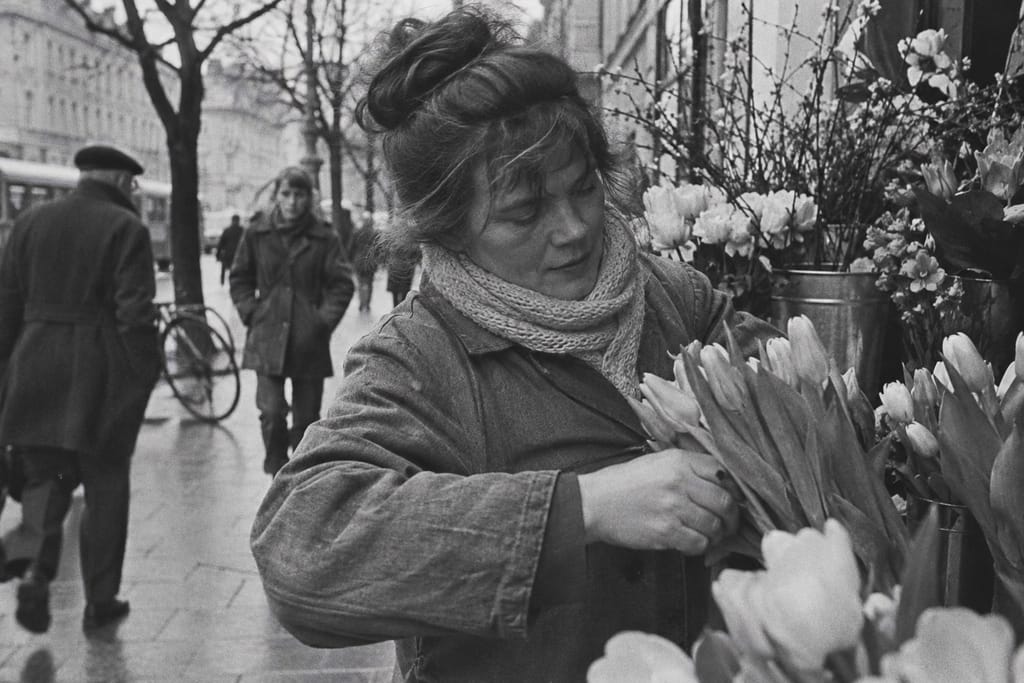
A woman in a coat and knitted scarf handles tulips at an outdoor flower stand. Pedestrians, a bicycle, bare trees and a bus appear along the wet city sidewalk behind her in this grainy black-and-white image. What the check saw. The image adopts a candid black-and-white street-photography style to depict everyday activity at a flower stall.
With other styles
Pairs with French humanist photography. Borrow the French school's patience for the gesture, then keep the Swedish crop, plain grey daylight and absence of wit, so the warmth stays reserved.
The opposite: Subjektive Fotografie. Steinert's circle abstracted and worked the darkroom; choose it for experiment, and this style when the person must stay recognisable in a straight print.
The opposite: New York street photography. New York's street photographers tilted, flashed and confronted; keep the level eye and the unnoticed approach here for a gentler read of the same crowd.