Styles / Early processes
West African coastal studio portraiture
- Key: the open sky, all around and above, soft.
- Reflector: a white card or reflector, about 55° to the camera’s right, soft.
Daylight studio: a skylight, a glasshouse or a courtyard, with a backdrop behind the sitter.
Schematic, not to scale: worked out from the style’s choices. No set-up of this style has been rendered yet.
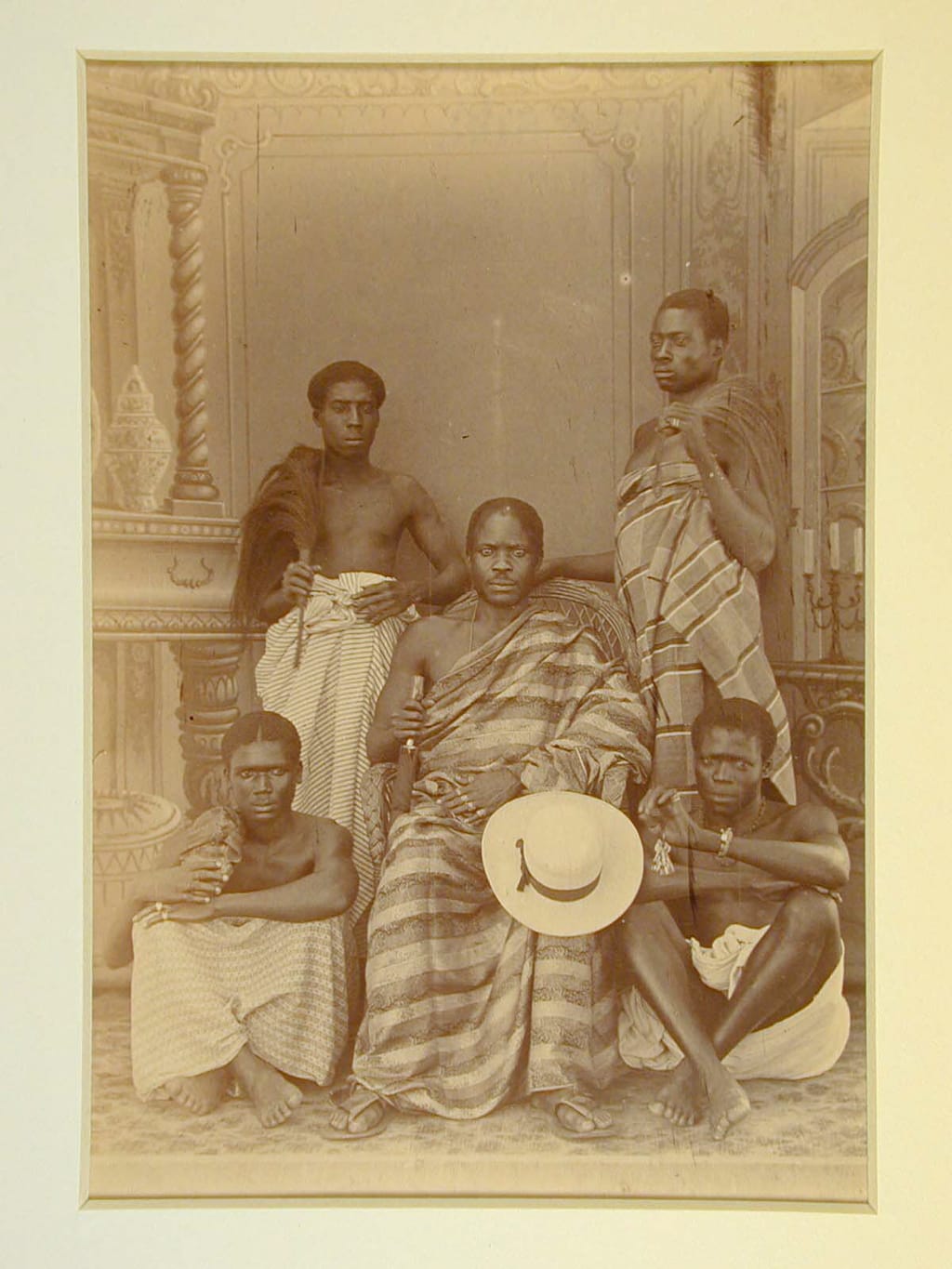
Five Men
Lutterodt and Son Studio, Five Men, ca. 1880-85, Metropolitan Museum of Art, Purchase, Ross Family Fund Gift, 1999 (1999.184.1); Open Access, via Wikimedia Commons. Source: Five Men at The Metropolitan Museum of Art

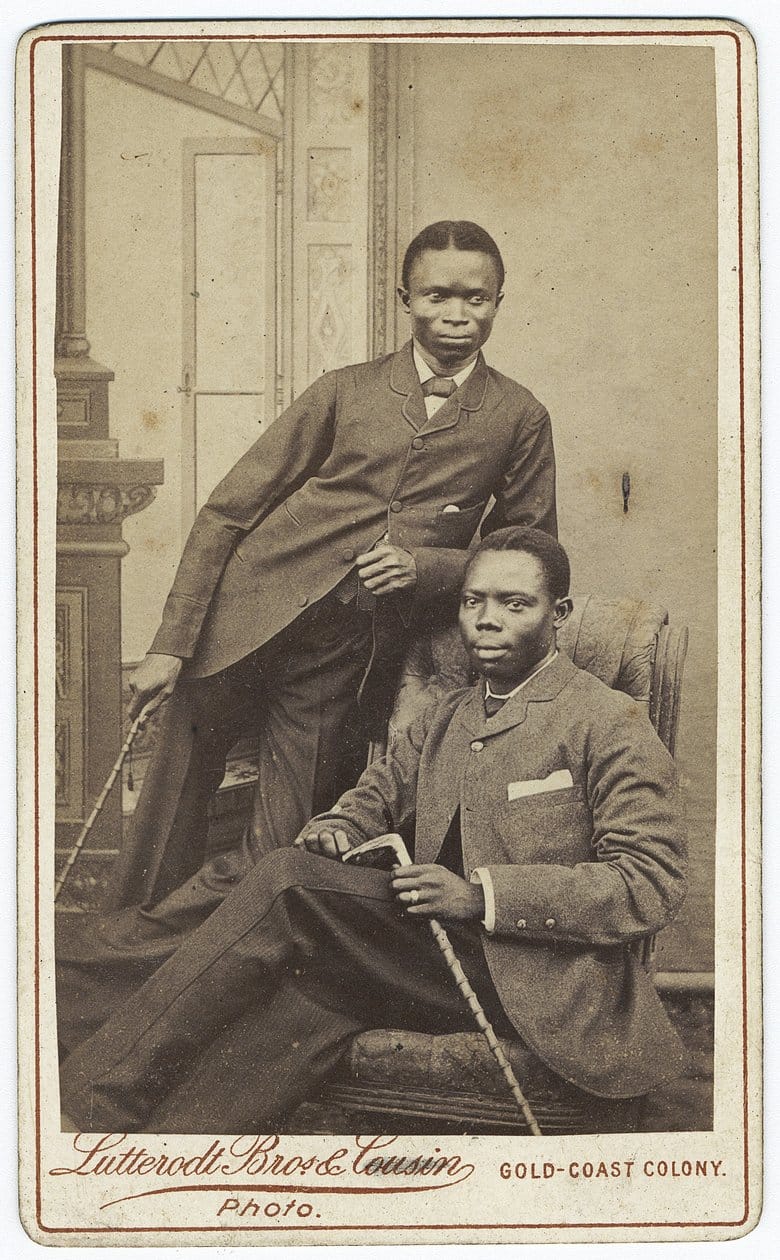
Double portrait of two men, Lutterodt Bros & Cousin
Lutterodt Brothers, double portrait, ca. 1880, public domain, via Wikimedia Commons. Source: Double portrait of two men, Lutterodt Bros & Cousin at Wikimedia Commons, from Harney, Mapping Modernisms (2018)

Whole-figure studio portraits made in the port towns of the Gold Coast and Sierra Leone by African and Euro-African photographers, in the Victorian carte and cabinet-card manner: sitters stand or sit beside a carved chair, column or painted backdrop in tailcoats, top hats, gowns and canes, or in wrapped cloth with a hat, fan or sword as a sign of rank. Dress and props were often the sitters' own. Mostly warm albumen prints on a card printed with the studio name; some Freetown postcards were made outdoors against a wall or veranda, in grey tones.
Built on two systems: Painted studio and Albumen view. What systems are.
Shoot sheet for your kit A prompt for an image model The photographs
How the look is made
- Let the sitters bring their own standing: a frock coat, gown, wrapped cloth, hat, cane, fan or sword, chosen by them and shown in full.
- Show the whole figure or the whole group on a small stage: a carved chair, a column, a rug, a painted or panelled backdrop.
- Pose for dignity: stand upright or sit square with a hand on the chair back or a prop, face composed, eyes at the lens, held still.
- Light from a skylight or open side and keep it soft, so face, cloth and backdrop all stay readable.
- Print on warm albumen paper from a glass negative and mount it on a card with the studio name and place; some prints become postcards.
Shoot sheet for your kit
Fill in your camera, lenses and lights, and the sheet says which light plays each part, what to work around and where to start on your camera. Without a kit it starts on a full-frame camera.
Light
Key: the open sky, all around and above, soft.
Reflector: a white card or reflector, about 55° to the camera’s right, soft.
- Daylight studio: a skylight, a glasshouse or a courtyard, with a backdrop behind the sitter.
- Shadow edges
- Shadows that fade gradually from light to dark, cast by a large or diffused light: a window, a softbox, a cloudy sky.
- Shadow depth
- Shadows kept light and full of detail by a reflector, a fill light, bounce or bright surroundings (a low lighting ratio, up to about 3:1: the shadow side at most a stop and a half darker).
How the style is lit
- Skylight or open side window in a studio with a painted backdrop, softened with blinds and light reflectors.
- Even daylight on a veranda or in a garden, for portraits made outdoors against a wall or plain cloth.
- The same daylight lighting backdrop and figure alike, shadows soft and short under the chair and feet.
This plan is worked out from the style’s choices, so it is drawn as a schematic. One way to get the light, not a record of how any photograph was lit.
Lens and settings
Start at
On a full-frame camera: the same depth of field and exposure as the style’s own numbers, in the same light. Then meter and adjust.
- The style’s f/13 on 8 × 10 in gives about the depth of field of f/1.8 on full frame.
- Then
- 40–65 mm · f/8–f/22 · 1/10–3 s · ISO 3–50 on 8 × 10 in, inferred from the gear and the look. Documented only by the camera class: Lisk-Carew used 8 x 10 inch view cameras and albumen prints early on; glass negatives, studio daylight and 10 x 15 cm to 8 x 10 inch prints are typical. Lenses, stops, times and plate speeds are inferred from daylight-studio practice with slow glass plates, and no source records them for these studios.
- Focal length
- Roughly the eye’s own perspective; no visible distortion.
- Angle
- The camera at the height of a standing person or of the subject.
- Distance
- Whole figures and their immediate surroundings.
- Balance
- The subject in the middle, the frame balanced around it. The subject faces the lens; planes run parallel to the picture.
- Crop & fill
- The subject shown small within its setting, which explains it.
- Duration
- An unmoving scene, exposed slowly and carefully.
Direct
Let the sitter pick what to wear and hold, then place them: stand upright with one hand on a chair back, column or cane and the other holding a hat, glove, fan or sword; or sit square on a carved or wicker chair, hands at rest or on a prop. Groups cluster around a seated centre, the eldest or highest-ranking person, with the others standing behind or sitting at the sides and on the floor. Faces composed and unsmiling, eyes to the lens, held still.
- Body position
- Upright, weight on both feet, shoulders level: the plain, even stance of a formal sitting or a line-up. On a chair or stool, back straight, hands and feet placed: the formal sitting.
- Turn to the camera
- Shoulders and hips face the lens straight on: direct, symmetrical, sometimes confrontational.
- Head & gaze
- Looking straight into the camera, so the subject meets the viewer’s eye.
- Arms & hands
- Arms by the sides, hands folded in the lap or resting on a chair: quiet and formal. Hands busy with a prop or a tool: flowers, a phone, a cup, a cigarette, an instrument, one’s own work.
- Line & energy
- Rigid and motionless, sometimes braced against a head rest or gripping a chair: held for a long exposure or a solemn occasion.
- Expression
- Unsmiling, composed and blank: the face gives nothing away.
- Several people
- Bodies close together, overlapping and leaning in: friends, a band, a family on a sofa.
- With the sitter
- The sitter arranged and still, facing the camera. The subject performs for the camera and shapes the picture.
Style the set
Sitters wear their own best: tailcoats, waistcoats, top hats and canes, or long gowns with fans and brooches; or wrapped, striped and patterned cloth, with a straw hat, a fly whisk, a sword or a staff as a sign of rank, often mixed with European dress. The studio supplies the set: a painted or panelled backdrop, a column, a carved or wicker chair, a rug.
- Clothes
- Best clothes, jewellery and accessories put on for the studio or the occasion. The wearers’ own festive, religious or wedding clothes: saris and lehengas, boubous, robes, kimono. Outfits the wearers put together to be seen, designer labels included: layering, sneakers, statement pieces.
- Set & props
- A painted, cloth, paper or seamless backdrop behind the subject. Things shown to say who the sitter is or wants to be, their own or lent by the studio: a radio, a bicycle, a watch, books, tools. The stock furniture of a portrait studio, standing in for a setting: a posing chair, a column, a balustrade, a draped table, a potted palm.
Finish
- Monochrome
- A monochrome image tinted sepia, brown, selenium purple or cyanotype blue.
- Colour
- An overall yellow, orange or red cast.
- Early processes
- Warm-brown prints of the 19th century, made from negatives.
- Film
- A view camera on a tripod: great detail, slow and deliberate.
- Texture
- The film edge, rebate or frame left in the picture.
- Post-production
- Nothing changed beyond exposure and development.
- Shown in
- Prints for an album, a card or a frame at home.
Stay away from snapshot, candid & unobserved, direct on-camera flash, tilted angle, visible grain, laughing, fast, full-body movement, shallow depth of field, low-key & chiaroscuro, black shadows and unstyled, as found.
Before you shoot it
These are portraits of real people, mostly unnamed in the surviving prints, taken in colonial coastal towns; some sitters were chiefs and elders, and some pictures were sold as postcards for the tourist and colonial market without the sitters' consent. Photographers of this circle also made ethnographic and masquerade views (for example of Sande society initiates, which carry sacred meaning), which are not part of this style. Credit the studios and name the sitters where they are known; credit, where known, the archive or family that holds the prints.
A prompt for an image model
No prompt for this style
Behind its pictures: colonial-era portraits of real sitters sold without consent, and views of sacred initiates.
Caution forbids reproducing the colonial gaze on new sitters.
These are portraits of real people, mostly unnamed in the surviving prints, taken in colonial coastal towns; some sitters were chiefs and elders, and some pictures were sold as postcards for the tourist and colonial market without the sitters' consent. Photographers of this circle also made ethnographic and masquerade views, which are not part of this style. Credit the studios and name the sitters where they are known; credit, where known, the archive or family that holds the prints.
Work with photographers of this tradition, or take only its light and lens (the shoot sheet above) without its people, places or rituals.
Photographs that define it
From open collections, shown whole with their credits. Later photographs are linked, not shown, while they are in copyright.
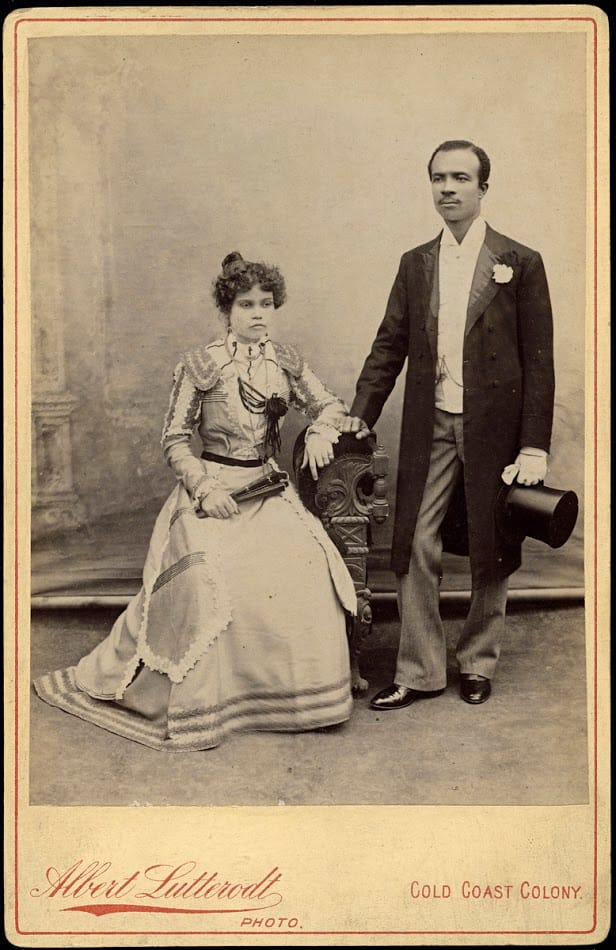
Double portrait of a couple, Albert Lutterodt
Albert Lutterodt, double portrait, before 1900, public domain, via Wikimedia Commons (Luminous-Lint credit). The Commons file title names the sitters (Albert Lutterodt with Mrs Lutterodt), but that identification is unverified, so they are not named here. Source: Double portrait of a couple, Albert Lutterodt at Wikimedia Commons (via Luminous-Lint)

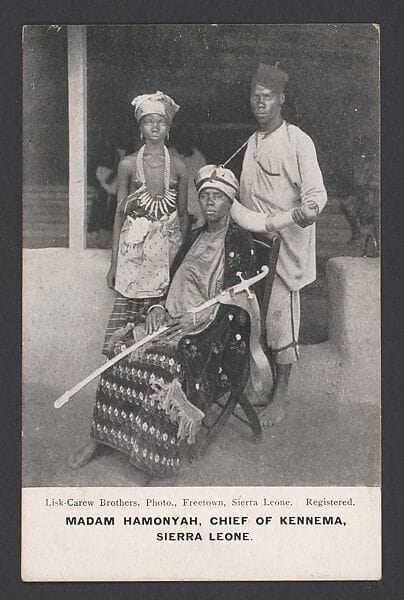
Madam Hamonyah, Chief of Kennema, Sierra Leone
Lisk-Carew Brothers, Freetown, Madam Hamonyah, Chief of Kennema, postcard, 1905-07, public domain, via Wikimedia Commons (page gives a source link to the Met collection page). Source: Madam Hamonyah, Chief of Kennema, Sierra Leone at Wikimedia Commons, crediting the Metropolitan Museum of Art

With other styles
Pairs with Carte-de-visite studio portraits. Start from the carte's whole-figure stage, but let the sitters choose their own dress, props and rank signs, and print on a card with the local studio name.
The opposite: Malian studio portraiture. Bamako sitters stand in black-and-white, flat-lit by daylight before a hung patterned cloth; here the sitters use a Victorian painted backdrop and carved chair on warm albumen, so choose the set and print to match the decade.
Pairs with Sapeur dandy portraiture. Both show sitters dressing with care to be seen as they wish to be; here the dress is tailcoat or wrapped cloth in a studio, not a street in colour.
Sources
- Alphonso Lisk-Carew, Wikipedia: https://en.wikipedia.org/wiki/Alphonso_Lisk-Carew (Lisk-Carew Brothers founded 1905 in Freetown; trained under W. S. Johnston, whose business began in 1893; Victorian-style portraits with painted backdrops for Creole and European clients; 8 x 10 inch view cameras and albumen prints early on; picture postcards; the Duke of Connaught's visit, 1910; scholarship by Julie Crooks and Christraud Geary)
- Lutterodt photographers, Wikipedia: https://en.wikipedia.org/wiki/Lutterodt_photographers (family of Danish and Ga descent; Accra studio and itinerant work along the coast from the 1870s; Albert George Lutterodt from about 1876; Frederick R. C. Lutterodt, Accra studio 1889; Gerhardt Lutterodt trained Alex Agbaglo Acolatse; hand-painted backgrounds; few attributed images)
- Five Men, Lutterodt and Son Studio, Metropolitan Museum of Art (accession 1999.184.1), via the Met Open Access API: https://collectionapi.metmuseum.org/public/collection/v1/objects/512837 (ca. 1880-85; albumen silver print from glass negative, 15.2 x 10.5 cm; public domain)
- Lutterodt Brothers, double portrait, ca. 1880, Wikimedia Commons: https://commons.wikimedia.org/wiki/File:Lutterodt_Brothers_-_Double_portrait_1880s_(albumen_print).jpg (card marked Lutterodt Bros & Cousin, Gold-Coast Colony; public domain; credits Harney 2018, The Modernist Lens of Lutterodt Studios)
- Double portrait by Albert Lutterodt, Accra, Wikimedia Commons: https://commons.wikimedia.org/wiki/File:Albert_Lutterodt_with_Mrs_Lutterodt.jpg (cabinet card marked Albert Lutterodt, Cold Coast Colony; before 1900; public domain)
- Madam Hamonyah, Chief of Kennema, Lisk-Carew Brothers, Wikimedia Commons: https://commons.wikimedia.org/wiki/File:Madam_Hamonyah,_chief_of_Kennema.jpg (postcard 13.7 x 8.9 cm, 1905-07; the page gives a source link to metmuseum.org/art/collection/search/320907; public domain)
- Lisk-Carew Brothers, Wikimedia Commons category: https://commons.wikimedia.org/wiki/Category:Lisk-Carew_Brothers (public-domain postcards and portraits)