Styles / Early processes
Western survey photography
- Key: the sun, from the camera’s left, at the side, high, hard.
Key high: about 30–45° above eye level, angled down.
Schematic, not to scale: worked out from the style’s choices. No set-up of this style has been rendered yet.
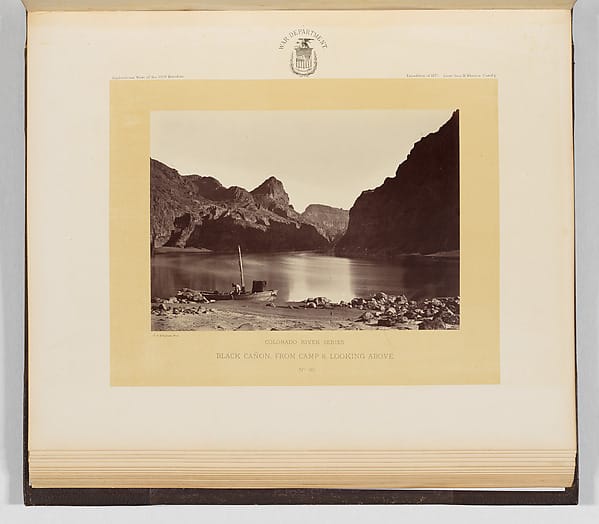
Black Cañon, From Camp 8, Looking Above
Timothy H. O'Sullivan, Black Cañon, From Camp 8, Looking Above, 1871. The Metropolitan Museum of Art, Purchase, Joseph Pulitzer Bequest and The Horace W. Goldsmith Foundation Gift through Joyce and Robert Menschel, 1986. Source: Black Cañon, From Camp 8, Looking Above at The Metropolitan Museum of Art
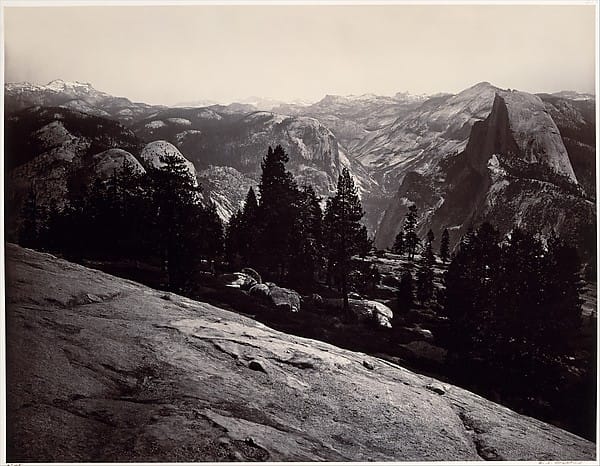
View from the Sentinel Dome, Yosemite
Carleton E. Watkins, View from the Sentinel Dome, Yosemite, 1865-66. The Metropolitan Museum of Art, Purchase, Joseph Pulitzer Bequest, 1989. Source: View from the Sentinel Dome, Yosemite at The Metropolitan Museum of Art
Untouched western land made monumental and measurable: canyons, domes, rivers and rock seen from far off on huge glass plates, every plane sharp, printed as warm albumen prints on mounts. Blue-sensitive collodion often leaves the sky blank or pale, though clouds are sometimes recorded; hard sun rakes the rock. People are absent or tiny, a boat or camp giving scale. Issued as albums and stereo views for science and railroads, and sold to the public; glass sharpness and albumen gloss set it apart from the calotype's soft paper fibre.
Built on two systems: Albumen view and Deadpan document. What systems are.
Shoot sheet for your kit A prompt for an image model The photographs
How the look is made
- Pick the vantage first: climb to a dome, rim or bench so the whole valley, river or rock face opens out in layers from foreground boulder to far ridge.
- Set the camera on a tripod, stop down and expose long enough for every plane to be sharp; take the time the plate needs, not the time the scene gives.
- Wait for hard side sun that models rock and trees; accept a sky that is often blank or pale (clouds are sometimes recorded) rather than printing in fake clouds.
- Place a boat, tent, wagon or small figure to give scale, and leave the rest of the frame to land.
- Print straight on warm albumen paper and mount it; make a plate for the album and a stereo pair for the public.
Shoot sheet for your kit
Fill in your camera, lenses and lights, and the sheet says which light plays each part, what to work around and where to start on your camera. Without a kit it starts on a full-frame camera.
Light
Key: the sun, from the camera’s left, at the side, high, hard.
- Key high: about 30–45° above eye level, angled down.
- Shape & form
- Light turning gradually into shade across faces and objects, so their volume shows. Shadows thrown away from what casts them (a figure’s long shadow, railings on a wall) that become shapes of their own in the composition.
How the style is lit
- Hard high or side sun raking rock, trees and water, with deep open shadows and no fill.
- Bright overcast sky that often prints as an empty or pale sheet above the land, though clouds are sometimes recorded.
- No flash or added light; the camera waits for the sun to reach the face it wants.
This plan is worked out from the style’s choices, so it is drawn as a schematic. One way to get the light, not a record of how any photograph was lit.
Lens and settings
Start at
On a full-frame camera: the same depth of field and exposure as the style’s own numbers, in the same light. Then meter and adjust.
- The style’s f/27 on 8 × 10 in gives about the depth of field of f/3.6 on full frame.
- Then
- 24–50 mm · f/16–f/45 · 0.5–10 s · ISO 1–3 on 8 × 10 in, inferred from the gear and the look. Worked out from the wet-collodion process (a few seconds in daylight, blue and ultraviolet sensitivity only), tripod-mounted large plates and the sharpness of the plates; f-numbers are given for 8 x 10 inch, and mammoth plates take smaller stops still. Focal length is an estimate for lenses of roughly 12 to 20 inches on these plate sizes; no source consulted gives the settings.
- Focal length
- Roughly the eye’s own perspective; no visible distortion.
- Focus
- Everything sharp from the nearest stone to the horizon.
- Angle
- Looking down on the subject.
- Distance
- Standing well back; people are small.
- Crop & fill
- The subject shown small within its setting, which explains it. A small subject in a large empty field.
- Depth
- A strong horizon splits the frame into bands. Separate events in the foreground, middle ground and background.
- Duration
- An unmoving scene, exposed slowly and carefully.
Direct
People are scale marks, not sitters: where a figure appears it stands or sits at the base of a tree, on a rock or by a boat, small and still, held in place by the long exposure; many views have none. They are not portraits.
- Without a pose
- No people at all, or people so small or far off that their pose does not read (hands alone are Hands alone).
Style the set
Nothing is dressed: the land is photographed as found. A boat, camp, wagon, survey instrument or one or two small men standing or sitting are placed (or allowed) in the frame to give scale, and the rest is rock, water and trees.
- How much is styled
- Nothing dressed, made up, moved or added for the picture.
Finish
- Monochrome
- A monochrome image tinted sepia, brown, selenium purple or cyanotype blue.
- Colour
- An overall yellow, orange or red cast.
- Early processes
- Warm-brown prints of the 19th century, made from negatives.
- Film
- A view camera on a tripod: great detail, slow and deliberate.
- Texture
- The film edge, rebate or frame left in the picture.
- Post-production
- Nothing changed beyond exposure and development.
- Shown as
- Pictures made and shown as a set. Two or three pictures shown together as one work.
- Shown in
- Prints for an album, a card or a frame at home.
Stay away from man-altered land, portrait, shallow depth of field, soft focus & diffusion, golden hour, soft studio light, composite & montage, heavy retouching, colour as subject, directed scene & tableau and glamour & aspiration.
Before you shoot it
The land was Indigenous land, much of it taken or contested, and the surveys served mapping, mining, railroads and settlement; the Yosemite and Yellowstone views of the 1860s and 1870s belong to the story of removing the Miwok, Shoshone and others from them. Survey photographers also photographed Native people and survey staff by name or as types; do not recreate those portraits or stage Indigenous people as scenery or scale figures.
A prompt for an image model
No prompt for this style
Behind its pictures: views of Indigenous land and sacred places.
Caution forbids presenting a generated view as a real place or a vintage survey print.
Several landforms and places are sacred or in use by living nations, so do not present a generated view as a record of a real place or as a vintage survey print, and label any generated image as AI-generated.
Work with photographers of this tradition, or take only its light and lens (the shoot sheet above) without its people, places or rituals.
Photographs that define it
From open collections, shown whole with their credits. Later photographs are linked, not shown, while they are in copyright.
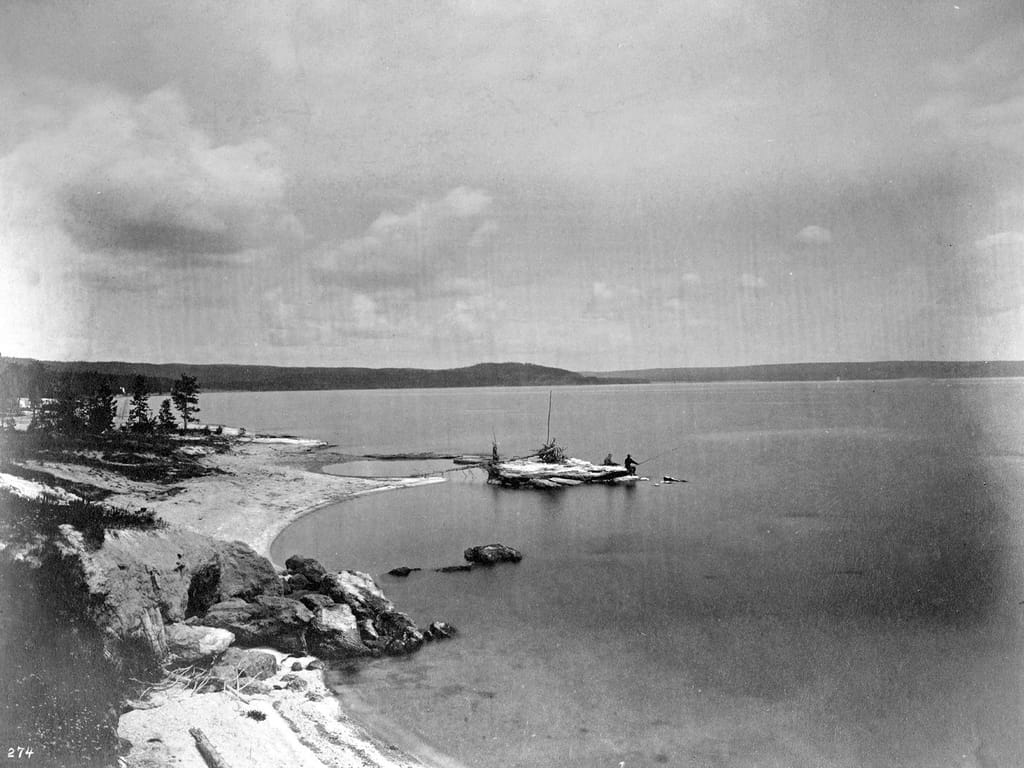
Yellowstone Lake, Southwest Arm
William Henry Jackson, Yellowstone Lake, Southwest Arm, Hayden Geological Survey of 1871. U.S. Geological Survey Photographic Library, public domain, via Wikimedia Commons. Source: Yellowstone Lake, Southwest Arm at U.S. Geological Survey Photographic Library, via Wikimedia Commons

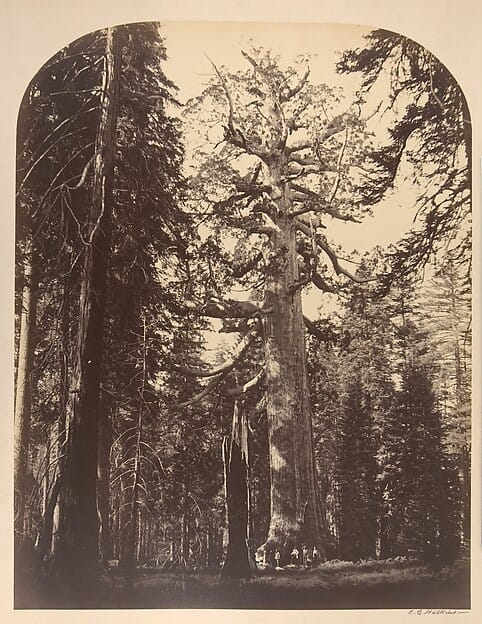
The Grizzly Giant, Mariposa Grove, Yosemite
Carleton E. Watkins, The Grizzly Giant, Mariposa Grove, Yosemite, 1861. The Metropolitan Museum of Art, Gilman Collection, Purchase, Gift of The Howard Gilman Foundation, by exchange, 2005. Source: The Grizzly Giant, Mariposa Grove, Yosemite at The Metropolitan Museum of Art
With other styles
Pairs with New Topographics. Its acknowledged descendant: keep the far, level, deadpan survey stance, but turn from wilderness to what people have built and let a series, not a monument, carry the point.
The opposite: Straight photography. Straight photography goes close and isolates forms on glossy gelatin silver for the gallery wall; the survey view stays far, includes the sky as blank paper and serves a report.
Pairs with Calotype and paper-negative photography. Both print warm on paper from a large negative and show land and buildings with no people to speak of; the calotype's paper negative leaves soft fibre and matte salted paper, while the survey view has glass-plate sharpness and glossy albumen.
Sources
- Carleton Watkins, Wikipedia: https://en.wikipedia.org/wiki/Carleton_Watkins (July 1861 Yosemite trip, 18 x 22 inch mammoth-plate camera and a stereo camera, Lincoln's 1864 Yosemite bill, medal at the Paris Exposition of 1867)
- Timothy H. O'Sullivan, Wikipedia: https://en.wikipedia.org/wiki/Timothy_H._O%27Sullivan (official photographer on the Fortieth Parallel Survey under Clarence King, Wheeler Survey west of the 100th meridian from 1871, earlier work for Brady and Gardner)
- William Henry Jackson, Wikipedia: https://en.wikipedia.org/wiki/William_Henry_Jackson (Hayden Surveys from 1870, 1871 Yellowstone, Yellowstone National Park March 1872, 18 x 22 inch plates for railroad work 1890-1892, sale of negatives to the Detroit Publishing Company in 1897)
- Wheeler Survey, Wikipedia: https://en.wikipedia.org/wiki/Wheeler_Survey (photographers O'Sullivan and William Bell, formal survey 1872-1879, earlier expeditions 1869-1871, Library of Congress holdings)
- Geological Exploration of the Fortieth Parallel, Wikipedia: https://en.wikipedia.org/wiki/Geological_Exploration_of_the_Fortieth_Parallel (fieldwork 1867-1872, Clarence King, O'Sullivan as photographer, results in eight volumes 1870-1880)
- Collodion process, Wikipedia: https://en.wikipedia.org/wiki/Collodion_process (wet plate exposed and developed within about 10-15 minutes, field darkrooms, blue and ultraviolet sensitivity, clouds hard to capture, collodion negatives printed on albumen paper)
- Metropolitan Museum of Art open-access records: Watkins, The Grizzly Giant, Mariposa Grove, Yosemite (1861) https://www.metmuseum.org/art/collection/search/283219; Watkins, View from the Sentinel Dome, Yosemite (1865-66) https://www.metmuseum.org/art/collection/search/689997; O'Sullivan, Black Cañon, From Camp 8, Looking Above (1871) https://www.metmuseum.org/art/collection/search/264711 (albumen silver prints from glass negatives, sizes and dates)