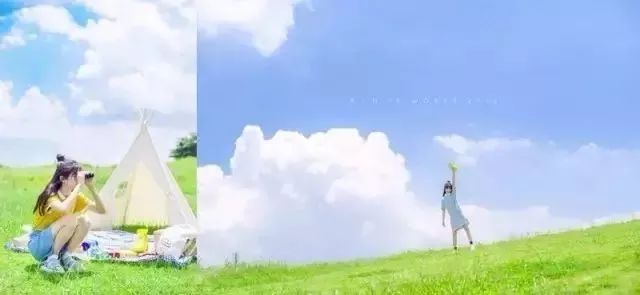
Styles / Digital & social
Xiaoqingxin (small fresh) photography
- Large side window: a large soft source, 140 × 220 cm, 1.3 m from the face, beside the subject, at the camera’s right, 32 cm above the eyes.
- White reflector fill: a white reflector, 100 × 120 cm, 1.1 m from the face, about 55° to the camera’s left, 13 cm below the eyes.
To scale, from the render’s scene file. One way to get this light, not a record of how any photograph was lit.
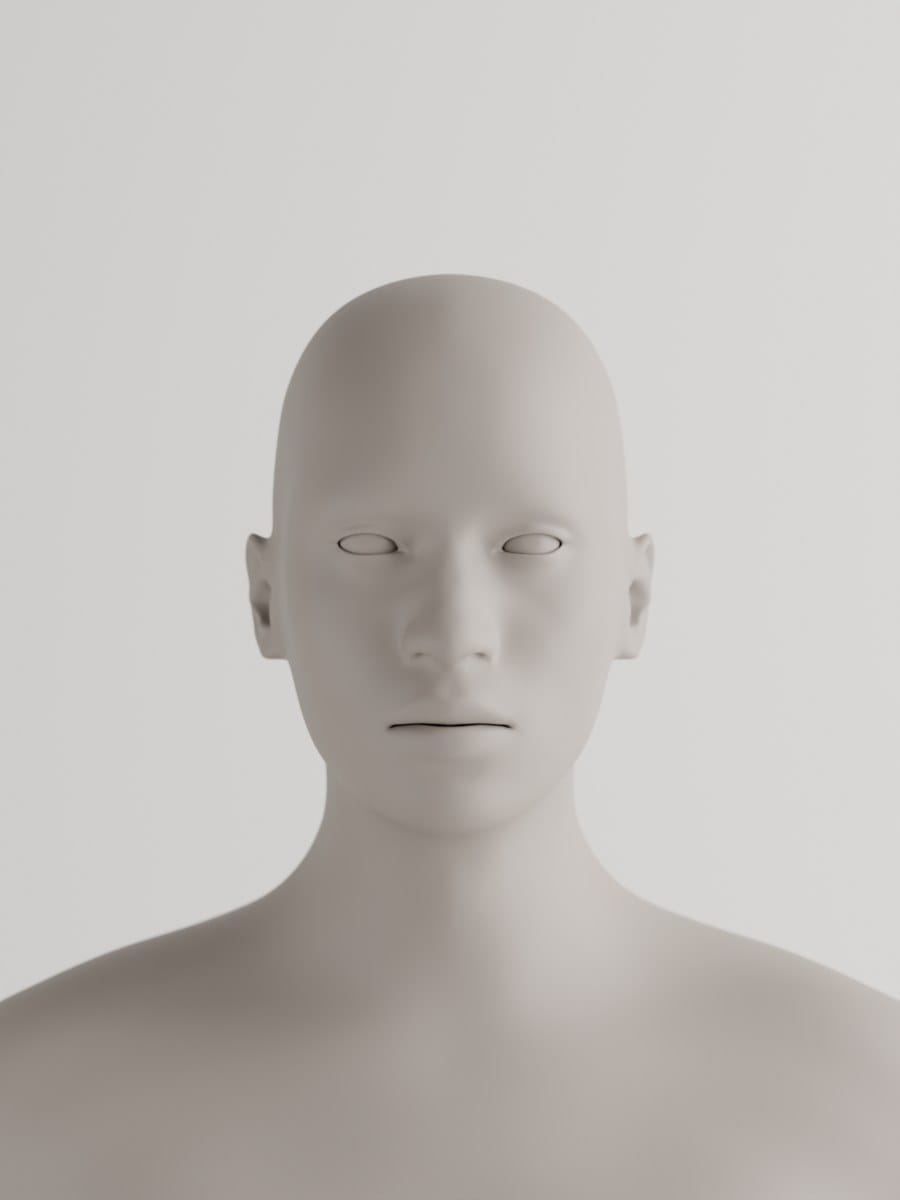
Rendered with this plan. A large side window close to the sitter, a white reflector opening the far cheek and a pale room behind (window light only, not the colour grade).
Render: a synthetic clay head made with MakeHuman, not a person, in Blender Cycles, 85 mm, f/5.6.
The photographs that define it are still in copyright, so they are linked below rather than shown.
An everyday idyll built before the shutter as well as in the grade: quiet location portraits, flowers and small domestic objects, clear compositions, pale clothing and bright available light. Low saturation and bright tones make the scene feel fresh; a cool cyan-green grade is characteristic, not compulsory. Chinese-language tutorials call it xiaoqingxin, often prefixed Japanese-style; film, digital cameras and phones all serve it. It is not a synonym for all contemporary Japanese photography.
Built mostly on one system: Sweet retouch. What systems are.
Shoot sheet for your kit A prompt for an image model The photographs
How the look is made
- Choose a small everyday subject or a quiet portrait setting; remove competing elements so the picture has one clear point.
- Build freshness with pale, simple clothes, flowers or a modest personal object, not elaborate bridal styling or luxury props.
- Use bright window light, open shade or backlight, keeping the face readable and avoiding clipped skin.
- Reduce saturation and contrast and lift the middle tones; for the cool-green variant, move foliage gently towards cyan-green while protecting skin. A restrained warm treatment can also belong.
- Alternate environmental views, portraits and close details in a small sequence instead of repeating one glamour pose.
- Direct quiet, unforced actions, a lowered gaze or a turn away; keep the participant's agency rather than manufacturing innocence.
Shoot sheet for your kit
Fill in your camera, lenses and lights, and the sheet says which light plays each part, what to work around and where to start on your camera. Without a kit it starts on a full-frame camera.
Light
Key: the open sky, all around and above, soft.
Rim or hair light: the sun, from behind, to the camera’s right, high, hard.
- Open shadows: bright surroundings (walls, ground, sky) fill them; no reflector needed.
- Shadow edges
- Shadows that fade gradually from light to dark, cast by a large or diffused light: a window, a softbox, a cloudy sky.
- Shadow depth
- Shadows kept light and full of detail by a reflector, a fill light, bounce or bright surroundings (a low lighting ratio, up to about 3:1: the shadow side at most a stop and a half darker).
How the style is lit
- A large side window in a pale room, with the subject close enough to the opening for soft cheek shadows; use a pale wall or white reflector to keep the far side readable.
- Afternoon sun behind the person in a leafy location, with open sky or pale ground filling the face; let the hair rim brighten without turning the face into a silhouette.
- Overcast daylight in a quiet location, using the broad sky for gentle shadows and keeping the background simple.
This plan is worked out from the style’s choices, so it is drawn as a schematic. The set-up at the top of the page is the one we rendered, to scale. One way to get the light, not a record of how any photograph was lit.
Lens and settings
Start at
On a full-frame camera: the same depth of field and exposure as the style’s own numbers, in the same light. Then meter and adjust.
- Then
- 35–85 mm · f/2–f/4 · 1/1000–1/125 s · ISO 100–800 on full frame, inferred from the gear and the look. A practical starting envelope for handheld daylight portraits, not a measured distribution or the settings of any specimen. Tutorials document normal and short-telephoto lenses and wide apertures; shutter and ISO here are inferred and must follow the actual light. Phone still lifes require their own format and deeper apparent focus.
- White balance
- Start daylight-balanced; for the common cool-green treatment, shift the surroundings gently towards cyan-green while protecting skin. Restrained warm variants are also documented.
- Focal length
- Roughly the eye’s own perspective; no visible distortion.
- Focus
- One plane sharp, the rest melting into blur and bokeh.
- Angle
- The camera at the height of a standing person or of the subject.
- Distance
- Within arm’s reach: faces, hands and details fill the frame.
- Crop & fill
- A small subject in a large empty field.
- Duration
- An unmoving scene, exposed slowly and carefully.
Direct
Use relaxed standing or seated positions, lowered eyes, a quiet sideward look, a turn of the back or hands occupied with a small object; include unposed-looking transitions without claiming an arranged portrait is candid. Still lifes have no figure.
- Head & gaze
- Eyes off the frame, past the camera or into the distance, as if lost in thought. Looking down, or eyes shut: inward, modest, asleep or praying.
- Line & energy
- Loose and unforced, as people stand and sit when they forget the camera, whether caught or coaxed by prompts.
- With the sitter
- The subject performs for the camera and shapes the picture.
- The set-up
- A scene staged and directed like a film still or a painting.
Style the set
Choose plain pale clothing, restrained natural-looking make-up, a small floral or fabric accent and an uncluttered real location; for objects, arrange flowers, glasses or other modest personal items on pale cloth. Keep such choices light rather than building an elaborate set.
- Clothes
- Simple, solid, unbranded clothes chosen so they do not distract from the face.
- Set & props
- Props chosen and placed for colour, texture and story: linen, ceramics, cutlery, flowers, scattered ingredients. A real place picked for its look as the setting for a shoot, not the subjects’ own: a street, a field, a palace, a hotel room.
- How much is styled
- A few small touches (a tidied table, a straightened collar, a chosen outfit) that still look unplanned.
- Look of the styling
- Few, simple elements on clean surfaces, with space around them.
Finish
- Colour
- Colour held back towards grey. An overall blue, cyan or green cast. Pale, light colours.
- Digital & other
- A modern digital camera: clean, detailed, neutral.
- Texture
- Smooth tones with no visible grain.
- Shown as
- Pictures made and shown as a set.
- Shown in
- Pictures made for a scrolling feed.
Stay away from direct on-camera flash, low-key & chiaroscuro, black shadows, saturated colour, teal & orange grade, hdr & tone-mapped, hyper-detailed and full glamour make-up.
Before you shoot it
This is a broad Chinese-language aesthetic label, not an ethnic identity, a claim about how all Japanese people photograph, or a licence to copy named living makers. Obtain consent for portraits and publication, credit the photographer and participant, and do not reproduce a real person's face or portfolio. Its youthful and sometimes school-uniform styling must not become sexualised innocence, compulsory pale skin or body reshaping: any illustrative people must be fictional adults, without school-age impersonation. Decorative film-poster templates in examples do not document a film, award or historical event; never present an illustration as a real person's memory or documentary record.
A prompt for an image model
A ready prompt that describes this look to an image model: where the lights stand, the lens, the framing and the colour. It starts on the style’s own choices; change any of them and the prompt and the notes follow.
The prompt
Notes on this prompt
- This is the set-up rendered at the top of the page, so the prompt puts its lights where the render has them. Image models put the light in the wrong place more often than anything else, so the prompt says where each light stands: which side of the picture, and how high. Keep to one light pattern per prompt, or the model splits the difference.
- Image models read “shallow depth of field” better than an f-number; the camera settings in the prompt are a guide to the look, not an order.
The model makes a new picture, not a photograph of anything that happened. Label it as AI-generated, and don’t pass it off as the style’s history or as a real person.
Where to see it
From open collections, shown whole with their credits. Later photographs are linked, not shown, while they are in copyright.
In copyright, so linked
- Back-turned portrait with a floral hair ribbon (descriptive title; first finished image in 夏日小清新) , Henry (hjcenry.com), Published 14 May 2022; article identifies the shoot with the May Day holiday. Henry, 开发技术分享 (hjcenry.com).
- White blouse, dark bow and loose hair against green bokeh (descriptive title; third finished image) , Henry (hjcenry.com), Published 14 May 2022; article identifies the shoot with the May Day holiday. Henry, 开发技术分享 (hjcenry.com).
- Lowered-gaze portrait in a dark blue dress on a garden path (descriptive title; fifth finished image) , Henry (hjcenry.com), Published 14 May 2022; article identifies the shoot with the May Day holiday. Henry, 开发技术分享 (hjcenry.com).
Made by an AI model
An image gpt-image-2 made from this style’s choices, then checked against them by a vision model. Not a photograph, and not part of the style’s history. All generated images
-
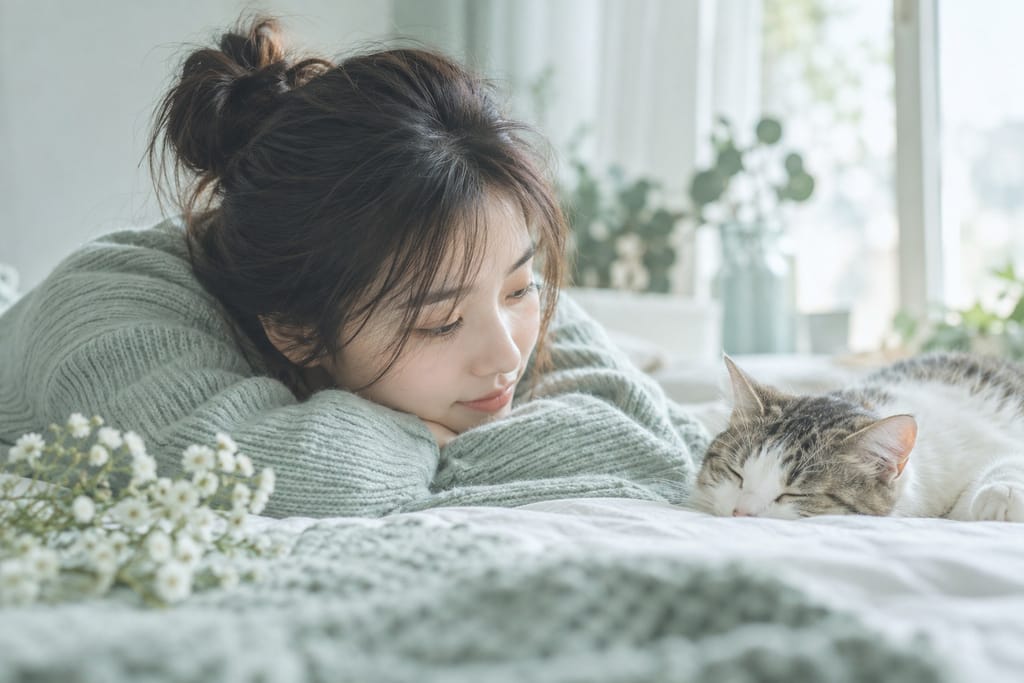
A woman with dark hair in a loose bun rests her chin on her folded arms, wearing a pale green knitted sweater and looking down at a sleeping tabby-and-white cat. They lie on white bedding beside a bright window, with small white flowers in the foreground and blurred plants behind them. What the check saw. This softly lit, closely framed portrait uses pale green and white tones and a sleeping cat to create a quiet, tender domestic scene.
With other styles
The opposite: Light and airy. Both use bright light, but replace the wedding album's affectionate couple and ivory romance with small everyday subjects; a cool cyan-green scene is one characteristic treatment, not a requirement.
Pairs with VSCO film-preset look. A restrained film filter can supply part of the finish, but choose the clean location, props and light first; a matte preset alone does not make a small-fresh photograph.
The opposite: Girly photo (onnanoko shashin). Keep the attention to ordinary life, but distinguish this carefully styled pale idyll from the earlier movement's often saturated, flash-lit, self-authored diary; no direct historical descent is claimed.
The opposite: Dark and moody food photography. For an everyday object sequence, choose between pale surroundings with open shadows and dark surfaces with negative fill instead of combining incompatible tonal aims.
Sources
- Fengniao, 日系小清新拍摄技巧及作品赏析, visible article date 1 July 2010: https://academy.fengniao.com/185/1851480_all.html . Contemporary evidence that the label was already popular; ordinary subjects, subdued colour, bright exposure, shallow focus, film and digital approaches. Its digital-processing advice explicitly permits either a faint blue cast or a little warm yellow, so cool colour is characteristic rather than compulsory. Its broad grouping of Japanese artists is not treated as their self-identification. The page's generated current-date metadata is not the historical publication date.
- 新叶, 清新人像 看实力摄影师总结进阶拍摄经验, first-person tutorial credited to POCO 新叶, republished by Fengniao 21 February 2014: https://academy.fengniao.com/434/4348114_all.html . Normal primes, reflector, quiet locations, available-light café portraits, pale wardrobe and cyan adjustments to foliage; warns against green spill on skin. No exact specimen exposure or place is inferred. Promotional cover and a two-frame montage were viewed but not used as standalone specimens.
- 水八口, 如何拍出日系小清新照片, 14 July 2016: https://shuiba.co/how-to-take-japanese-style-photos . Author's own iPhone 6s overhead still life, simple composition, white fabric, flowers and selective cool-green processing with VSCOcam. This supplies an object-photography counterexample to the portrait strand, but its capture location was not confirmed and it is not admitted as a geographic specimen.
- Henry, 夏日小清新 | 日系电影感 | 摄影修图, created 14 May 2022, modified 30 June 2024: https://hjcenry.com/archives/1dec8db9-8e4c-40ac-8b20-808499eba473 . Original author's Shuangxiu Park, Beijing photographs; bright low-contrast processing, reduced saturation, yellow-to-green and green-to-cyan adjustments. The named camera/lens kit is a series-level list, not an exposure record for an individual frame. The page links CC BY-NC-SA 4.0, which is not an atlas-display licence.
- Shuibaco copyright statement: https://shuiba.co/copyright . Images are original unless otherwise identified and all rights reserved; neither an available image URL nor the older blog's noncommercial sharing terms establishes an eligible open file licence.
- Evidence limits: the three retained specimen frames come from one explicitly located Beijing series, not three independent photographers. The wider style description is triangulated with the two earlier practitioners and the 2010 naming evidence; a separately located still-life specimen would improve coverage. No 2000 founding date, Taiwanese origin, universal camera settings or artist-specific lineage was verified.
- Revision 1 specimen search: re-read the full 2014 Xinye tutorial and the original 2016 Shuibaco still-life tutorial; neither establishes the capture location of its individual examples. Also checked the geographically specific lead 一半旅行, 你肯定还不知道的拍照地点攻略之【广州篇】, 29 November 2017: https://www.sohu.com/a/207470183_650606 . Its 官洲揽胜园 section explicitly credits Xinye and a small-fresh example in Guangzhou, but the revision's attempted CDN path used /images/20171129/ rather than the source page's actual linked path, https://5b0988e595225.cdn.sohucs.com/images/20171130/d7ae4718dc9745bc863e19dfa2ec54f3.jpeg . The round-2 reviewer tested both paths and reported HTTP 403 for each; the earlier revision also reported blocked HTTP and HTTPS vision retrieval. Its visible fit and single-frame status therefore could not be checked. Other sections group several makers under one illustration. No replacement was admitted: retaining the three verified Henry frames is preferable to inventing a location, assigning an ambiguous maker or admitting an unviewed file. A general biographical location or travel history does not locate the 2016 still life.