Styles / Modernist
Zagreb School of photography
- Key: the open sky, all around and above, soft.
Open shadows: bright surroundings (walls, ground, sky) fill them; no reflector needed.
Schematic, not to scale: worked out from the style’s choices. No set-up of this style has been rendered yet.
The photographs that define it are still in copyright, so they are linked below rather than shown.
Zagreb photographs of the 1930s in two strands, a soft-light close portrait of the poor and a hard-sun shadow-and-diagonal street picture, made by club and salon photographers and best known through Tošo Dabac's street cycle of beggars, fairs and passers-by. Prints are rich in detail in the dark areas and strongly contrasted, with shadows acting almost as figures, diagonal and S-shaped compositions and carefully bleached highlights on chlorobromide paper. The street is seen at close range with social attention, but the finish stays that of the exhibition print.
Built on three systems: Flash snapshot, Event reportage and Pictorial print. What systems are.
Shoot sheet for your kit A prompt for an image model The photographs
How the look is made
- Go to the street, market or doorstep and photograph the poor, the old and passers-by close enough that a hand, a face or a bundle fills the frame.
- Let a cast shadow carry meaning: shoot into low or side sun so that a shadow stretches across the pavement as a second figure.
- Build the picture on a diagonal or an S-curve, a railing, kerb or line of shadow leading the eye through the frame.
- Expose for the shadows and keep detail in the darks, then print on contrasty paper and bleach the brightest areas for a luminous top.
- Make a series of a place and its people, and print each frame as a finished exhibition print for the club salon.
Shoot sheet for your kit
Fill in your camera, lenses and lights, and the sheet says which light plays each part, what to work around and where to start on your camera. Without a kit it starts on a full-frame camera.
Light
Key: the open sky, all around and above, soft.
- Open shadows: bright surroundings (walls, ground, sky) fill them; no reflector needed.
- Shadow edges
- Shadows with crisp outlines, cast by a small or distant light: direct sun, a bare flash, a spotlight.
- Shadow depth
- Dark shadows that still hold some detail (a high lighting ratio, about 4:1 to 8:1: the shadow side two to three stops darker). Shadows kept light and full of detail by a reflector, a fill light, bounce or bright surroundings (a low lighting ratio, up to about 3:1: the shadow side at most a stop and a half darker).
- Shape & form
- Shadows thrown away from what casts them (a figure’s long shadow, railings on a wall) that become shapes of their own in the composition.
How the style is lit
- Low or side sun on a street or market, with long hard shadows across the paving.
- Open shade or overcast light for a close portrait of a doorway sitter, exposed for the darks.
- Backlit pavement with a pale, bleached top and dark figures.
This plan is worked out from the style’s choices, so it is drawn as a schematic. One way to get the light, not a record of how any photograph was lit.
Lens and settings
Start at
On a full-frame camera: the same depth of field and exposure as the style’s own numbers, in the same light. Then meter and adjust.
- Then
- 40–60 mm · f/5.6–f/11 · 1/500–1/125 s · ISO 25–100 on full frame, inferred from the gear and the look. Inferred, not sourced: the camera, lens and exposures of these photographers were not found. Slow period film in bright sun suggests a mid to small stop at 1/125-1/500 s; the focal length is a normal lens as the 35 mm equivalent. Greater depth of field and longer times apply in shade.
- Focal length
- Roughly the eye’s own perspective; no visible distortion.
- Angle
- The camera at the height of a standing person or of the subject.
- Distance
- Within arm’s reach: faces, hands and details fill the frame.
- Balance
- Tilted lines and oblique movement drive the picture.
- Crop & fill
- The subject shown small within its setting, which explains it. The edges cut into the subject: heads, limbs or objects run out of frame.
- Instant
- A casual, unplanned instant, taken quickly.
Direct
Mostly nobody is directed: people are caught eating, resting, waiting or walking, often looking away. Where a sitter is aware, as with a woman at a doorstep with her child, keep the pose unforced and let hands and gaze tell the story. The genome blends two strands: soft, flat-light portraits of the poor at close range (Dabac's beggar woman with child) and hard-sun street pictures built on shadow and diagonal (Janeković's lady with a dog).
- Body position
- Caught or posed in mid-step, one foot lifted, clothes swinging.
- Head & gaze
- Attention on what the hands are doing or on a thing (working, reading, eating, playing), not on the camera. Eyes off the frame, past the camera or into the distance, as if lost in thought.
- The moment
- People photographed as they are, unaware or unconcerned.
Style the set
Nothing is styled for the camera: worn coats, headscarves and children's wraps, railings and cobbles are taken as they are. Where the picture is of fashion on the street, the clothes are the sitter's own best.
- Clothes
- What people happened to be wearing; nothing chosen for the picture.
- Set & props
- A real home, workplace or street that belongs to the people in it, not a set, with their own things and traces of use.
- How much is styled
- Nothing dressed, made up, moved or added for the picture.
Finish
- Monochrome
- A black-and-white scale pushed towards pure black and pure white, with few middle greys. Rich blacks, clean whites and every grey between. Low contrast and gentle greys.
- Post-production
- Areas lightened and darkened by hand in printing.
- Shown as
- Each picture stands on its own. Pictures made and shown as a set.
Stay away from fisheye, direct on-camera flash, hdr & tone-mapped, saturated colour, deadpan, smiling, tilted angle and glamour & aspiration.
Before you shoot it
Dabac died in 1970 and the other authors' rights have not been cleared, so the specimens are link-only; named sitters (for example Melanija Lowy in Dama sa psom) are people whose likeness should not be reused. The link to pictorialism is an interpretation (bleached highlights, exhibition prints), not stated by the sources.
A prompt for an image model
A ready prompt that describes this look to an image model: where the lights stand, the lens, the framing and the colour. It starts on the style’s own choices; change any of them and the prompt and the notes follow.
The prompt
Notes on this prompt
- How the style uses it: let a cast shadow carry meaning: shoot into low or side sun so that a shadow stretches across the pavement as a second figure. Image models put the light in the wrong place more often than anything else, so the prompt says where each light stands: which side of the picture, and how high. Keep to one light pattern per prompt, or the model splits the difference.
- Describe an invented person by age, clothes and pose. Never name a real or famous person, and never write “looks like”.
- Black and white: colour words in the subject (a red dress, green leaves) can pull the model back to colour, so leave them out.
The model makes a new picture, not a photograph of anything that happened. Label it as AI-generated, and don’t pass it off as the style’s history or as a real person.
Where to see it
From open collections, shown whole with their credits. Later photographs are linked, not shown, while they are in copyright.
In copyright, so linked
- Dama sa psom (Melanija Lowy) (Lady with a Dog) , Đuro Janeković, 1934. Catalogue Doživjeti Zagreb 30-ih (Muzej za umjetnost i obrt, 2009), via Croatian Wikipedia.
- Prosjakinja s djetetom (Beggar Woman with Child) , Tošo Dabac, 1932/33. Reproduced in Zagreb tridesetih godina (Arhiv Tošo Dabac, 1994), via Croatian Wikipedia.


Made by an AI model
An image gpt-image-2 made from this style’s choices, then checked against them by a vision model. Not a photograph, and not part of the style’s history. All generated images
-
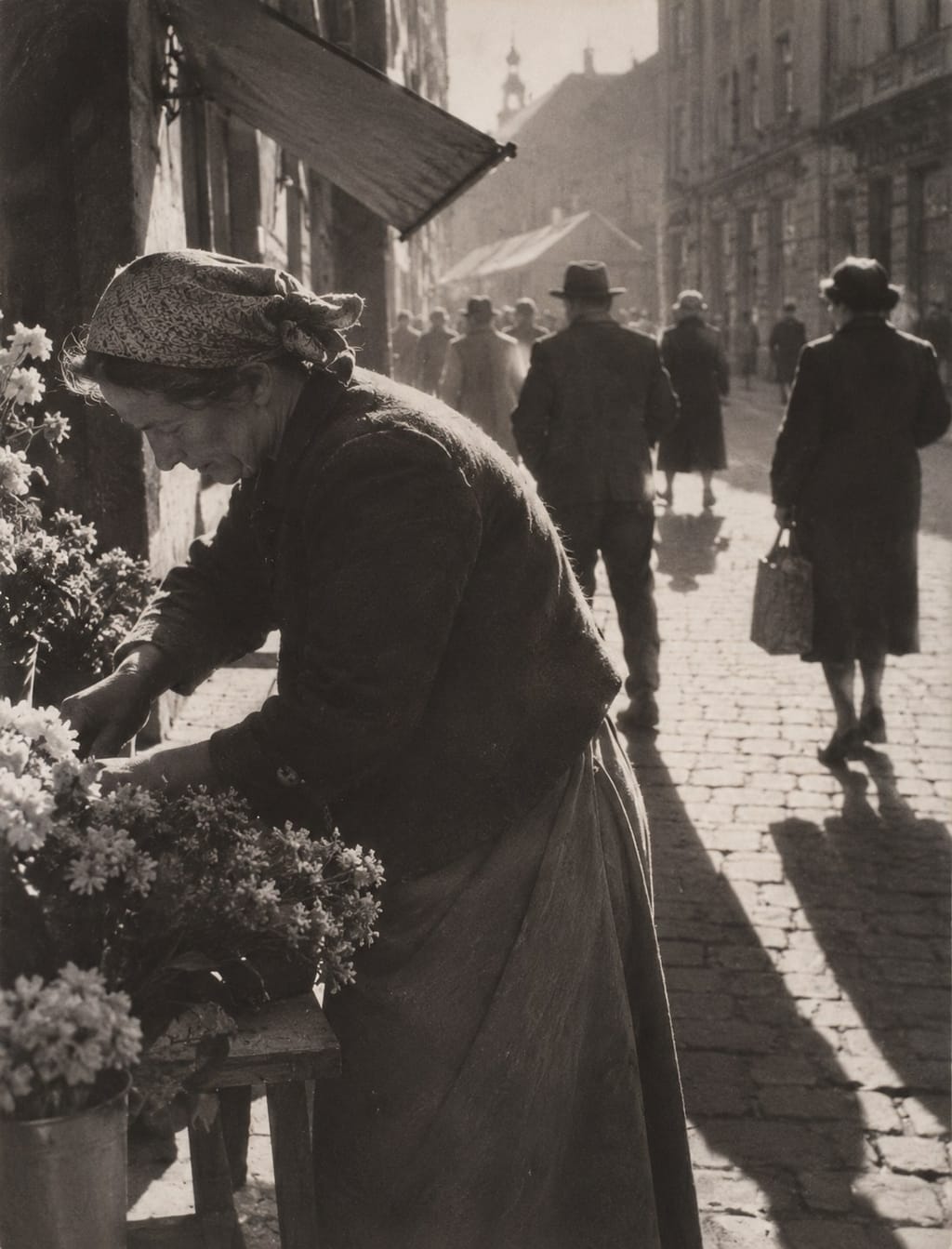
An older woman wearing a patterned headscarf and apron bends over flowers displayed outside a shop. Behind her, pedestrians in coats and hats walk along a cobblestone street, casting long shadows in the sunlight. What the check saw. The warm monochrome image evokes an old street photograph through visible grain, strong backlighting and layered figures receding into a hazy background.
With other styles
Pairs with New Vision. Borrow its diagonals and high or low viewpoints, then point them at a market or doorstep instead of a staircase.
Pairs with French humanist photography. Add its tenderness toward passers-by and the shared street, keeping the harder contrast and shadow shapes.
Pairs with FSA/OWI documentary photography. Combine its close, dignified portraits of the poor with a contrasty exhibition print and a cast-shadow structure.
The opposite: New Objectivity photography. Where it isolates things frontally in even light, work with a moving shadow, a diagonal and a person caught off guard.
Sources
- https://hr.wikipedia.org/wiki/Zagreba%C4%8Dka_%C5%A1kola_fotografije (name not coined in Croatia; 1930s, Fotoklub Zagreb; 1938 touring exhibition; members; Grčević 1965 and Lozić 2011 titles; strong contrast, rich detail in dark areas, shadows as figures, chlorobromide paper and bleaching, diagonal and S-shaped compositions)
- https://hr.wikipedia.org/wiki/To%C5%A1o_Dabac (Bijeda and Život ulice 1932-35; one of the school's founders and main representatives; exhibitions from 1932)
- https://en.wikipedia.org/wiki/To%C5%A1o_Dabac (born 1907, died 1970; Ljudi s ulice 1933-37, first shown as Misery; joined Photo Club Zagreb 1933; archive of about 200,000 negatives)
- https://www.croatiaweek.com/fotoklub-zagreb-celebrating-its-130th-anniversary/ (Fotoklub Zagreb founded 1892; Dabac and Frajtić named as products of the Zagreb School of Photography)