Styles / Early processes
Botanical cyanotype photograms
- Key: the sun, about 45° to the camera’s left, high, hard.
Key high: about 30–45° above eye level, angled down.
Schematic, not to scale: worked out from the style’s choices. No set-up of this style has been rendered yet.
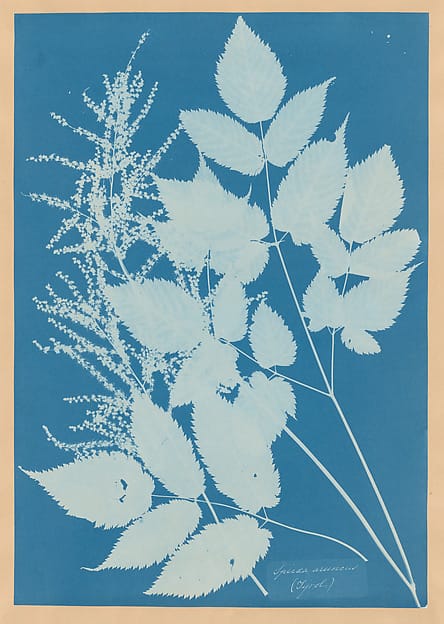
Spiraea aruncus (Tyrol)
Anna Atkins, Spiraea aruncus (Tyrol), 1851-54. Cyanotype. The Metropolitan Museum of Art, Purchase, Alfred Stieglitz Society Gifts, 2004 (2004.172). Open Access. Source: Spiraea aruncus (Tyrol) at The Metropolitan Museum of Art
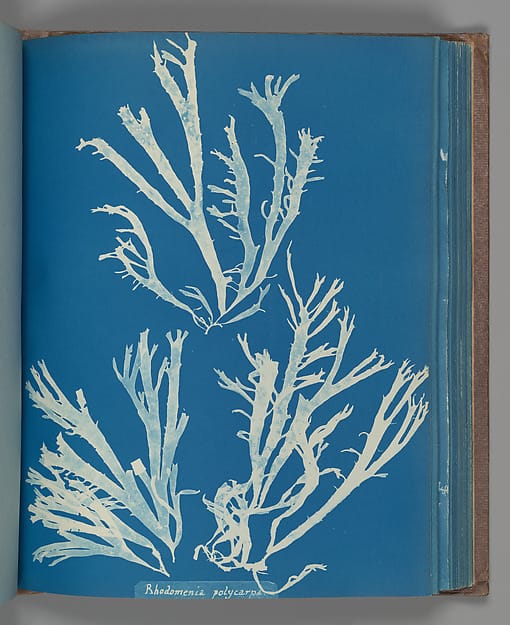
Rhodomenia Polycarpa
Anna Atkins, Rhodomenia Polycarpa, ca. 1853, from Photographs of British Algae: Cyanotype Impressions. Cyanotype. The Metropolitan Museum of Art, Gilman Collection, Purchase, The Horace W. Goldsmith Foundation Gift, through Joyce and Robert Menschel, 2005 (2005.100.557 (82)). Open Access. Source: Rhodomenia Polycarpa at The Metropolitan Museum of Art
Dried plants, algae and ferns laid directly on paper coated with iron salts, exposed to sun and washed in water, so each specimen prints as a pale, translucent silhouette on Prussian blue. No camera or lens is involved: the picture is a life-size contact impression, flat, sharp to the finest frond and centred on its page, usually captioned by hand and gathered into a series or album as a catalogue of species.
Built mostly on one system: Cameraless still life. What systems are.
Shoot sheet for your kit A prompt for an image model The photographs
How the look is made
- Choose thin, flat or pressed specimens (algae, ferns, leaves, grasses, feathery flowers) that let light through, and keep one species to a plate.
- Coat good paper with the iron-salt sensitiser by brush in dim light, dry it in the dark, and lay the specimen straight on it under glass or a weight so it touches everywhere and the edges stay crisp.
- Arrange the plant by hand before exposing: spread branches so they do not overlap, or let a few overlap on purpose so thinner parts print darker; fill the sheet and leave a margin. A crowded sheet of overlapping leaves is a deliberate choice, not the default; a single sprig on a wide field of blue is equally true to the book.
- Expose in direct sun until the blue deepens and the uncovered paper turns dull grey-bronze (seconds in strong sun, ten to twenty minutes on a dull day), then rinse in running water until the yellow is gone and the blue is fixed.
- Print life-size by contact, with no lens: do not enlarge, do not crop into the plant, and accept the pale silhouette as the whole picture.
- Caption each sheet by hand or in a neat label, keep paper, margins and exposure uniform, and present the plates as a numbered series or album.
Shoot sheet for your kit
Fill in your camera, lenses and lights, and the sheet says which light plays each part, what to work around and where to start on your camera. Without a kit it starts on a full-frame camera.
Light
Key: the sun, about 45° to the camera’s left, high, hard.
- Key high: about 30–45° above eye level, angled down.
- Shadow edges
- Shadows with crisp outlines, cast by a small or distant light: direct sun, a bare flash, a spotlight. Light from all around, so almost no shadows form even under the chin or behind objects: a white cove, a light tent, a large ring light, fog over snow.
- Shape & form
- Light from the camera’s own position (an on-camera flash, a ring light, a frontal softbox) fills every hollow, so faces and objects look flat, with little shape.
How the style is lit
- Direct midday sun on a sensitised sheet pressed under glass, a few seconds to a few minutes in strong sun.
- Bright overcast sky or open shade for a longer, softer exposure of ten to twenty minutes.
- An ultraviolet exposure unit with tubes or lamps for repeatable contact printing indoors.
This plan is worked out from the style’s choices, so it is drawn as a schematic. One way to get the light, not a record of how any photograph was lit.
Lens and settings
Start at
On a full-frame camera: the same depth of field and exposure as the style’s own numbers, in the same light. Then meter and adjust.
- 2 min: on a tripod.
- Then
- 10 s–20 min, documented. No camera, lens, aperture or ISO applies, and no sheet format is fixed (Atkins's plates are page-sized sheets). Exposure by contact print is seconds in strong sun and 10-20 minutes on a dull day (V&A: about 15 minutes); it varies with sun, paper and sensitiser, so test a strip first. The viewpoint and optics traits are placeholders the atlas requires: nothing is photographed, the plant simply lies flat under the glass, and the absent lens is the nearest match (pinhole, "crude or absent lens").
- Balance
- The subject in the middle, the frame balanced around it.
- Crop & fill
- Detail runs to every edge with no single centre.
- Depth
- Depth collapsed into pattern and flat shapes.
- Duration
- Seconds or more: water turns to mist, lights become trails. An unmoving scene, exposed slowly and carefully.
Direct
Nobody in the picture.
- Without a pose
- No people at all, or people so small or far off that their pose does not read (hands alone are Hands alone).
- The set-up
- The same kind of subject, photographed the same way, many times.
Style the set
Pressed or dried specimens are laid out singly or in a small, balanced cluster on plain sensitised paper, one species to a sheet, with generous margin and a handwritten Latin name below. Nothing else is added: no props, no set.
- Food & things
- Objects set in rows, grids or neat patterns, squared up and evenly spaced (knolling).
- Look of the styling
- Few, simple elements on clean surfaces, with space around them.
Finish
- Monochrome
- A monochrome image tinted sepia, brown, selenium purple or cyanotype blue.
- Colour
- An overall blue, cyan or green cast.
- Early processes
- Prussian-blue prints made in sunlight.
- Digital & other
- Photograms and chemigrams: images made on light-sensitive material without a camera.
- Post-production
- Nothing changed beyond exposure and development.
- Shown as
- Pictures made and shown as a set.
- Shown in
- The book as the main form of the work. Prints for an album, a card or a frame at home.
Stay away from portrait, shallow depth of field, wide angle, soft studio light, low-key & chiaroscuro, deep shadows, black shadows, colour as subject, warm cast, clean digital capture, smartphone & computational, visible grain, candid & unobserved, tilted angle, motion blur, glamour & aspiration and sell & persuade.
A prompt for an image model
A ready prompt that describes this look to an image model: where the lights stand, the lens, the framing and the colour. It starts on the style’s own choices; change any of them and the prompt and the notes follow.
The prompt
Notes on this prompt
- How the style uses it: choose thin, flat or pressed specimens that let light through, and keep one species to a plate. Image models put the light in the wrong place more often than anything else, so the prompt says where each light stands: which side of the picture, and how high. Keep to one light pattern per prompt, or the model splits the difference.
- Black and white: colour words in the subject (a red dress, green leaves) can pull the model back to colour, so leave them out.
- Blur needs a cause: say what moves, and that the exposure is long enough to smear it.
The model makes a new picture, not a photograph of anything that happened. Label it as AI-generated, and don’t pass it off as the style’s history or as a real person.
Photographs that define it
From open collections, shown whole with their credits. Later photographs are linked, not shown, while they are in copyright.
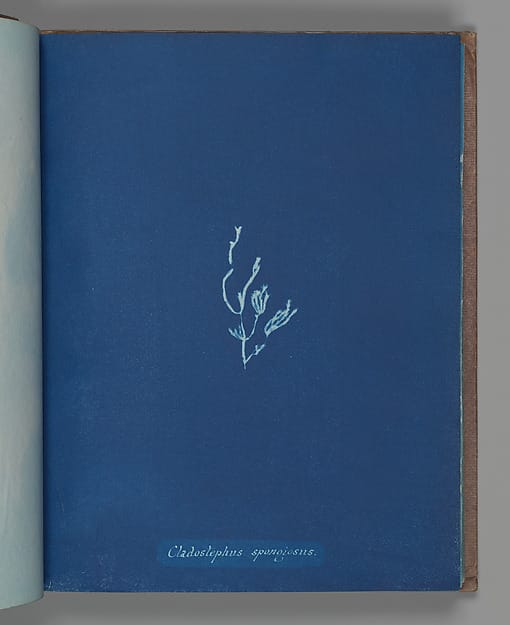
Cladostephus spongiosus
Anna Atkins, Cladostephus spongiosus, ca. 1853, from Photographs of British Algae: Cyanotype Impressions. Cyanotype. The Metropolitan Museum of Art, Gilman Collection, Purchase, The Horace W. Goldsmith Foundation Gift, through Joyce and Robert Menschel, 2005 (2005.100.557 (23)). Open Access. Source: Cladostephus spongiosus at The Metropolitan Museum of Art
Made by an AI model
An image gpt-image-2 made from this style’s choices, then checked against them by a vision model. Not a photograph, and not part of the style’s history. All generated images
-
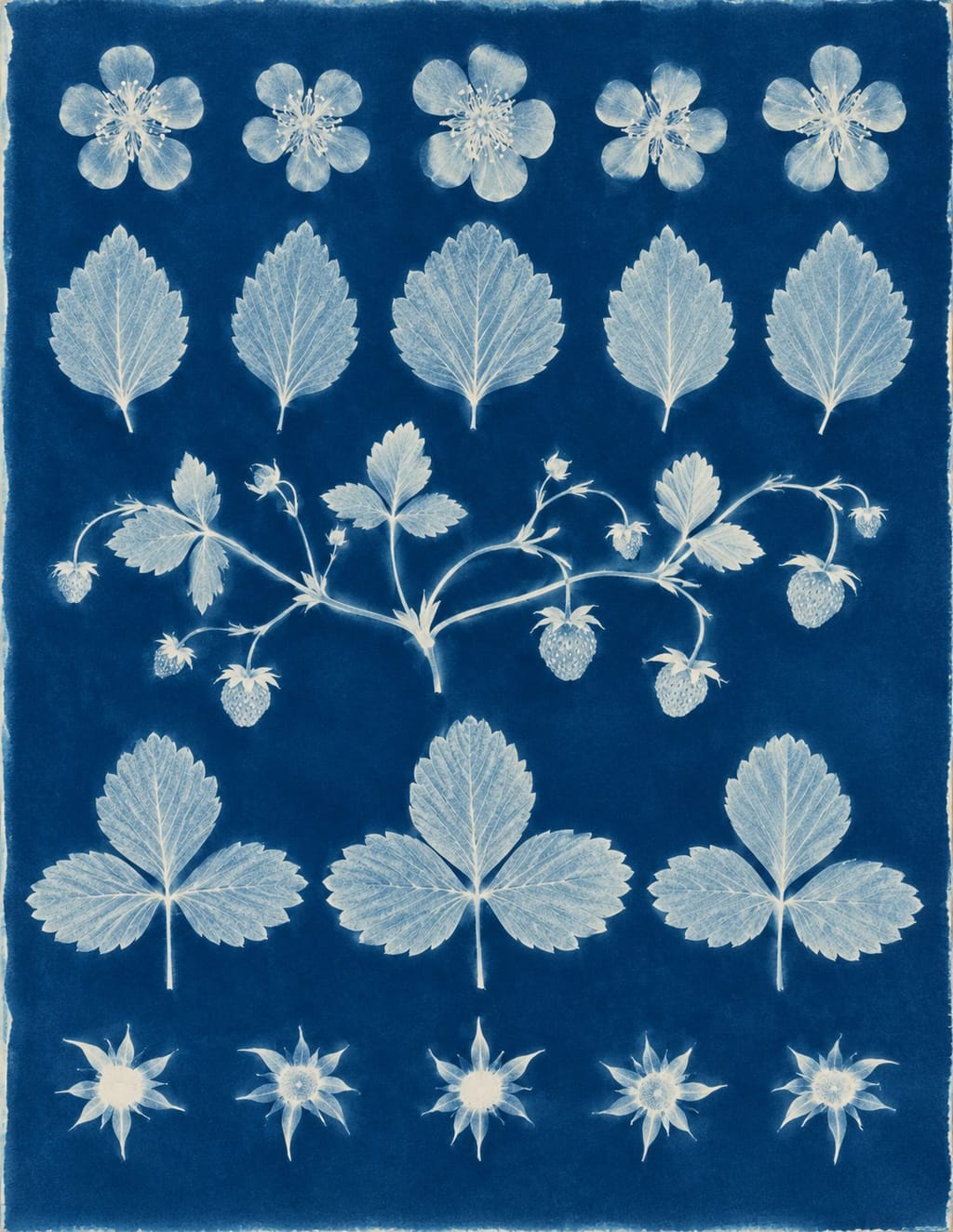
A blue-and-white botanical cyanotype-style image arranges strawberry flowers, individual serrated leaves, and three-leaf clusters in neat rows. A branching strawberry stem with hanging berries stretches across the middle, with fine veins visible in the pale leaves. What the check saw. The image resembles a carefully arranged botanical contact print rather than a conventional lens-based photograph, with pale plant details against textured Prussian blue.
With other styles
The opposite: Calotype and paper-negative photography. Comparison, not descent: both are early paper processes, but a calotype goes through a camera and a paper negative, whereas the cyanotype photogram descends from Herschel's contact printing; here the plant is the negative and the print is made life-size by contact.
The opposite: Flat lay. Both lay things flat on a table, but a flat lay is lit by window light and photographed from above; a cyanotype photogram needs no camera, only sun and the plant on the paper.
The opposite: Surrealist photography. Cameraless prints can turn objects into enigmas; here keep the plant whole and legible, one species per sheet, so the picture reads as a catalogue.
Pairs with New Objectivity photography. Borrow its sharp, frontal, plant-by-plant plates and show them as a systematic series.
Pairs with Wet-plate collodion revival. Show both in one exhibition of hand-made 19th-century processes; a cyanotype can be repeated from the same plant, a collodion plate cannot.
Sources
- Met Museum, Anna Atkins, Photographs of British Algae: Cyanotype Impressions, 1843-53, Gilman Collection, 2005.100.557: https://www.metmuseum.org/art/collection/search/286656 (public-domain open access record, via collectionapi.metmuseum.org/public/collection/v1/objects/286656)
- Met Museum, Anna Atkins, Spiraea aruncus (Tyrol), 1851-54, 2004.172: https://www.metmuseum.org/art/collection/search/285421
- V&A, Cyanotype (Photographic processes): https://www.vam.ac.uk/articles/photographic-processes (Herschel, 1842; iron salts brushed on paper, object placed on it in direct sunlight, about 15 minutes, washed in water; white image on brilliant blue)
- V&A, Anna Atkins, Dandelion (Taraxacum Officinale), ca. 1854, PH.382-1981: https://api.vam.ac.uk/v2/museumobject/O82810 (Atkins took up the process as soon as it was invented in 1842; album given to Anne Dixon in 1854; made without a camera)
- Wikipedia, Anna Atkins: https://en.wikipedia.org/wiki/Anna_Atkins (first instalment October 1843, three volumes by 1853, handwritten text, 17 known copies, specimens placed directly on cyanotype paper, Anne Dixon)
- Wikipedia, Cyanotype: https://en.wikipedia.org/wiki/Cyanotype (chemistry, UV contact exposure of seconds to 10-20 minutes, water rinse, Prussian blue, contemporary artists' use)