Styles / Early processes
Wet-plate collodion revival
- Key: a softbox, from the camera’s left, at the side, high, soft.
Key high: about 30–45° above eye level, angled down.
Schematic, not to scale: worked out from the style’s choices. No set-up of this style has been rendered yet.
The photographs that define it are still in copyright, so they are linked below rather than shown.
Contemporary portraits and constructed still lifes made as wet-collodion tintypes or ambrotypes: a deliberately prepared plate, composed stillness, monochrome modelling and a visible material perimeter. Coating irregularities can remain beside a sharply resolved face or object. Unlike a cased daguerreotype or a painterly gum print, the hand-poured surface confronts present-day subjects with an older image-making process. This entry covers the direct-positive strand, not every use of collodion negatives.
Built mostly on one system: Painted studio. What systems are.
Shoot sheet for your kit A prompt for an image model The photographs
How the look is made
- Make an actual wet-collodion direct positive and retain its plate perimeter; do not substitute a vintage preset or claim that an illustration is a physical plate.
- Arrange one deliberate encounter with a consenting sitter, or construct one spare object study, rather than collecting a burst of unplanned frames.
- Place a face, hands or an object's folds in a legible plane of focus and allow the background to soften; do not diffuse every edge into painterly haze.
- Model the subject with directional light and preserve dark-to-light transitions; use sufficient illumination for the plate rather than lifting all shadows afterwards.
- Retain genuine coating marks and modest surface irregularities when they contribute to the picture, without adding counterfeit scratches or artificial ageing.
- Keep contemporary clothes or a plainly constructed object visible so the photograph is not mistaken for an anonymous nineteenth-century record.
Shoot sheet for your kit
Fill in your camera, lenses and lights, and the sheet says which light plays each part, what to work around and where to start on your camera. Without a kit it starts on a full-frame camera.
Light
Key: a softbox, from the camera’s left, at the side, high, soft.
- Key high: about 30–45° above eye level, angled down.
- Shadow edges
- Shadows that fade gradually from light to dark, cast by a large or diffused light: a window, a softbox, a cloudy sky.
- Shadow depth
- Dark shadows that still hold some detail (a high lighting ratio, about 4:1 to 8:1: the shadow side two to three stops darker).
- Shape & form
- Light turning gradually into shade across faces and objects, so their volume shows.
How the style is lit
- For an indoor portrait, place a large studio key above and to one side of the lens against a quiet dark backdrop; let the cheek and hand turn into a darker shadow side. A powerful flash is an alternative to a seconds-long continuous-light sitting; the plate surface is not a lighting effect.
- For an outdoor standing portrait, use available beach daylight, keep the figures still and allow directional sun to model faces and cast shadows on the sand; do not confuse stillness of pose with a photograph of surfing action.
- For a constructed object study, light a pale folded or crumpled form from above and to one side against a dark ground, keeping small shadows in its folds. This is a visual reconstruction of the specimen's light, not a documented rig.
This plan is worked out from the style’s choices, so it is drawn as a schematic. One way to get the light, not a record of how any photograph was lit.
Lens and settings
Start at
On a full-frame camera: the same depth of field and exposure as the style’s own numbers, in the same light. Then meter and adjust.
- The style’s f/4.1 on 4 × 5 in gives about the depth of field of f/1.2 on full frame.
- Then
- 57–59 mm · f/3.8–f/4.5 · 8 s · ISO 1 on 4 × 5 in, inferred from the gear and the look. Source-anchored examples, not a universal exposure: a first-person account recalls an approximately 8 s sitting whose illumination is unspecified, and separately lists ISO 1 for the author's studio-flash rig. Focal equivalents convert documented 203–210 mm lenses on 4×5; f/3.8–4.5 is an inferred near-wide-open starting range from their maximum apertures, not recorded working stops. Do not combine the 8 s example with flash as if it described flash duration; larger plates require different choices.
- Focal length
- Roughly the eye’s own perspective; no visible distortion.
- Focus
- One plane sharp, the rest melting into blur and bokeh.
- Angle
- The camera at the height of a standing person or of the subject.
- Distance
- Within arm’s reach: faces, hands and details fill the frame.
- Balance
- The subject in the middle, the frame balanced around it. The subject faces the lens; planes run parallel to the picture.
- Duration
- An unmoving scene, exposed slowly and carefully.
Direct
Ask consenting adults to choose a comfortable, repeatable pose and settle before exposure. Keep a composed face, a direct gaze and still shoulders; hands may rest or deliberately cover part of the face. Outdoor pairs can stand beside their own objects rather than wear historical costume. In an object study there is no figure to pose.
- Head & gaze
- Looking straight into the camera, so the subject meets the viewer’s eye.
- Line & energy
- Rigid and motionless, sometimes braced against a head rest or gripping a chair: held for a long exposure or a solemn occasion.
- Expression
- Unsmiling, composed and blank: the face gives nothing away.
- With the sitter
- The subject performs for the camera and shapes the picture. The sitter arranged and still, facing the camera.
Style the set
Prefer the sitter's contemporary everyday clothes, natural skin and a spare backdrop or actual outdoor setting. For the constructed still-life strand, place a simple tactile form against a quiet dark ground. Avoid dressing people as anonymous historical types or distressing clothes and scenery to manufacture age.
- Clothes
- What people happened to be wearing; nothing chosen for the picture.
- Hair & make-up
- No visible make-up; skin, hair and blemishes as they are.
- Look of the styling
- Few, simple elements on clean surfaces, with space around them.
Finish
- Monochrome
- A monochrome image tinted sepia, brown, selenium purple or cyanotype blue. Rich blacks, clean whites and every grey between.
- Early processes
- A unique image on silvered metal or glass, often cased.
- Texture
- The film edge, rebate or frame left in the picture. Marks of age and handling on the image.
- Post-production
- Nothing changed beyond exposure and development.
- Shown as
- Each picture stands on its own. Pictures made and shown as a set.
Stay away from filter & preset look, heavy retouching, hdr & tone-mapped, composite & montage, gum & pigment processes, smartphone & computational and snapshot.
Before you shoot it
These specimens show real people and protected works by named contemporary makers. A sitter's participation in a portrait is not an invitation to reconstruct their identity. Do not turn surfers, Indigenous communities or other living groups into anonymous antique types, reproduce celebrity likenesses, or invent an ancestor, deceased person or historical encounter. Any illustrative image must show invented subjects, be labelled as an illustration and never be offered as a genuine plate, documentary record or historical photograph. The settings are orientation, not a chemical-processing or workshop-safety manual.
A prompt for an image model
A ready prompt that describes this look to an image model: where the lights stand, the lens, the framing and the colour. It starts on the style’s own choices; change any of them and the prompt and the notes follow.
The prompt
Notes on this prompt
- How the style uses it: model the subject with directional light and preserve dark-to-light transitions; use sufficient illumination for the plate rather than lifting all shadows afterwards. Image models put the light in the wrong place more often than anything else, so the prompt says where each light stands: which side of the picture, and how high. Keep to one light pattern per prompt, or the model splits the difference.
- Describe an invented person by age, clothes and pose. Never name a real or famous person, and never write “looks like”.
- Black and white: colour words in the subject (a red dress, green leaves) can pull the model back to colour, so leave them out.
The model makes a new picture, not a photograph of anything that happened. Label it as AI-generated, and don’t pass it off as the style’s history or as a real person.
Where to see it
From open collections, shown whole with their credits. Later photographs are linked, not shown, while they are in copyright.
In copyright, so linked
- James Franco, Sundance Film Festival tintype portrait , Victoria Will, January 2015. Invision/Associated Press, AP Images blog.
- 16.02.20 #8 Elise + Stacy, Santa Cruz, CA, from the Surfland series , Joni Sternbach, 2016. High Museum of Art.
- A subterfuge , Ben Cauchi, 2013. Museum of New Zealand Te Papa Tongarewa.
Made by an AI model
An image gpt-image-2 made from this style’s choices, then checked against them by a vision model. Not a photograph, and not part of the style’s history. All generated images
-
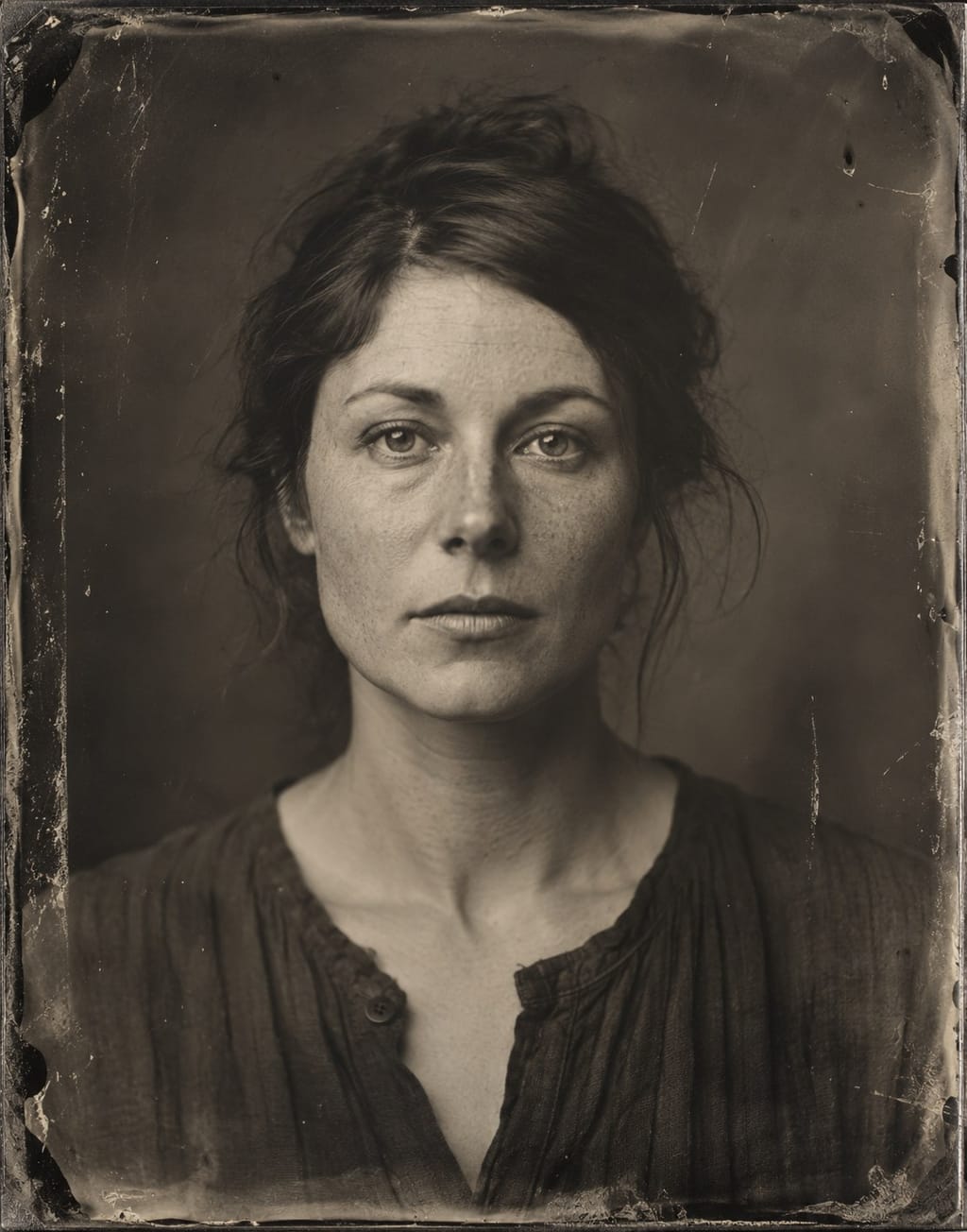
A woman with loosely pinned dark hair and a plain dark blouse looks directly at the camera with an unsmiling expression. The tightly framed, brown-toned portrait has a plain background and heavily scratched, chipped, plate-like edges. What the check saw. The frontal pose, direct gaze, restrained styling and distressed antique finish make this a solemn portrait resembling an early photographic plate.
With other styles
The opposite: Daguerreotype portraiture. Keep the deliberateness of a unique plate but choose hand-poured collodion, contemporary dress and an exposed perimeter rather than a silver mirror image in a gilt case; these are different chemistries, not successive versions of one process.
The opposite: Pictorialism. Let an object or face remain locally sharp and let the collodion surface carry its irregularities; do not replace it with all-over soft focus, brushed gum or a matte painterly print.
The opposite: Everyday colour-negative film revival. Choose between a deliberately prepared monochrome plate and an everyday colour-negative roll; an analogue material alone does not make the staged sitting a casual film snapshot.
Sources
- Victoria and Albert Museum, An A to Z of photographic processes: https://www.vam.ac.uk/articles/photographic-processes (collodion negative section: introduced in 1851, hand-coated glass, exposure while wet and immediate development; daguerreotype section establishes the chemically distinct silvered-plate process).
- Victoria Will, first-person account, Victoria Will's tintype portraits, AP Images, 22 March 2015: https://apimagesblog.com/blog/2015/03/22/victoria-will-sundance-tintype-portraits (2014–15 Sundance practice, aluminium support, processing while wet, sitter collaboration, approximately 8 s in a separate Penumbra sitting; technical list gives two 4×5 cameras, 203 mm f/3.8 and 210 mm f/4.5 lenses, powerful flash and ISO 1. Lens apertures are specifications, not per-image settings).
- High Museum of Art, Joni Sternbach, 16.02.20 #8 Elise + Stacy, Santa Cruz, CA, from the Surfland series, 2016, accession 2020.175: https://high.org/collection/16-02-20-8-elise-stacy-santa-cruz-ca-from-the-surfland-series/ (tintype, 11×14 inches, gift of the artist; describes on-site pouring, exposure and development and the relationship to surf culture; image copyright © Joni Sternbach).
- Museum of New Zealand Te Papa Tongarewa, Ben Cauchi, A subterfuge, 2013, O.041245: https://collections.tepapa.govt.nz/object/1410119 (production place recorded as West Germany; wet-collodion ambrotype, 200×250 mm, purchased 2014; collection commentary interprets the ambiguous paper-like form and processing flaw. Image rights: All Rights Reserved).
- Vocabulary qualification: process.daguerreotype is used only for the fixed trait's broader 'direct positive' category, not to identify these works as daguerreotypes. No process.large-format trait is added: its label specifies sheet film, whereas these specimens are plates. finish.border records the retained plate perimeter; finish.damage is limited to visible marks and processing faults, not a claim of age. Camera settings and the reconstructed object-lighting line are explicitly inferential. The three specimens establish a selected shared idiom, not a census of all wet-collodion practice.