Styles / Fashion & commercial
Boudoir photography
- Key: a softbox, about 40° to the camera’s left, high, soft.
- Reflector: a white card or reflector, about 55° to the camera’s right, soft.
Key high: about 30–45° above eye level, angled down.
Schematic, not to scale: worked out from the style’s choices. No set-up of this style has been rendered yet.
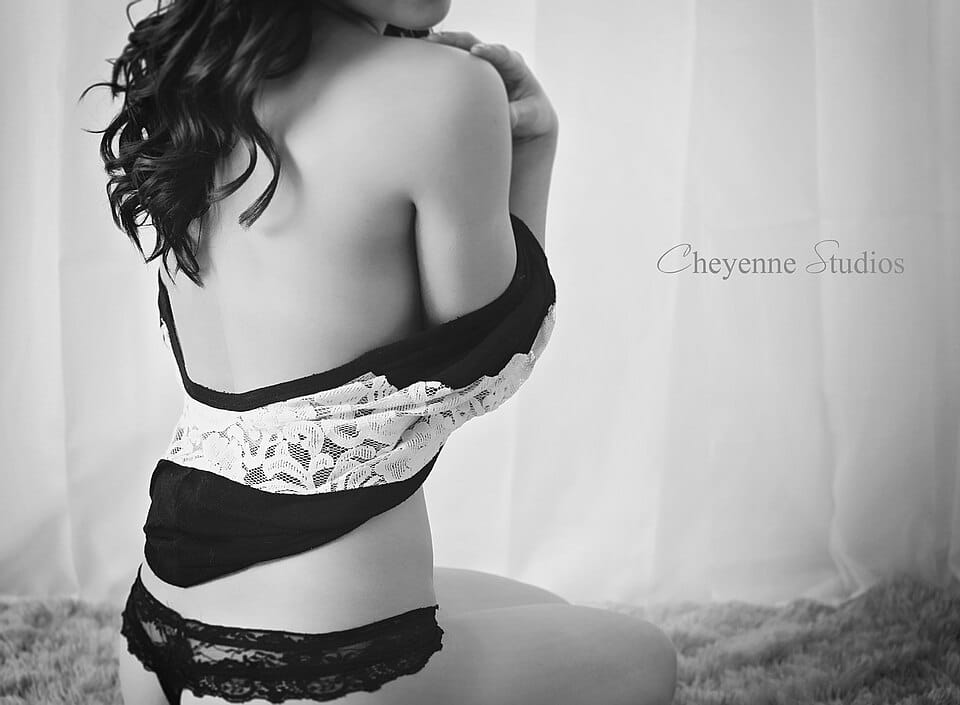
Sabrina (Redding, CA Boudoir Photography)
Cheyenne Studios, CC BY 2.0, via Wikimedia Commons. Source: Sabrina (Redding, CA Boudoir Photography) at Wikimedia Commons (from Flickr)

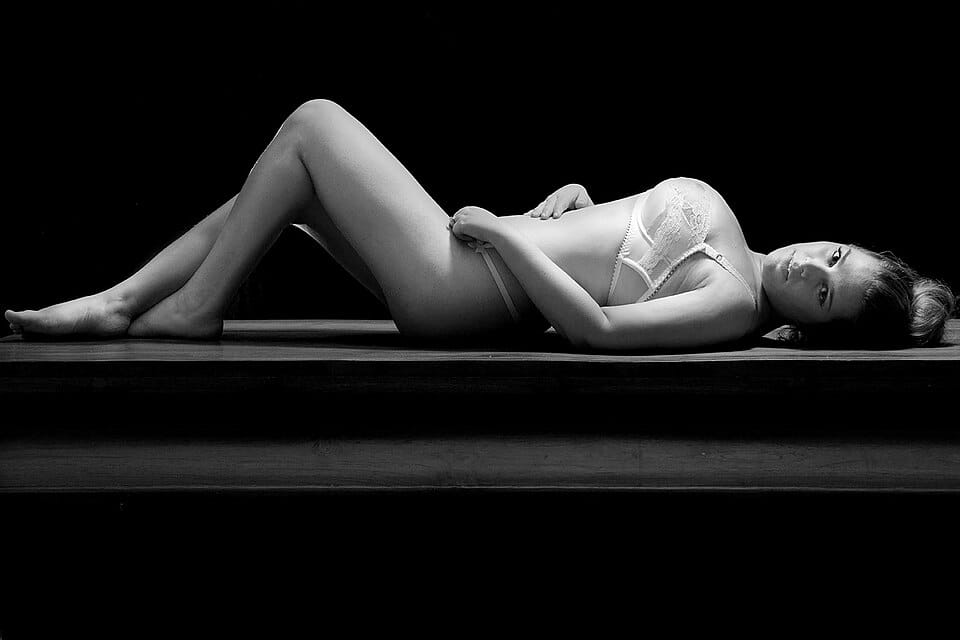
Bridal Boudoir
Jesus del Toro Garcia, CC BY 2.0, via Wikimedia Commons. Source: Bridal Boudoir at Wikimedia Commons (from Flickr)

Intimate portraits of an adult client in lingerie, a sheet, a shirt or implied undress, usually kept for herself or a partner rather than published. Light is soft and flattering (a window, a large softbox, high key, or low key in grainy black and white), focus is shallow, the body is posed reclining, seated or turned away with a look back, and the skin is gently retouched. A consultation beforehand sets the limits, and the client directs as much as the photographer.
Built on two systems: Gloss and curve and Sweet retouch. What systems are.
Shoot sheet for your kit A prompt for an image model The photographs
How the look is made
- Hold a consultation first: agree what she will wear, which poses and how much is shown, and keep checking during the session, because limits shift as she relaxes.
- Light soft and wide: a window with a white curtain or a large softbox beside the pose, so skin wraps in gradual shadows rather than hard edges.
- Pose the body in long, easy lines: reclining on a bed, seated with the torso turned, a look back over the shoulder, hands resting on hip, hair or collarbone.
- Shoot close and shallow: open the aperture or use a short telephoto, crop into curves, lace and a hand, and let the room fall away.
- Finish gently: smooth blemishes and stray lines, dodge and burn the contours, and choose soft black and white or warm tones; keep her likeness and skin texture.
- Show the pictures to the client in a private album or prints, not as advertising, and ask before any public use.
Shoot sheet for your kit
Fill in your camera, lenses and lights, and the sheet says which light plays each part, what to work around and where to start on your camera. Without a kit it starts on a full-frame camera.
Light
Key: a softbox, about 40° to the camera’s left, high, soft.
Reflector: a white card or reflector, about 55° to the camera’s right, soft.
- Key high: about 30–45° above eye level, angled down.
- Shadow edges
- Shadows that fade gradually from light to dark, cast by a large or diffused light: a window, a softbox, a cloudy sky.
- Shadow depth
- Shadows kept light and full of detail by a reflector, a fill light, bounce or bright surroundings (a low lighting ratio, up to about 3:1: the shadow side at most a stop and a half darker).
- Shape & form
- Light turning gradually into shade across faces and objects, so their volume shows.
How the style is lit
- A north or east window with a white sheer curtain, the client beside it, a white reflector on the far side for open shadows.
- A large softbox or octabox close to the pose at 45 degrees, a white wall or sheet as fill, high key and gently exposed for skin.
- A single small source from one side against a dark room, flagged from the lens, for a low-key black-and-white version with visible grain (a hard-edged low-key variant, not the style's soft core).
This plan is worked out from the style’s choices, so it is drawn as a schematic. One way to get the light, not a record of how any photograph was lit.
Lens and settings
Start at
On a full-frame camera: the same depth of field and exposure as the style’s own numbers, in the same light. Then meter and adjust.
- Then
- 50–105 mm · f/1.8–f/8 · 1/250–1/20 s · ISO 100–1600 on full frame, inferred from the gear and the look. Inferred from the style's description (shallow focus, window and soft light) and from the EXIF of the three specimens here (35 mm equivalents 52 to 80 mm, f/2.8 to f/8, ISO 100 to 1600). Studio strobe work stops down to f/8 and ISO 100; window light needs a wide aperture and higher ISO. Aperture numbers are for full frame.
- White balance
- Daylight balance for window light or flash, grey-card for mixed rooms; keep skin warm and the window slightly cool.
- Focus
- One plane sharp, the rest melting into blur and bokeh.
- Distance
- Within arm’s reach: faces, hands and details fill the frame.
- Crop & fill
- The edges cut into the subject: heads, limbs or objects run out of frame.
- Duration
- An unmoving scene, exposed slowly and carefully.
Direct
Direct an adult client, after a consultation, into easy long lines: reclining on a bed or a low platform with one knee raised, seated on the floor with the torso turned away, or standing near a window. Ask for a look back over the shoulder, a soft or slightly parted mouth, chin lowered, hands on the hip, collarbone, hair or fabric. Keep changing small things between frames and show her the back of the camera, so she steers what is kept.
- Whole body
- MustHold a consultation before the session: agree what she will wear, which poses and how much is shown. Check again during the session and stop or change anything she asks.Safety and consent. Consent is the core of the practice; limits shift as she relaxes, and a session where she cannot set them is not this style.
- MustShow her the back of the camera as you go and let her choose the selects and how far the retouching goes. Share nothing publicly without her written consent for each use, and no face or detail she has not approved.Safety and consent. The pictures show real clients in states of undress; misuse can expose or harm them.
- MustAdult clients only. Never present a generated image as a real client or as a real session.Safety and consent. The entry's caution: adults only, and generated images must not pass as evidence of a person.
- MustShe chooses the lingerie, shirt, sheet or robe with you beforehand; pose only in what she is at ease in.Subject chooses. The styling is chosen with the client, and a sitter who is uneasy in her clothes cannot hold an easy line.
- MustPose her reclining on a bed or a low platform, propped on an elbow or lying along the sheet, so the body makes one long, easy line.Photographer directs. The reclining pose is the style's centre, taken from Hollywood glamour.
- OptionalOffer a frame with her back to the camera, standing near the window; it keeps her face out if she wants pictures without it.Subject chooses.
- AvoidDo not keep strained or in-between frames; change one small thing between frames until the pose looks easy.Photographer directs. Boudoir plans, directs and finishes every frame; an awkward pose works against the flattering look.
- Head and neck
- UsuallyWith her body turned away, ask for a look back over the shoulder, the chin lowered a little.Photographer directs.
- Face and eyes
- UsuallyA soft or slightly parted mouth and a slow, heavy-lidded look into the lens.Photographer directs.
- OptionalFor a quieter frame, lower the eyes or close them, the face turned a little down.Photographer directs.
- Hands
- UsuallyRest the hands on the hip, the collarbone or the fabric, fingers relaxed; a hand on lace makes a close crop.Photographer directs. The style crops close into curves, lace and a hand, so the hands are often in the frame.
- OptionalBring a hand to the hair or the face, fingers loose and separated rather than pressed flat.Photographer directs.
- Torso and hips
- UsuallySeated on the floor or the edge of the bed, turn the torso away from the camera and let the shoulders and waist make the curve.Photographer directs.
- Legs
- UsuallyWhile she reclines, raise one knee a little and keep the other leg long, so the legs make a soft angle instead of lying side by side.Photographer directs. The posing calls for one knee raised; two flat legs read stiff.
- Feet
- OptionalWhere the feet show, extend them softly with the line of the leg; do not let a foot flex towards the lens.Photographer directs. A flexed foot near the camera breaks the long line and looks large at a short distance.
Must: the look depends on it · Usually: what the style does most of the time · Optional: one possibility among others · Avoid: works against the look.
- With the sitter
- The subject performs for the camera and shapes the picture.
- The set-up
- A scene staged and directed like a film still or a painting.
Style the set
Lingerie, lace, a shirt, a sheet or a robe, chosen with the client; hair and make-up done for a polished, glamorous face; a bed, white linen, a sheer curtain, a chair, jewellery or pearls as props in a private or hotel room or a clean studio, with the set tidied of clutter.
- Hair & make-up
- Visible artifice: sculpted brows, strong lips, lashes, contouring and set or sculpted hair. Groomed hair and finished make-up that still look natural: even skin, defined eyes, neat brows.
- Set & props
- A real place picked for its look as the setting for a shoot, not the subjects’ own: a street, a field, a palace, a hotel room.
- How much is styled
- Clothes, hair, make-up, props and set all chosen and placed by a team to one idea.
Finish
- Monochrome
- Low contrast and gentle greys.
- Digital & other
- A modern digital camera: clean, detailed, neutral.
- Texture
- Smooth tones with no visible grain.
- Post-production
- Perfected skin and surfaces. Areas lightened and darkened by hand in printing.
- Shown as
- Each picture stands on its own.
- Shown in
- Prints for an album, a card or a frame at home.
Stay away from straight print, candid & unobserved, direct on-camera flash, hard-edged shadows, awkward & in-between, unstyled, as found, document & record, scratches, dust & decay, gallery scale and sell & persuade.
Before you shoot it
The pictures show real adult clients in states of undress, and misuse can expose or harm them: publish or share only with written consent for each use, and never with a face or identifying detail the client has not approved. Consent is the core of the practice: the consultation and the client's final say over selects and retouching are part of the style, and a session where she cannot direct the limits is not this style. The article notes that the 'empowerment' framing is debated alongside the male gaze and postfeminist claims about choice, so do not treat it as settled. Study the shared choices, not any living studio's signature. The specimens are real, identifiable people published under a CC licence: describe them but do not extend their use, and note the Sabrina specimen carries a studio watermark. Jean Agélou is cited only as history; his article reports an underage model, the opposite of this style's adults-only rule.
A prompt for an image model
No prompt for this style
Behind its pictures: real adult clients undressed, with consent at its core.
A generated image could be taken for a real client or session.
The pictures show real adult clients in states of undress, and misuse can expose or harm them: publish or share only with written consent for each use, and never with a face or identifying detail the client has not approved. Adults only; never minors, and never a generated image presented as a real client or as evidence of a real session. Consent is the core of the practice: the consultation and the client's final say over selects and retouching are part of the style, and a session where she cannot direct the limits is not this style. The article notes that the 'empowerment' framing is debated alongside the male gaze and postfeminist claims about choice, so do not treat it as settled. Study the shared choices, not any living studio's signature. his article reports an underage model, the opposite of this style's adults-only rule.
Work with photographers of this tradition, or take only its light and lens (the shoot sheet above) without its people, places or rituals.
Photographs that define it
From open collections, shown whole with their credits. Later photographs are linked, not shown, while they are in copyright.
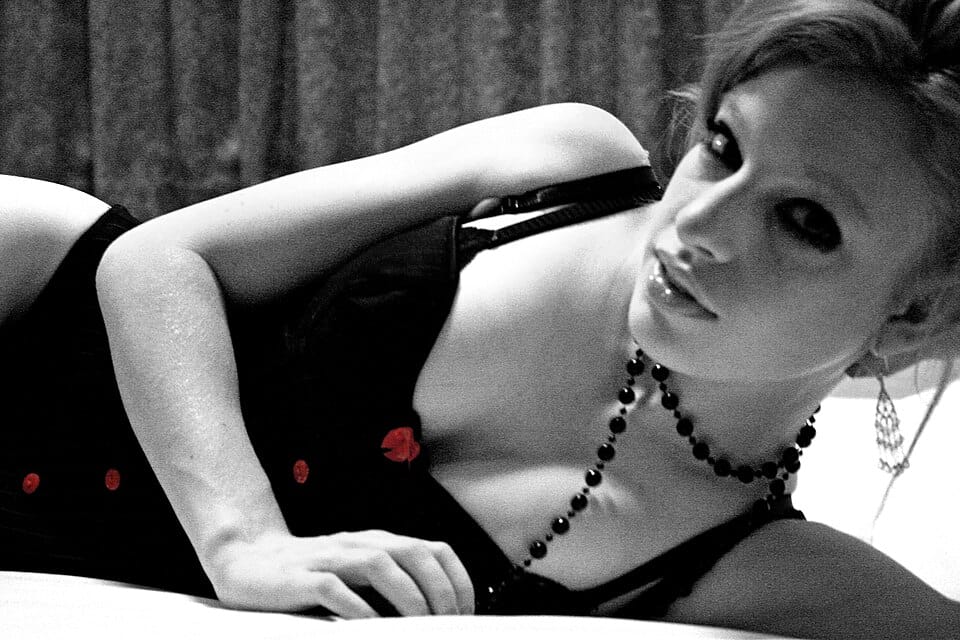
Boudoir
Laura Doherty, CC BY 2.0, via Wikimedia Commons. Source: Boudoir at Wikimedia Commons (from Flickr)

With other styles
Pairs with Hollywood glamour portraiture. The lineage is pose and attitude (the reclining pose and the heavy-lidded look), not lighting: glamour's hard, low-key, large-format light is swapped for a large soft source so the skin stays gentle.
Pairs with Glossy beauty retouch. Take its disciplined skin retouching, but keep the body, the room and the whole figure in the picture rather than a face-only crop.
The opposite: Diaristic snapshot photography. The diaristic snapshot keeps the unposed, unretouched moment; boudoir plans, directs and finishes every frame.
Sources
- Boudoir photography, Wikipedia: https://en.wikipedia.org/wiki/Boudoir_photography (origin of the term; mid-1980s and millennium dates; pin-up lineage; typical diffuse high-key and low-key grainy looks; shallow depth of field; consultation and boundaries; difference from glamour and art nude; the debate about empowerment)
- Jean Agélou, Wikipedia: https://en.wikipedia.org/wiki/Jean_Agélou (French photographer 1878-1921 of erotic and nude postcards and stereo views)
- Bridal Boudoir (11184530646), Wikimedia Commons, CC BY 2.0, Jesus del Toro Garcia, 29 November 2013: https://commons.wikimedia.org/wiki/File:Bridal_Boudoir_(11184530646).jpg (EXIF read from the file)
- Sabrina, Redding, CA Boudoir Photography (13182832194), Wikimedia Commons, CC BY 2.0, Cheyenne Studios, 14 March 2014: https://commons.wikimedia.org/wiki/File:Sabrina_-Redding,_CA_Boudoir_Photography-_(13182832194).jpg (EXIF read from the file)
- Boudoir (2456082297), Wikimedia Commons, CC BY 2.0, Laura Doherty, 5 August 2007: https://commons.wikimedia.org/wiki/File:Boudoir_(2456082297).jpg (EXIF read from the file)