Styles / Pictorialist
Camera Club of the Philippines salon photography
- Key: a window, about 60° to the camera’s left, soft.
Schematic, not to scale: worked out from the style’s choices. No set-up of this style has been rendered yet.
The photographs that define it are still in copyright, so they are linked below rather than shown.
The photography of Manila's amateur camera club from 1928: outing pictures of the countryside and coached portrait sittings, printed in the club's shared darkrooms and enlarged to 11 x 14 and 20 x 24 inches for fairs and foreign salons. The club's histories do not describe the look of its prints, so the soft salon finish is an inference from the salon circuit it entered.
Built on two systems: Pictorial print and Painted studio. What systems are.
How the look is made
- Go on an outing to the countryside or coast, and choose a viewpoint and hour that give the print one clear subject.
- When a portrait is made, coach the sitter in a sitting for a portrait, not a snapshot, as Guzman did.
- Print it yourself in the club darkroom and enlarge it to exhibition size (up to 20 x 24 inches).
- Judge each print against the salon's rules: one clear subject, a balanced frame, clean tones.
Shoot sheet for your kit
Fill in your camera, lenses and lights, and the sheet says which light plays each part, what to work around and where to start on your camera. Without a kit it starts on a full-frame camera.
Light
Key: a window, about 60° to the camera’s left, soft.
How the style is lit
- Soft window or lamp light from one side on a seated sitter, with a reflector for the shadow cheek (inferred, not documented).
- Open daylight on outings, side-lit in the morning or late afternoon (inferred).
This plan is worked out from the style’s choices, so it is drawn as a schematic. One way to get the light, not a record of how any photograph was lit.
Lens and settings
Start at
On a full-frame camera: the same depth of field and exposure as the style’s own numbers, in the same light. Then meter and adjust.
- The style’s f/7 on 9 × 12 cm gives about the depth of field of f/2 on full frame.
- Then
- 50–90 mm · f/4.5–f/11 · 1/100–0.5 s · ISO 25–100 on 9 × 12 cm, inferred from the gear and the look. Placeholder only: the club's histories give print sizes (11 x 14 to 20 x 24 inches) and darkroom practice but no camera data; these numbers are inferred from period amateur gear and are not sourced to the club.
Direct
Seat the sitter upright, shoulders turned three-quarter, composed rather than caught: the sitting is coached and collaborative (Guzman coached portraits; Flora Ongpin was the club's first model). Details are inferred, not documented.
- With the sitter
- The sitter arranged and still, facing the camera. The subject performs for the camera and shapes the picture.
Style the set
Sitters dressed for the occasion, a plain backdrop; outing subjects left as found, chosen for a clear shape. Inferred, not documented.
Finish
- Monochrome
- Low contrast and gentle greys.
- Post-production
- Areas lightened and darkened by hand in printing.
- Shown in
- Large prints on the wall, like paintings.
Stay away from snapshot and candid & unobserved.
Before you shoot it
The sources describe the club's history, not the look of its prints, and no specimens could be found, so treat this entry as a hypothesis. The club is still active (over 150 members); its members, named sitters such as Flora Ongpin, and their descendants are real people: do not imitate any living member's work. Colonial-era Philippine photography often framed Filipinos as picturesque types; avoid rural poverty or ethnic costume as a pretty subject.
A prompt for an image model
A ready prompt that describes this look to an image model: where the lights stand, the lens, the framing and the colour. It starts on the style’s own choices; change any of them and the prompt and the notes follow.
The prompt
Notes on this prompt
- Image models put the light in the wrong place more often than anything else, so the prompt says where each light stands: which side of the picture, and how high. Keep to one light pattern per prompt, or the model splits the difference.
- Describe an invented person by age, clothes and pose. Never name a real or famous person, and never write “looks like”.
- Black and white: colour words in the subject (a red dress, green leaves) can pull the model back to colour, so leave them out.
The model makes a new picture, not a photograph of anything that happened. Label it as AI-generated, and don’t pass it off as the style’s history or as a real person.
Made by an AI model
An image gpt-image-2 made from this style’s choices, then checked against them by a vision model. Not a photograph, and not part of the style’s history. All generated images
-
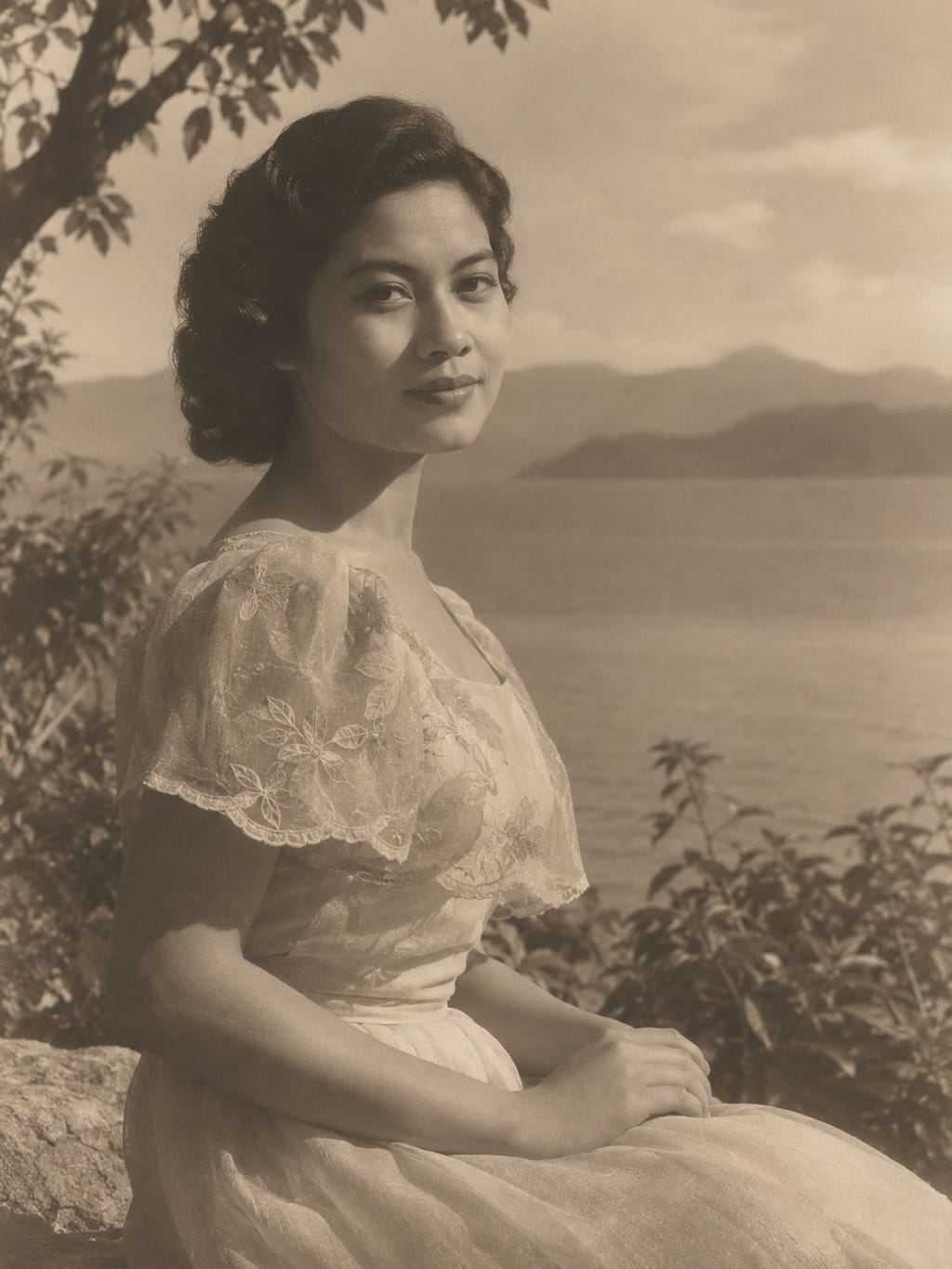
A woman with swept, wavy dark hair sits on a rock in a light embroidered dress, her hands resting together in her lap as she looks toward the camera. Trees and shrubs frame a lake and distant mountains in this sepia-toned portrait. What the check saw. The formal seated pose, directional sunlight, fine grain and faded sepia tones give the photograph the appearance of a vintage outdoor portrait.
With other styles
Pairs with Pictorialism. Borrow pictorialism's soft focus and handwork for the exhibition print, but keep the sitter's composed, society-portrait finish.
The opposite: Straight photography. A sharp, unmanipulated print is the opposite of the soft, enlarged salon print; try both from one negative.
Sources
- Camera Club of the Philippines, Lucie Awards jury page: https://www.lucies.org/jury/camera-club-of-the-philippines/ (founded 19 August 1928; eight founders; darkroom, shoots, critiques; Kodak International Salon distinctions in the 1930s)
- History, Camera Club of the Philippines: https://cameraclubph.com/history/ (Paterno Building; Mencarini first president; two darkrooms; Luis Guzman's portrait coaching; 1932 exhibit of 11 x 14 to 20 x 24 inch prints; foreign salons; competition rules 1936; Vicente Mills a Kodak International finalist)
- Juan Mencarini Pierotti, Wikipedia: https://en.wikipedia.org/wiki/Juan_Mencarini_Pierotti (took part in founding the club on 19 August 1928; earlier camera clubs in Shanghai and Fuzhou)