Styles / Documentary & reportage
Camera-trap wildlife photography
- Key: a flash on the camera, from the camera, hard.
Schematic, not to scale: worked out from the style’s choices. No set-up of this style has been rendered yet.
The photographs that define it are still in copyright, so they are linked below rather than shown.
Pictures made by nobody: a camera fixed low on a tree, trail or waterhole fires when an animal trips a wire or crosses an infrared beam, recording animals unaware. Two eras share the habit: Shiras-era flash plates are mid-tone, grainy and soft; modern frames are digital, often monochrome, fur burned out against black, with a date strip (blown, black, bw and digital traits fit these only). The animal in its setting is the stronger habit; tight crops are chance.
Built on two systems: Rough and unseen and Machine eye. What systems are.
How the look is made
- Fix the camera low (knee to chest height), square to a trail, waterhole or bait site, and leave it: the animal chooses the frame, not you.
- Use a wide lens and stop down so the whole path is sharp from the lens to the trees behind; accept that animals will be cropped or half in frame.
- At night light the scene with the camera's own flash, either white or invisible infrared, and let the nearest fur burn out and the background fall to black.
- Choose a trigger and a burst count that capture a sequence, and keep every frame in the order it fired, empty ones too (a series habit, not frames shown side by side).
- Leave the picture raw: no retouching, no re-framing for beauty, and keep the time, date and temperature strip as part of the evidence.
Shoot sheet for your kit
Fill in your camera, lenses and lights, and the sheet says which light plays each part, what to work around and where to start on your camera. Without a kit it starts on a full-frame camera.
Light
Key: a flash on the camera, from the camera, hard.
- Shadow edges
- Shadows with crisp outlines, cast by a small or distant light: direct sun, a bare flash, a spotlight.
How the style is lit
- The camera's own on-axis infrared or white flash at night: the nearest animal and foliage burn out, the distance goes black, eyes show as bright discs.
- Historic flash powder or bulb fired by the animal's own trip, lighting a dark wood from a few metres off-axis.
This plan is worked out from the style’s choices, so it is drawn as a schematic. One way to get the light, not a record of how any photograph was lit.
Lens and settings
Start at
On a full-frame camera: the same depth of field and exposure as the style’s own numbers, in the same light. Then meter and adjust.
- The style’s f/3.3 on a small-sensor compact gives about the depth of field of f/19 on full frame.
- Then
- 24–35 mm · f/2.8–f/4 · 1/2000–1/30 s · ISO 100–800 on a small-sensor compact, inferred from the gear and the look. Inferred from one openly licensed night frame whose file records a Bushnell trail camera at f/2.8, 1/30 s and ISO 800, plus the fixed-focus wide lenses and auto-ISO behaviour typical of the type. Night frames rely on the flash and low auto settings, and the figures vary by model. Focal length is an inferred wide-angle equivalent; no specimen records it.
- White balance
- Fixed or automatic: infrared night frames are monochrome, and white-flash frames are cool with near foliage burned out.
- Focal length
- A wide view; near things loom and lines stretch towards the edges.
- Focus
- Everything sharp from the nearest stone to the horizon.
- Angle
- Looking up: the subject towers.
- The photographer
- Shot from the hip, hidden or unnoticed.
- Crop & fill
- The subject shown small within its setting, which explains it. The edges cut into the subject: heads, limbs or objects run out of frame.
- Instant
- A casual, unplanned instant, taken quickly. Movement stopped dead by a fast shutter or flash.
Direct
Nobody in the picture.
- Without a pose
- No people at all, or people so small or far off that their pose does not read (hands alone are Hands alone).
- The moment
- People photographed as they are, unaware or unconcerned. Ordinary photographs by and for ordinary people, or images that look like them.
Style the set
Nothing is styled. Choose the site (a trail, a log, a waterhole, a bait station), clear only what blocks the lens or sets off false triggers, and leave the vegetation as found.
- How much is styled
- Nothing dressed, made up, moved or added for the picture.
Finish
- Post-production
- Nothing changed beyond exposure and development.
Stay away from arm’s length & selfie, negative space, shallow depth of field, golden hour, soft studio light, heavy retouching, composite & montage, directed scene & tableau and teal & orange grade.
Before you shoot it
Trail cameras also photograph people: hikers, landowners, poachers and Indigenous communities using their own land can be recorded without consent. Keep human frames private, never publish identifiable people or locations of vulnerable or poached species, and respect land and community rules for placing cameras. The specimen set contains no people, and nothing in it should be used to imply a real survey.
A prompt for an image model
A ready prompt that describes this look to an image model: where the lights stand, the lens, the framing and the colour. It starts on the style’s own choices; change any of them and the prompt and the notes follow.
The prompt
Notes on this prompt
- How the style uses it: at night light the scene with the camera's own flash, either white or invisible infrared, and let the nearest fur burn out and the background fall to black. Image models put the light in the wrong place more often than anything else, so the prompt says where each light stands: which side of the picture, and how high. Keep to one light pattern per prompt, or the model splits the difference.
- Give the camera height in plain words: from knee height looking up, from a stepladder looking down, straight down onto the table.
- Say what the crop cuts: the top of the head, the hands at the edge. A model left to itself centres everything with room to spare.
The model makes a new picture, not a photograph of anything that happened. Label it as AI-generated, and don’t pass it off as the style’s history or as a real person.
Made by an AI model
An image gpt-image-2 made from this style’s choices, then checked against them by a vision model. Not a photograph, and not part of the style’s history. All generated images
-
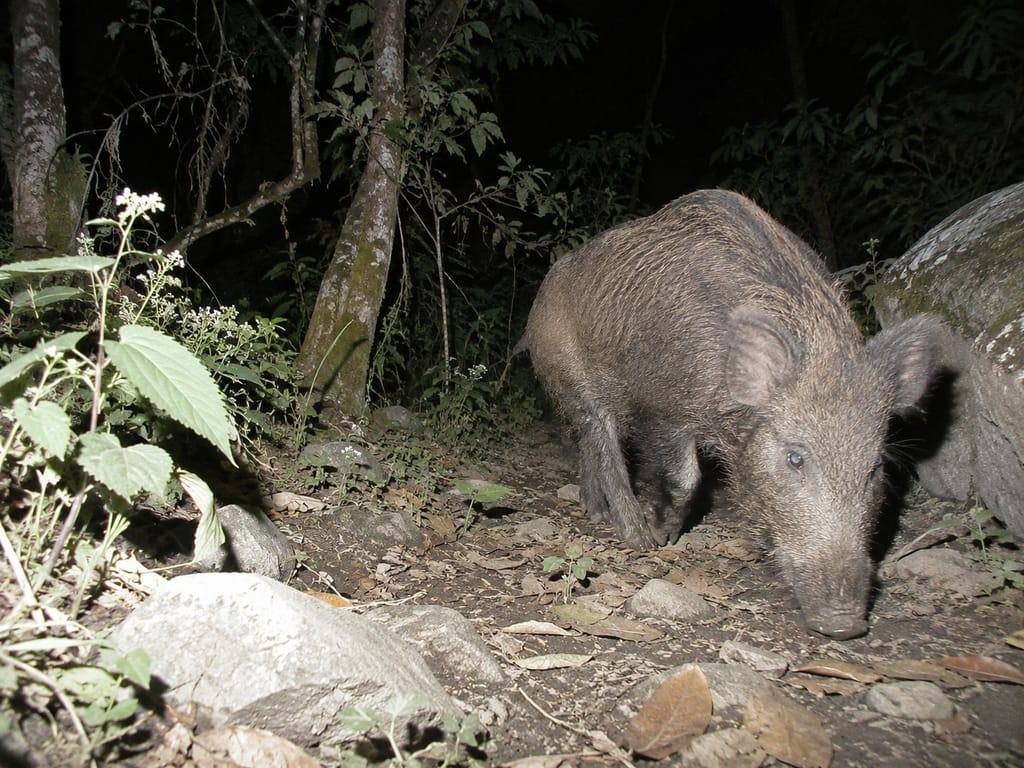
A wild boar lowers its snout toward a rocky, leaf-covered forest floor at night. Bright frontal flash illuminates its coarse fur, nearby plants and tree trunks against a nearly black background. What the check saw. The low, wide-angle viewpoint and harsh frontal flash give the image the appearance of a nighttime wildlife camera-trap photograph.
With other styles
The opposite: Drone top-down photography. Both put a camera where a person is not, but this one sits fixed at animal height and waits for the subject; the drone is flown and aimed from above.
The opposite: Y2K digicam and flash revival. A shared surface look only (on-axis flash, burned-out near subjects, black backgrounds, date stamp). Y2K digicam flash is a social snapshot style about people, pose and intimacy; this one is unattended and about animals.
The opposite: New Topographics. Both are deadpan records of the land, but this one lets an animal's chance appearance decide the frame and sits in a scientific-record lineage, while the topographic photographer chooses level, composed views.
Sources
- Camera trap, Wikipedia: https://en.wikipedia.org/wiki/Camera_trap (commercial infrared-triggered cameras from the early 1990s; hunters' demand; 940 nm No-Glow infrared flash; film models collected and developed; no named photographers).
- George Shiras III, Wikipedia: https://en.wikipedia.org/wiki/George_Shiras_III (1859-1942; National Geographic called him the father of wildlife photography for early camera traps and flash; 1935 two-volume book of over 960 photographs).
- Wildlife photography, Wikipedia: https://en.wikipedia.org/wiki/Wildlife_photography ("In July 1906, National Geographic published its first wildlife photos" by George Shiras III; "Some of his photos were taken with the first wire-tripped camera traps"; fetched and confirmed).
- Frederick Walter Champion, Wikipedia: https://en.wikipedia.org/wiki/Frederick_Walter_Champion (1893-1970; 1920s tripwire cameras in the Siwalik Hills; first night photographs of wild tigers and leopards; With Camera in Tiger-land, 1927; The Jungle in Sunlight and Shadow, 1934). Secondary source only.
- Wikimedia Commons, George Shiras III files: Two deer in the woods at night (National Geographic, July 1906) and A bull elk catches a camera string in his antlers, triggering a flash (Yellowstone, July 1913): public domain; downloaded and viewed.
- Wikimedia Commons, NPS: A mountain lion triggers a wildlife camera at Rancho Corral de Tierra (21 August 2023), public domain; EXIF records a Bushnell Huntingcam, 1/30 s, f/2.8, ISO 800. Downloaded and viewed.
- Research boundary: Shiras's wire-trip method comes from secondary sources and Commons captions; Champion's work was not checked on a primary source. The Shiras Commons deer plate does not itself show animal-triggering. Pre-1990 and post-1990 pictures share a habit (unattended, animal-triggered, flash-lit), not a single organised movement. The Shiras Commons deer plate page does not show wire-tripping. No colour daytime trail-camera specimen was added, so daylight and neutral colour are not claimed.