Styles / Street & snapshot
Concert and live-music photography
- Key: a lamp, sign or screen, about 40° to the camera’s left, soft.
- Rim or hair light: a spot or bare head, from behind, to the camera’s right, high, hard.
- Black flag: a black card, about 60° to the camera’s right, soft.
- Edge light: a strip softbox, from behind, to the camera’s left, soft.
- Edge light: a strip softbox, from behind, to the camera’s right, soft.
No fill: a black card on the shadow side keeps the shadows dark (negative fill). Coloured shadows: light the shadow side only by the sky or a second, differently coloured light. Visible beams: smoke, steam or dust in a directional light.
Schematic, not to scale: worked out from the style’s choices. No set-up of this style has been rendered yet.
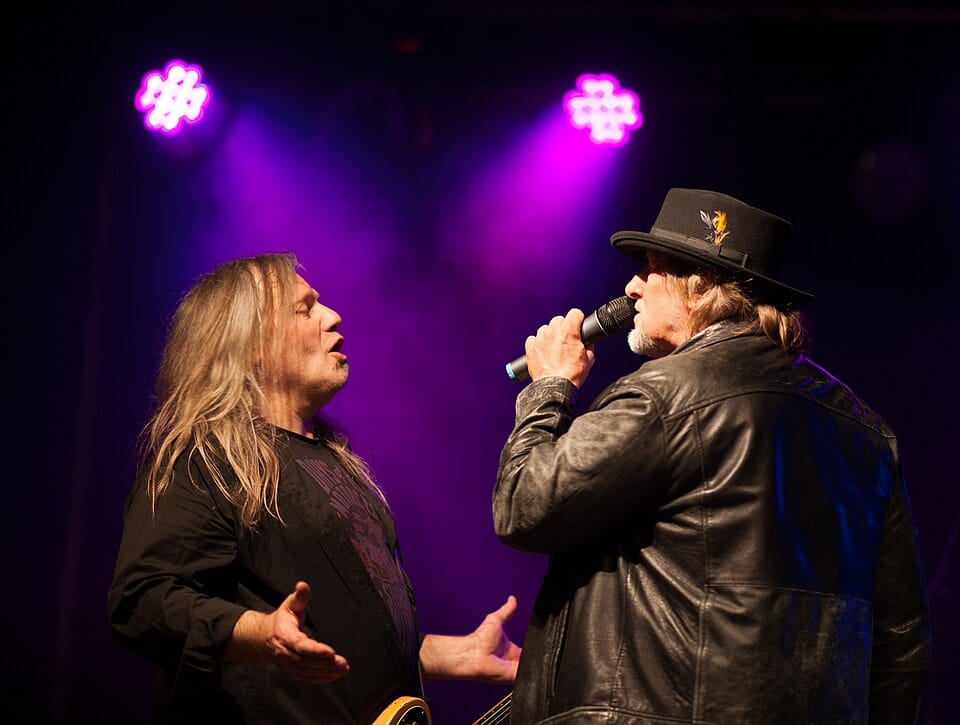
The Booze Band at the Magni Fest, Brunswick (DSC05312)
PtrQs, via Wikimedia Commons, CC BY-SA 4.0. Source: The Booze Band at the Magni Fest, Brunswick (DSC05312) at Wikimedia Commons

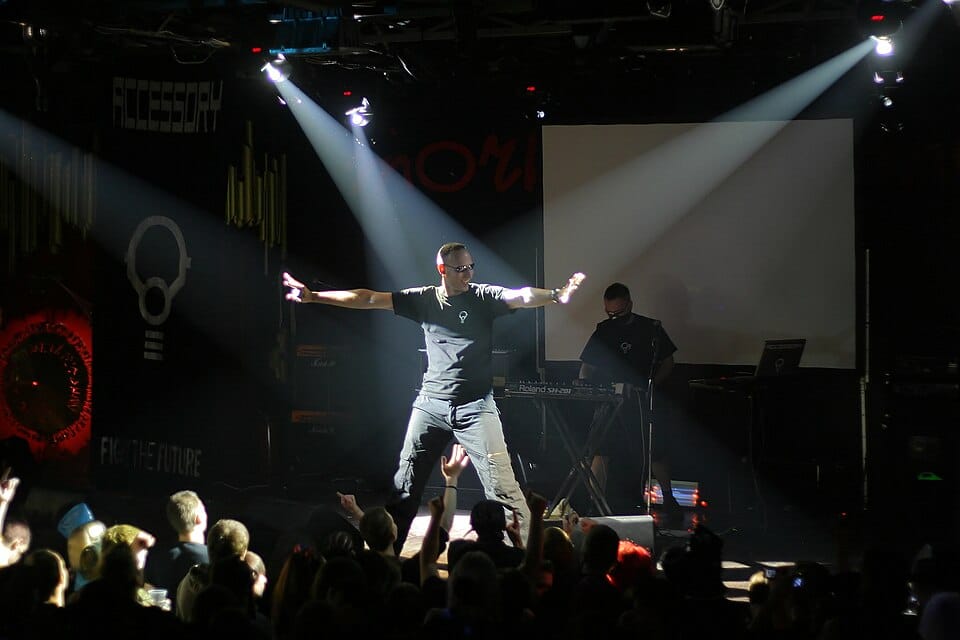
Accessory live at the Tochka club, Moscow
Shansov.net, via Wikimedia Commons, CC BY-SA 3.0. Source: Accessory live at the Tochka club, Moscow at Wikimedia Commons

Performers caught mid-song in the light the show provides: spotlights, beams, haze and coloured gels, with no flash. Shot from the pit or the crowd with fast lenses and high ISO, so faces glow out of dark stages, highlights burn, noise is tolerated and the peak gesture is the picture.
Built mostly on one system: Stage light. What systems are.
Shoot sheet for your kit A prompt for an image model The photographs
How the look is made
- Work with the stage light only: no flash, expose for the lit face and let the rest fall to black.
- Shoot wide open on a fast lens or a long telephoto to isolate one performer from rigging and crowd.
- Hold the shutter at about 1/60-1/200 s to freeze the gesture, and accept high ISO grain to do it.
- Wait for the peak: open mouth, raised arm, head thrown back, eye contact with the audience.
- Keep the gel colour: let magenta, blue and amber wash the skin rather than correcting it to neutral.
- Frame tight or low so the performer dominates, and include beams, smoke or audience silhouettes for scale.
Shoot sheet for your kit
Fill in your camera, lenses and lights, and the sheet says which light plays each part, what to work around and where to start on your camera. Without a kit it starts on a full-frame camera.
Light
Key: a lamp, sign or screen, about 40° to the camera’s left, soft.
Rim or hair light: a spot or bare head, from behind, to the camera’s right, high, hard.
Black flag: a black card, about 60° to the camera’s right, soft.
Edge light: a strip softbox, from behind, to the camera’s left, soft.
Edge light: a strip softbox, from behind, to the camera’s right, soft.
- No fill: a black card on the shadow side keeps the shadows dark (negative fill).
- Coloured shadows: light the shadow side only by the sky or a second, differently coloured light.
- Visible beams: smoke, steam or dust in a directional light.
- Shadow depth
- Shadows with no fill at all that fall to pure black with no detail, so parts of the subject disappear. Dark shadows that still hold some detail (a high lighting ratio, about 4:1 to 8:1: the shadow side two to three stops darker). Shadows tinted a different colour from the lit side: blue shadows on sunlit snow or sand (lit by the sky alone), or the coloured shadows where two gelled lights overlap.
- Highlights
- The brightest parts burn out to pure white with no detail, on purpose or because the light was too strong.
How the style is lit
- Stage rig only: moving-head spots and PAR cans with coloured gels, backlight and side-light from truss, haze to show beams.
- Follow-spot on the singer against a dark stage, with coloured wash from the sides on the faces.
- Small-club mixed light: a few coloured LED fixtures and a practical sign, exposed for the brightest face.
This plan is worked out from the style’s choices, so it is drawn as a schematic. One way to get the light, not a record of how any photograph was lit.
Lens and settings
Start at
On a full-frame camera: the same depth of field and exposure as the style’s own numbers, in the same light. Then meter and adjust.
- Then
- 50–200 mm · f/1.8–f/4 · 1/200–1/40 s · ISO 400–6400 on full frame, inferred from the gear and the look. Inferred from the four Wikimedia Commons concert frames inspected (1/45-1/100 s, f/1.8-f/4.5, ISO 400-3200, 50-135 mm) and the Wikipedia article's general advice (f/2.8-f/4, ISO 3200 or higher); the 1/60-1/200 s shutter range and the 70-200 mm end are inferred, not sourced. Pit shooters go longer and faster; small-club shooters wider and slower.
- White balance
- Daylight or fixed 3200-5600 K; do not chase the rig. Leave gel colours (magenta, blue, amber) as the lighting designer set them, and let tungsten spots stay warm against cool washes.
- Focal length
- A long lens stacks distant planes close together.
- Focus
- One plane sharp, the rest melting into blur and bokeh.
- Angle
- Looking up: the subject towers.
- Distance
- Within arm’s reach: faces, hands and details fill the frame.
- Crop & fill
- The edges cut into the subject: heads, limbs or objects run out of frame.
- Instant
- Gesture and geometry peak together in one instant. Movement stopped dead by a fast shutter or flash.
Direct
Nobody is posed: the performer works the stage and the photographer waits for the peak, a held note, a raised arm, a head thrown back or a look into the crowd. Rare cooperation is a glance to the pit or a moment in a soundcheck.
- Head & gaze
- Attention on what the hands are doing or on a thing (working, reading, eating, playing), not on the camera.
- Arms & hands
- Hands busy with a prop or a tool: flowers, a phone, a cup, a cigarette, an instrument, one’s own work.
- Line & energy
- Large, readable gestures and attitudes, as on a stage or in a silent film: a feeling or a story acted out. Running, dancing, spinning or tumbling, with hair and clothes flying; an ordinary walk is Walking & mid-stride.
- Expression
- A hard, searching stare or a set jaw: gravity, strength or defiance. Tears, grief, anger, fear or elation shown openly on the face and in the body.
- The moment
- People photographed as they are, unaware or unconcerned.
Style the set
Stage costume, instruments and the stage set are the styling, left exactly as the act chose them. The photographer adds nothing and cannot move a mic stand, cable or lamp out of the frame, so they crop or move instead.
- Clothes
- Period dress, fancy dress, stage costume or someone else’s clothes, worn to play a part rather than as one’s own. Outfits the wearers put together to be seen, designer labels included: layering, sneakers, statement pieces.
Finish
- Colour
- Strong, dense colours.
- Texture
- Film grain or noise you can see at normal size.
- Shown in
- Pictures made for magazine pages and spreads.
Stay away from soft studio light, high-key, overcast & flat daylight, direct on-camera flash, deadpan, formal posed portrait, deep focus, heavy retouching, relaxed & natural and soft focus & diffusion.
Before you shoot it
The photographs show real performers, often in a public moment of intensity, and venues, promoters and acts set access rules, credentialing and image rights: commission or credit properly, follow the pit rules and do not use a performer's likeness commercially without consent. Audience members in the frame are private people. The specimen photographs of real performers, including a tribute band, are licensed for reuse but their Commons pages carry personality-rights notes that still apply.
A prompt for an image model
No prompt for this style
Behind its pictures: real performers and audiences.
Its caution asks for credit and consent and warns against fake gig photographs of real artists.
The photographs show real performers, often in a public moment of intensity, and venues, promoters and acts set access rules, credentialing and image rights: commission or credit properly, follow the pit rules and do not use a performer's likeness commercially without consent. Audience members in the frame are private people. Do not generate fake gig photographs of real artists or present a generated image as a documentary or press photograph.
Work with photographers of this tradition, or take only its light and lens (the shoot sheet above) without its people, places or rituals.
Photographs that define it
From open collections, shown whole with their credits. Later photographs are linked, not shown, while they are in copyright.
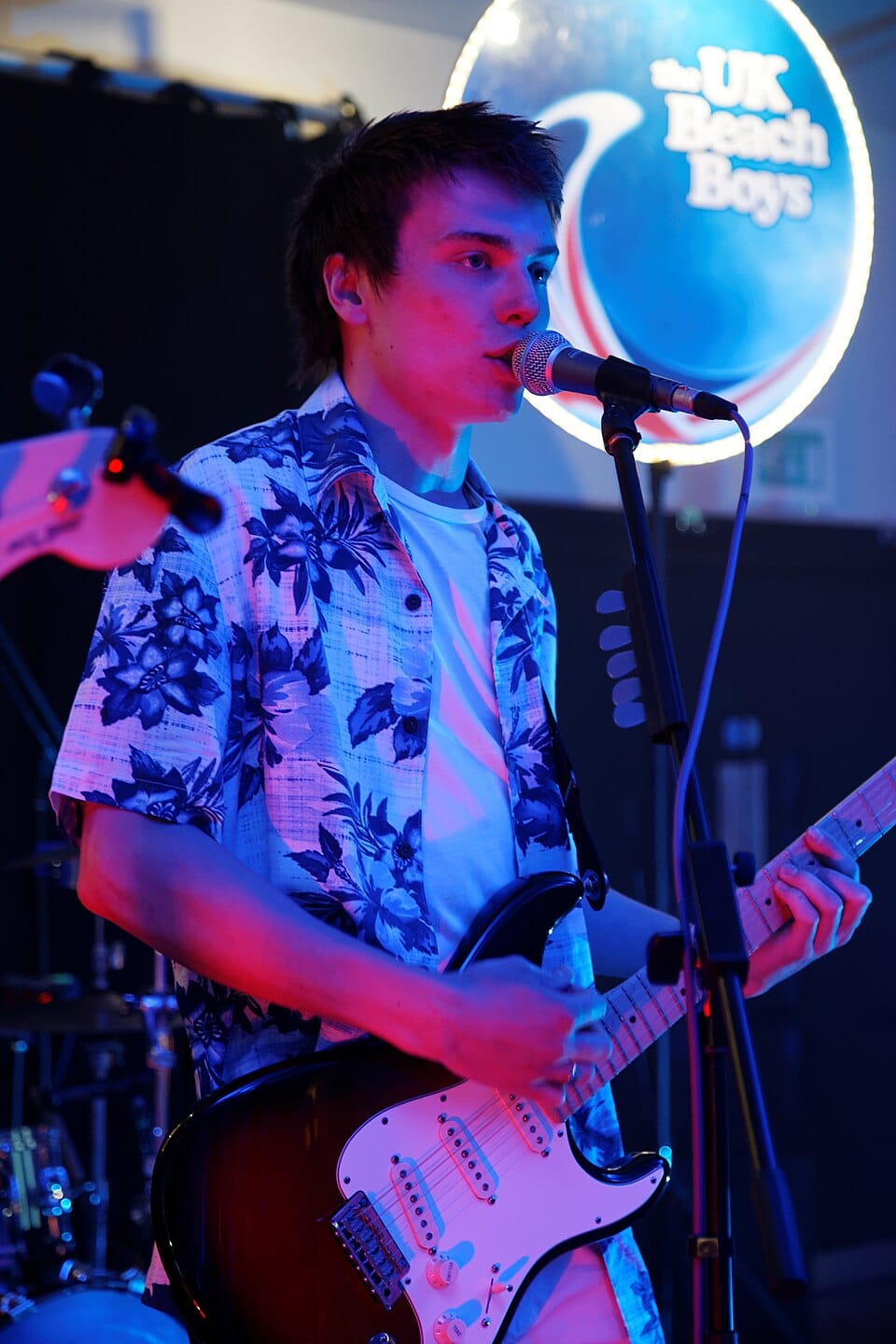
The UK Beach Boys tribute band at Dreamland, Margate (05)
Acabashi, via Wikimedia Commons, CC BY-SA 4.0. Source: The UK Beach Boys tribute band at Dreamland, Margate (05) at Wikimedia Commons

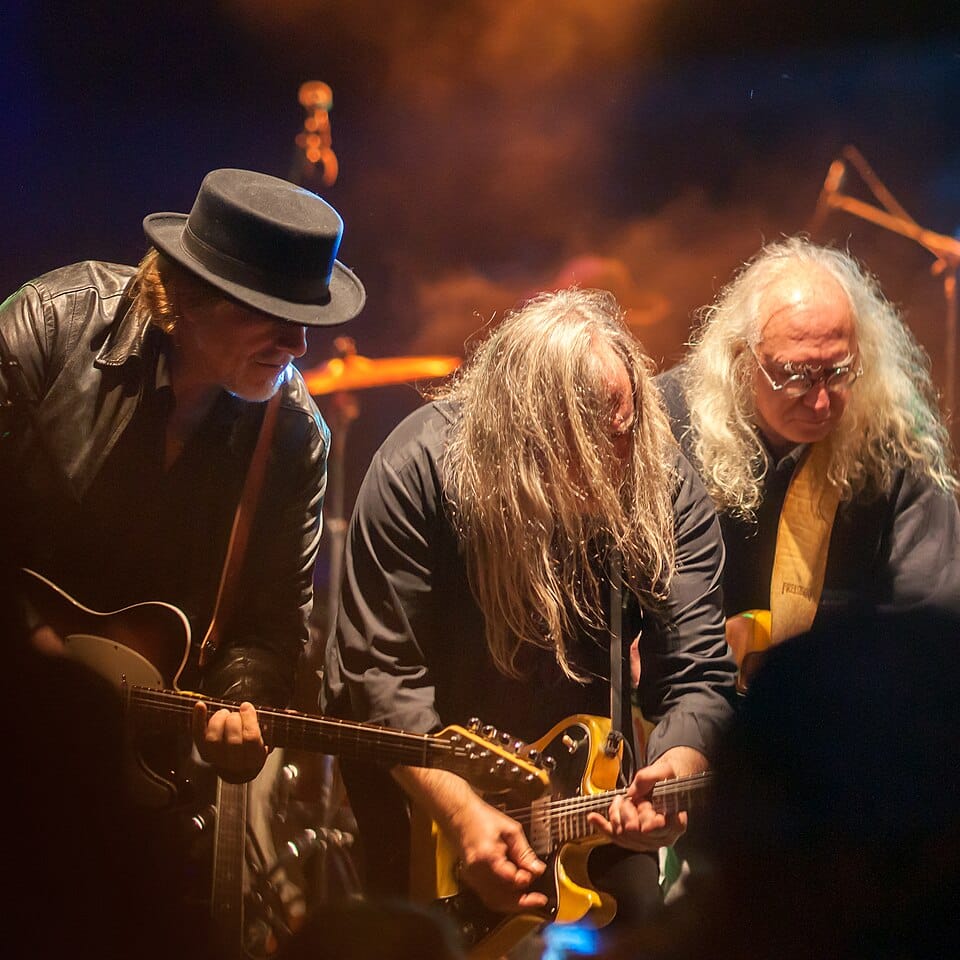
The Booze Band at the Magni Fest, Brunswick (DSC05245)
PtrQs, via Wikimedia Commons, CC BY-SA 4.0. Source: The Booze Band at the Magni Fest, Brunswick (DSC05245) at Wikimedia Commons

With other styles
The opposite: New York street photography. Shares the street school's candid timing, but the concert photographer works from a controlled-access vantage in stage light, where the street gives ambient chaos.
Pairs with Tungsten cine-stock night look (CineStill halation). Shoot a gig on tungsten cine stock to add halation around the stage lamps.
The opposite: Tabloid flash press photography. Press flash lights everything from the camera; a concert frame keeps the venue's own light and lets the background fall away.
The opposite: Surf-magazine action photography. Both freeze peak action with long lenses, but surf is lit by open daylight and water; the concert frame depends on gels, beams and a black stage.