Styles / Street & snapshot
Congolese nightlife and ambiance photography
- Key: a flash on the camera, from the camera, hard.
The flash reaches only what is near it, so shadows and background fall to black.
Schematic, not to scale: worked out from the style’s choices. No set-up of this style has been rendered yet.
The photographs that define it are still in copyright, so they are linked below rather than shown.
Night pictures of Congolese bars, dance floors and pavements, made with a flash by a photographer who works the room. Patrons dressed for the evening pose for him in tight groups, arms around each other and faces turned to the lens, so the flash lights the people hard and lets the club fall into black. Mostly black and white, often on 6x6 negatives, printed with strong contrast: the evening's glamour recorded as a keepsake and as a portrait of the city's social life.
Built on two systems: Bright selfie and Event reportage. What systems are.
Shoot sheet for your kit A prompt for an image model The photographs
How the look is made
- Go to the bar, the dance floor or the pavement outside where people have dressed for the night, and photograph them where they stand.
- Put the flash on the camera and fire it at the group; let the background drop to black beyond the first few metres.
- Ask people to give you the pose: heads together, hips tilted, hands on a shoulder or a glass, faces to the lens, and take it before the moment moves on.
- Keep the clothes, shoes and hair whole in the frame: full dresses, striped fabric, sharp trousers are part of the evening.
- Include a piece of the room (a bar front, a hung decoration, a car, a table with glasses) so the picture says where the night happened.
- Print in strong black and white with deep blacks and bright whites, and keep the grain.
Shoot sheet for your kit
Fill in your camera, lenses and lights, and the sheet says which light plays each part, what to work around and where to start on your camera. Without a kit it starts on a full-frame camera.
Light
Key: a flash on the camera, from the camera, hard.
- The flash reaches only what is near it, so shadows and background fall to black.
- Shadow edges
- Shadows with crisp outlines, cast by a small or distant light: direct sun, a bare flash, a spotlight.
- Shadow depth
- Shadows with no fill at all that fall to pure black with no detail, so parts of the subject disappear.
- Shape & form
- Shadows thrown away from what casts them (a figure’s long shadow, railings on a wall) that become shapes of their own in the composition.
How the style is lit
- On-camera flash, direct and unmodified, fired at a group a few metres away; the room behind falls to black.
- Flash plus the bar's own tungsten and neon, so a lit counter or hung decoration holds a trace of detail behind the people.
- A street lamp or car headlights at the pavement outside the club, with flash for the people.
This plan is worked out from the style’s choices, so it is drawn as a schematic. One way to get the light, not a record of how any photograph was lit.
Lens and settings
Start at
On a full-frame camera: the same depth of field and exposure as the style’s own numbers, in the same light. Then meter and adjust.
- The style’s f/11 on 6 × 6 cm gives about the depth of field of f/6.2 on full frame.
- With flash, 1/125 s stays under every camera’s flash sync speed (1/160–1/250 s, by camera): set the exposure with the flash power and the f-number.
- Then
- 35–50 mm · f/8–f/16 · 1/125–1/59 s · ISO 100–400 on 6 × 6 cm, inferred from the gear and the look. Documented: a 6x6 Yashica Mat-124 G for Pellosh and a flash for Depara; a square frame is visible in Chez 'Oui Fifi'. Stops, shutter times and film speeds are inferred from flash-at-a-few-metres practice; a medium-format normal lens (80 mm) is about 45 mm in 35 mm terms. No exposure data for any specimen was found. The 6x6 format is documented for Pellosh and for the Chez 'Oui Fifi' print; Leopoldville la nuit is not square.
- Focal length
- Roughly the eye’s own perspective; no visible distortion.
- Angle
- The camera at the height of a standing person or of the subject.
- Distance
- Whole figures and their immediate surroundings.
- Balance
- The subject in the middle, the frame balanced around it.
- Crop & fill
- The subject shown small within its setting, which explains it.
- Instant
- Movement stopped dead by a fast shutter or flash.
Direct
The photographer calls the group in and the patrons give the pose: faces tipped toward each other, an arm around a shoulder or a waist, a hand on a hip, a glass held, eyes at the lens, a smile or a cool look; women lean on a car or sit on bar stools with skirts spread; the photographer takes one frame, sometimes two, before the pose dissolves.
- Head & gaze
- Looking straight into the camera, so the subject meets the viewer’s eye.
- Arms & hands
- Signs made at the camera: the V sign, heart hands, finger hearts, a thumbs-up, pointing at the lens.
- Expression
- A smile, posed or natural, lips closed or showing teeth.
- Several people
- Bodies close together, overlapping and leaning in: friends, a band, a family on a sofa. People talking, playing, working or dancing together, absorbed in each other rather than the camera. People holding, hugging, kissing, leaning on or carrying one another.
- With the sitter
- The sitter arranged and still, facing the camera. The subject performs for the camera and shapes the picture.
Style the set
Patrons wear their evening best, chosen by themselves: full-skirted striped or printed cotton dresses, sharp shirts and trousers, hairstyles, jewellery, shoes. The place is left as found: a bar front with a hung decoration, stools, a table of glasses, a parked car. No backdrop is brought in.
- Clothes
- Best clothes, jewellery and accessories put on for the studio or the occasion. Outfits the wearers put together to be seen, designer labels included: layering, sneakers, statement pieces.
- Set & props
- A real place picked for its look as the setting for a shoot, not the subjects’ own: a street, a field, a palace, a hotel room.
- How much is styled
- Nothing dressed, made up, moved or added for the picture.
Finish
- Monochrome
- A black-and-white scale pushed towards pure black and pure white, with few middle greys.
- Texture
- Film grain or noise you can see at normal size.
- Post-production
- Nothing changed beyond exposure and development.
- Shown as
- Each picture stands on its own.
Stay away from soft studio light, overcast & flat daylight, studio backdrop, shallow depth of field, heavy retouching, deadpan, nobody in the picture, unseen camera and pastel.
Before you shoot it
The people in these pictures are real patrons, many unnamed, and their families may be alive; show them with the photographer's credit and the holder's licence, and caption the places and years only as far as sources give them. The archives are held by the photographers' estates and galleries (Depara's untitled negatives were titled by a friend with the family's permission; some prints are later) so the specimens here are link-only. The wider picture of these cities is not this style alone: Kinshasa's and Pointe-Noire's practices are related by subject, not shown to be one school.
A prompt for an image model
A ready prompt that describes this look to an image model: where the lights stand, the lens, the framing and the colour. It starts on the style’s own choices; change any of them and the prompt and the notes follow.
The prompt
Notes on this prompt
- How the style uses it: put the flash on the camera and fire it at the group; let the background drop to black beyond the first few metres. Image models put the light in the wrong place more often than anything else, so the prompt says where each light stands: which side of the picture, and how high. Keep to one light pattern per prompt, or the model splits the difference.
- Describe an invented person by age, clothes and pose. Never name a real or famous person, and never write “looks like”.
- Black and white: colour words in the subject (a red dress, green leaves) can pull the model back to colour, so leave them out.
The model makes a new picture, not a photograph of anything that happened. Label it as AI-generated, and don’t pass it off as the style’s history or as a real person.
Where to see it
From open collections, shown whole with their credits. Later photographs are linked, not shown, while they are in copyright.
In copyright, so linked
- Leopoldville la nuit , Jean Depara, 1959. MAGNIN-A, Paris.
- Chez "Oui Fifi" , Jean Depara, 1958. MAGNIN-A, Paris.
Made by an AI model
An image gpt-image-2 made from this style’s choices, then checked against them by a vision model. Not a photograph, and not part of the style’s history. All generated images
-
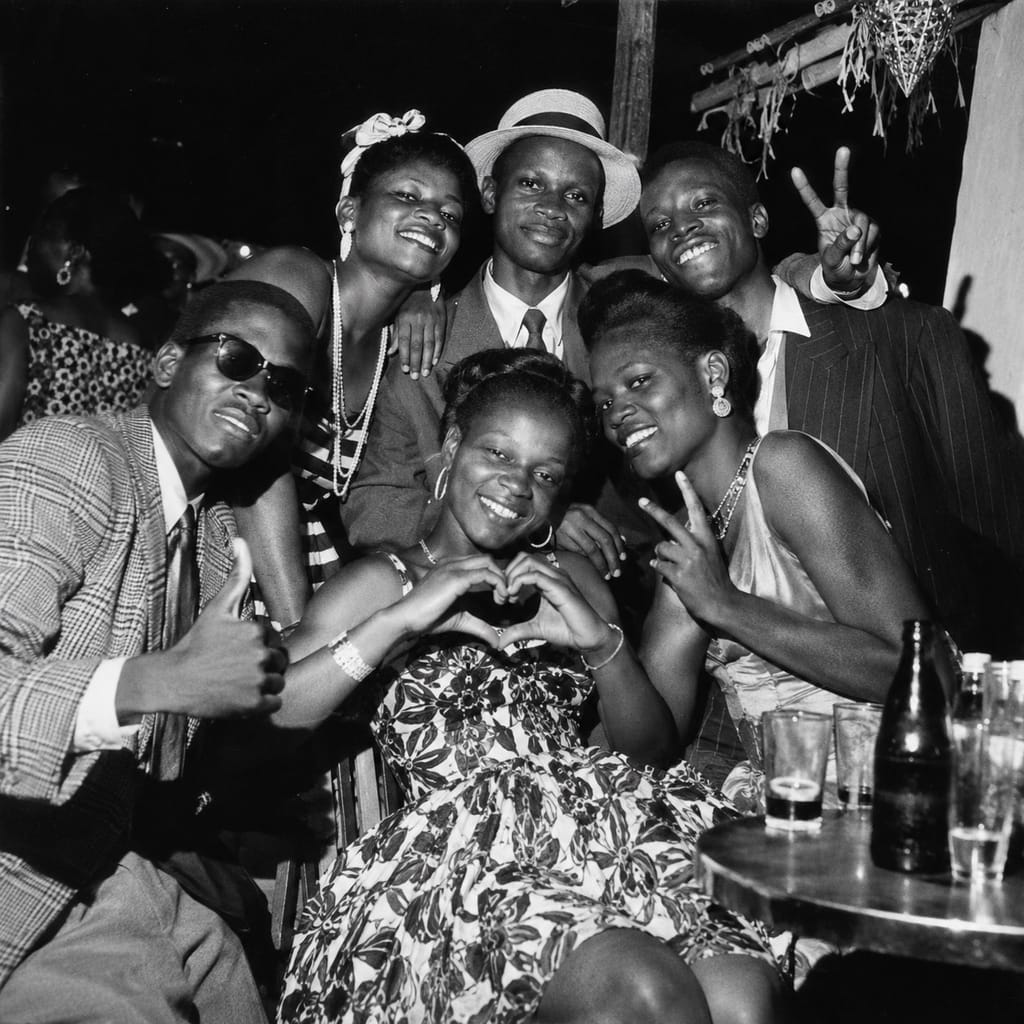
Six smiling people in suits and dresses cluster together beside a table with bottles and drinking glasses in a black-and-white photograph. They face the camera, making thumbs-up, peace signs and a heart shape with their hands. What the check saw. Direct flash, visible grain and deep background shadows give this tightly framed group portrait the appearance of a vintage party snapshot.
With other styles
Pairs with Drum magazine photography. Both use on-camera flash on African city nightlife; Drum was magazine-commissioned photojournalism, here the work is a keepsake made for the patrons.
Pairs with Malian studio portraiture. An analogy only, with no documented transmission to Congolese practice: both record clients in their chosen best, but here the set is a real bar and a direct flash, and the sitters keep authorship of the pose.
The opposite: Sapeur dandy portraiture. Sapeur portraits are daytime colour pictures of single dandies in the street; here the subject is the group in the night club in hard flash and black and white.
The opposite: Tabloid flash press photography. Both use the on-camera flash against a dark room, but the press hunts the event; here the patrons agree and perform for the camera.
Sources
- MAGNIN-A, Jean Depara biography: https://www.magnin-a.com/en/artists/105-jean-depara/biography/ (born 1928 in Angola, d. 1997 in Kinshasa; small Adox camera in 1950; Franco's photographer from 1954; flash for Kinshasa's night life; bars and clubs; collections)
- MAGNIN-A, Jean Depara, Leopoldville la nuit (1959), silver gelatin print: https://www.magnin-a.com/en/artists/105-jean-depara/works/11233-jean-depara-leopoldville-la-nuit-1959/
- MAGNIN-A, Jean Depara, Chez 'Oui Fifi' (1958), silver bromide print, 36 x 36 cm: https://www.magnin-a.com/en/artists/105-jean-depara/works/2576-jean-depara-chez-oui-fifi-1958/
- Maurice Pellosh, Wikipedia: https://en.wikipedia.org/wiki/Maurice_Pellosh (b. 1951, d. 2023; apprenticeship 1971; Studio Pellosh opened 17 December 1973; Yashica Mat-124 G, 6x6; evening bar and ballroom work; colour from the 1980s)
- Hyperallergic, on Maurice Pellosh: https://hyperallergic.com/remembering-a-congolese-photographers-images-of-post-liberation-congo/ (one take per customer; clubgoers and musicians among his subjects)