Styles / Documentary & reportage
Industrial construction-progress photography
- Key: the open sky, all around and above, soft.
Open shadows: bright surroundings (walls, ground, sky) fill them; no reflector needed.
Schematic, not to scale: worked out from the style’s choices. No set-up of this style has been rendered yet.
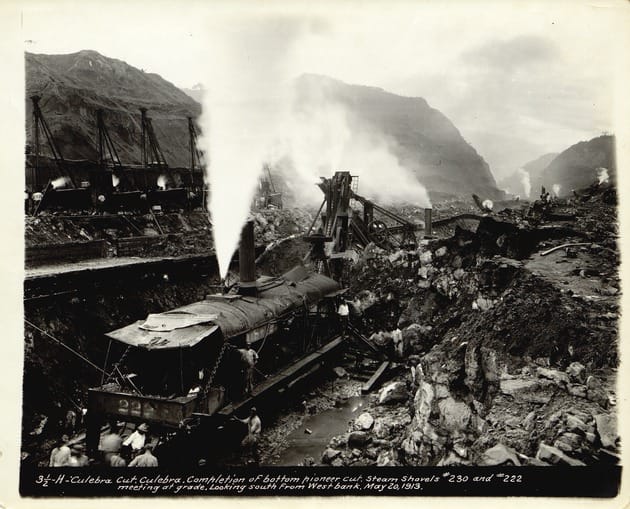
Culebra Cut: completion of bottom pioneer cut, Steam Shovels #230 and #222 meeting at grade
Ernest 'Red' Hallen / Isthmian Canal Commission, University of Florida Digital Collections (public domain), via Wikimedia Commons. Source: Culebra Cut: completion of bottom pioneer cut, Steam Shovels #230 and #222 meeting at grade at University of Florida Digital Collections, via Wikimedia Commons

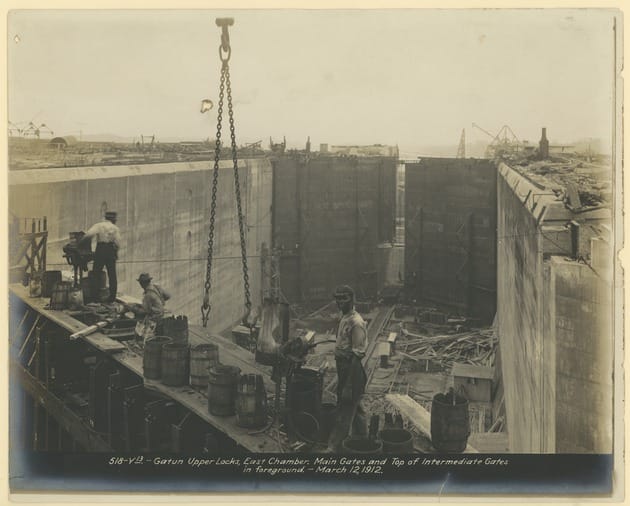
Gatun Upper Locks, East Chamber, Main Gates and Top of Intermediate Gates in foreground
Ernest 'Red' Hallen / Isthmian Canal Commission, University of Florida Digital Collections (public domain), via Wikimedia Commons. Source: Gatun Upper Locks, East Chamber, Main Gates and Top of Intermediate Gates in foreground at University of Florida Digital Collections, via Wikimedia Commons

Large-format photographs commissioned by an owner or state to record an engineering work as it grows: the same cut, lock chamber or steel frame returns on a schedule. Each print is numbered, dated and captioned in the picture. The camera stands on a rim, bench or girder and looks down across excavation, formwork and machinery, sharp from the foreground to the far wall, with labourers small in the middle distance. The prints are filed in albums as proof of progress.
Built on two systems: Deadpan document and Event reportage. What systems are.
Shoot sheet for your kit A prompt for an image model The photographs
How the look is made
- Fix the vantage on a rim, scaffold or bench high enough to read the whole works, and where the commission allows go back to it on a schedule (the commission asked for about one visit a month) so prints can be set beside each other.
- Stop down and keep every plane sharp from the nearest chain or formwork to the far wall; this is a record, so leave no important part out of focus.
- Include the men and machines at work, small and unposed in the middle distance, as scale and evidence of labour; do not wait for them to look up.
- Keep verticals upright; a diagonal of rail, gate or girder may lead into the depth.
- Shoot in whatever daylight the schedule gives, usually flat or overcast in the plates seen, and print it straight: no cloud printing, no dramatising of the sky.
- Number, date and caption every plate in the print margin or strip, with the place, the viewing direction and what changed, and file it in an album in order.
Shoot sheet for your kit
Fill in your camera, lenses and lights, and the sheet says which light plays each part, what to work around and where to start on your camera. Without a kit it starts on a full-frame camera.
Light
Key: the open sky, all around and above, soft.
- Open shadows: bright surroundings (walls, ground, sky) fill them; no reflector needed.
- Shadow depth
- Shadows kept light and full of detail by a reflector, a fill light, bounce or bright surroundings (a low lighting ratio, up to about 3:1: the shadow side at most a stop and a half darker).
How the style is lit
- Available daylight, flat tropical overcast in the plates seen (hard sun possible), no fill.
- A bright sky left blank or pale; long exposures to hold shadowed pits and chambers.
This plan is worked out from the style’s choices, so it is drawn as a schematic. One way to get the light, not a record of how any photograph was lit.
Lens and settings
Start at
On a full-frame camera: the same depth of field and exposure as the style’s own numbers, in the same light. Then meter and adjust.
- The style’s f/38 on 8 × 10 in gives about the depth of field of f/5 on full frame.
- Then
- 28–50 mm · f/22–f/64 · 1/25–2 s · ISO 5–50 on 8 × 10 in, inferred from the gear and the look. Inferred from the large plate-camera prints, their depth of field and the stillness of the labourers; no maker's settings were found. Fast machines and blasts show motion blur or a frozen cloud, so exposure varied with the light and the scene.
- Focal length
- Roughly the eye’s own perspective; no visible distortion.
- Focus
- Everything sharp from the nearest stone to the horizon.
- Angle
- Looking down on the subject.
- Distance
- Standing well back; people are small. Whole figures and their immediate surroundings.
- Balance
- Tilted lines and oblique movement drive the picture.
- Crop & fill
- The subject shown small within its setting, which explains it.
- Depth
- Separate events in the foreground, middle ground and background.
- Duration
- An unmoving scene, exposed slowly and carefully.
- Many times
- Successive instants shown side by side or in one frame.
Direct
Do not pose anyone. Workers are caught at their jobs, side-on or absorbed in the work, in clusters at a machine, gate or scaffold; some look at the camera for the long exposure. For a scale figure, wait for one to stand still on a ledge or beam.
- Head & gaze
- Attention on what the hands are doing or on a thing (working, reading, eating, playing), not on the camera.
- Several people
- Bodies close together, overlapping and leaning in: friends, a band, a family on a sofa.
- The moment
- People photographed as they are, unaware or unconcerned.
- With the sitter
- Neutral, unemotional and distant.
Style the set
Nothing is styled. Men wear their work clothes, hats and caps; machines, barrels, rails, timber and spoil are left as the site has them. Sweep nothing and move nothing, except to clear the view and show the new work.
- Clothes
- Simple, solid, unbranded clothes chosen so they do not distract from the face.
- Set & props
- A real home, workplace or street that belongs to the people in it, not a set, with their own things and traces of use.
- How much is styled
- Nothing dressed, made up, moved or added for the picture.
Finish
- Monochrome
- Rich blacks, clean whites and every grey between. A monochrome image tinted sepia, brown, selenium purple or cyanotype blue.
- Film
- A view camera on a tripod: great detail, slow and deliberate.
- Post-production
- Nothing changed beyond exposure and development. Words or graphic marks added to the photograph.
- Shown as
- Pictures made and shown as a set.
- Shown in
- Prints for an album, a card or a frame at home.
Stay away from golden hour, shallow depth of field, soft focus & diffusion, composite & montage, tilted angle, glamour & aspiration, theatrical & acted, fully art-directed and heavy retouching.
Before you shoot it
The photographs record dangerous, often exploited labour. The Panama Canal workforce included many West Indian and other labourers who are rarely named; Hallen's captions in the specimens name places and works, not workers, and the pictures were commissioned by the owner or state to show progress, so they say little about deaths, pay or conditions. Name workers only where the record does, never present a modern image as an archival progress print, and read the 'progress' framing as the commissioning body's, not as neutral fact. This is a classification of an idiom, not a claim that every progress photograph celebrates harm. The evidence base is one maker's Panama work (1907-1913 specimens); the wider idiom is not verified, and the commissioner's promotional use of the prints is not the same as a neutral record.
A prompt for an image model
A ready prompt that describes this look to an image model: where the lights stand, the lens, the framing and the colour. It starts on the style’s own choices; change any of them and the prompt and the notes follow.
The prompt
Notes on this prompt
- Image models put the light in the wrong place more often than anything else, so the prompt says where each light stands: which side of the picture, and how high. Keep to one light pattern per prompt, or the model splits the difference.
- Describe an invented person by age, clothes and pose. Never name a real or famous person, and never write “looks like”.
- Black and white: colour words in the subject (a red dress, green leaves) can pull the model back to colour, so leave them out.
The model makes a new picture, not a photograph of anything that happened. Label it as AI-generated, and don’t pass it off as the style’s history or as a real person.
Photographs that define it
From open collections, shown whole with their credits. Later photographs are linked, not shown, while they are in copyright.
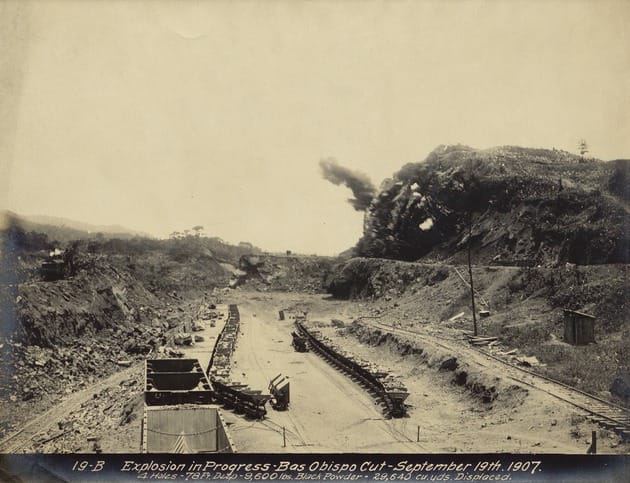
Explosion in Progress, Bas Obispo Cut
Ernest 'Red' Hallen / Isthmian Canal Commission, University of Florida Digital Collections (public domain), via Wikimedia Commons. Source: Explosion in Progress, Bas Obispo Cut at University of Florida Digital Collections, via Wikimedia Commons

With other styles
Pairs with Western survey photography. Borrow its high vantage and sharp layered depth, then add dated returns to one view and a caption strip. The link is kinship of idiom (about 15 years and a different subject apart), not a documented lineage.
The opposite: Modernist architectural photography. Photograph the finished building with the architect's chosen corner for contrast: here the unfinished works, mud and labour stay in.
The opposite: FSA/OWI documentary photography. Turn from the commissioned record of a work to a commissioned record of people: faces and captions about lives, not progress.
The opposite: Soviet socialist realist press photography. Compare building as neutral record with building as an argument for progress: low angles, heroic ranks and staged collective scenes.
Pairs with New Topographics. Rephotograph a changing site from a fixed vantage at intervals and show it in a deadpan series.