Styles / Staged & conceptual
Double-exposure silhouette portraiture
- Key: the open sky, all around and above, soft.
- Rim or hair light: the sun, from behind, to the camera’s right, high, hard.
Silhouette: expose for the bright background and leave the subject unlit.
Schematic, not to scale: worked out from the style’s choices. No set-up of this style has been rendered yet.
The photographs that define it are still in copyright, so they are linked below rather than shown.
A readable head or figure becomes a container for trees, foliage or rock: nature replaces much of the dark portrait while its contour survives against a nearly empty pale ground. Still profiles and quiet full figures turn two photographs into a lyrical human–nature metaphor. In-camera multiple exposures and later digital composites reach a related composition, but are different workflows; generic ghost doubles and landscape-filled objects fall outside this entry.
Built on two systems: Graphic abstraction and Pictorial print. What systems are.
Shoot sheet for your kit A prompt for an image model The photographs
How the look is made
- Photograph a still person against a bright, uncluttered ground, leaving the face or body dark enough to hold another image.
- Keep a readable profile or whole-figure contour; retain a little facial or bodily detail rather than dissolving the person completely.
- Choose a second photograph of foliage, trees or rock whose branching or texture follows the portrait's shape.
- Combine the photographs either through an in-camera multiple-exposure mode or through aligned digital layers; distinguish these routes in the caption.
- Suppress distracting surroundings and preserve pale space outside the figure, allowing selected branches to break its outline.
- Make the relation between person and landscape an openly constructed metaphor, not a claim about a real encounter.
Shoot sheet for your kit
Fill in your camera, lenses and lights, and the sheet says which light plays each part, what to work around and where to start on your camera. Without a kit it starts on a full-frame camera.
Light
Key: the open sky, all around and above, soft.
Rim or hair light: the sun, from behind, to the camera’s right, high, hard.
- Silhouette: expose for the bright background and leave the subject unlit.
- Shadow depth
- Dark shadows that still hold some detail (a high lighting ratio, about 4:1 to 8:1: the shadow side two to three stops darker).
- Highlights
- The brightest parts burn out to pure white with no detail, on purpose or because the light was too strong.
How the style is lit
- For the base portrait, place the sitter under an overhang or beside a window facing a bright blank sky; expose to keep the outer ground pale and the face largely dark, with a little side detail. The nature image is a separate exposure, not a pattern projected onto the face.
- As a controlled alternative, light a plain background from behind the sitter and limit frontal spill so the head or figure remains a dark outline; combine it with a separately exposed nature photograph. This is a practical reconstruction of the documented silhouette principle, not a recorded studio diagram.
This plan is worked out from the style’s choices, so it is drawn as a schematic. One way to get the light, not a record of how any photograph was lit.
Lens and settings
Start at
On a full-frame camera: the same depth of field and exposure as the style’s own numbers, in the same light. Then meter and adjust.
- Then
- 50–85 mm · f/4–f/8 · 1/500–1/125 s · ISO 100–400 on full frame, inferred from the gear and the look. Illustrative daylight starting ranges for a still base portrait on full frame, not measured typical settings or an attribution to any exemplar; the sources do not state numerical exposures for the selected finished works. Meter the bright ground and adjust to retain the intended dark outline; expose the nature layer independently and adapt to the camera's blending mode.
- White balance
- For colour variants, balance the daylight source images consistently and keep colour restrained; inferred guidance, not a documented common setting.
- Focal length
- Roughly the eye’s own perspective; no visible distortion.
- Angle
- The camera at the height of a standing person or of the subject.
- Distance
- Within arm’s reach: faces, hands and details fill the frame.
- Crop & fill
- A small subject in a large empty field.
- Depth
- Depth collapsed into pattern and flat shapes.
- Many times
- Several exposures laid over each other in one frame.
Direct
Hold the head in a clear side profile with an unsmiling mouth; allow lowered or closed eyes as well as an averted gaze, and distinguish an upward head tilt from the direction of the eyes. For a whole-figure variation, stand quietly with arms at rest and turn enough for the silhouette to read. Keep movement out of the outline and do not force every portrait into the same pose.
- Turn to the camera
- Seen from the side, the face or the whole body turned 90° from the lens, like a head on a coin.
- Head & gaze
- Eyes off the frame, past the camera or into the distance, as if lost in thought. Looking down, or eyes shut: inward, modest, asleep or praying.
- Expression
- Unsmiling, composed and blank: the face gives nothing away.
- The set-up
- A scene staged and directed like a film still or a painting.
Style the set
Use plain clothing and little set dressing so that the profile, hair and body contour remain legible; remove busy surroundings from the base composition. Let the separately photographed foliage or rock supply the internal texture, not patterned costume or physically dappled light on skin.
- Clothes
- Simple, solid, unbranded clothes chosen so they do not distract from the face.
- Look of the styling
- Few, simple elements on clean surfaces, with space around them.
Finish
- Monochrome
- Rich blacks, clean whites and every grey between.
- Digital & other
- A modern digital camera: clean, detailed, neutral.
- Post-production
- Several photographs combined into one picture.
- Shown as
- Each picture stands on its own.
Stay away from nobody in the picture, filled frame, tilted angle, maximal & patterned, candid & unobserved, document & record and hdr & tone-mapped.
Before you shoot it
These are living practitioners' authored works, often involving friends, relatives and children. Credit the makers and distinguish their projects rather than claiming a universal school or copying a signature photograph. Obtain informed consent for both the portrait and its transformation, permission for both source images, and guardian consent plus age-appropriate assent for children; a publicly visible portrait is not permission to reuse it. Do not imply that inserted scenery reveals the sitter's psychology, ancestry, trauma or actual history, and never present the merge as a documentary encounter. The specimen files have no confirmed open licences and must remain link-only.
A prompt for an image model
A ready prompt that describes this look to an image model: where the lights stand, the lens, the framing and the colour. It starts on the style’s own choices; change any of them and the prompt and the notes follow.
The prompt
Notes on this prompt
- Image models put the light in the wrong place more often than anything else, so the prompt says where each light stands: which side of the picture, and how high. Keep to one light pattern per prompt, or the model splits the difference.
- Describe an invented person by age, clothes and pose. Never name a real or famous person, and never write “looks like”.
- Black and white: colour words in the subject (a red dress, green leaves) can pull the model back to colour, so leave them out.
The model makes a new picture, not a photograph of anything that happened. Label it as AI-generated, and don’t pass it off as the style’s history or as a real person.
Where to see it
From open collections, shown whole with their credits. Later photographs are linked, not shown, while they are in copyright.
In copyright, so linked
- Upward-facing profile with foliage (descriptive title; source file dizi.jpg) , Christoffer Relander, 2010–2012. Christoffer Relander, We Are Nature.
- Standing figure and dog filled with rock texture (descriptive title; source file multiexponering-11.jpg) , Christoffer Relander, 2010–2012. Christoffer Relander, We Are Nature.
- Profile with evergreen branches, cover of Double Exposures – Simple Steps (descriptive artwork title) , Brandon Kidwell, published 12 February 2014; individual composite date not stated. Brandon Kidwell, Double Exposures – Simple Steps.
Made by an AI model
An image gpt-image-2 made from this style’s choices, then checked against them by a vision model. Not a photograph, and not part of the style’s history. All generated images
-
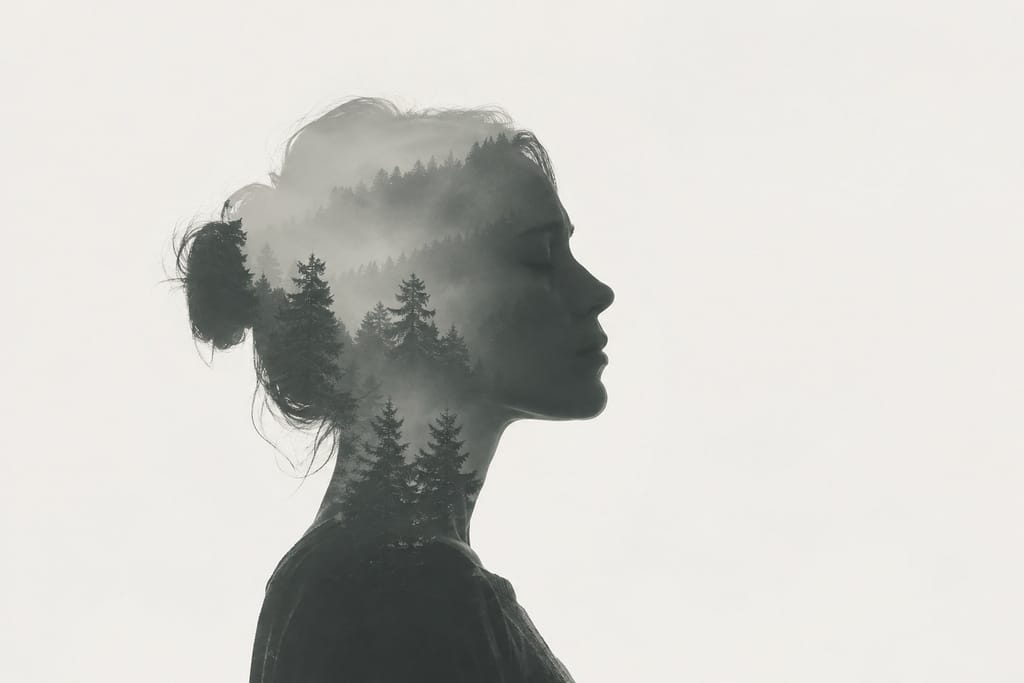
A person with their hair in a bun appears in right-facing profile with closed eyes against an off-white background. Misty hills and evergreen trees are superimposed within their head, neck and shoulders in a muted monochrome double-exposure effect. What the check saw. This is an atmospheric composite portrait rather than a product photograph, with no identifiable product presented for sale.
With other styles
Pairs with Surrealist photography. Compare its superimposition and estrangement, but keep this strand's readable portrait container, natural texture and pale surrounding field rather than low-key fragments or solarisation; resemblance does not prove descent.
The opposite: New Vision. Keep the camera near eye level and the portrait contour calm instead of making steep angles, diagonals and urban structures carry the composition.
The opposite: Helsinki School: constructed and layered nature. Here nature occupies a human outline on a pale ground; the adjacent entry builds or layers nature scenes with people absent. Shared Finnish geography is not school membership.
The opposite: Light and airy. Both can use a bright background, but keep this portrait dark enough to hold the second photograph rather than exposing the face brightly and opening every shadow.
Sources
- https://www.christofferrelander.com/projects/we-are-nature/ — primary page, text available through ?format=json and photographs in HTML: selection dated 2010–2012, DSLR in-camera multiple exposures, pigment editions. Viewed dizi.jpg and multiexponering-11.jpg; rejected multiexponering-2.jpg because its face/object overlay lacks this entry's nature-filled portrait-container composition. Filenames are identifiers, not established artwork titles or capture dates.
- https://www.christofferrelander.com/wan-past-works — primary retrospective account: in-camera double exposures made in Finland, combining landscapes with portraits of friends and relatives; contextual evidence for geography and metaphor, not a date for an individual photograph.
- https://www.brandonkidwell.com/tutorials/2014/2/12/double-exposures-simple-steps — primary tutorial, dated 12 February 2014 in /tutorials?format=json: base portrait from November 2013, iPhone 5 and Camera+, near-silhouette with retained facial highlights, overcast/overhang/window alternatives, separate tree photograph and Screen blending in Filterstorm. Viewed the finished cover IMG_7943.JPG; it includes tutorial lettering and the maker's site address. No numerical settings or open licence found.
- https://www.brandonkidwell.com/tutorials/unionappde — primary tutorial, 21 April 2014: Union and Mextures workflow; near-silhouette rather than total black, simple second layer and attention to shape. Establishes a second teaching work, not another independently inspected specimen.
- https://www.christofferrelander.com/blog/2024/9/17/we-are-nature-vol-vii — primary dated continuation: series begun in 2010, in-camera multiple exposure and childhood theme. No 2024 photograph is included as a specimen here. No historical lineage, Mountford attribution or title-sequence popularisation claim is made. The exemplars include distinct works by two independently documented practitioners, not three independently verified photographers.