Styles / Vernacular & studio
Forced-perspective tourist photography
- Key: the sun, about 45° to the camera’s left, high, hard.
Key high: about 30–45° above eye level, angled down. Open shadows: bright surroundings (walls, ground, sky) fill them; no reflector needed.
Schematic, not to scale: worked out from the style’s choices. No set-up of this style has been rendered yet.
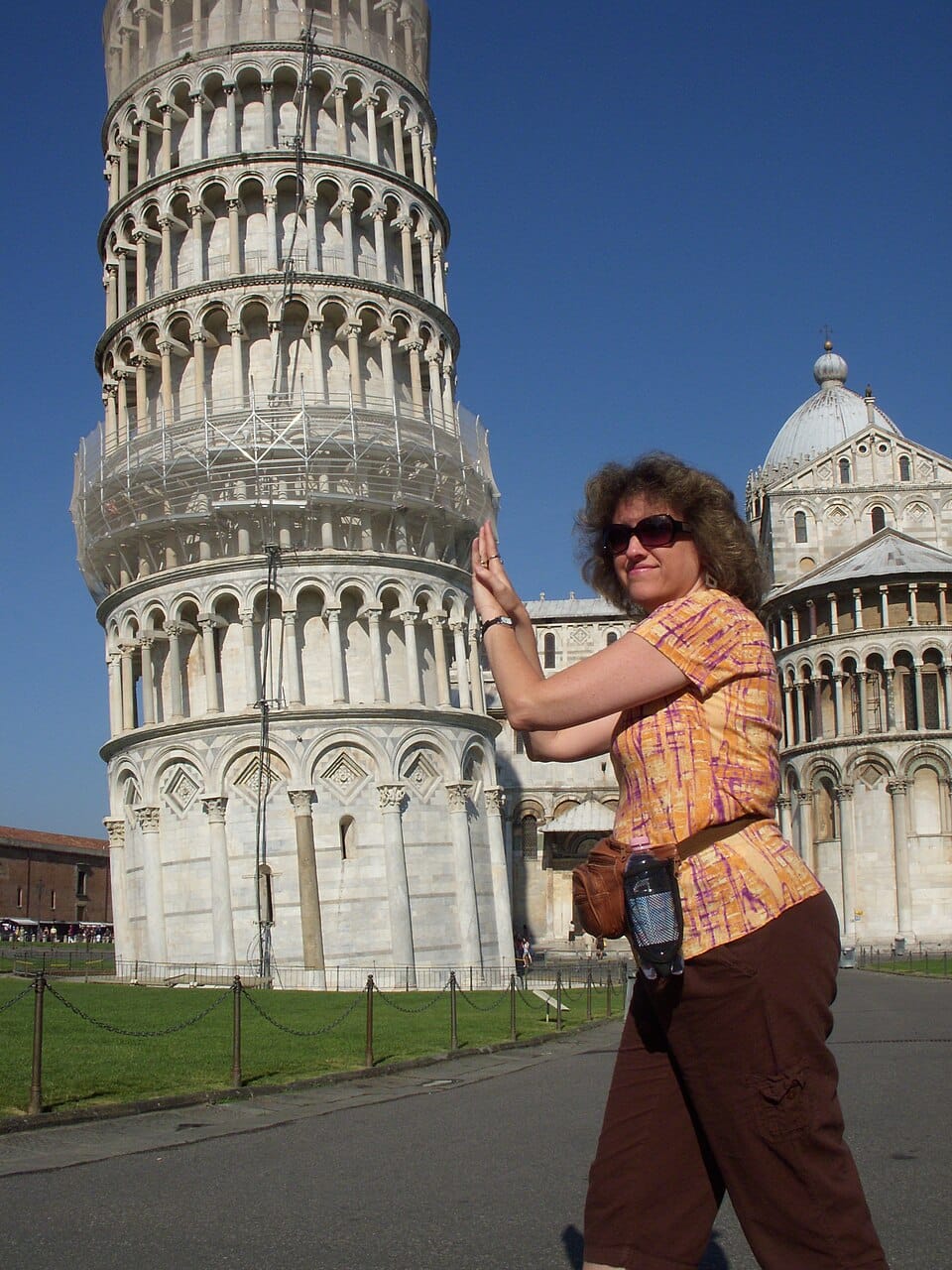
Tower of Pisa - push
Rp2006, Wikimedia Commons, CC BY-SA 4.0. Italian cultural-heritage notice on Commons (Legislative Decree 42/2004): personal use and study are permitted; commercial or other reuse needs authorisation from the Italian Ministry of Heritage and Culture. Source: Tower of Pisa - push at Wikimedia Commons

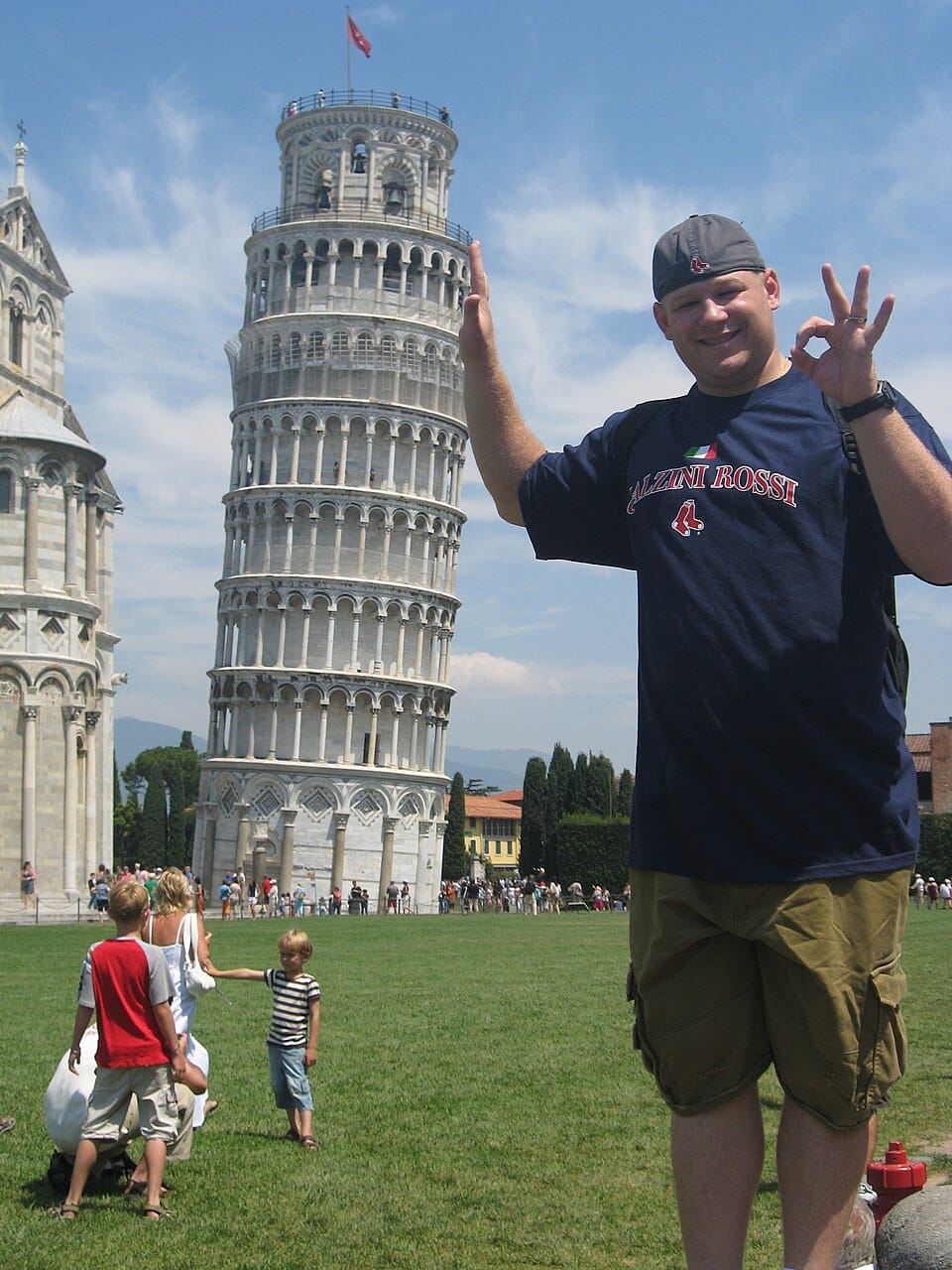
Picture of the leaning tower (visitor with raised hands, Pisa)
Vin7474, Wikimedia Commons, public domain as labelled on Commons; the photograph illustrates the tourist use in Wikipedia's Forced perspective article. Italian cultural-heritage notice on Commons (Legislative Decree 42/2004): personal use and study are permitted; commercial or other reuse needs authorisation from the Italian Ministry of Heritage and Culture. Source: Picture of the leaning tower (visitor with raised hands, Pisa) at Wikimedia Commons

A person stands near the lens and holds out a hand while a famous building stands far behind, so that from the camera it seems to be propped, pushed or pinched between their fingers. The picture is a snapshot made in hard midday sun with everything sharp, a friend behind the camera crouching or tilting up to line the gesture with the monument. It is a visual joke about size and distance, shared as a holiday souvenir.
Built on two systems: Bright selfie and Event reportage. What systems are.
Shoot sheet for your kit A prompt for an image model The photographs
How the look is made
- Put the monument far away and the person close to the lens, then line their hand or body up with the monument's outline so that it reads as touching it.
- Keep both near and far sharp: use a wide-angle phone or compact camera in bright light so the tourist and the landmark are both crisp.
- Have the friend behind the camera crouch, lower the lens and tilt up a little; look through the screen and ask the model to move an inch until the hands meet the edge of the tower.
- Make the gesture read at once as a silhouette: arms out flat as if pushing, a pinch at the tip, a cupped palm; hold the pose still for the shutter.
- Leave the surroundings, other tourists and ordinary clothes in frame: the joke needs the real, crowded place, not a cleaned-up view.
- Shoot several tries, check each on the screen, keep the one where the line-up works, and share it with the person who posed.
Shoot sheet for your kit
Fill in your camera, lenses and lights, and the sheet says which light plays each part, what to work around and where to start on your camera. Without a kit it starts on a full-frame camera.
Light
Key: the sun, about 45° to the camera’s left, high, hard.
- Key high: about 30–45° above eye level, angled down.
- Open shadows: bright surroundings (walls, ground, sky) fill them; no reflector needed.
- Shadow depth
- Shadows kept light and full of detail by a reflector, a fill light, bounce or bright surroundings (a low lighting ratio, up to about 3:1: the shadow side at most a stop and a half darker).
How the style is lit
- Midday or afternoon sun with the camera facing the monument: a hard, bright sky and an evenly lit person and facade, no fill needed.
- Overcast or hazy daylight: flat and even, so near and far are exposed alike and no shadow breaks the illusion.
This plan is worked out from the style’s choices, so it is drawn as a schematic. One way to get the light, not a record of how any photograph was lit.
Lens and settings
Start at
On a full-frame camera: the same depth of field and exposure as the style’s own numbers, in the same light. Then meter and adjust.
- The style’s f/2.2 on a small-sensor compact gives about the depth of field of f/13 on full frame.
- 1/15 s: on a tripod.
- Then
- 24–35 mm · f/1.8–f/2.8 · 1/1000–1/250 s · ISO 50–200 on a small-sensor compact, inferred from the gear and the look. Inferred from the technique: a wide compact (the 2007 and 2009 specimens were made on compacts) or phone lens in bright sun keeps the near hand and far monument both sharp (a small sensor at f/1.8 to f/2.8 is already deep). Phones are the later form. No source states the settings; the distance between person and lens and the exact line-up matter more than the exposure.
- White balance
- Automatic daylight balance, about 5500 K; the sky stays blue, the pale marble stays neutral-warm and the person is left as the sun lights them.
- Focal length
- A wide view; near things loom and lines stretch towards the edges.
- Focus
- Everything sharp from the nearest stone to the horizon.
- Angle
- Looking up: the subject towers.
- Distance
- Standing well back; people are small. Within arm’s reach: faces, hands and details fill the frame.
- Crop & fill
- The subject shown small within its setting, which explains it.
- Depth
- Separate events in the foreground, middle ground and background.
- Instant
- A casual, unplanned instant, taken quickly. Movement stopped dead by a fast shutter or flash.
Direct
The photographer stands a few metres from the model and asks them to face the lens, arm out, palm flat as if pushing, fingers pinched as if holding the tip, or hands up as if shouldering a weight; the model holds still, smiles or mugs to the camera and shifts a few centimetres on the photographer's cue until the hand meets the monument's edge. Groups line up side by side in a row with identical gestures.
- Head & gaze
- Looking straight into the camera, so the subject meets the viewer’s eye.
- Arms & hands
- Arms stretched out, pointing or waving, or hands caught mid-gesture while talking. Signs made at the camera: the V sign, heart hands, finger hearts, a thumbs-up, pointing at the lens.
- Line & energy
- Rigid and motionless, sometimes braced against a head rest or gripping a chair: held for a long exposure or a solemn occasion.
- Expression
- A smile, posed or natural, lips closed or showing teeth.
- The moment
- Ordinary photographs by and for ordinary people, or images that look like them.
- With the sitter
- The subject performs for the camera and shapes the picture.
Style the set
Nothing is styled: visitors wear their holiday clothes, backpacks and sunglasses, and the landmark and the lawn, railings and other tourists are left as they are. The only arrangement is the alignment of hand and monument.
- Clothes
- What people happened to be wearing; nothing chosen for the picture.
- Set & props
- A real place picked for its look as the setting for a shoot, not the subjects’ own: a street, a field, a palace, a hotel room.
- How much is styled
- Nothing dressed, made up, moved or added for the picture.
Finish
- Colour
- Strong, dense colours.
- Digital & other
- A modern digital camera: clean, detailed, neutral.
- Post-production
- Nothing changed beyond exposure and development.
- Shown as
- Each picture stands on its own.
- Shown in
- Pictures made for a scrolling feed.
Stay away from shallow depth of field, soft focus & diffusion, candid & unobserved, deadpan, low-key & chiaroscuro, heavy retouching, fully art-directed and glamour & aspiration.
Before you shoot it
The photographs show real visitors, often with strangers, children and other tourists unavoidably in the background and sometimes facing the lens, so get consent from the person posing, blur or crop bystanders before posting, and take care with minors. The pose can crowd a site: in Pisa the queue of posers is part of the scene, so do not block paths, climb on railings or lean on protected monuments, and respect rules at sacred or memorial sites, where a joke pose may be offensive. The three Commons examples carry an Italian cultural-heritage notice (Decree 42/2004): personal use and study only; commercial reuse needs Ministry authorisation and may carry a fee. The 2007 specimen shows a man with two children and a woman at lower left, and the 2023 page has a personality-rights warning.
A prompt for an image model
A ready prompt that describes this look to an image model: where the lights stand, the lens, the framing and the colour. It starts on the style’s own choices; change any of them and the prompt and the notes follow.
The prompt
Notes on this prompt
- How the style uses it: keep both near and far sharp: use a wide-angle phone or compact camera in bright light so the tourist and the landmark are both crisp. Image models put the light in the wrong place more often than anything else, so the prompt says where each light stands: which side of the picture, and how high. Keep to one light pattern per prompt, or the model splits the difference.
- Describe an invented person by age, clothes and pose. Never name a real or famous person, and never write “looks like”.
- Give the camera height in plain words: from knee height looking up, from a stepladder looking down, straight down onto the table.
The model makes a new picture, not a photograph of anything that happened. Label it as AI-generated, and don’t pass it off as the style’s history or as a real person.
Photographs that define it
From open collections, shown whole with their credits. Later photographs are linked, not shown, while they are in copyright.
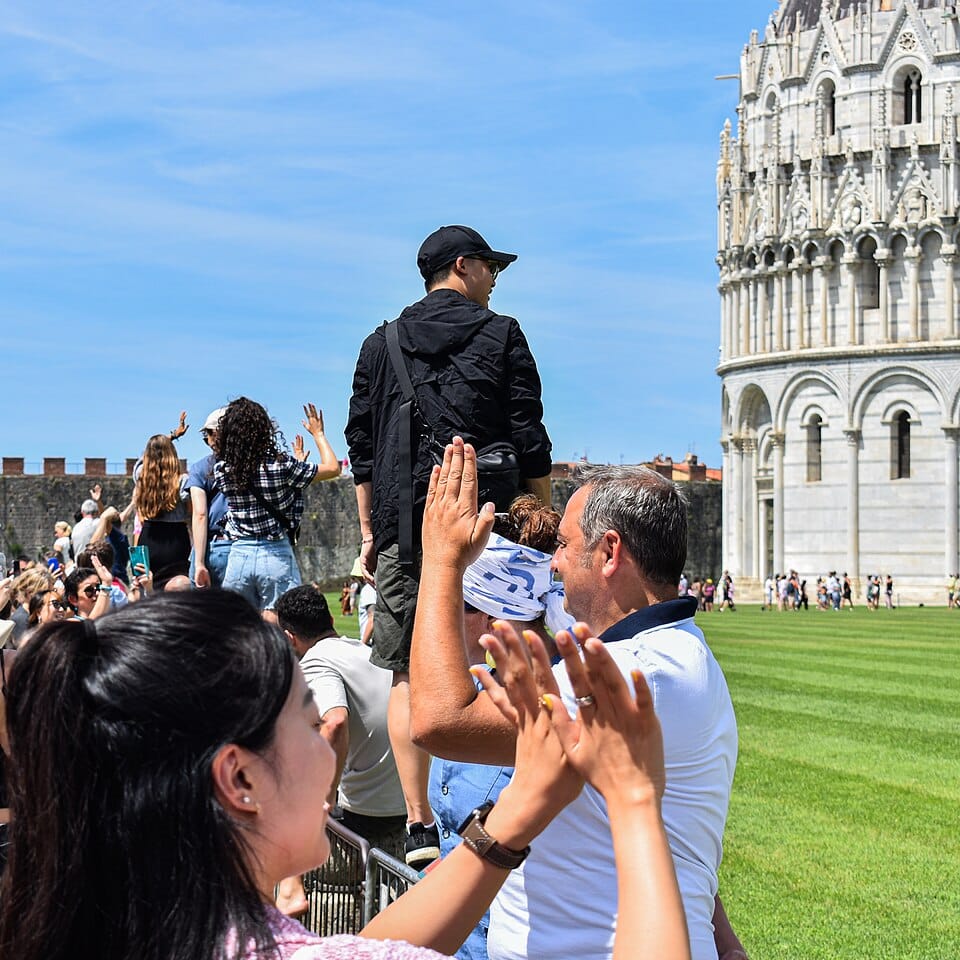
Tourists Posing to hold the Leaning Tower of Pisa, 2023
Julian Lupyan, Wikimedia Commons, CC0. Italian cultural-heritage notice on Commons (Legislative Decree 42/2004): personal use and study are permitted; commercial or other reuse needs authorisation from the Italian Ministry of Heritage and Culture. The Commons page also carries a personality-rights warning. Source: Tourists Posing to hold the Leaning Tower of Pisa, 2023 at Wikimedia Commons

With other styles
Pairs with Diaristic snapshot photography. Take its casual, friend-behind-the-camera closeness and keep the real crowded place in frame, but add a gag built on position in the picture, not on intimacy.
The opposite: Tiny-planet photographic panoramas. Both reshape how a landmark reads, but the tiny planet bends the whole surround and leaves nobody posed; here the lens stays ordinary and a person near the camera plays against the far building.
The opposite: BeReal dual-camera snapshot. Both are phone vernaculars, but BeReal pairs a selfie with a view of an ordinary moment; here a single frame stages one gesture against a famous monument, planned with a friend.
The opposite: Y2K digicam and flash revival. Both are friends' compact-camera snapshots, but the digicam look is flash-lit, blurred and nostalgic at night; this one is sharp, sunlit and outdoors, and the light is never the point.
Sources
- Wikipedia, Forced perspective (fetched): 'Use of forced perspective with tourist attractions like the Leaning Tower of Pisa is popular in tourist photography', citing Hugh Morris, The Telegraph, 2016-09-07 and Jennifer Polland, Business Insider, 2014-03-28 (both pages blocked to the fetch tool, so their content is unverified; baby mugging described with Yahoo 2013-05-30 and Fox 4 2013-04-26 sources): https://en.wikipedia.org/wiki/Forced_perspective
- Wikipedia, Baby mugging (fetched): short-lived 2013 meme, babies made to look as if in mugs by forced perspective: https://en.wikipedia.org/wiki/Baby_mugging
- Wikipedia, Leaning Tower of Pisa (fetched): gallery captions 'A tourist in a common pose at the Tower of Pisa, June 2009' and 'A large group of tourists posing, 2023'; no mention of forced perspective: https://en.wikipedia.org/wiki/Leaning_Tower_of_Pisa
- Wikimedia Commons files 'Tower of Pisa - push.jpg' (CC BY-SA 4.0, Rp2006, 2009-06-18), 'Europe 2007 Disk 1 340.jpg' (public domain label, Vin7474) and 'Tourists Posing to hold the Leaning Tower of Pisa, 2023.jpg' (CC0, Julian Lupyan, 2023-08-09): licences and dates from the Commons API; images downloaded and viewed. Italian cultural-heritage notice on Commons (Legislative Decree 42/2004): personal use and study are permitted; commercial or other reuse needs authorisation from the Italian Ministry of Heritage and Culture.
- Research boundary: the scout's start date of 2000 and the Business Insider and Telegraph pages could not be confirmed; the period starts at the earliest dated Commons example (2007).