Styles / Documentary & reportage
Green image-intensifier night-vision photography
- Key: a lamp, sign or screen, about 40° to the camera’s left, soft.
No reflector or fill: let the shadows fall to black.
Schematic, not to scale: worked out from the style’s choices. No set-up of this style has been rendered yet.
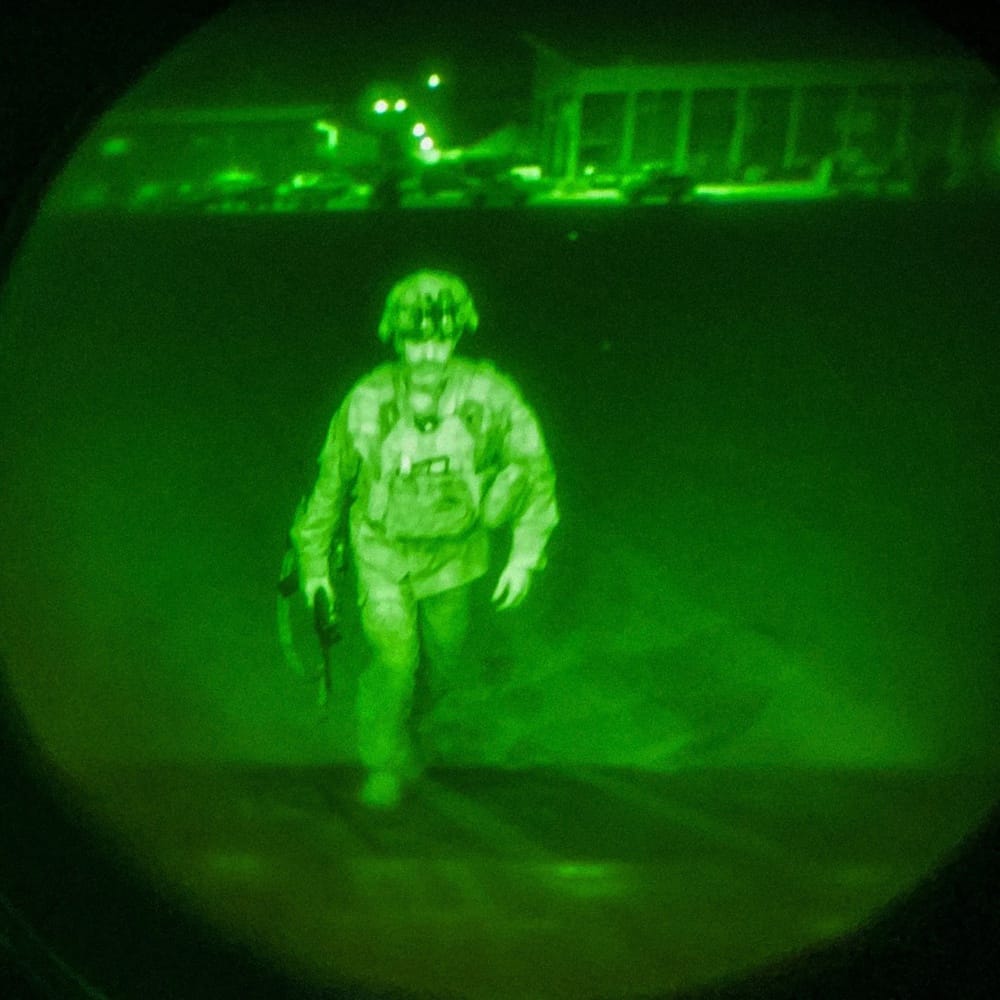
Last American Soldier leaves Afghanistan
Master Sgt. Alexander Burnett, US Army, 30 August 2021, VIRIN 210830-A-UV471-201. DVIDS, listed as public domain. Source: Last American Soldier leaves Afghanistan at DVIDS (Defense Visual Information Distribution Service)
Stills made through a low-light image intensifier held or taped in front of the camera: a green monochrome world whose darkness is black and grainy, lamps bloom, edges soften and a round optical mask often frames the scene. The device's view, not the place, makes the picture look surveilled.
Built on two systems: Machine eye and Rough and unseen. What systems are.
Shoot sheet for your kit A prompt for an image model The photographs
How the look is made
- Record through a real image intensifier fixed in front of the lens; do not tint an ordinary night photograph green afterwards.
- Work in the dark with whatever light exists, such as street lamps and distant windows, and let unlit ground fall to black.
- Keep the device's own marks: the soft edges, the grain, the round mask and the blooming lamps. Do not crop or clean them away.
- Frame a legible place or figure at middle distance, level with the eye, so the viewer sees what the observer saw.
- Hold the camera still and let the scene stand; the intensifier's slow response means moving figures smear and lights streak.
- Caption the picture with who looked, where, when and with what device; the privileged military view is not neutral.
Shoot sheet for your kit
Fill in your camera, lenses and lights, and the sheet says which light plays each part, what to work around and where to start on your camera. Without a kit it starts on a full-frame camera.
Light
Key: a lamp, sign or screen, about 40° to the camera’s left, soft.
- No reflector or fill: let the shadows fall to black.
- Shadow depth
- Shadows with no fill at all that fall to pure black with no detail, so parts of the subject disappear.
- Highlights
- The brightest parts burn out to pure white with no detail, on purpose or because the light was too strong.
How the style is lit
- No added light: the intensifier amplifies the dark scene's ambient and reflected light (street lamps, windows, moon and starlight), so lamps bloom and unlit ground goes black.
- Optional infrared illuminator on the device or camera, invisible to the eye, which the intensifier turns into even green brightness of nearby surfaces.
This plan is worked out from the style’s choices, so it is drawn as a schematic. One way to get the light, not a record of how any photograph was lit.
Lens and settings
Start at
On a full-frame camera: the same depth of field and exposure as the style’s own numbers, in the same light. Then meter and adjust.
- 1/30 s: on a tripod.
- Then
- 35–85 mm · f/1.8–f/4 · 1/125–1/4 s · ISO 400–3200 on full frame, inferred from the gear and the look. Inferred from the set-up (a camera behind an eyepiece that shows a bright green image), not recorded for the specimens. The device sets the brightness and the field, so the camera needs a wide aperture, a medium-to-high ISO and a steady hold. Exposure varies with the device and with how the camera is coupled to it.
- White balance
- The phosphor screen sets the green, so fix the camera on daylight or auto and leave the green; lamps bloom white-green and nothing stays warm.
- Focus
- A soft glow around highlights; edges never quite sharp.
- Rendering
- The corners fall into darkness.
- Angle
- The camera at the height of a standing person or of the subject.
- Distance
- Whole figures and their immediate surroundings.
- Crop & fill
- The subject shown small within its setting, which explains it.
- Depth
- Doors, windows, mirrors or arches frame the subject again.
Direct
Where people appear they are not directed: a soldier or civilian walks, stands or crouches while the observer watches, and faces are often partly obscured by dark, glare or a helmet. Never direct real people into the poses of a raid, detention or surveillance scene.
- Without a pose
- No people at all, or people so small or far off that their pose does not read (hands alone are Hands alone).
- The moment
- People photographed as they are, unaware or unconcerned.
Style the set
Nothing is styled. Photograph the street, building, vehicle or uniform as it is at night, and leave lamps, signs and clothes as found. Do not dress anyone in military gear or props to imitate a real operation.
- How much is styled
- Nothing dressed, made up, moved or added for the picture.
Finish
- Monochrome
- A monochrome image tinted sepia, brown, selenium purple or cyanotype blue.
- Colour
- An overall blue, cyan or green cast.
- Texture
- Film grain or noise you can see at normal size. The flaws of digital capture and sharing.
- Post-production
- Nothing changed beyond exposure and development.
- Shown as
- Pictures made and shown as a set.
Stay away from uncorrected lamp colour, infrared & false colour, neutral, true colour, shallow depth of field, heavy retouching and filter & preset look.
Before you shoot it
The pictures can show real people under coercion: civilians in raids, detainees, soldiers and people photographed at night without knowing it. The view is the observer's, the privileged position of an armed force or a surveillant, and it makes its subjects look watched and anonymous. Do not imitate raids, prisoners, vulnerable people or real operations, and do not fabricate documentary or news evidence, such as an evacuation, a strike or a patrol. The Burnett frame shows a real, identifiable officer: do not name or reconstruct him or any real soldier. Do not copy the named artists' compositions. Name the maker, place, date and device, and treat the official source's framing as one perspective. A green filter over an ordinary photograph is not this process and should not be passed off as a real record.
A prompt for an image model
No prompt for this style
Behind its pictures: real people under coercion (raids, detainees, soldiers) from an armed observer's view.
An imitation could fabricate documentary or news evidence.
The pictures can show real people under coercion: civilians in raids, detainees, soldiers and people photographed at night without knowing it. The view is the observer's, the privileged position of an armed force or a surveillant, and it makes its subjects look watched and anonymous. Do not imitate raids, prisoners, vulnerable people or real operations, and do not fabricate documentary or news evidence, such as an evacuation, a strike or a patrol. Do not copy the named artists' compositions. Name the maker, place, date and device, and treat the official source's framing as one perspective. A green filter over an ordinary photograph is not this process and should not be passed off as a real record. Any generated image must be labelled as such.
Work with photographers of this tradition, or take only its light and lens (the shoot sheet above) without its people, places or rituals.
Where to see it
From open collections, shown whole with their credits. Later photographs are linked, not shown, while they are in copyright.
In copyright, so linked
- Nacht 11 II , Thomas Ruff, 1992. Städel Museum, Frankfurt am Main.
- Iraq | Perspectives II: Nightvision (portfolio frames) , Benjamin Lowy, 2003-2008. Benjamin Lowy, portfolio website.
With other styles
The opposite: Camera-trap wildlife photography. Both are monochrome night records with burned-out near subjects, but here a person looks through the device and frames the picture, while a camera trap waits for an animal to trigger it.
Pairs with Combat photojournalism. Use the green view to show how war is seen at night by those holding the device, and caption it as the observer's privileged view, not a neutral one.
The opposite: Düsseldorf School of Photography.
The opposite: Aerochrome false-colour infrared. Both estrange a place through a non-visual sensor, but this one maps brightness to a single green, while Aerochrome maps foliage to pink and red.
Sources
- Thomas Ruff, Nights: https://www.thomasruff.com/en/works/nights/ - artist's series page: 1992-1996, a light intensifier attached to the camera, prompted by Gulf War night broadcasts; fetched.
- Städel Museum, Thomas Ruff, Nacht 11 II: https://sammlung.staedelmuseum.de/de/werk/nacht-11-ii - 1992, C-print, Diasec, 189 x 189 cm, DZF 6; text says camera combined with a night-vision device. In copyright (VG Bild-Kunst); link only.
- Benjamin Lowy, Iraq | Perspectives II: https://www.benlowy.com/iraq-perspectives-2 - his statement says goggles were fastened to the camera, and the book's photographs were taken over 2003-2008; fetched. No open licence. The 2011 publication date is not on this page and was not verified here.
- DVIDS, Last American Soldier leaves Afghanistan: https://www.dvidshub.net/image/6810419/last-american-soldier-leaves-afghanistan - Master Sgt. Alexander Burnett, 30 August 2021, VIRIN 210830-A-UV471-201, rights listed as public domain; image downloaded and viewed.
- Task & Purpose, interview with Burnett (25 October 2021): https://taskandpurpose.com/military-life/army-photo-last-soldier-afghanistan-alex-burnett/ - a phone camera behind night observation devices (fetched: he put his night observation devices in front of his phone camera; page shows updated 25 October 2021).
- Exosens FAQ: https://www.exosens.com/frequently-asked-questions-faq - manufacturer's account of the phosphor screen as the source of the green output (fetched: the IIT phosphor screen produces the green image; P43 green, P45 white alternative).
- Specimen note: only the Burnett DVIDS image is open-licensed and viewable in the app; Ruff and Lowy are link-only and were not viewed. Vignette is set to 0.6 because only the Burnett frame shows the round mask. tone.toned 0.6 approximates a phosphor-green monochrome (the trait is defined for sepia, selenium or cyanotype tints). Placing Ruff's Nights in the documentary branch is debatable; they are placed there for the shared device-mediated record.
- Scope: excludes thermal imaging, infrared-flash camera traps, consumer NightShot modes, a green post-production filter, and the Luiz Braga and fashion-editorial 'night vision' work, none of which was shown to use an intensifier. No 2020s fashion scene was confirmed.