Styles / Digital & social
Hanfu photography
- Key: the open sky, all around and above, soft.
Open shadows: bright surroundings (walls, ground, sky) fill them; no reflector needed.
Schematic, not to scale: worked out from the style’s choices. No set-up of this style has been rendered yet.
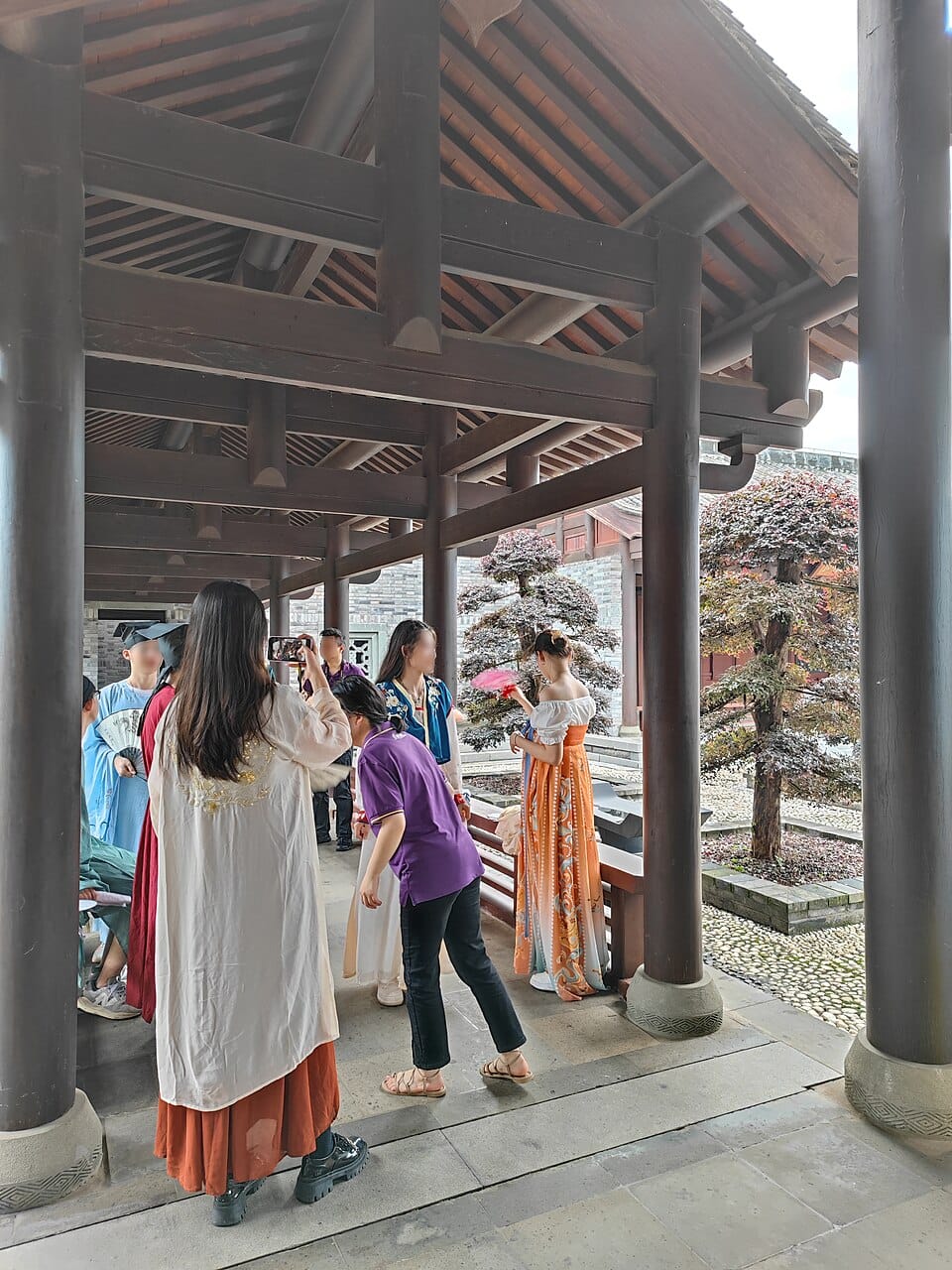
Hanfu hobbyists in Qu Yuan Temple, Yueyang, Hunan
Huangdan2060, CC BY 3.0, via Wikimedia Commons. Source: Hanfu hobbyists in Qu Yuan Temple, Yueyang, Hunan at Wikimedia Commons

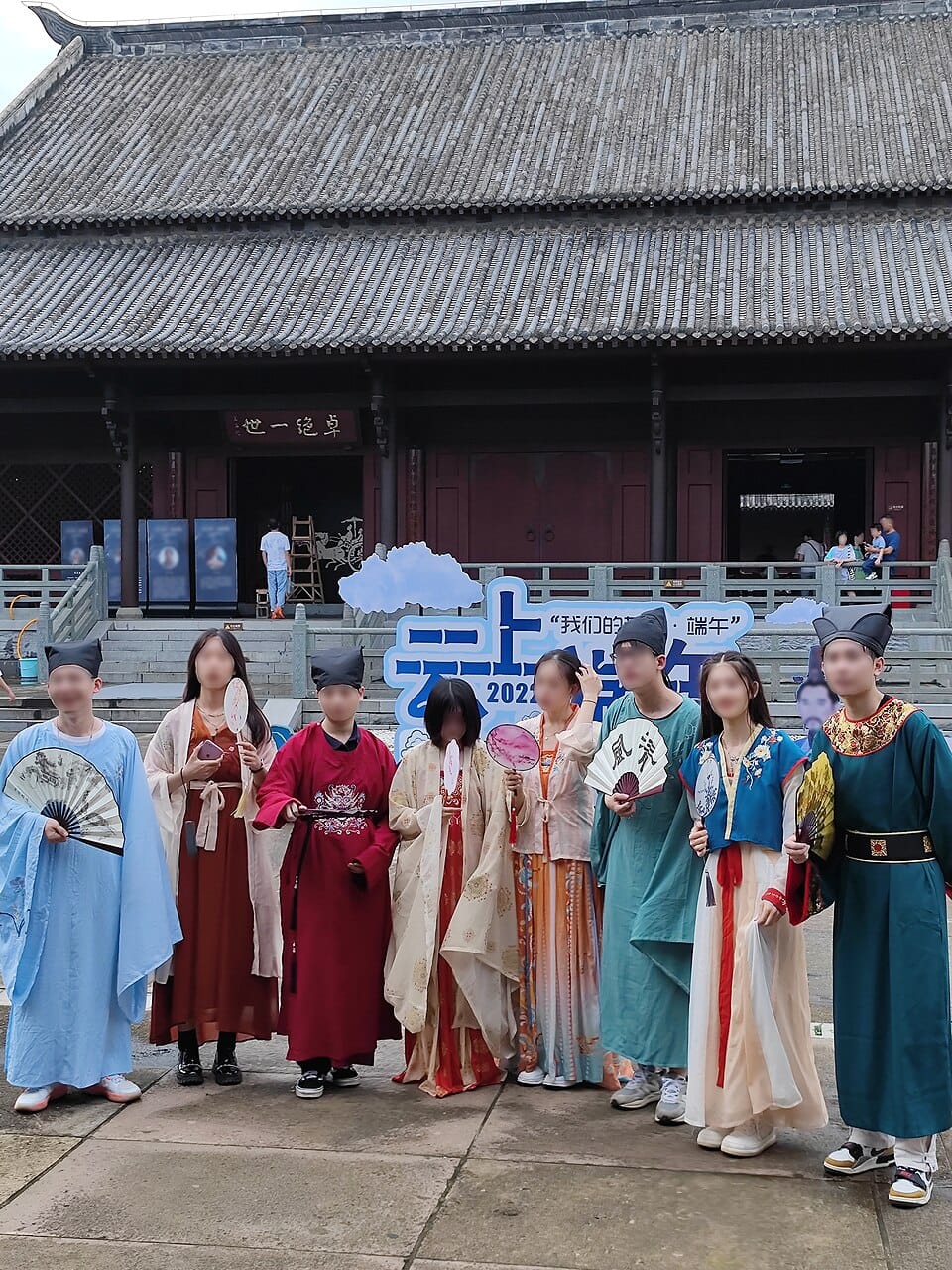
Hanfu hobbyists in Qu Yuan Temple, Yueyang, Hunan
Huangdan2060, CC BY 3.0, via Wikimedia Commons. Source: Hanfu hobbyists in Qu Yuan Temple, Yueyang, Hunan at Wikimedia Commons

Portraits of people in hanfu-style Han dress at temples, gardens, old streets and lakesides. The costume and heritage setting lead: sleeves, fans and umbrellas against tiled roofs, red walls and water, in soft daylight. Often casual phone snapshots and group frames; the polished, retouched series look is the hobby's and rental studios' output on Chinese social platforms.
Built mostly on one system: Telephoto colour. What systems are.
Shoot sheet for your kit A prompt for an image model The photographs
How the look is made
- Choose the dress and the place together: match the garment's period and colour to a temple, garden, old street, lake or interior that suits it.
- Photograph the whole costume: leave room for sleeves, skirt, hair ornaments and the architecture, and use a short telephoto from a middle distance so the setting compresses behind the wearer.
- Use soft daylight (open shade, backlit golden hour, a window) so fabric, face and hair ornaments stay readable; keep red and gold from clipping.
- Direct elegant, slow movements: a fan, an umbrella or a sleeve held away, a turn of the back, a look over the shoulder, a lowered gaze.
- Frame through doorways, moon gates, eaves and branches, and shoot a set of wide, half-length and detail frames to publish as a series.
- Finish lightly: keep fabric colour true, soften contrast and, if a grade is wanted, add a gentle preset; agree any smoothing of faces with the sitter. Casual group and phone snapshots at the site are the commonest case; the polished series look is the hobby's and rental studios' output seen mainly on Chinese social platforms.
Shoot sheet for your kit
Fill in your camera, lenses and lights, and the sheet says which light plays each part, what to work around and where to start on your camera. Without a kit it starts on a full-frame camera.
Light
Key: the open sky, all around and above, soft.
- Open shadows: bright surroundings (walls, ground, sky) fill them; no reflector needed.
- Shadow edges
- Shadows that fade gradually from light to dark, cast by a large or diffused light: a window, a softbox, a cloudy sky.
- Shadow depth
- Shadows kept light and full of detail by a reflector, a fill light, bounce or bright surroundings (a low lighting ratio, up to about 3:1: the shadow side at most a stop and a half darker).
How the style is lit
- Open shade or overcast daylight in a courtyard, garden or temple corridor, with the wearer turned to the brighter side so cheeks and sleeves are lit softly.
- Low afternoon sun behind the wearer at a lake, wall or street, with sky or pale paving filling the face; the hair ornaments and sleeve edges take the rim.
- Large window beside a studio or teahouse set with a white reflector, or lanterns and street lamps for an evening street scene with the face lifted by a small soft light.
This plan is worked out from the style’s choices, so it is drawn as a schematic. One way to get the light, not a record of how any photograph was lit.
Lens and settings
Start at
On a full-frame camera: the same depth of field and exposure as the style’s own numbers, in the same light. Then meter and adjust.
- The style’s f/3.2 on a phone gives about the depth of field of f/16 on full frame.
- 1/15 s: on a tripod.
- Then
- 50–135 mm · f/1.8–f/5.6 · 1/500–1/100 s · ISO 100–800 on a phone, inferred from the gear and the look. Inferred starting ranges; I found no documented settings or measured distribution. Phone snapshots are the commonest case (deep focus, auto exposure); the ranges below suit a camera with a short telephoto for handheld daylight portraits. Stop down for group frames and architecture. Format is the commonest case (phone); camera users shoot full-frame or similar.
- White balance
- Daylight or auto balance, slightly warm at golden hour; keep red and gold fabric true and skin from greening in the pastel edit.
- Angle
- The camera at the height of a standing person or of the subject.
- Distance
- Whole figures and their immediate surroundings.
- Crop & fill
- The subject shown small within its setting, which explains it.
- Depth
- Doors, windows, mirrors or arches frame the subject again.
- Duration
- An unmoving scene, exposed slowly and carefully.
Direct
Direct slow, elegant movements with the whole costume in mind: hold a fan or umbrella, lift a wide sleeve, turn the back and look over the shoulder, walk away down a corridor, rest the hands lightly. Alternate the composed lowered gaze with a smile, and obtain the wearer's consent to every pose, crop and edit.
- Turn to the camera
- The body turned away and the head turned back over the shoulder to the lens. Seen from behind, facing into the scene, so the viewer looks with them.
- Head & gaze
- Eyes off the frame, past the camera or into the distance, as if lost in thought.
- Arms & hands
- Fingers placed on purpose: relaxed and separated, shown edge-on, wrists softly bent, as in ballet, fashion and glamour. Hands busy with a prop or a tool: flowers, a phone, a cup, a cigarette, an instrument, one’s own work.
- With the sitter
- The subject performs for the camera and shapes the picture.
- The set-up
- A scene staged and directed like a film still or a painting.
Style the set
Dress the wearer in a coherent hanfu outfit of a period (Tang-style qixiong ruqun, Song, Ming), with matching hair, headpieces, makeup, a fan, lantern, instrument or umbrella; choose a heritage site, garden or street of the same register. Hybrid tourist costumes exist: choose accurate garments if the wearers ask for them.
- Clothes
- Period dress, fancy dress, stage costume or someone else’s clothes, worn to play a part rather than as one’s own. The wearers’ own festive, religious or wedding clothes: saris and lehengas, boubous, robes, kimono.
- Hair & make-up
- Groomed hair and finished make-up that still look natural: even skin, defined eyes, neat brows.
- Set & props
- A real place picked for its look as the setting for a shoot, not the subjects’ own: a street, a field, a palace, a hotel room. Props chosen and placed for colour, texture and story: linen, ceramics, cutlery, flowers, scattered ingredients.
- How much is styled
- Clothes, hair, make-up, props and set all chosen and placed by a team to one idea.
Finish
- Colour
- Colour held back towards grey. The colour of ordinary things treated as the point of the picture.
- Digital & other
- A modern digital camera: clean, detailed, neutral. A phone camera and its processing: deep focus, bright shadows, synthetic blur.
- Post-production
- Perfected skin and surfaces.
- Shown as
- Pictures made and shown as a set.
- Shown in
- Pictures made for a scrolling feed.
Stay away from decisive moment, direct on-camera flash, low-key & chiaroscuro, unstyled, as found, scratches, dust & decay, hdr & tone-mapped, objective & scientific and nobody in the picture.
Before you shoot it
These photographs show real people, mostly young women, in a living community and hobby with real disputes over authenticity, hybrid or tourist costumes borrowed from minority dress, and Han nationalism (Hanfu movement, Wikipedia). Ask the wearer before photographing or publishing, never post photographs of strangers in hanfu without consent, and credit the photographer and the wearer. Do not treat hanfu as the single dress of all Chinese people or as a costume for other ethnic groups, do not whiten skin or reshape bodies in retouching, and keep any illustration of people fictional adults.
A prompt for an image model
A ready prompt that describes this look to an image model: where the lights stand, the lens, the framing and the colour. It starts on the style’s own choices; change any of them and the prompt and the notes follow.
The prompt
Notes on this prompt
- How the style uses it: finish lightly: keep fabric colour true, soften contrast and, if a grade is wanted, add a gentle preset; agree any smoothing of faces with the sitter. Casual group and phone snapshots at the site are the commonest case. Image models put the light in the wrong place more often than anything else, so the prompt says where each light stands: which side of the picture, and how high. Keep to one light pattern per prompt, or the model splits the difference.
- Describe an invented person by age, clothes and pose. Never name a real or famous person, and never write “looks like”.
- Heavy retouching: ask for smooth skin that keeps its pores, or the model makes it look like plastic.
The model makes a new picture, not a photograph of anything that happened. Label it as AI-generated, and don’t pass it off as the style’s history or as a real person.
Photographs that define it
From open collections, shown whole with their credits. Later photographs are linked, not shown, while they are in copyright.
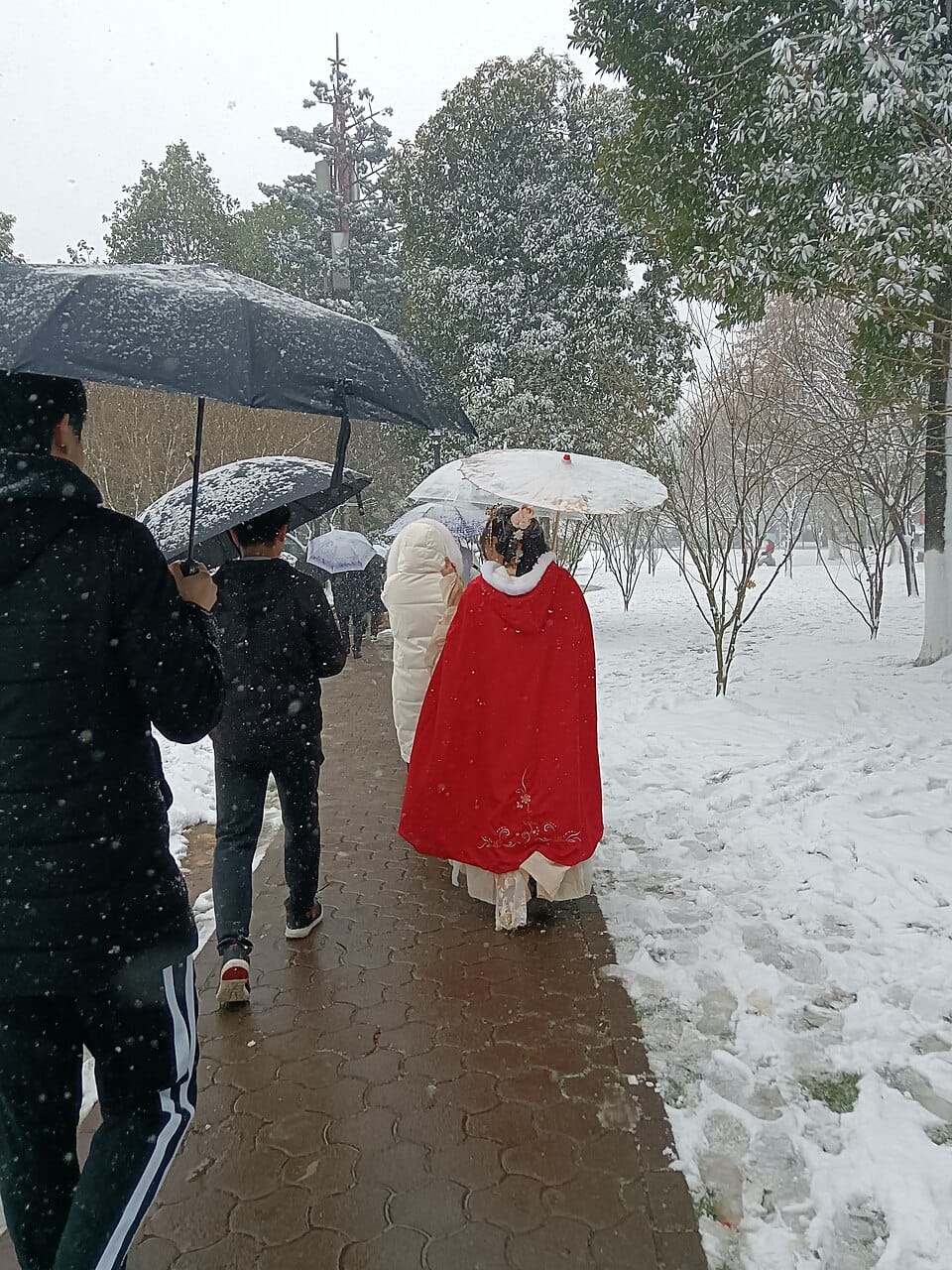
Person in hanfu and red cloak with an oil-paper umbrella, Orange Isle, snowy day
Huangdan2060, CC BY 3.0, via Wikimedia Commons. Source: Person in hanfu and red cloak with an oil-paper umbrella, Orange Isle, snowy day at Wikimedia Commons

With other styles
Pairs with Xiaoqingxin (small fresh) photography. Borrow its pale, bright finish and quiet gestures for the grade, but put the period costume and heritage location first.
The opposite: East Asian pre-wedding photography. Choose hanfu when the wearers plan and share the shoot themselves around a costume, not a commissioned multi-outfit couple album.
The opposite: Cottagecore pastoral photography. Share the soft golden light, but swap meadow and linen for a specific cultural dress and its architecture.
The opposite: Yokohama photography. Both sell costume as a view of the place; here the wearers dress and pose themselves, rather than a studio staging a souvenir scene.
Sources
- Hanfu movement, Wikipedia: https://en.wikipedia.org/wiki/Hanfu_movement . Wang Letian's shenyi in Zhengzhou in November 2003; first online shop c. 2005; Xitang Hanfu Culture Week from 2013; Travelling with Hanfu by Dang Xiaoshi and Xu Jiao, 2014; hybrid costumes in tourist-area studios; authenticity and nationalism disputes. Read the first 100,000 characters.
- Songge Shi, Travelling With Hanfu: A Social Media Analysis of Contemporary Chinese Travelling for Artistic Photographs, Master's thesis, Auckland University of Technology, 2021: https://openrepository.aut.ac.nz/items/fa8a32e3-1bd1-4695-b353-8e57e7d7fb29 . Repository abstract read: dressing in hanfu at tourist sites to be photographed, DIY, rental-shop and professional approaches, sharing online. Only the abstract was read; the full PDF was not.
- Wikimedia Commons photographs by Huangdan2060 (CC BY 3.0), 3 June 2022, Qu Yuan Temple, Yueyang, Hunan, and 26 December 2021, Orange Isle, Changsha; downloaded and looked at as specimens.
- Limits: no exact exposure data, no primary source for the 2014 series, and no verified share of the look held by studios against hobbyists; the two specimens are bystander snapshots, so polished-series traits are held at low weights; lighting, gear and settings are inferred.