Styles / Documentary & reportage
Heroic Age polar expedition photography
- Key: the sun, from behind, to the camera’s left, high, hard.
Key high: about 30–45° above eye level, angled down.
Schematic, not to scale: worked out from the style’s choices. No set-up of this style has been rendered yet.
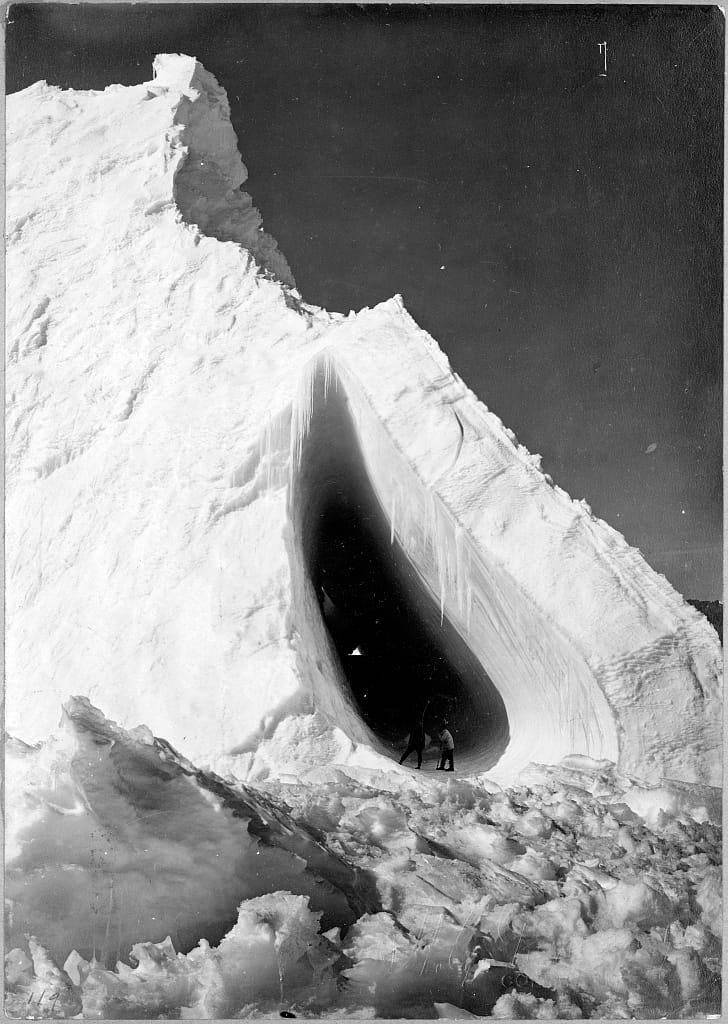
Exterior of the Grotto iceberg
Herbert Ponting, Exterior of the Grotto iceberg, 5 January 1911. Library of Congress, via Wikimedia Commons (public domain). Source: Exterior of the Grotto iceberg at Library of Congress
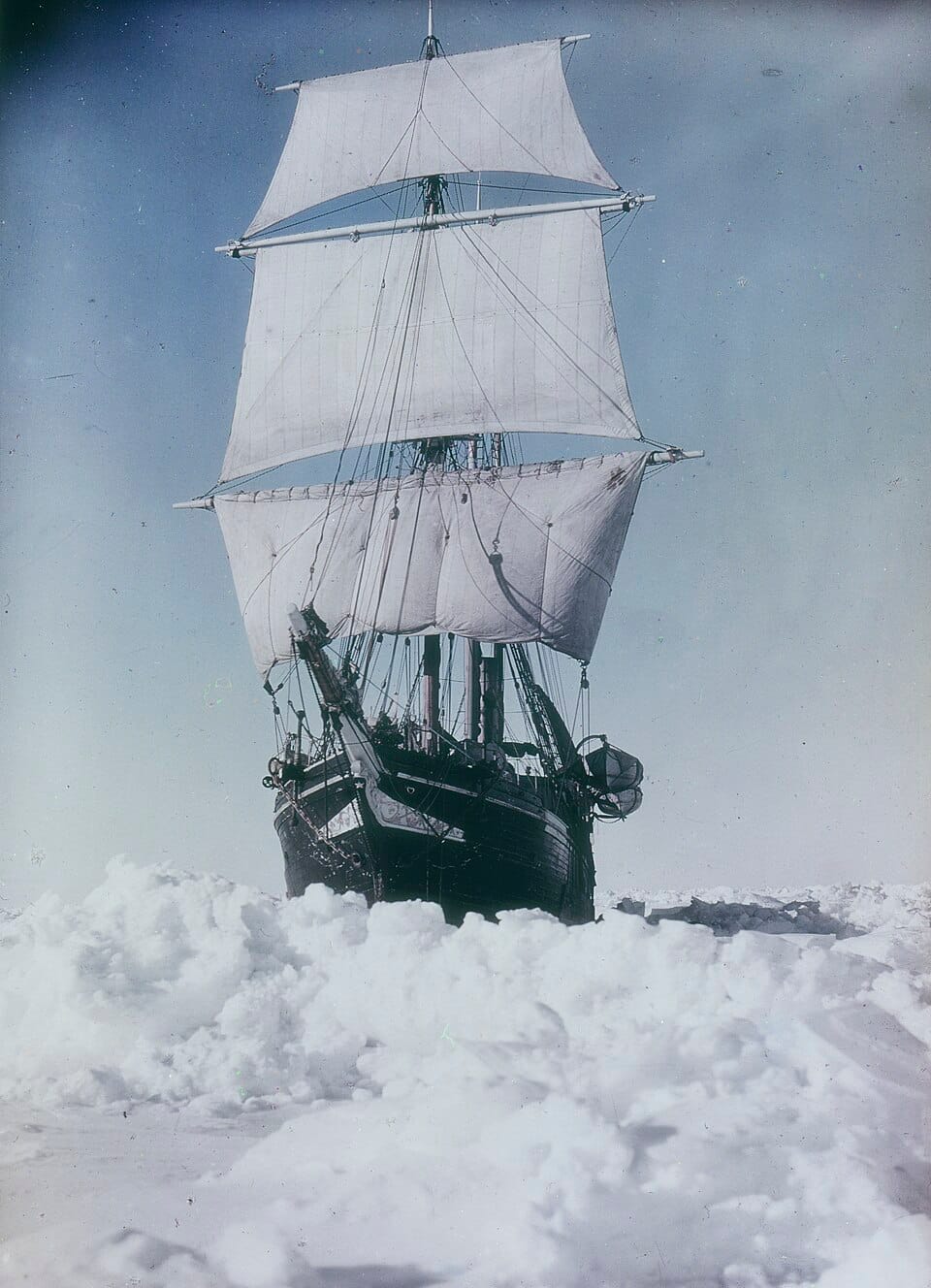
Endurance under sail trying to break through pack ice, Weddell Sea
Frank Hurley, Endurance under full sail, 1915, from the original Paget plate, State Library of New South Wales ON 26-12, via Wikimedia Commons (public domain). Source: Endurance under sail trying to break through pack ice, Weddell Sea at State Library of New South Wales

Pictures made to bring back an expedition: ice, ships and tiny men on a monumental scale, shot on glass plates in hard polar sun and shown in books and lantern-slide lectures. Black and white is the usual form, sharp from foreground ice to far horizon, with blank white snow and black sky; a few Paget colour plates add pale blue and rust. People are scale marks, working or posed against the ice, not sitters.
Built on two systems: Event reportage and Deadpan document. What systems are.
Shoot sheet for your kit A prompt for an image model The photographs
How the look is made
- Pick the ship, berg or ridge as the subject and shoot it whole, sharp from the ice at your feet to the horizon; the expedition is the story, so show the place it faces.
- Put a small, still human figure in the frame to give the scale of the ice, and keep the rest of the frame white or black space.
- Choose low or distant vantage points that make cliffs of ice and ship's masts tower; stop down and brace the camera so everything is sharp.
- Shoot in hard polar sun, with backlight through rime and spray and long hard shadows, and expose for the snow detail; let sky go dark or the shadows block up.
- Work in the cold: warm the plates, keep a darkroom or tent for developing, and take colour plates only when the light is still and the subject holds still.
- Sequence the plates into a narrative (departure, ship, ice, men, work, return) and publish them as a book and projected lantern slides.
Shoot sheet for your kit
Fill in your camera, lenses and lights, and the sheet says which light plays each part, what to work around and where to start on your camera. Without a kit it starts on a full-frame camera.
Light
Key: the sun, from behind, to the camera’s left, high, hard.
- Key high: about 30–45° above eye level, angled down.
- Shadow edges
- Shadows with crisp outlines, cast by a small or distant light: direct sun, a bare flash, a spotlight.
- Shape & form
- Shadows thrown away from what casts them (a figure’s long shadow, railings on a wall) that become shapes of their own in the composition.
- Highlights
- The brightest parts burn out to pure white with no detail, on purpose or because the light was too strong.
How the style is lit
- Hard low polar sun raking snow and ice, with deep black shadows and no fill.
- Backlight through rime, spray and rigging, with the sun behind a berg or sail.
- Bright overcast or twilight over pack ice for the colour plates, with long exposures on a steady tripod.
This plan is worked out from the style’s choices, so it is drawn as a schematic. One way to get the light, not a record of how any photograph was lit.
Lens and settings
Start at
On a full-frame camera: the same depth of field and exposure as the style’s own numbers, in the same light. Then meter and adjust.
- The style’s f/19 on 5 × 7 in gives about the depth of field of f/3.7 on full frame.
- Then
- 24–50 mm · f/11–f/32 · 1/100–0.5 s · ISO 3–25 on 5 × 7 in, inferred from the gear and the look. Worked out from the glass plates, their slow emulsions, the sharp-to-far results and the bright snow light; no source consulted records the settings for these photographs. Colour plates (Paget) needed much longer exposures than black and white. F-numbers are given for a 5 x 7 inch plate and the focal length is a rough 35 mm equivalent.
- White balance
- Colour plates (Paget) hold a cool pale-blue sky and bluish-white snow; the few warm notes are rust, timber, flags and skin, and everything else stays neutral to cold.
- Focal length
- Roughly the eye’s own perspective; no visible distortion.
- Focus
- Everything sharp from the nearest stone to the horizon.
- Angle
- Looking up: the subject towers.
- Distance
- Standing well back; people are small.
- Crop & fill
- A small subject in a large empty field. The subject shown small within its setting, which explains it.
- Depth
- Separate events in the foreground, middle ground and background.
- Duration
- An unmoving scene, exposed slowly and carefully.
Direct
Men are placed or caught as scale and as workers: one or two stand still at the mouth of a grotto, haul a sledge, lean into the wind or stand in rows on the ice, held steady by the exposure. In the plates described here the figures are small and dark against the ice; no one is asked for charm.
- Line & energy
- Rigid and motionless, sometimes braced against a head rest or gripping a chair: held for a long exposure or a solemn occasion.
- The set-up
- A scene staged and directed like a film still or a painting.
Style the set
Nothing is dressed: ship, ice, hut, sledges and gear are photographed as found, and the men wear the windproof clothing, furs and boots they work in. The ice, sky and ship's rigging are the set; a figure or two are stationed where they give scale.
- Set & props
- A real place picked for its look as the setting for a shoot, not the subjects’ own: a street, a field, a palace, a hotel room.
- How much is styled
- Nothing dressed, made up, moved or added for the picture.
Finish
- Monochrome
- Rich blacks, clean whites and every grey between. A black-and-white scale pushed towards pure black and pure white, with few middle greys.
- Film
- A view camera on a tripod: great detail, slow and deliberate.
- Post-production
- Nothing changed beyond exposure and development.
- Shown as
- Pictures made and shown as a set.
- Shown in
- The book as the main form of the work.
Stay away from portrait, shallow depth of field, soft focus & diffusion, soft studio light, golden hour, heavy retouching, filter & preset look, glamour & aspiration and saturated colour.
Before you shoot it
These photographs served an imperial, heroic story: expeditions that cost lives (Scott's polar party in 1912; Mertz and Ninnis on the Mawson expedition) were sold as national triumph, and the pictures were built to fund and to glorify them. Do not use the style to glamorise hardship or death, and do not stage fake expedition photographs as genuine records of real people or ships. Some of the expedition work was also staged or reworked for effect (Hurley later used composites in the First World War, not in his polar plates, and the Grotto picture is a placed-figure view), so do not treat the pictures as plain fact.
A prompt for an image model
No prompt for this style
Behind its pictures: real, named expedition members who died, in imperial heroic propaganda.
Caution forbids generating identifiable members or archival-looking plates.
These photographs served an imperial, heroic story: expeditions that cost lives were sold as national triumph, and the pictures were built to fund and to glorify them. Do not use the style to glamorise hardship or death, and do not stage fake expedition photographs as genuine records of real people or ships. Real named men appear in the originals; do not generate identifiable members of these expeditions or make AI images look like archival plates. Label any generated image as AI-generated. Some of the expedition work was also staged or reworked for effect, so do not treat the pictures as plain fact.
Work with photographers of this tradition, or take only its light and lens (the shoot sheet above) without its people, places or rituals.
Photographs that define it
From open collections, shown whole with their credits. Later photographs are linked, not shown, while they are in copyright.
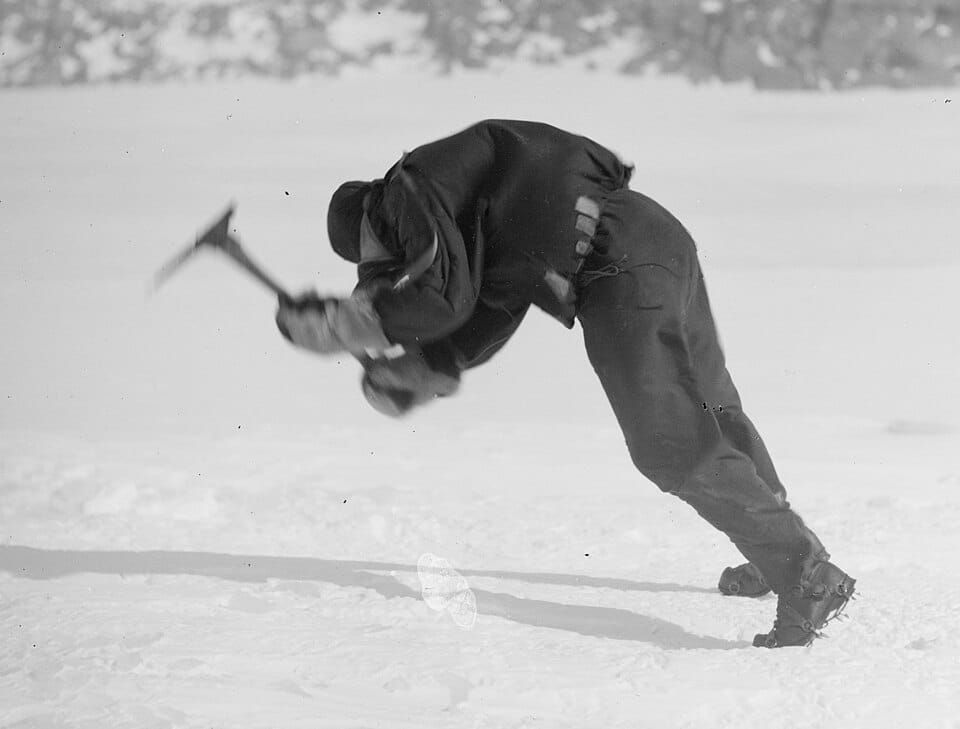
Leaning on 160 kilometres per hour wind while picking ice, Cape Denison
Frank Hurley, Leaning on 160 kilometers per hour wind while picking ice, Cape Denison, 1912, plate glass negative, State Library of New South Wales ON 144/H138, via Wikimedia Commons (public domain). Source: Leaning on 160 kilometres per hour wind while picking ice, Cape Denison at State Library of New South Wales

With other styles
Pairs with Western survey photography. Its parent: the same far, sharp, monumental view with small figures for scale, here on ice, ships and an expedition narrative with lantern-slide and book publication.
Pairs with Autochrome colour photography. Both made some of the first colour stills of their subjects on grainy additive plates; here the colour plates are rare, cool and mostly of ice and ships, not portraits and gardens.
The opposite: Combat photojournalism. Frank Hurley later photographed the First World War, where his wartime work included composites, while Ponting did not photograph the war; combat work is hand-held, close and unposed, while the polar expedition stands back and sets up. Composites belong to Hurley's wartime work, not his polar plates, so finish.composite is left out here.
Sources
- Herbert Ponting, Wikipedia: https://en.wikipedia.org/wiki/Herbert_Ponting (camera artist on the Terra Nova expedition 1910-13, Cape Evans darkroom, more than 1,700 plates, autochrome and cinematograph, The Great White South 1921)
- Frank Hurley, Wikipedia: https://en.wikipedia.org/wiki/Frank_Hurley (official photographer on Mawson's AAE 1911-14 and Endurance 1914-16, Paget colour plates, 120 glass negatives kept and about 400 smashed, wartime composites)
- Heroic Age of Antarctic Exploration, Wikipedia: https://en.wikipedia.org/wiki/Heroic_Age_of_Antarctic_Exploration (death table: Scott's polar party 1912; Ninnis 14 December 1912 and Mertz 7 January 1913 on Mawson's expedition)
- Library of Congress, Exterior of the Grotto iceberg (Ponting, 5 January 1911): https://www.loc.gov/pictures/item/2009633382/
- State Library of New South Wales, Hurley Paget plates and Cape Denison glass negatives (via Wikimedia Commons): https://commons.wikimedia.org/wiki/File:Endurance_under_full_sail_Frank_Hurley_State_Library_NSW_a090012h.jpg