Styles / Modernist
La Bussola high-key lyrical photography
- Key: the open sky, all around and above, soft.
- Reflector: a white card or reflector, about 55° to the camera’s right, soft.
High-key: expose for the shadows, so the bright background goes towards white.
Schematic, not to scale: worked out from the style’s choices. No set-up of this style has been rendered yet.
The photographs that define it are still in copyright, so they are linked below rather than shown.
Pale, quiet black-and-white pictures of beaches, skies, bottles, hands and reclining bodies, printed in a bright high key with mostly faint shadows and a long scale of soft greys; dark accents (a sleeve, a gate, a shaded gable) may appear. The Milan group La Bussola set formal purity against Neorealist documentary, and Cavalli said the subject 'has no importance at all' (Estorick), with light carrying the picture. Compositions are simple and often empty, and the print is the work. Evidence here is Cavalli's; paper surface, development and dodging are inferred, not documented.
Built on two systems: Pictorial print and Sweet retouch. What systems are.
Shoot sheet for your kit A prompt for an image model The photographs
How the look is made
- Light the subject evenly and brightly, from a large window, an overcast sky or a bounce, so that shadows stay faint and the whole picture sits in the upper greys.
- Expose generously and aim for a pale, soft scale of greys: keep detail in the whites and let the blacks stay small (inferred from the prints, not a documented recipe).
- Choose a plain subject (a bottle, a beach hut, a hand, the sea) and treat it as form and light, not as news or social comment.
- Leave most of the frame empty: set a few shapes against a bare pale sky, wall or sea, with a low horizon or a single edge.
- Present each picture alone as a finished work; hand dodging and burning to hold the tone is likely but not documented (inferred).
Shoot sheet for your kit
Fill in your camera, lenses and lights, and the sheet says which light plays each part, what to work around and where to start on your camera. Without a kit it starts on a full-frame camera.
Light
Key: the open sky, all around and above, soft.
Reflector: a white card or reflector, about 55° to the camera’s right, soft.
- High-key: expose for the shadows, so the bright background goes towards white.
- Shadow edges
- Shadows that fade gradually from light to dark, cast by a large or diffused light: a window, a softbox, a cloudy sky.
- Shadow depth
- Shadows kept light and full of detail by a reflector, a fill light, bounce or bright surroundings (a low lighting ratio, up to about 3:1: the shadow side at most a stop and a half darker).
How the style is lit
- North-facing window or open shade with a white wall or sheet as bounce, no hard shadows.
- Flat bright overcast daylight or sea-side haze, exposed generously.
This plan is worked out from the style’s choices, so it is drawn as a schematic. One way to get the light, not a record of how any photograph was lit.
Lens and settings
Start at
On a full-frame camera: the same depth of field and exposure as the style’s own numbers, in the same light. Then meter and adjust.
- Then
- 35–75 mm · f/5.6–f/16 · 1/250–1/8 s · ISO 25–100 on full frame, inferred from the gear and the look. Not documented in the sources opened: worked out from the second-hand 35 mm Leica Cavalli bought (Estorick), normal lenses and slow fine-grain film in bright flat light. Exposure was probably generous to hold the high key; printing carried the tone.
- Focal length
- Roughly the eye’s own perspective; no visible distortion.
- Angle
- The camera at the height of a standing person or of the subject.
- Crop & fill
- A small subject in a large empty field.
- Depth
- A strong horizon splits the frame into bands.
- Duration
- An unmoving scene, exposed slowly and carefully.
Direct
Most pictures have no one in them. When a figure appears it is quiet and anonymous: a hand gripping a mirror rim, a reclining body. No gesture, no laughter, no action.
- Without a pose
- No people at all, or people so small or far off that their pose does not read (hands alone are Hands alone).
Style the set
Nothing is dressed. Bottles, glasses, huts, gates and sea are taken as found or set on a plain pale surface, spare, with no props that tell a story. Figures wear plain clothes or are undressed and unadorned, with no make-up, against a pale wall.
- How much is styled
- Nothing dressed, made up, moved or added for the picture.
- Look of the styling
- Few, simple elements on clean surfaces, with space around them.
Finish
- Monochrome
- Low contrast and gentle greys.
- Film
- A small handheld camera: quick, mobile, grainy when pushed.
- Shown as
- Each picture stands on its own.
Stay away from hard, direct sun, low-key & chiaroscuro, black shadows, hard-edged shadows, high-contrast black & white, saturated colour, testimony & advocacy, document & record, candid & unobserved, snapshot and composite & montage.
Before you shoot it
Cavalli died in 1961 and his photographs are in copyright; no open image was found, so specimens are link-only. The group defined itself against Neorealist documentary, so avoid presenting a high-key picture as a record of postwar Italian life or as a news photograph. Do not reproduce the named Tate works one to one.
A prompt for an image model
A ready prompt that describes this look to an image model: where the lights stand, the lens, the framing and the colour. It starts on the style’s own choices; change any of them and the prompt and the notes follow.
The prompt
Notes on this prompt
- How the style uses it: light the subject evenly and brightly, from a large window, an overcast sky or a bounce, so that shadows stay faint and the whole picture sits in the upper greys. Image models put the light in the wrong place more often than anything else, so the prompt says where each light stands: which side of the picture, and how high. Keep to one light pattern per prompt, or the model splits the difference.
- Black and white: colour words in the subject (a red dress, green leaves) can pull the model back to colour, so leave them out.
The model makes a new picture, not a photograph of anything that happened. Label it as AI-generated, and don’t pass it off as the style’s history or as a real person.
Where to see it
From open collections, shown whole with their credits. Later photographs are linked, not shown, while they are in copyright.
In copyright, so linked
- Cabins , Giuseppe Cavalli, 1955. Tate (Prints and Drawings Room, Tate Britain).
- Desire for Immensity , Giuseppe Cavalli, 1954. Tate (Prints and Drawings Room, Tate Britain).
- The Hand and the Mirror , Giuseppe Cavalli, 1951. Tate (Prints and Drawings Room, Tate Britain).
Made by an AI model
An image gpt-image-2 made from this style’s choices, then checked against them by a vision model. Not a photograph, and not part of the style’s history. All generated images
-
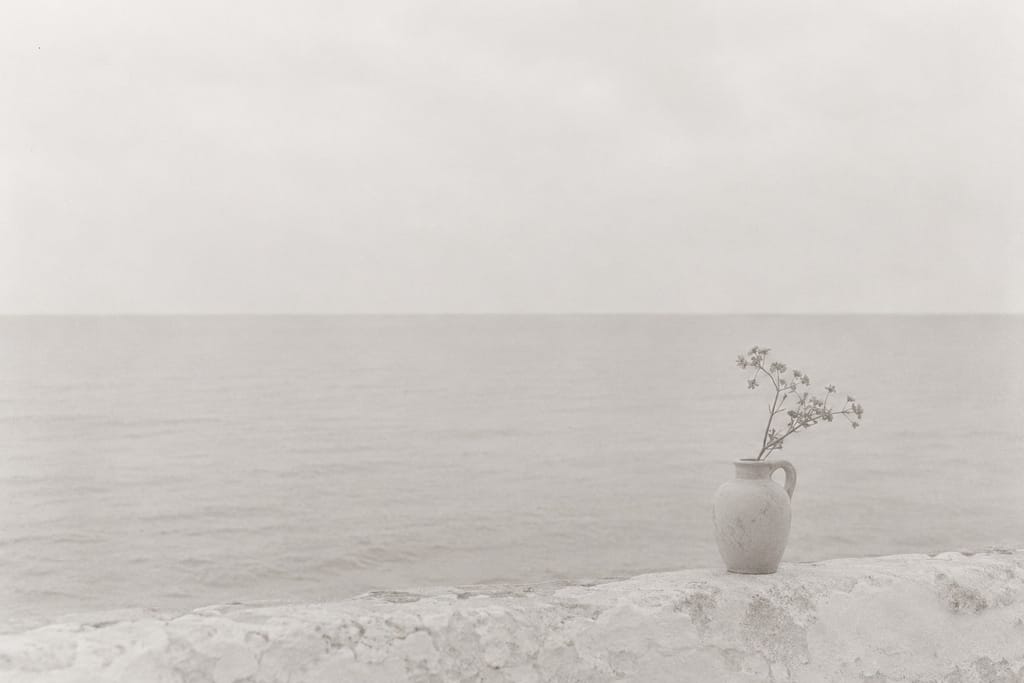
A pale ceramic pitcher holding a few slender flowering stems sits on a rough white stone ledge beside the sea. A calm expanse of water and a pale sky fill most of the softly toned image. What the check saw. The off-centre still life, expansive empty sky and delicate near-monochrome tones create a quiet, minimalist photograph.
With other styles
The opposite: Straight photography. Keep the same clean, unmanipulated seeing but trade its deep blacks and hard focus for pale, shadowless light and soft greys.
Pairs with Pictorialism. Borrow its lyrical softness of tone while keeping the lens sharp and the print plain, with no hand-worked surface.
The opposite: Viaggio in Italia everyday landscape. Keep the empty Italian seaside but swap its deadpan colour document for a lyrical monochrome of light.