Styles / Fashion & commercial
Modest fashion editorial
- Broad high key: a large soft source, 120 × 160 cm, 1.4 m from the face, about 40° to the camera’s left, 77 cm above the eyes.
- Weaker white bounce fill: a white reflector, 100 × 120 cm, 1.2 m from the face, about 50° to the camera’s right, 23 cm below the eyes.
To scale, from the render’s scene file. One way to get this light, not a record of how any photograph was lit.
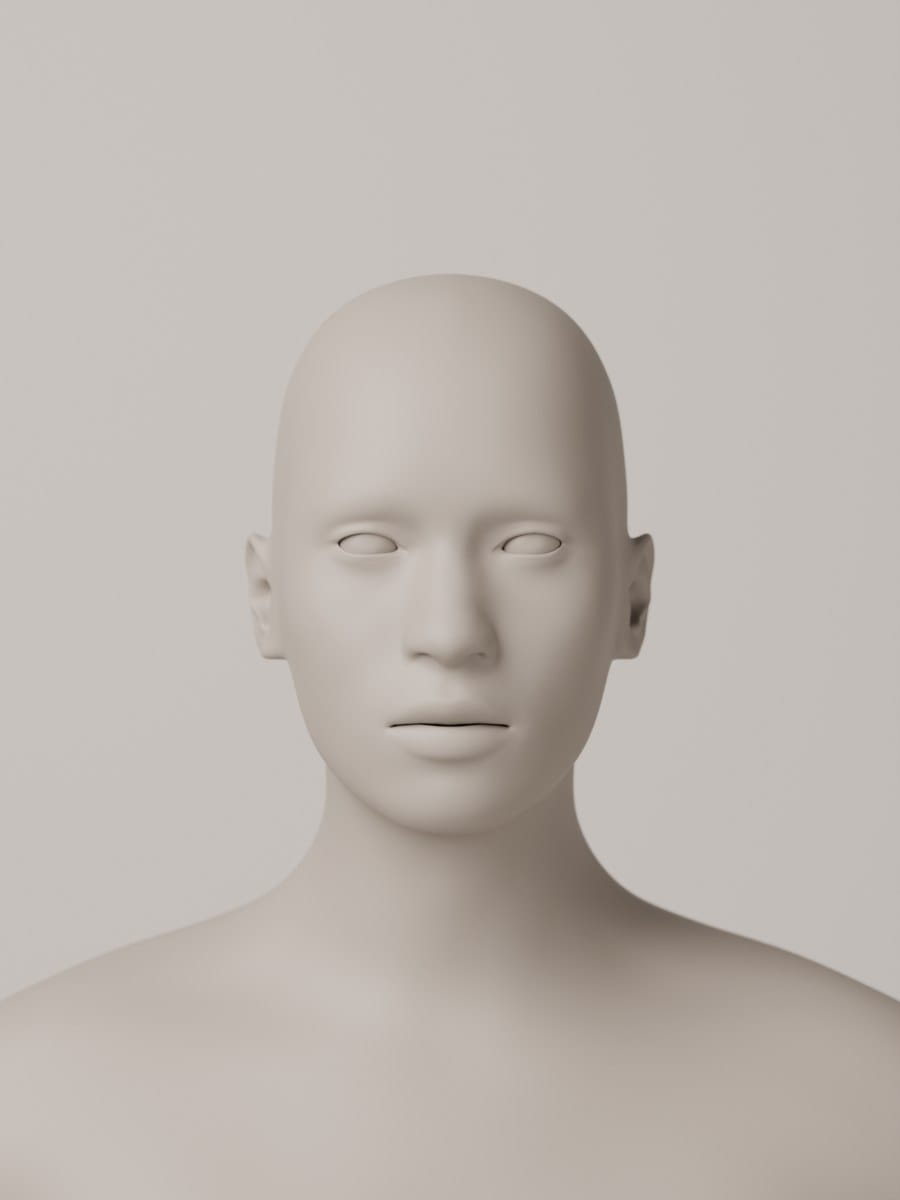
Rendered with this plan. A broad key high to one side of the camera, weaker bounce fill opposite and a pale backdrop (an inferred studio option; light only, not a garment demonstration).
Render: a synthetic clay head made with MakeHuman, not a person, in Blender Cycles, 85 mm, f/5.6.
The photographs that define it are still in copyright, so they are linked below rather than shown.
Directed colour fashion pictures that make coverage, layering and fabric volume the visual event: long garments, trousers under dresses, sleeves and deliberately arranged headwear when the wearer chooses it. Show the outfit at figure scale and shape a gesture around its drape, in a studio or a selected location. This entry covers the commissioned garment-led strand, not all Muslim dress, all modest-fashion imagery or candid street style; there is no mandatory pastel palette or single lighting recipe.
Built mostly on one system: Glamour studio. What systems are.
Shoot sheet for your kit A prompt for an image model The photographs
How the look is made
- Agree the wearer's own coverage and headwear choices before styling; build the image around layered proportions and fabric rather than treating coverage as an exotic accessory.
- Frame the figure at full or three-quarter length with enough room for the outer silhouette, sleeves and moving fabric; reserve close details for supporting pictures.
- Direct a turn, a placed hand or a controlled movement that separates the layers and reveals their fall without changing the agreed coverage.
- Choose a studio field or a location whose shapes and colours answer the outfit; make a planned fashion picture rather than pretending to discover an unobserved street moment.
- Expose and light for both dark and pale fabric texture; keep the garment's colour relationships readable instead of applying a compulsory pastel or faded grade.
- Edit a garment-led sequence with consistent colour and purposeful changes of pose; preserve the wearer's identity and the actual construction of the clothes.
Shoot sheet for your kit
Fill in your camera, lenses and lights, and the sheet says which light plays each part, what to work around and where to start on your camera. Without a kit it starts on a full-frame camera.
Light
Key: the open sky, all around and above, soft.
- Shadow edges
- Shadows that fade gradually from light to dark, cast by a large or diffused light: a window, a softbox, a cloudy sky.
- Shape & form
- Light turning gradually into shade across faces and objects, so their volume shows.
- Highlights
- Even the brightest parts (clouds, white cloth, snow) keep texture and detail.
How the style is lit
- For a studio garment study, use a broad key above and to one side of the camera with weaker bounce fill and a plain light backdrop; retain folds and a visible transition into shade rather than lighting only the face. This is an inferred option, not the recorded rig of a specimen.
- On a chosen location, use open shade or overcast daylight and a reflector only if needed to keep dark cloth readable; let the location keep its own colour while the outfit remains distinct. This is a practical interpretation, not a claim that every editorial uses daylight alone.
This plan is worked out from the style’s choices, so it is drawn as a schematic. The set-up at the top of the page is the one we rendered, to scale. One way to get the light, not a record of how any photograph was lit.
Lens and settings
Start at
On a full-frame camera: the same depth of field and exposure as the style’s own numbers, in the same light. Then meter and adjust.
- Then
- 35–85 mm · f/4–f/8 · 1/500–1/125 s · ISO 100–800 on full frame, inferred from the gear and the look. Suggested starting ranges for figure-scale directed fashion work, inferred from the visible framing, fabric detail and controlled movement; none of the inspected pages documents the cameras or exposures. These are not measured population norms or specimen settings. Adjust for available light and flash sync.
- White balance
- Balance to a neutral reference under the main light; retain garment colours and skin tones, allowing some location warmth without a compulsory pastel wash (inferred).
- Focal length
- Roughly the eye’s own perspective; no visible distortion.
- Angle
- The camera at the height of a standing person or of the subject.
- Distance
- Whole figures and their immediate surroundings.
- Balance
- The subject in the middle, the frame balanced around it.
- Instant
- Movement stopped dead by a fast shutter or flash.
- Duration
- An unmoving scene, exposed slowly and carefully.
Direct
Work with an adult wearer's own boundaries: turn the torso or head, place a hand to clarify a sleeve or layer, hold a prop if it supports the setting, or stop a small movement that opens the fabric. Use composed or engaged expressions, not a compulsory lowered gaze. Keep three-quarter and full-figure views alongside any supporting details; check that a turn or lifted arm does not reveal more than was agreed.
- Turn to the camera
- The body, the head or both turned about 45° from the lens, so one side is nearer the camera and the far ear is hidden.
- Head & gaze
- Eyes off the frame, past the camera or into the distance, as if lost in thought.
- Arms & hands
- Hands busy with a prop or a tool: flowers, a phone, a cup, a cigarette, an instrument, one’s own work.
- With the sitter
- The subject performs for the camera and shapes the picture.
- The set-up
- A scene staged and directed like a film still or a painting.
Style the set
Build covered proportions through long outer layers, sleeves, skirts, dresses or trousers, with underlayers and any use of translucent fabric agreed with the wearer. Arrange headwear only when the wearer chooses it, and let the wearer approve how it sits. Coordinate cloth, accessories and setting through colour and scale; bright pattern, restrained neutrals and black-on-black can all belong. The shared choice is controlled silhouette and layering, not a universal religious dress code.
- Clothes
- Clothes from a designer’s collection, chosen, fitted and pinned by a stylist for the shoot.
- Set & props
- A real place picked for its look as the setting for a shoot, not the subjects’ own: a street, a field, a palace, a hotel room.
- How much is styled
- Clothes, hair, make-up, props and set all chosen and placed by a team to one idea.
- Look of the styling
- Clothes, props and set kept to a few chosen colours that work together.
Finish
- Colour
- Strong, dense colours. White balanced to the light, so whites stay white and skin, food and products keep their real colour, with no overall cast.
- Digital & other
- A modern digital camera: clean, detailed, neutral.
- Texture
- Smooth tones with no visible grain.
- Shown as
- Pictures made and shown as a set.
- Shown in
- Pictures made for magazine pages and spreads.
- Frame
- A tall frame made for phones and screens.
Stay away from body & nude, macro, unseen camera, candid & unobserved, unstyled, as found, hdr & tone-mapped and scratches, dust & decay.
Before you shoot it
These photographs concern living people, Muslim and other communities, and working creative teams; clothing alone does not establish someone's religion, consent or personal definition of modesty. Do not equate coverage with submission, prescribe a single correct hijab, confuse everyday dress with sacred ceremony, or use a community's clothing as exotic costume. Agree coverage, handling of headwear, mixed-gender crew access, changing arrangements, retouching and publication with the wearer rather than assuming permission. Credit photographers, stylists and designers and do not copy a named person's face, portfolio composition or distinctive living brand identity. The equestrian specimen is contextual evidence, not an instruction to recreate its rider, veil or horse performance: never provoke an animal to rear or compromise human or animal welfare.
A prompt for an image model
A ready prompt that describes this look to an image model: where the lights stand, the lens, the framing and the colour. It starts on the style’s own choices; change any of them and the prompt and the notes follow.
The prompt
Notes on this prompt
- This is the set-up rendered at the top of the page, so the prompt puts its lights where the render has them. Image models put the light in the wrong place more often than anything else, so the prompt says where each light stands: which side of the picture, and how high. Keep to one light pattern per prompt, or the model splits the difference.
- Describe an invented person by age, clothes and pose. Never name a real or famous person, and never write “looks like”.
The model makes a new picture, not a photograph of anything that happened. Label it as AI-generated, and don’t pass it off as the style’s history or as a real person.
Where to see it
From open collections, shown whole with their credits. Later photographs are linked, not shown, while they are in copyright.
In copyright, so linked
- Layered outfit at a pomegranate stall (descriptive title; modest-fashion creatives editorial) , Danika Lawrence; styling by Alizé Demange, Published 14 May 2026; May 2026 issue; exact capture date not stated. Vogue Arabia / Condé Nast.
- Salma Tahri in black abaya on a rearing horse (descriptive title) , Alienor Gasper, Published 28 August 2026; September 2026 issue; exact capture date not stated. Vogue Arabia / Condé Nast.
- Photograph of a Melinda Looi Sunset in Africa ensemble (descriptive title) , Sebastian Kim, Photograph undated; published by Vogue 21 September 2018 and reproduced by Cooper Hewitt 3 January 2020; ensemble from the 2012 collection. Cooper Hewitt, Smithsonian Design Museum.
With other styles
The opposite: Street-style fashion photography. Keep its readable outfit scale, but replace found self-styling and an incidental pavement encounter with a commissioned wardrobe, chosen setting and agreed direction; not every modest street snap belongs here.
The opposite: Glossy beauty retouch. Move back from the face and cosmetic surface to show layers, hems and fabric volume; do not make macro makeup detail or heavy skin retouching the organising choice.
Pairs with Postwar couture fashion photography. Use deliberate silhouette and garment-serving gestures as a formal comparison, while keeping contemporary colour, wearer-defined coverage and no claim of a demonstrated historical lineage.
Sources
- Vogue, 16 June 2017, July issue: https://www.vogue.com/article/halima-aden-runway-model-yeezy (Corbijn credit and garment editorial; supports the approximate boundary, not a founding date).
- Vogue, 21 September 2018: https://www.vogue.com/article/contemporary-muslim-fashions-modest-dressing-de-young-museum (same Kim composition; publication anchor, not capture date).
- Cooper Hewitt, Smithsonian Design Museum, Contemporary Muslim Fashions: https://www.cooperhewitt.org/exhibition/contemporary-muslim-fashions/ (page publication metadata 3 January 2020; credited Sebastian Kim photograph of a Melinda Looi ensemble from the 2012 collection; exhibition and catalogue distinguish diverse Muslim fashion networks, documentary material and fashion photography. Collection year is not the photograph's capture date; museum hosting is not a CC0 grant for this file).
- Nadine El Chaer, 4 Modest Fashion Creatives Redefining Style and Representation / Beyond the Modest Stereotype, Vogue Arabia, 14 May 2026, May issue: https://www.voguearabia.com/article/modest-fashion-creatives (photography Danika Lawrence, styling Alizé Demange; first-person statements establish variation in coverage and its meaning; commissioned outfit credits establish editorial rather than candid street production).
- Jihane Bougrine, Inside Salma Tahri's World of Arabian Horses, Moroccan Heritage and Modest Fashion, Vogue Arabia, 28 August 2026, September issue: https://www.voguearabia.com/article/salma-tahri-arabian-horses-moroccan-heritage-modest-fashion (photographs credited Alienor Gasper; describes coordinated black abaya, fabric fluidity and equestrian design; a particular practitioner's variant, not a universal modest look).
- Ty Gaskins, Modest Dressing Has Entered Its It-Girl Era, Meet the 5 Arab Women Leading it, Vogue Arabia, 17 July 2025: https://www.voguearabia.com/article/modest-dressing-has-entered-its-it-girl-era (fashion-press context for layered proportions, sculptural coats and variation from quiet neutrals to saturated colour; feed styling is contextual, not automatically an editorial specimen).
- Research limits: the inspected sources establish a named fashion field and several directed photographic interpretations, not an autonomous photographic movement or a common lighting recipe. The approximate boundary reflects the earliest directed editorial publication inspected here, not an exhaustive historical search. The 2010 start in the scout brief and any founding photographer remain unverified. A FAMSF exhibition page and the Fashion Gone Rogue Candice Huffine page/image were blocked; neither is used as specimen evidence. Camera bodies, capture dates for the museum image, exact exposure settings and open reuse licences were not established. The digital gear and settings are explicitly inferred practical options. Performed poses and production credits support staging.collaborative in the vocabulary's performed-for-camera sense, not a claim that negotiated consent has been independently documented.