Styles / Digital & social
Nordic slow-living editorial
- Key: a window, about 60° to the camera’s left, soft.
Open shadows: bright surroundings (walls, ground, sky) fill them; no reflector needed.
Schematic, not to scale: worked out from the style’s choices. No set-up of this style has been rendered yet.
The photographs that define it are still in copyright, so they are linked below rather than shown.
Quiet pictures of homes, tables, ceramics, linen and small gatherings, shot in soft window or overcast light and held to a muted, neutral palette of whites, greys, oatmeal, wood and clay. Rooms are spare and uncluttered, tables are set but slightly lived-in, people are half-seen or caught absorbed, and the frame leaves empty wall or cloth around a few things.
Built mostly on one system: Styled tabletop. What systems are.
How the look is made
- Light the scene with one window or an overcast sky and let the shadows fall soft and open; never flash, never hard sun. For a dinner, a candle or lamp may stay in frame as a small warm accent beside the daylight.
- Hold the palette to a few muted neutrals (whites, greys, oatmeal, pale wood, clay) and take out anything saturated, branded or plastic before shooting.
- Keep the set spare: few things, natural materials (linen, ceramic, wood, wool), and one slightly imperfect element such as a crumpled napkin or a half-poured cup.
- Leave wall, table or cloth empty around the subject and frame it quietly, square-on or from above, with the horizon and verticals straight.
- Show people absorbed in a slow act (pouring, passing a dish, reading) or only their hands; do not ask for smiles to the lens.
- Expose for the highlights and grade down: keep whites cream rather than blown, never tint them pastel, and keep skin and wood slightly warm and everything else neutral.
Shoot sheet for your kit
Fill in your camera, lenses and lights, and the sheet says which light plays each part, what to work around and where to start on your camera. Without a kit it starts on a full-frame camera.
Light
Key: a window, about 60° to the camera’s left, soft.
- Open shadows: bright surroundings (walls, ground, sky) fill them; no reflector needed.
- Shadow edges
- Shadows that fade gradually from light to dark, cast by a large or diffused light: a window, a softbox, a cloudy sky.
- Shadow depth
- Shadows kept light and full of detail by a reflector, a fill light, bounce or bright surroundings (a low lighting ratio, up to about 3:1: the shadow side at most a stop and a half darker).
How the style is lit
- One north- or east-facing window, curtains drawn to diffuse, no fill or a white card.
- Overcast daylight through open doors for outdoor tables and terraces.
- Late-day window light with candles or a single warm lamp left in frame for a dinner.
This plan is worked out from the style’s choices, so it is drawn as a schematic. One way to get the light, not a record of how any photograph was lit.
Lens and settings
Start at
On a full-frame camera: the same depth of field and exposure as the style’s own numbers, in the same light. Then meter and adjust.
- Then
- 28–85 mm · f/2–f/8 · 1/250–1/17 s · ISO 100–800 on full frame, inferred from the gear and the look. Inferred from the look and from the window-lit interiors; no source states typical settings. Interiors and tables are shot at moderate apertures for sharp rooms; portraits and details open up, and a tripod allows longer shutters at base ISO in dim rooms.
- White balance
- Daylight or cloudy balance: windows stay neutral to slightly cool, wood, linen and any candle or lamp stay warm, and the grade keeps desaturated neutrals (inferred).
- Focal length
- Roughly the eye’s own perspective; no visible distortion.
- Angle
- Straight down onto a table, floor or ground.
- Balance
- The subject faces the lens; planes run parallel to the picture.
- Crop & fill
- A small subject in a large empty field.
- Duration
- An unmoving scene, exposed slowly and carefully.
Direct
People are rarely posed to the lens: a host pours, hands pass a dish, a guest reads or looks down, seated loosely around a table; backs, profiles and hands carry many frames. Faces are calm rather than smiling, and nobody is asked to look at the camera, so the picture reads as a pause in a slow day.
- Head & gaze
- Attention on what the hands are doing or on a thing (working, reading, eating, playing), not on the camera.
- Arms & hands
- Only hands in the frame, holding, pouring, cutting or offering, with no face.
- Without a pose
- No people at all, or people so small or far off that their pose does not read (hands alone are Hands alone).
- The set-up
- Sets, models and miniatures built to be photographed.
Style the set
Linen shirts and wool knits in oatmeal, grey and navy without logos, natural make-up, and rooms or tables dressed with a few ceramics, a loaf, branches or a candle on pale wood and stone; the arrangement is deliberate but kept slightly lived-in (a crumpled napkin, a half-eaten loaf) and free of bright colours, plastic and screens.
- Set & props
- Props chosen and placed for colour, texture and story: linen, ceramics, cutlery, flowers, scattered ingredients. A real home, workplace or street that belongs to the people in it, not a set, with their own things and traces of use.
- Food & things
- Planned mess: crumbs, drips, spilled flour, torn bread, crumpled napkins, a bite taken.
- Look of the styling
- Few, simple elements on clean surfaces, with space around them.
Finish
- Colour
- Colour held back towards grey. White balanced to the light, so whites stay white and skin, food and products keep their real colour, with no overall cast.
- Digital & other
- A modern digital camera: clean, detailed, neutral.
- Post-production
- A ready-made grade laid over the whole image.
- Shown in
- Pictures made for magazine pages and spreads.
Stay away from direct on-camera flash, hard, direct sun, coloured gels, high-key, saturated colour, pastel, teal & orange grade, hdr & tone-mapped, hyper-detailed, blown highlights, maximal & patterned, full glamour make-up, sell & persuade, glamour & aspiration, smiling, backlight & rim, golden hour, lens flare & haze, soft focus & diffusion and heavy retouching.
Before you shoot it
The look is practised by many living photographers and stylists and owned by magazines and brands: describe its choices, never prompt with a photographer's name or copy a portfolio or issue. Its homes and tables belong to real, usually affluent households, and critics call the pared-down look homogeneous, twee and a performance of class and consumption; the founder himself called its Instagram spread 'kind of scary'. It signals Nordic calm but is not documentary of Nordic life.
A prompt for an image model
A ready prompt that describes this look to an image model: where the lights stand, the lens, the framing and the colour. It starts on the style’s own choices; change any of them and the prompt and the notes follow.
The prompt
Notes on this prompt
- How the style uses it: light the scene with one window or an overcast sky and let the shadows fall soft and open; never flash, never hard sun. For a dinner, a candle or lamp may stay in frame as a small warm accent beside the daylight. Image models put the light in the wrong place more often than anything else, so the prompt says where each light stands: which side of the picture, and how high. Keep to one light pattern per prompt, or the model splits the difference.
- Describe an invented person by age, clothes and pose. Never name a real or famous person, and never write “looks like”.
- Give the camera height in plain words: from knee height looking up, from a stepladder looking down, straight down onto the table.
The model makes a new picture, not a photograph of anything that happened. Label it as AI-generated, and don’t pass it off as the style’s history or as a real person.
Made by an AI model
An image gpt-image-2 made from this style’s choices, then checked against them by a vision model. Not a photograph, and not part of the style’s history. All generated images
-
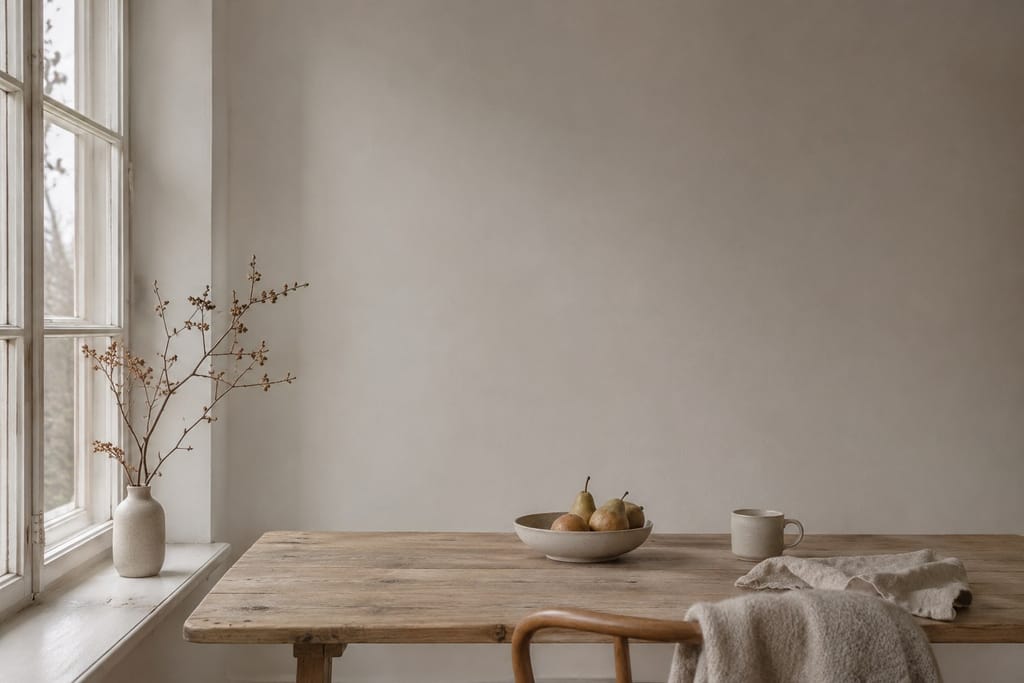
A wooden table beside a tall window holds a ceramic bowl of pears, a mug and rumpled linen, with a fabric-draped chair in the foreground. A pale vase of dried branches sits on the windowsill beneath a large expanse of bare off-white wall. What the check saw. Soft side light from the window, subdued earth tones and generous empty wall space give this carefully arranged still life a quiet, restrained atmosphere.
With other styles
The opposite: Light and airy. Both love window light, but swap its pastel ivory glow, backlight and romance for muted neutrals, lower exposure and an unposed, quiet gathering.
The opposite: Dark and moody food photography. It shoots the same bread and ceramics under a daylight window with open shadows and pale surfaces; choose it over low-key for spring or everyday tables.
Pairs with Flat lay. Shoot the table from above for the still-life pages, then leave empty cloth and one imperfection so it reads as a meal, not a catalogue.
Pairs with Xiaoqingxin (small fresh) photography. Borrow its attention to small ordinary things, but keep the earthy neutrals and shared tables instead of cool green pastels.
The opposite: Cottagecore pastoral photography. Strip out its costume, wildflowers and golden-hour warmth for plain linen, bare rooms and neutral light.
Sources
- https://en.wikipedia.org/wiki/Kinfolk_(magazine)
- https://www.dezeen.com/2016/03/02/kinfolk-magazine-interview-founder-editor-in-chief-nathan-williams-instagram/
- https://www.dinesen.com/en/inspiration/the-kinfolk-gallery
- https://www.kinfolk.com/stories/home-tour-alekos-fassianos/
- https://www.philstar.com/lifestyle/young-star/2015/09/24/1503507/keeping-kinfolk