Styles / Fashion & commercial
Photographic pin-up (cheesecake) photography
- Key: a softbox, about 40° to the camera’s left, high, soft.
- Fill: a softbox, about 35° to the camera’s right, soft.
Key high: about 30–45° above eye level, angled down.
Schematic, not to scale: worked out from the style’s choices. No set-up of this style has been rendered yet.
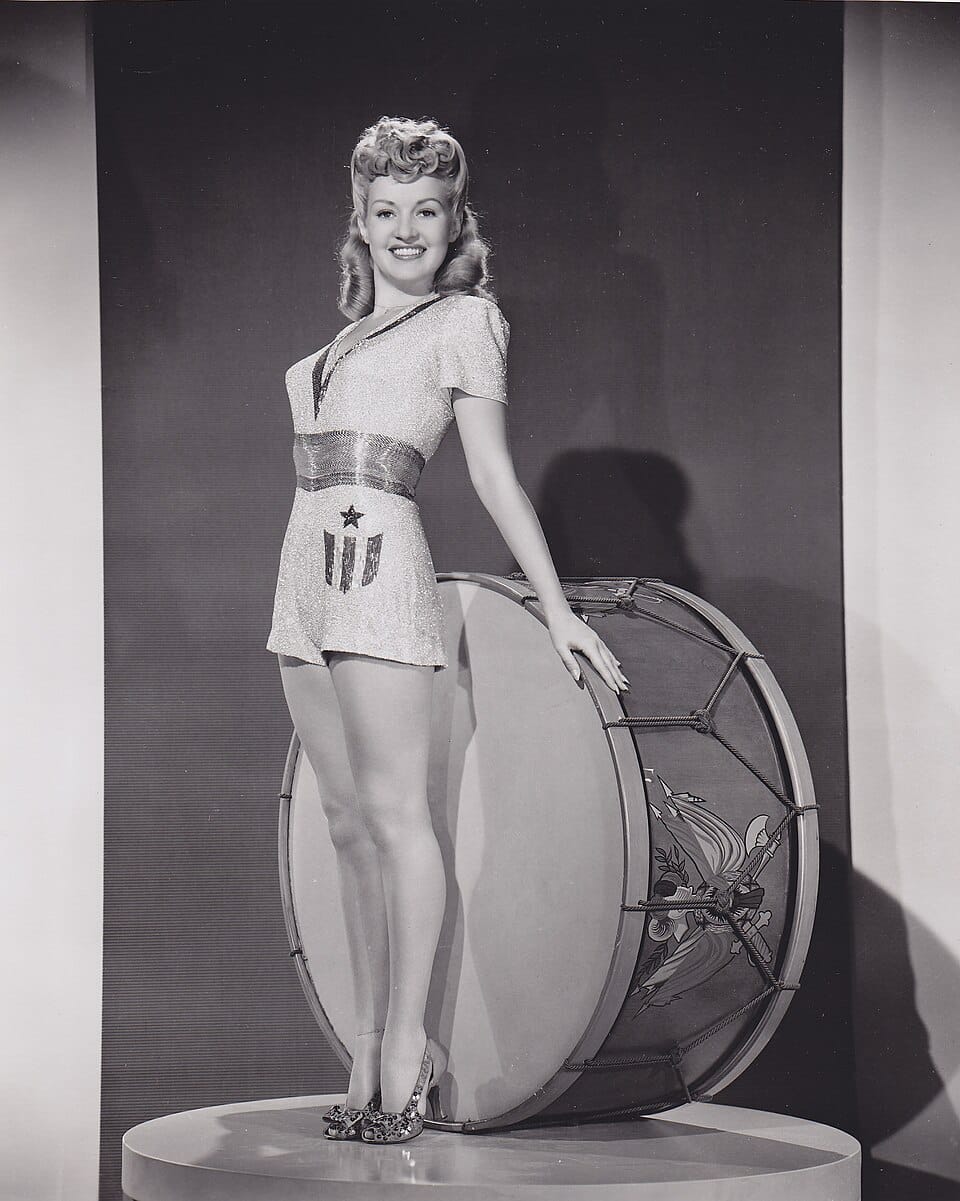
Betty Grable, pin-up photograph for Yank, the Army Weekly
Yank, the Army Weekly, 25 June 1943, via Wikimedia Commons (tagged public domain as a U.S. Army work; it looks like a studio publicity print reproduced in Yank, so that basis is doubtful and it may still be protected outside the US). Source: Betty Grable, pin-up photograph for Yank, the Army Weekly at Wikimedia Commons (U.S. Army, Yank)

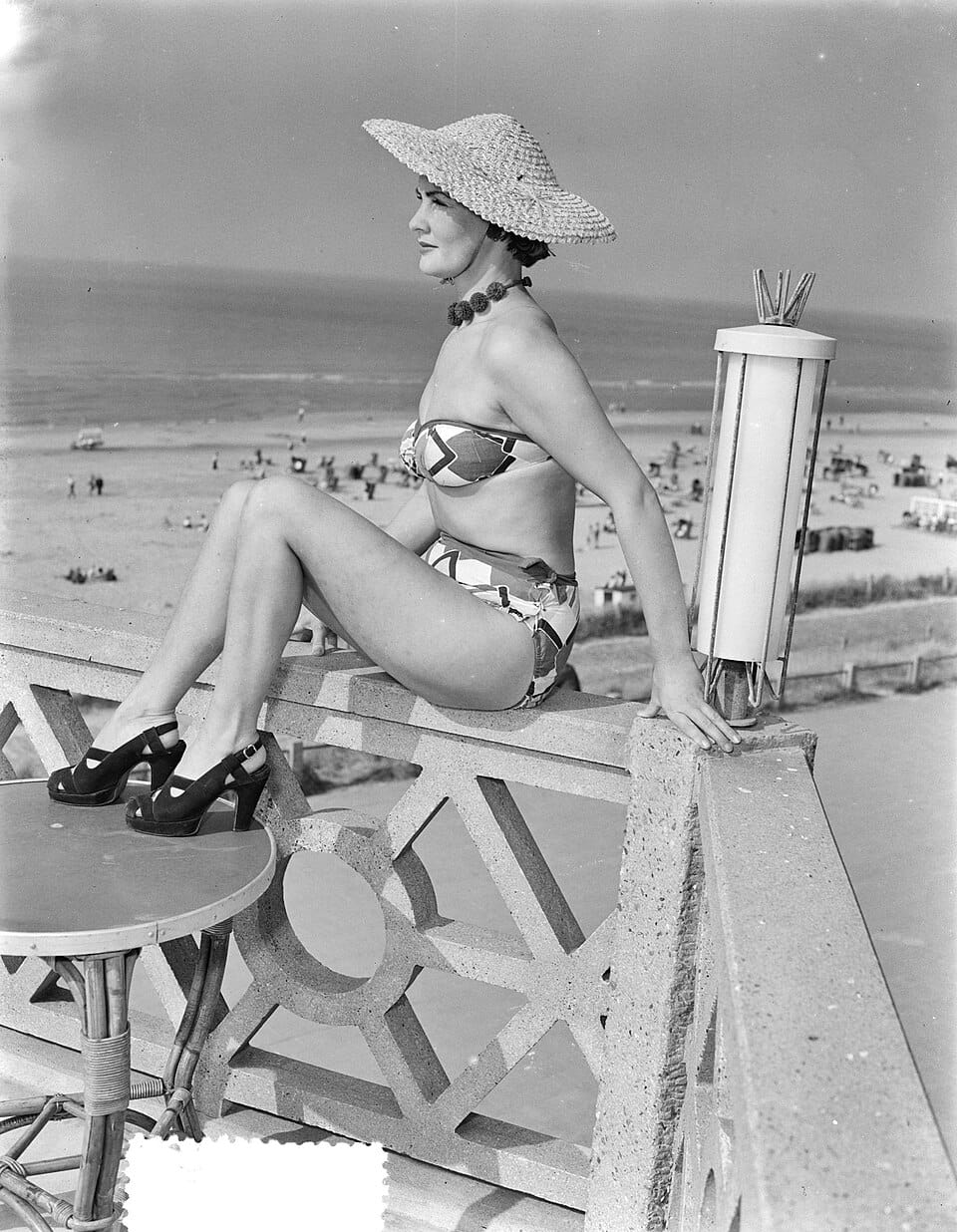
Opnamen badschonen (Pin Up)
Harry Pot / Anefo, Nationaal Archief, 1955, CC0, via Wikimedia Commons. Source: Opnamen badschonen (Pin Up) at Nationaal Archief, Fotocollectie Anefo

Full-length pictures of a young woman posed to be pinned on a wall: a bright smile, a turned hip, long legs, a swimsuit, shorts or a costume with a wink, shot in a studio or on a sunny beach and printed in black and white or saturated colour for calendars, magazines and soldiers' lockers. It borrows Hollywood glamour's polish but swaps the star's remote mystique for cheerful, approachable flirtation.
Built on two systems: Costumed tableau and Gloss and curve. What systems are.
Shoot sheet for your kit A prompt for an image model The photographs
How the look is made
- Pose the whole figure, head to heels: weight on one leg, hip turned, a hand on a prop, sometimes shoulders looking back at the lens.
- Make the face friendly rather than remote: a broad smile or a wink straight at the viewer, the playful girl-next-door rather than the star.
- Dress the picture with a gag or theme (a drum, a beach ball, a Santa hat, military-style trim) and let the swimsuit, high heels and bare legs be the point.
- Light the figure evenly and brightly: soft studio key with fill indoors, or sun with fill flash outdoors, so the skin glows and shadows stay light.
- Shoot outdoors where you can, on a beach, a rail or a lawn, at a normal lens distance, and keep the horizon and the sea as a bright, simple ground.
- Retouch to a smooth, flawless finish and crop vertically for the calendar, the magazine page or the poster.
Shoot sheet for your kit
Fill in your camera, lenses and lights, and the sheet says which light plays each part, what to work around and where to start on your camera. Without a kit it starts on a full-frame camera.
Light
Key: a softbox, about 40° to the camera’s left, high, soft.
Fill: a softbox, about 35° to the camera’s right, soft.
- Key high: about 30–45° above eye level, angled down.
- Shadow depth
- Shadows kept light and full of detail by a reflector, a fill light, bounce or bright surroundings (a low lighting ratio, up to about 3:1: the shadow side at most a stop and a half darker).
How the style is lit
- A large soft key high and in front with a fill beside the camera and a hair light, against a plain graded backdrop in a studio.
- Midday sun on a beach or terrace with on-camera or bracket fill flash to lift the shadows under chin, hat and arms.
- A light, even photoflood bounced off a white wall or card for a location indoors, a colour backdrop behind.
This plan is worked out from the style’s choices, so it is drawn as a schematic. One way to get the light, not a record of how any photograph was lit.
Lens and settings
Start at
On a full-frame camera: the same depth of field and exposure as the style’s own numbers, in the same light. Then meter and adjust.
- The style’s f/11 on 6 × 6 cm gives about the depth of field of f/6.2 on full frame.
- Then
- 40–75 mm · f/8–f/16 · 1/250–1/125 s · ISO 10–100 on 6 × 6 cm, inferred from the gear and the look. Worked out from the gear of the period and the look: roll-film or sheet-film cameras at a normal lens, stopped down for a sharp full-length figure, a flash-synch shutter speed in sun with fill, and slow colour transparency film. Sources do not give a typical exposure.
- White balance
- Daylight-balanced film or sensor outdoors, with skin and sun left warm and sea and sky cool; studio colour on tungsten stock or filtered, keeping skin pink.
- Focal length
- Roughly the eye’s own perspective; no visible distortion.
- Angle
- The camera at the height of a standing person or of the subject.
- Instant
- Movement stopped dead by a fast shutter or flash.
Direct
Pose the model full-length and standing, weight on one leg, a hip turned, one hand on a prop or the waist and the other on a hip or raised in a wave; or seated, reclining or kneeling on a rail, sand or a rug with the legs lengthened and one knee bent. Turn the shoulders and look back over one shoulder or straight into the lens with a broad smile or a wink; keep the mood bright and flirtatious rather than brooding.
- Whole body
- MustPose the whole figure, head to heels, standing: weight on one leg and the hip turned, so the body draws an S.Photographer directs. The pin-up is a full-length figure made to be pinned on a wall; the turned hip is its signature.
- MustAdults only. Agree in writing, before the shoot, where each picture may be used and circulated.Safety and consent. Many period models had no clear control over how their pictures circulated.
- MustIn generated images use invented adult models only: never a lookalike of a real star or model, and never present the image as a vintage photograph.Safety and consent.
- UsuallyAgree the outfit with the model beforehand: a swimsuit, shorts, a playsuit or a themed costume (a sash, a sailor trim, a Santa hat).Subject chooses.
- AvoidDo not keep half-set or slumped frames; reset the stance from the feet up between frames.Photographer directs.
- AvoidDo not cast, pose or retouch towards the period's slim, white ideal by default; pose the body the model has.Photographer directs. The original pictures set a narrow ideal of body and face; the entry asks not to reproduce it.
- Head and neck
- MustSet the hair and finish the face, red lips included, before the first frame, and touch them up between set-ups.Photographer directs. A polished, smooth finish is part of the look, in the face as in the retouching.
- OptionalTurn the back to the camera and look back over one shoulder at the lens.Photographer directs. Frank Powolny's 1943 bathing-suit picture of Betty Grable, the most requested pin-up among G.I.s, uses this pose.
- Face and eyes
- UsuallyA broad smile straight into the lens.Photographer directs. The pin-up is friendly and approachable, the girl next door rather than the remote star.
- UsuallyFor variety, a wink or a playful face at the viewer.Photographer directs.
- AvoidDo not ask for a heavy-lidded, brooding look; keep the mood bright and flirtatious.Photographer directs. Smouldering mystique belongs to Hollywood glamour, the pin-up's foil.
- Arms
- OptionalThe free hand on the waist or the hip, or raised in a wave to the viewer.Photographer directs.
- Hands
- UsuallyGive her one gag prop to hold or rest a hand on: a beach ball, a parasol, a straw hat, a drum or a bicycle.Photographer directs. A single themed prop sets the gag of the picture.
- Torso and hips
- UsuallyTurn the hip one way and bring the shoulders back towards the lens, so the waist shows the turn.Photographer directs. The turn of hip against shoulders makes the S of the standing pose.
- Legs
- MustKeep the legs long: the standing leg straight, the other knee relaxed and bent a little.Photographer directs. The swimsuit, the heels and the bare legs are the point of the picture.
- OptionalSeated, reclining or kneeling on a rail, the sand or a rug, lengthen the legs and bend one knee.Photographer directs. The sitting and lying variants keep the same long line as the standing pose.
- Feet
- UsuallyKeep the high heels or sandals on, on sand too, and the heels lifted.Photographer directs. Heels belong to the styling and keep the legs long.
Must: the look depends on it · Usually: what the style does most of the time · Optional: one possibility among others · Avoid: works against the look.
- The set-up
- A scene staged and directed like a film still or a painting.
Style the set
Dress the model in a swimsuit, shorts, a playsuit or a costume with a theme (a patriotic sash, a drum, a Santa hat, a sailor trim), with high heels or sandals, set hair and red lips; add a single gag prop such as a beach ball, a parasol, a straw hat or a bicycle, and a beach, terrace, lawn or plain backdrop behind.
- Clothes
- Period dress, fancy dress, stage costume or someone else’s clothes, worn to play a part rather than as one’s own.
- Hair & make-up
- Groomed hair and finished make-up that still look natural: even skin, defined eyes, neat brows.
- Set & props
- The stock furniture of a portrait studio, standing in for a setting: a posing chair, a column, a balustrade, a draped table, a potted palm.
- How much is styled
- Clothes, hair, make-up, props and set all chosen and placed by a team to one idea.
Finish
- Monochrome
- Rich blacks, clean whites and every grey between.
- Post-production
- Perfected skin and surfaces.
- Frame
- A tall frame made for phones and screens.
Stay away from smouldering look, awkward & in-between, low-key & chiaroscuro, deep shadows, black shadows, candid & unobserved, deadpan, nobody in the picture, natural face & hair, visible grain, muted & desaturated and document & record.
Before you shoot it
The photographs show real, mostly young women posed for a male gaze, many named, some without clear control over how their pictures were circulated, and they set a narrow ideal of body and face. Avoid reproducing the period's near-exclusive white, slim ideal by default, and treat the pin-up's wartime role, as morale and sales material for troops, as a commercial and propagandist use rather than a neutral fashion. Desire is deliberately left out of the intent profile: the pin-up is cheerful, playful and sold, not explicitly sensual.
A prompt for an image model
A ready prompt that describes this look to an image model: where the lights stand, the lens, the framing and the colour. It starts on the style’s own choices; change any of them and the prompt and the notes follow.
The prompt
Notes on this prompt
- How the style uses it: light the figure evenly and brightly: soft studio key with fill indoors, or sun with fill flash outdoors, so the skin glows and shadows stay light. Image models put the light in the wrong place more often than anything else, so the prompt says where each light stands: which side of the picture, and how high. Keep to one light pattern per prompt, or the model splits the difference.
- Black and white: colour words in the subject (a red dress, green leaves) can pull the model back to colour, so leave them out.
- Heavy retouching: ask for smooth skin that keeps its pores, or the model makes it look like plastic.
The model makes a new picture, not a photograph of anything that happened. Label it as AI-generated, and don’t pass it off as the style’s history or as a real person.
Where to see it
From open collections, shown whole with their credits. Later photographs are linked, not shown, while they are in copyright.
With other styles
The opposite: Hollywood glamour portraiture. Use its hard-lit, heavy-lidded close portrait as the foil when you want mystique; the pin-up wants a full figure and an open smile.
The opposite: Postwar couture fashion photography. Couture editorial puts the garment and the designer's idea first; the pin-up puts the smiling figure first and sells the picture of her.
The opposite: Tabloid flash press photography. Both can use a flash for fill, but the press flash is harsh and unposed; the pin-up flash only lifts shadows on a directed pose.
The opposite: Y2K digicam and flash revival. On-camera flash for a casual snapshot look is the foil to the pin-up's directed, retouched finish.
Sources
- Pin-up girl, Wikipedia: https://en.wikipedia.org/wiki/Pin-up_girl ('pin-up' first attested in English in 1941; 'cheesecake' in the US from the 1940s; Betty Grable's 1943 photograph; Esquire's Vargas Girls and 9 million copies sent to troops in 1942-1946)
- Bunny Yeager, Wikipedia: https://en.wikipedia.org/wiki/Bunny_Yeager (1929-2014; night class in 1953, first sale 1954; Bettie Page 1954 and the January 1955 Playboy centrefold; fill flash in bright sun; outdoor shooting around Miami and Jamaica; six Playboy centrefolds; bikini pictures of Ursula Andress for Dr. No, 1962)
- Betty Grable, Wikipedia: https://en.wikipedia.org/wiki/Betty_Grable (Frank Powolny's 1943 20th Century Fox bathing-suit pin-up over her shoulder; most requested photograph among G.I.s; Life 2003 and Time lists of influential photographs)
- Betty Grable 1943 Yank.jpg, Wikimedia Commons: https://commons.wikimedia.org/wiki/File:Betty_Grable_1943_Yank.jpg (pin-up photo for Yank, the Army Weekly, 25 June 1943; public domain)
- Opnamen badschonen (Pin Up), Anefo, Nationaal Archief, 22 September 1955: https://commons.wikimedia.org/wiki/File:Opnamen_badschonen_(_Pin_Up_),_Bestanddeelnr_907-3423.jpg (Harry Pot; CC0)