Styles / Vernacular & studio
Quinceañera portraiture
- Key: the open sky, all around and above, soft.
Daylight studio: a skylight, a glasshouse or a courtyard, with a backdrop behind the sitter. Open shadows: bright surroundings (walls, ground, sky) fill them; no reflector needed.
Schematic, not to scale: worked out from the style’s choices. No set-up of this style has been rendered yet.
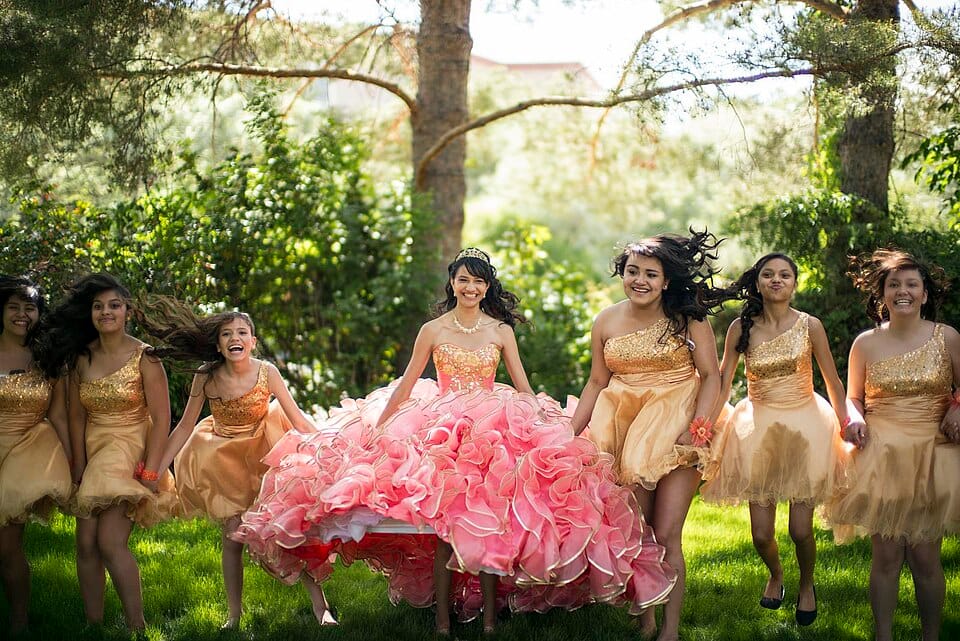
Quinceañera. Santa Fe
Christopher Michel, CC BY 2.0, via Wikimedia Commons. Source: Quinceañera. Santa Fe at Wikimedia Commons

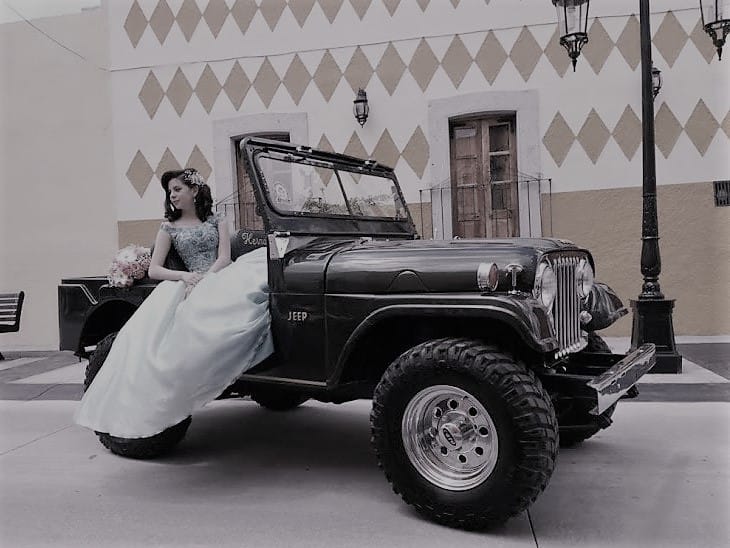
La Quinceañera (XVGirl)
Blancaeoliva, CC BY-SA 4.0, via Wikimedia Commons. Source: La Quinceañera (XVGirl) at Wikimedia Commons

Commissioned portraits of a girl turning fifteen in a ball gown and tiara: full-length frames of the skirt on a park lawn, staircase, historic square or studio backdrop, then bodice and tiara details, family and court groups. Daylight on location is what the openly licensed examples show; flash fill, soft studio light and light retouching are common in studio guides but unobserved here. The pictures are made for an album and a framed enlargement.
Built on two systems: Telephoto colour and Painted studio. What systems are.
Shoot sheet for your kit A prompt for an image model The photographs
How the look is made
- Photograph the gown as the subject: start with full-length frames that show the whole skirt and silhouette, then move to details of bodice, tiara, bouquet and shoes.
- Choose a backdrop that flatters the gown's colour and keep it uncluttered: a garden, staircase, church steps, historic square or plain studio backdrop, never a busy texture behind detailed beadwork.
- Direct the pose: stand her tall with shoulders turned, a bouquet or skirt held in arranged hands, a chin slightly down and a smile for the camera.
- Lift the face with soft frontal light: open shade or daylight on location, and, as studio guides commonly advise, flash fill or a softbox for studio frames (not observed in the specimens).
- Sequence the session for the album: solo, parents and godparents, court of damas and chambelanes, with the gown spread for each frame, and finish with colour grading; one studio guide recommends warm, slightly saturated tones, but the specimens vary from saturated to dark and muted.
Shoot sheet for your kit
Fill in your camera, lenses and lights, and the sheet says which light plays each part, what to work around and where to start on your camera. Without a kit it starts on a full-frame camera.
Light
Key: the open sky, all around and above, soft.
- Daylight studio: a skylight, a glasshouse or a courtyard, with a backdrop behind the sitter.
- Open shadows: bright surroundings (walls, ground, sky) fill them; no reflector needed.
- Shadow edges
- Shadows that fade gradually from light to dark, cast by a large or diffused light: a window, a softbox, a cloudy sky.
- Shadow depth
- Shadows kept light and full of detail by a reflector, a fill light, bounce or bright surroundings (a low lighting ratio, up to about 3:1: the shadow side at most a stop and a half darker).
How the style is lit
- Outdoor park or garden session: gown-facing shade or open shade as the ambient base, a camera-side flash through a diffuser or bounced for fill and tiara sparkle (common in studio guides; not observed in the specimens).
- Studio portrait on a plain or painted backdrop: a large softbox beside the camera axis as key, a reflector or second soft light below for fill, a hair light to separate the dark hair from the backdrop (inferred set-up; no studio specimen).
This plan is worked out from the style’s choices, so it is drawn as a schematic. One way to get the light, not a record of how any photograph was lit.
Lens and settings
Start at
On a full-frame camera: the same depth of field and exposure as the style’s own numbers, in the same light. Then meter and adjust.
- Then
- 50–135 mm · f/2–f/5.6 · 1/250–1/125 s · ISO 100–800 on full frame, inferred from the gear and the look. Starting ranges inferred for a modern portrait session, not a measured distribution. One openly licensed Santa Fe quinceañera photograph carries file data of 50 mm, f/1.2, 1/2000 s, ISO 200 on a full-frame camera, a much wider open aperture than a studio set-up. Use a shorter lens for full-length skirt and group frames, a longer one for tiara and face. Church interiors in a Mass often need ISO 1600 or more. The light.flash-ambient, soft-studio, key-fill, direct-flash, catchlight, specular and retouching traits are inferred from studio pages that give no lighting details; the three specimens show daylight.
- White balance
- Daylight or flash balance near 5500 K so the gown colour stays true; leave indoor tungsten and church lighting to read a little warm rather than correcting it to neutral (inferred).
- Angle
- The camera at the height of a standing person or of the subject.
- Distance
- Whole figures and their immediate surroundings.
- Crop & fill
- The subject shown small within its setting, which explains it.
- Duration
- An unmoving scene, exposed slowly and carefully.
Direct
Stand her tall in the full gown, one foot slightly forward, shoulders turned and chin slightly down, with the bouquet or the skirt held in arranged hands; alternate a direct smile with a look over the shoulder and a seated frame on stairs. Spread or lift the skirt so it fills the frame, pose parents and godparents beside her, and give the court of damas and chambelanes a tidy line with the quinceañera at its centre.
- Arms & hands
- Fingers placed on purpose: relaxed and separated, shown edge-on, wrists softly bent, as in ballet, fashion and glamour. Hands busy with a prop or a tool: flowers, a phone, a cup, a cigarette, an instrument, one’s own work.
- Expression
- A smile, posed or natural, lips closed or showing teeth.
- The moment
- Ordinary photographs by and for ordinary people, or images that look like them.
- The set-up
- A scene staged and directed like a film still or a painting.
Style the set
A ball gown in the girl's chosen colour, tiara, bouquet, jewellery and heels, with hair and makeup done for the day; sets are a chosen park, garden, church steps, staircase or a plain or painted studio backdrop, sometimes with a vehicle or flowers as props. Last doll, rosary, medal and similar ritual objects are part of some families' portraits; follow the family's own choices.
- Clothes
- Best clothes, jewellery and accessories put on for the studio or the occasion. The wearers’ own festive, religious or wedding clothes: saris and lehengas, boubous, robes, kimono.
- Hair & make-up
- Groomed hair and finished make-up that still look natural: even skin, defined eyes, neat brows.
- Set & props
- A real place picked for its look as the setting for a shoot, not the subjects’ own: a street, a field, a palace, a hotel room. A painted, cloth, paper or seamless backdrop behind the subject.
Finish
- Digital & other
- A modern digital camera: clean, detailed, neutral.
- Shown in
- Prints for an album, a card or a frame at home.
Stay away from candid & unobserved, deadpan, black & white, full range, faded & matte, unstyled, as found, scratches, dust & decay, objective & scientific and unseen camera.
Before you shoot it
These pictures show real girls, usually fifteen years old and therefore minors, in a Catholic and family rite that belongs to living Latin American and Latino communities. Photograph only with the girl's and her parents' consent, never publish a minor's image or name without it, and credit and commission community photographers rather than imitating a studio's signature set. Do not present an illustration as a real quinceañera, family or album, and do not sexualise the sitter: the rite is a family celebration, and the glamour is that of a gown, not of the body. The gown is the wearer's own festive dress, and tiara, last doll, Mass and the Virgin of Guadalupe carry religious and family meaning, so ask before staging them as props or costume. Practices differ in Mexico, Cuba, Colombia, Argentina, the Caribbean and the United States; this entry is not one generic Latino look. The studio pages named here are living businesses, so their photographs stay link-only.
A prompt for an image model
No prompt for this style
Behind its pictures: real girls who are minors in a living religious and family rite.
Its caution asks to commission and credit community photographers.
Photograph only with the girl's and her parents' consent, never publish a minor's image or name without it, and credit and commission community photographers rather than imitating a studio's signature set. Do not present an illustration as a real quinceañera, family or album, and do not sexualise the sitter: the rite is a family celebration, and the glamour is that of a gown, not of the body. The studio pages named here are living businesses, so their photographs stay link-only. Photogeny image generation must never produce a realistic quinceañera minor, and specimens of real girls stay unnamed.
Work with photographers of this tradition, or take only its light and lens (the shoot sheet above) without its people, places or rituals.
Photographs that define it
From open collections, shown whole with their credits. Later photographs are linked, not shown, while they are in copyright.
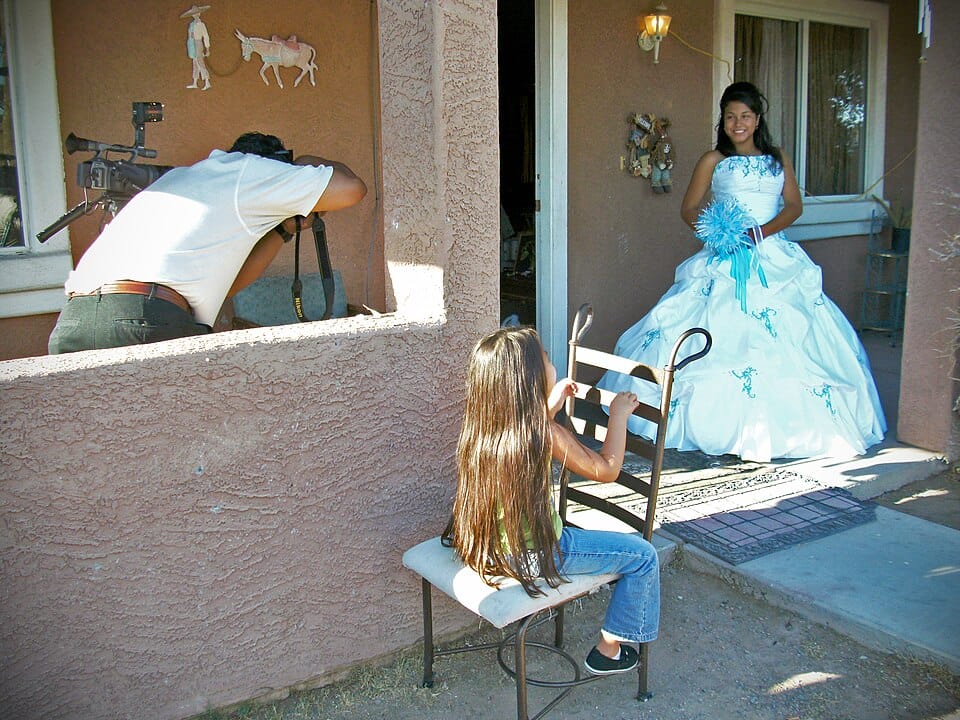
Miss quinceneara (photographer at work)
Ms. Phoenix, CC BY 2.0, via Wikimedia Commons. Source: Miss quinceneara (photographer at work) at Wikimedia Commons

With other styles
Pairs with East Asian pre-wedding photography. Borrow its multi-outfit, multi-set album sequence, but keep the quinceañera alone in a single gown and bring family and court into the frame.
Pairs with Glossy beauty retouch. Borrow light skin finishing only with the girl and her family's agreement, and keep the full gown in the frame rather than cropping into the face.
The opposite: Hollywood glamour portraiture. Use its sculpted key light for drama; choose the quinceañera approach of open, soft light, saturated colour and a smile when the picture is for the family album.
The opposite: Indian candid and pre-wedding photography. Keep the portrait session directed and the gown the subject, and switch to candid coverage for the Mass, the waltz and the party.
The opposite: Light and airy. Choose its pastel airiness for a soft outdoor set, but keep the quinceañera session's saturated gown colour and directed poses.
Sources
- Wikipedia, Quinceañera, https://en.wikipedia.org/wiki/Quincea%C3%B1era . Read in full for this entry: dates the celebration in Los Angeles and San Diego in the mid-to-late 1970s and in Texas in the early 1980s (citing Gonzalez, New York Times, 2016, and Cantú and Nájera-Ramírez, 2002, neither consulted), and describes the gown, tiara, last doll, Mass, waltz and court. The page says little about photography.
- Tov Studio Photo, Quinceanera Photography Guide, https://tovstudiophoto.com/quinceanera-photography-guide/ . A commercial studio guide read for the portrait sequence: full-length gown frames first, details, family and court frames, the court group-portrait window of 30 to 60 minutes (the guide offers a separate session before the event as an option), and warm, slightly saturated editing. Gives no focal lengths or flash settings.
- Golightly Studios, Quinceañera Photographer, https://www.golightlystudios.com/services/quinceanera-photographer . A commercial page read for the pre-event 'Mis XV Session' at outdoor or urban locations, handcrafted lay-flat albums, parent albums, wall art and gift prints. No lighting or lens details. The page's location is only implied by Knoxville headings.
- Wikimedia Commons, Christopher Michel, Quinceañera. Santa Fe (14369403262), CC BY 2.0, https://commons.wikimedia.org/wiki/File:Quincea%C3%B1era._Santa_Fe_(14369403262).jpg . Downloaded and viewed; the file's embedded data was read for the capture. The file metadata also carries an 'All rights reserved' usage term that conflicts with the CC BY 2.0 licence shown on Commons.
- Scope and uncertainty: no museum or academic source on quinceañera photography was found within the search budget, so the principles rest on studio guides and on the specimens. The genome and settings are inferred from those. The 1975 start is an approximation from Wikipedia's reporting, and no parent style is established. Round-2 review: the flash and studio traits are inferred from commercial studio pages; no lineage source (e.g. 20th-century wedding or studio portraiture) was found, so influences stay empty.