Styles / Early processes
Tintype and ferrotype portraiture
- Key: the open sky, all around and above, soft.
Daylight studio: a skylight, a glasshouse or a courtyard, with a backdrop behind the sitter.
Schematic, not to scale: worked out from the style’s choices. No set-up of this style has been rendered yet.
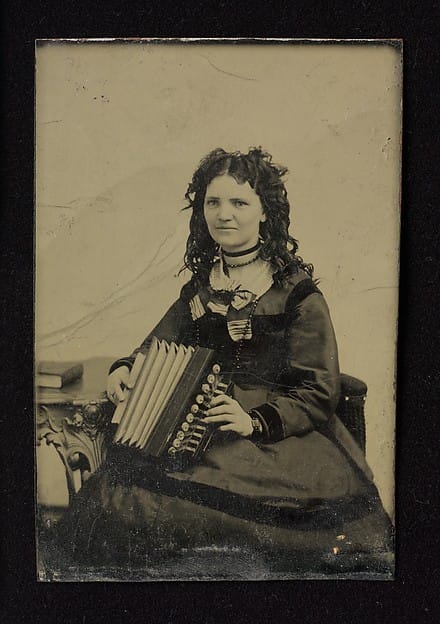
Woman Holding an Accordion tintype
Woman Holding an Accordion tintype, late 1860s. The Metropolitan Museum of Art, Purchase, Frederick M. Lehman Bequest, 2005 (Open Access). Source: Woman Holding an Accordion tintype at The Metropolitan Museum of Art
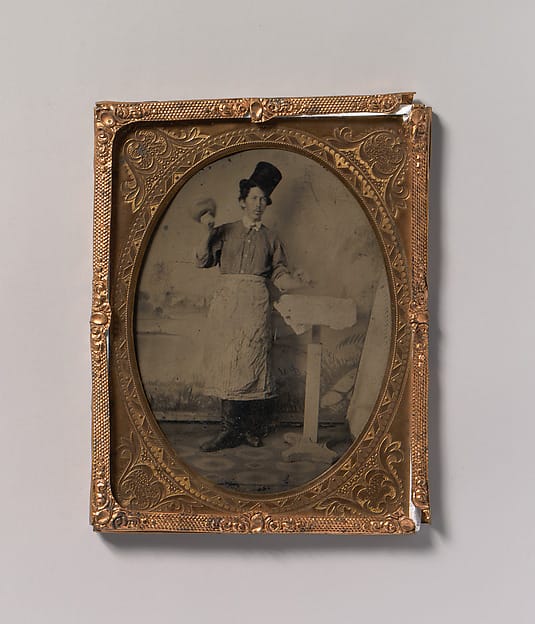
[Stone Mason in Top Hat and Apron with Mallet and Chisel]
[Stone Mason in Top Hat and Apron with Mallet and Chisel], 1870s-80s. The Metropolitan Museum of Art, Bequest of Herbert Mitchell, 2008 (Open Access). Source: [Stone Mason in Top Hat and Apron with Mallet and Chisel] at The Metropolitan Museum of Art
Small, unique portraits of ordinary people on blackened iron, made in minutes by itinerant and booth photographers: soldiers, workers, couples and friends, stiff before a painted backdrop. The positive is dark, grey-brown and low in contrast, shallow in tone, reversed left to right, and the lacquered iron is scratched, rusted and chipped at the corners. It was kept in a pocket, a paper sleeve, a small frame or a case, not printed in multiples.
Built mostly on one system: Painted studio. What systems are.
Shoot sheet for your kit A prompt for an image model The photographs
How the look is made
- Seat or stand one sitter, a pair or a small group close to the lens and ask them to hold still for several seconds; the stiffness is part of the picture.
- Place them in front of a painted or plain backdrop with one or two studio props (a column, a table, a chair, a tool of their trade, a musical instrument) and keep the frame tight enough that the plate edge cuts the figure.
- Light from a skylight, window or open shade, flat and from the front, and let the faces go grey and the whites go creamy: expose for a dark, low-contrast direct positive, not for rich blacks.
- Make one unique image on iron, no print and no copies; let scratches, rust, lacquer cracks, clipped corners and uneven collodion stay.
- Keep the sitter ordinary and unflattered: working clothes, uniforms and Sunday best, direct gaze, closed mouth, no smile, no retouching.
Shoot sheet for your kit
Fill in your camera, lenses and lights, and the sheet says which light plays each part, what to work around and where to start on your camera. Without a kit it starts on a full-frame camera.
Light
Key: the open sky, all around and above, soft.
- Daylight studio: a skylight, a glasshouse or a courtyard, with a backdrop behind the sitter.
- Shadow edges
- Shadows that fade gradually from light to dark, cast by a large or diffused light: a window, a softbox, a cloudy sky.
- Shape & form
- Light from the camera’s own position (an on-camera flash, a ring light, a frontal softbox) fills every hollow, so faces and objects look flat, with little shape.
How the style is lit
- Open shade or a skylight in a booth or tent, soft and from the front, no reflector.
- A window or skylight to one side in a small studio, with the sitter close to it and the shadow side left to fall dark.
This plan is worked out from the style’s choices, so it is drawn as a schematic. One way to get the light, not a record of how any photograph was lit.
Lens and settings
Start at
On a full-frame camera: the same depth of field and exposure as the style’s own numbers, in the same light. Then meter and adjust.
- The style’s f/5.3 on Quarter plate gives about the depth of field of f/1.7 on full frame.
- Then
- 50–80 mm · f/3.5–f/8 · 1–10 s · ISO 1–2 on Quarter plate, inferred from the gear and the look. Worked out from the process and its portrait lenses on a quarter-plate: wet collodion is about ISO 1, so exposures run from a second or two in bright open shade to several seconds indoors. Real plates ran from gem to 4 x 5.75 in, so the f-numbers and the focal length scale with the plate.
- Focal length
- Roughly the eye’s own perspective; no visible distortion.
- Angle
- The camera at the height of a standing person or of the subject.
- Distance
- Whole figures and their immediate surroundings.
- Balance
- The subject in the middle, the frame balanced around it. The subject faces the lens; planes run parallel to the picture.
- Duration
- An unmoving scene, exposed slowly and carefully.
Direct
Sitters sit upright or stand stiffly for a few seconds, the head steadied by a rest, a hand on a chair back or table, or a tool held for the picture (a mallet, an accordion, a pistol, a hat). Faces are closed and serious and the eyes go to the lens. Pairs and friends sit close, a hand on a shoulder or a knee; soldiers sit in uniform, often with a weapon or a flag.
- Body position
- On a chair or stool, back straight, hands and feet placed: the formal sitting.
- Head & gaze
- Looking straight into the camera, so the subject meets the viewer’s eye.
- Line & energy
- Rigid and motionless, sometimes braced against a head rest or gripping a chair: held for a long exposure or a solemn occasion.
- Expression
- Unsmiling, composed and blank: the face gives nothing away.
- The moment
- Ordinary photographs by and for ordinary people, or images that look like them.
- With the sitter
- The sitter arranged and still, facing the camera.
Style the set
Sunday best, working clothes or uniform, as the sitter brought them; a painted landscape or plain backdrop, a rustic or painted prop, one table or column. Colour, where used, is a pink touch on the cheeks and gilt on buttons added by hand. Nothing is styled for glamour.
- Clothes
- Best clothes, jewellery and accessories put on for the studio or the occasion.
- Set & props
- A painted, cloth, paper or seamless backdrop behind the subject. The stock furniture of a portrait studio, standing in for a setting: a posing chair, a column, a balustrade, a draped table, a potted palm.
Finish
- Monochrome
- Low contrast and gentle greys. A monochrome image tinted sepia, brown, selenium purple or cyanotype blue.
- Early processes
- A unique image on silvered metal or glass, often cased.
- Texture
- Marks of age and handling on the image.
- Post-production
- Nothing changed beyond exposure and development.
- Shown as
- Each picture stands on its own.
Stay away from snapshot, candid & unobserved, hyper-detailed, clean & noiseless, heavy retouching, visible grain, direct on-camera flash, wide angle and series.
Before you shoot it
Tintypes show real people, most of them anonymous workers, soldiers, couples and children who never agreed to be shown or named; many are unidentified and should be shown without a guessed name. Civil War tintypes show men, many soon killed, who fought a war over slavery: do not present Confederate imagery as a heroic or nostalgic style, and do not imitate the tintypes of Ku Klux Klan members that also survive. Mourning and post-mortem plates exist; never imitate them.
A prompt for an image model
A ready prompt that describes this look to an image model: where the lights stand, the lens, the framing and the colour. It starts on the style’s own choices; change any of them and the prompt and the notes follow.
The prompt
Notes on this prompt
- How the style uses it: light from a skylight, window or open shade, flat and from the front, and let the faces go grey and the whites go creamy: expose for a dark, low-contrast direct positive, not for rich blacks. Image models put the light in the wrong place more often than anything else, so the prompt says where each light stands: which side of the picture, and how high. Keep to one light pattern per prompt, or the model splits the difference.
- Describe an invented person by age, clothes and pose. Never name a real or famous person, and never write “looks like”.
- Black and white: colour words in the subject (a red dress, green leaves) can pull the model back to colour, so leave them out.
The model makes a new picture, not a photograph of anything that happened. Label it as AI-generated, and don’t pass it off as the style’s history or as a real person.
Photographs that define it
From open collections, shown whole with their credits. Later photographs are linked, not shown, while they are in copyright.
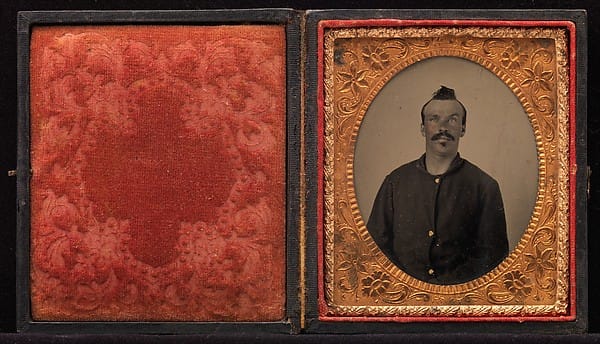
Corporal Hiram Warner, Company C, Second United States Sharp Shooters
Corporal Hiram Warner, Company C, Second United States Sharp Shooters, 1861-62. The Metropolitan Museum of Art, The Horace W. Goldsmith Foundation Fund, through Joyce and Robert Menschel, 2012 (Open Access). Source: Corporal Hiram Warner, Company C, Second United States Sharp Shooters at The Metropolitan Museum of Art
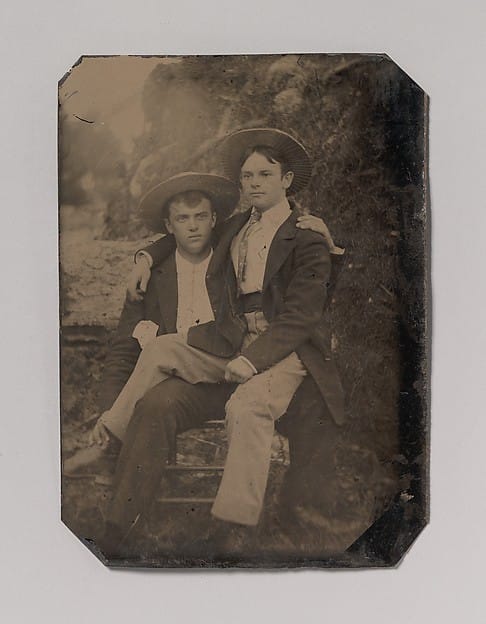
[Two Young Men in Straw Hats, One Seated in the Other's Lap]
[Two Young Men in Straw Hats, One Seated in the Other's Lap], 1870s-80s. The Metropolitan Museum of Art, Bequest of Herbert Mitchell, 2008 (Open Access). Source: [Two Young Men in Straw Hats, One Seated in the Other's Lap] at The Metropolitan Museum of Art
Made by an AI model
An image gpt-image-2 made from this style’s choices, then checked against them by a vision model. Not a photograph, and not part of the style’s history. All generated images
-
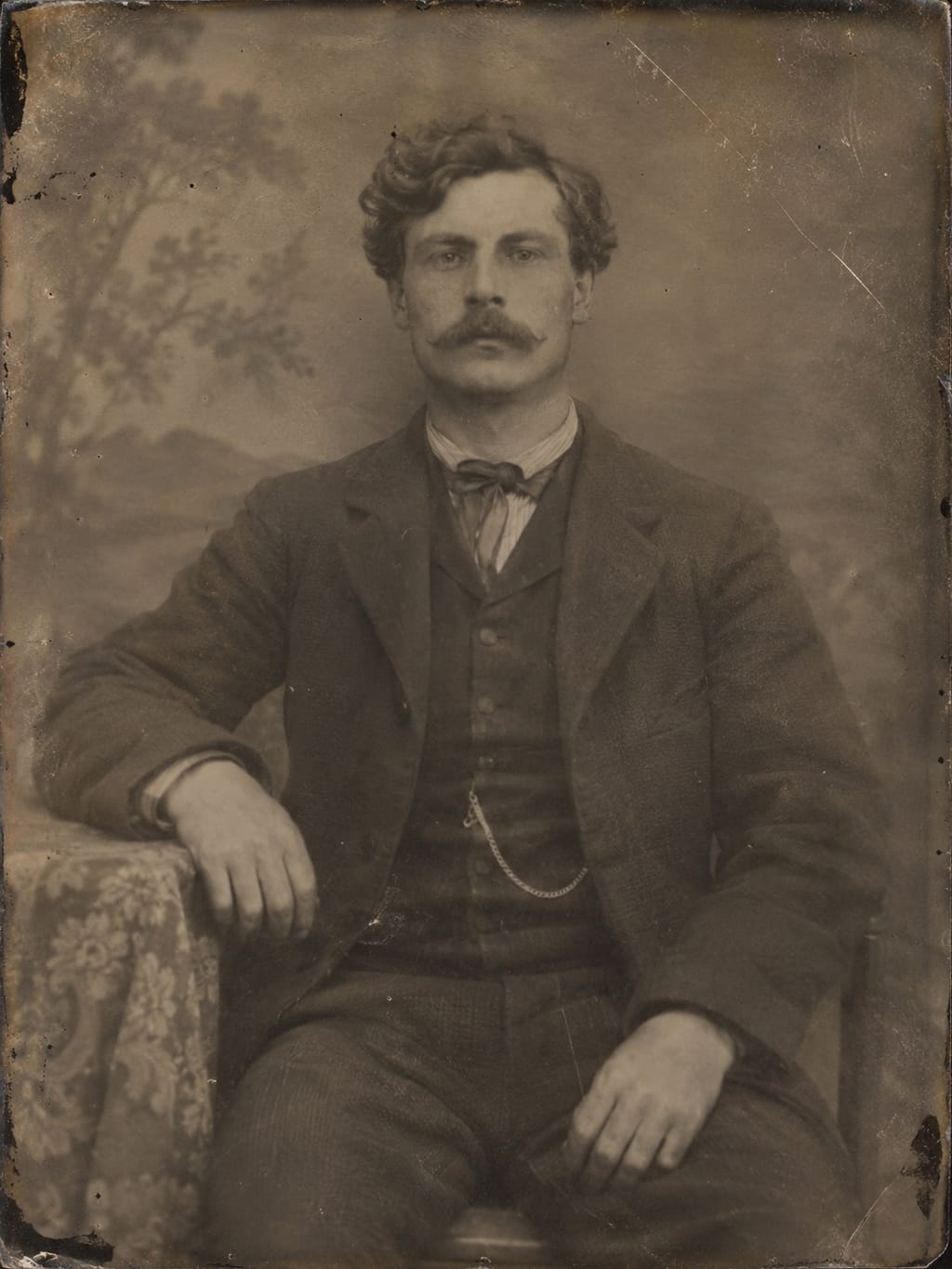
A moustached man with wavy hair sits facing the camera in a three-piece suit and bow tie, with a watch chain across his waistcoat. One forearm rests on a patterned, cloth-covered table against a painted landscape backdrop, and the sepia-toned image has extensive scratches and worn edges. What the check saw. The formal frontal pose, subdued brown tones and simulated plate damage give this portrait the appearance of a nineteenth-century studio photograph.
With other styles
The opposite: Daguerreotype portraiture. Choose the daguerreotype for one close, silver-sharp likeness in a case; choose the tintype for a dark, soft, scratched pocket picture of a working person before a cheap backdrop.
The opposite: Carte-de-visite studio portraits. Make the carte when the brief wants a full-length, repeatable paper print on a card; make the tintype when it must be one unique object on iron.
Pairs with Wet-plate collodion revival. Borrow the revival's slow stillness and plate edges for a modern portrait, but keep the booth's cheap backdrop and unflattering directness for the historical look.
Sources
- Tintype, Wikipedia: https://en.wikipedia.org/wiki/Tintype (Martin 1853, Smith's 1856 patent; direct positive on japanned iron; names melainotype and ferrotype; gem and bon-ton sizes; cheaper and quicker than the daguerreotype, made in minutes; booths, tents, fairs and sidewalk photographers; Civil War use; laterally reversed; displaced by albumen prints from the mid-1860s but a novelty for over half a century; 21st-century revival, Ed Drew in Afghanistan in 2013)
- Woman Holding an Accordion tintype, late 1860s, Metropolitan Museum of Art: https://www.metmuseum.org/art/collection/search/504132
- Corporal Hiram Warner, Company C, Second United States Sharp Shooters, 1861-62, Metropolitan Museum of Art: https://www.metmuseum.org/art/collection/search/301944
- Stone Mason in Top Hat and Apron with Mallet and Chisel, 1870s-80s, Metropolitan Museum of Art: https://www.metmuseum.org/art/collection/search/291915
- Two Young Men in Straw Hats, One Seated in the Other's Lap, 1870s-80s, Metropolitan Museum of Art: https://www.metmuseum.org/art/collection/search/291890