Styles / Modernist
Underwater photography
- Key: the open sky, all around and above, soft.
- Rim or hair light: the sun, from behind, to the camera’s right, high, hard.
- Fill: a flash on the camera, from the camera, hard.
Open shadows: bright surroundings (walls, ground, sky) fill them; no reflector needed. Visible beams: smoke, steam or dust in a directional light.
Schematic, not to scale: worked out from the style’s choices. No set-up of this style has been rendered yet.
The photographs that define it are still in copyright, so they are linked below rather than shown.
Pictures made beneath the surface, where water absorbs red and everything turns blue-green. Photographers swim close, use a dome port for wide angles or a flat port for macro, and fire strobes off the lens axis to restore colour and avoid backscatter. Divers, wrecks and animals sit against blue water; split-level frames join air and sea.
Built mostly on one system: Macro on black. What systems are.
How the look is made
- Get close: swim to within an arm or two of the subject so less water sits between lens and colour.
- Shoot wide through a dome port and stop down, so the subject and the reef or wreck behind stay sharp.
- Aim upward from below the subject so it stands against the bright blue water or the sun.
- Fire strobes off the lens axis, angled out and forward, to restore red and keep the flash out of backscatter.
- Set exposure for the water: keep the background blue, not black, and light the foreground with flash.
- Where a diver appears, give them a task, a torch or a direction of travel, and keep them small or at the edge of the frame.
Shoot sheet for your kit
Fill in your camera, lenses and lights, and the sheet says which light plays each part, what to work around and where to start on your camera. Without a kit it starts on a full-frame camera.
Light
Key: the open sky, all around and above, soft.
Rim or hair light: the sun, from behind, to the camera’s right, high, hard.
Fill: a flash on the camera, from the camera, hard.
- Open shadows: bright surroundings (walls, ground, sky) fill them; no reflector needed.
- Visible beams: smoke, steam or dust in a directional light.
- Shadow edges
- Shadows that fade gradually from light to dark, cast by a large or diffused light: a window, a softbox, a cloudy sky.
- Shadow depth
- Shadows kept light and full of detail by a reflector, a fill light, bounce or bright surroundings (a low lighting ratio, up to about 3:1: the shadow side at most a stop and a half darker).
How the style is lit
- Ambient sunlight from above, filtered to blue-green with depth, with a pair of strobes on arms held off the lens axis to restore warm colour on the near subject.
- A single strobe or a snooted strobe off to one side, to pick out an animal against open blue water.
- Back-lit from below: the sun as a bright disc through the surface with the subject as a silhouette or rimmed with strobe.
This plan is worked out from the style’s choices, so it is drawn as a schematic. One way to get the light, not a record of how any photograph was lit.
Lens and settings
Start at
On a full-frame camera: the same depth of field and exposure as the style’s own numbers, in the same light. Then meter and adjust.
- With flash, 1/125 s stays under every camera’s flash sync speed (1/160–1/250 s, by camera): set the exposure with the flash power and the f-number.
- Then
- 14–24 mm · f/8–f/16 · 1/250–1/125 s · ISO 100–400 on full frame, inferred from the gear and the look. Inferred from the technique's logic: a dome port needs a wide lens and a small aperture for depth, and the shutter is held near the flash sync speed to keep the water blue. No source here records numbers, and macro and ambient-light work will differ. Focal length is an inferred wide-angle equivalent.
- White balance
- Set daylight or a custom balance for the strobes, which supply the warm colour; the water behind stays blue-green, and the farther the subject, the less red returns.
- Focal length
- A wide view; near things loom and lines stretch towards the edges.
- Focus
- Everything sharp from the nearest stone to the horizon.
- Angle
- Looking up: the subject towers.
- Distance
- Within arm’s reach: faces, hands and details fill the frame.
- Balance
- The subject placed off-centre, balanced against open space.
- Crop & fill
- The subject shown small within its setting, which explains it. A small subject in a large empty field.
- Depth
- Separate events in the foreground, middle ground and background.
- Instant
- Movement stopped dead by a fast shutter or flash.
Direct
Where people appear they are divers, directed by hand signals: they hold a torch or a task, hang weightless with the bubbles rising, and look at the subject rather than the lens. Models are usually small in the frame, seen from below or the side.
- Without a pose
- No people at all, or people so small or far off that their pose does not read (hands alone are Hands alone).
- The moment
- People photographed as they are, unaware or unconcerned.
Style the set
Nothing is styled. The subject is the animal, wreck or reef as found; divers wear their own gear, and the best frames are made without touching or moving anything.
- How much is styled
- Nothing dressed, made up, moved or added for the picture.
Finish
- Colour
- An overall blue, cyan or green cast. Strong, dense colours.
- Digital & other
- A modern digital camera: clean, detailed, neutral.
- Texture
- Smooth tones with no visible grain.
- Post-production
- Nothing changed beyond exposure and development.
- Shown as
- Each picture stands on its own.
- Shown in
- Pictures made for magazine pages and spreads.
Stay away from soft studio light, golden hour, theatrical & acted, studio backdrop, formal posed portrait, soft focus & diffusion, composite & montage, heavy retouching and faded & matte.
Before you shoot it
Divers are real, often identifiable people; get their consent, and do not show a diver in difficulty or a death as a spectacle. Wrecks can be war graves and many are protected sites: follow site rules, do not remove or disturb anything, and treat human remains with respect.
A prompt for an image model
A ready prompt that describes this look to an image model: where the lights stand, the lens, the framing and the colour. It starts on the style’s own choices; change any of them and the prompt and the notes follow.
The prompt
Notes on this prompt
- How the style uses it: aim upward from below the subject so it stands against the bright blue water or the sun. Image models put the light in the wrong place more often than anything else, so the prompt says where each light stands: which side of the picture, and how high. Keep to one light pattern per prompt, or the model splits the difference.
- Give the camera height in plain words: from knee height looking up, from a stepladder looking down, straight down onto the table.
The model makes a new picture, not a photograph of anything that happened. Label it as AI-generated, and don’t pass it off as the style’s history or as a real person.
Made by an AI model
An image gpt-image-2 made from this style’s choices, then checked against them by a vision model. Not a photograph, and not part of the style’s history. All generated images
-
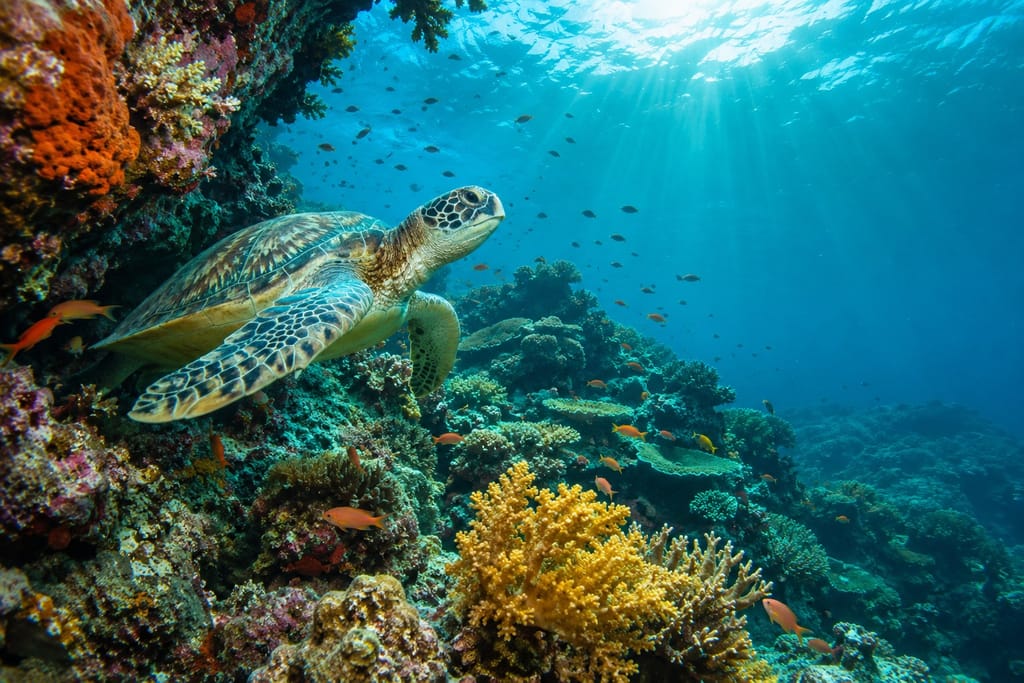
A sea turtle swims beside a colourful coral reef surrounded by small orange and dark fish. Sunlight streams through the rippled water surface into the blue water above the reef. What the check saw. This vivid underwater photograph uses a wide view, detailed foreground reef, and descending sunbeams to frame the turtle against open blue water.
With other styles
The opposite: Blackwater macro photography. Choose this for ambient blue water and wide-angle surroundings; blackwater macro uses strobes only, against black, for plankton.
Pairs with Surf-magazine action photography. Both meet water; only a split-level frame, with air above and sea below, joins the two looks.
The opposite: Camera-trap wildlife photography. Both put a camera where a person is not; this one is held and aimed close, the other is left to wait.
